

 20 minutes read
Let’s be real for a moment. The traditional model of hiring an in-house paralegal is a slow, expensive grind. It’s not just the salary; you're on the hook for benefits, payroll taxes, office space, and a recruitment process that feels like it was designed by your worst enemy. For too many firms, this old-school approach is a fixed-cost anchor in a world that demands agility.
Think about the last time you hired a full-time employee. How many hours did you sink into sifting through résumés that all looked suspiciously the same? Every hour spent playing HR is an hour you can't bill a client or, you know, actually practice law. The traditional model locks you into a fixed cost for what is almost always a variable workload.
When a massive case lands on your desk, you’re suddenly drowning. But during the slow months, you’re paying a full-time salary for someone who might just be color-coding the supply closet. It’s a broken system. Shifting your mindset isn't just a "nice to have"—it's about plugging a massive leak in your firm's budget, one smart freelance hire at a time.
A paralegal's salary is just the tip of a very expensive iceberg. The real financial drain comes from the hidden costs that nobody talks about until payroll slaps you in the face.
Here are a few of the big offenders:
This simple chart really drives the point home. It’s not fuzzy math; it’s just the brutal truth of overhead.
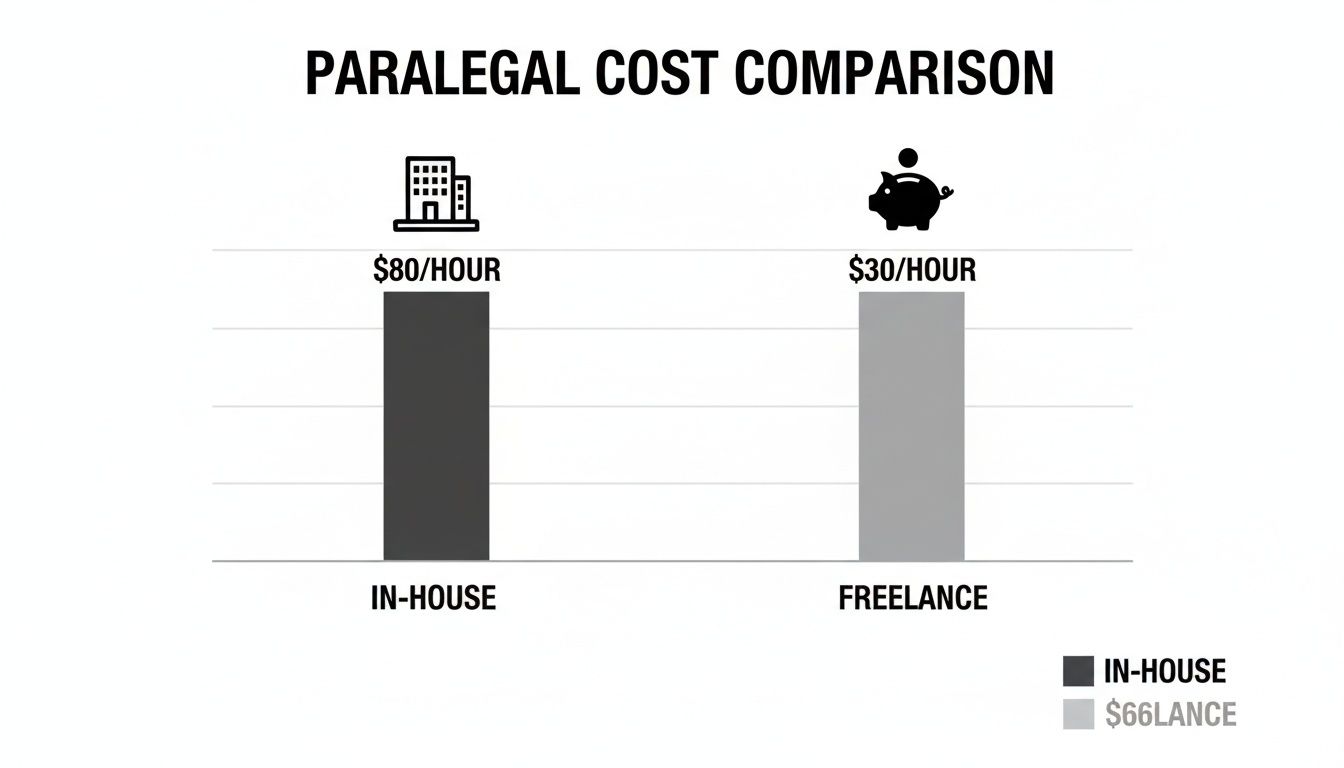
See that? It’s not even close. With a freelancer, you pay for productive work, not for someone to keep a chair warm.
To really understand the financial gut punch, let’s lay it out side-by-side. This isn't just about saving a few bucks; it's about fundamentally changing your cost structure.
| Cost Factor | In-House Paralegal (Annual Cost) | Freelance Paralegal (On-Demand Cost) |
|---|---|---|
| Salary/Hourly Rate | Average $61,010 annual salary | $45-$125 per hour, billed only for work you actually need |
| Benefits | 15-25% of salary (the expensive stuff) | $0 (That's their problem, not yours) |
| Payroll Taxes | ~7.65% employer contribution | $0 (Again, their problem) |
| Recruitment & Training | $4,000+ per hire (plus your sanity) | $0 (Hire for skills you don't have to teach) |
| Office Space & Equipment | $5,000+ annually (desk, computer, sad office plant) | $0 (They use their own gear) |
| Software Licenses | $500 – $1,500+ annually | $0 (Pros come with their own tools) |
| Paid Time Off | 2-4 weeks of paying for nothing | $0 (You don't pay for their beach vacations) |
Looking at it this way, it’s painfully clear that the freelance model offers a predictable, contained cost structure that’s directly tied to your revenue-generating work. Wild, I know.
The move toward on-demand talent isn't some fleeting trend; it’s a strategic answer to the economic reality that law firms face. While employed paralegals earn a median salary of $61,010, experienced freelancers typically bill between $45-$125 per hour. This lets you slash payroll expenses by bringing in expert help only when there's a fire to put out.
And good luck finding full-time help anyway. With a projected unemployment rate for paralegals at a laughable 1.9% in 2025, finding qualified full-time candidates is becoming a full-contact sport.

You're not just hiring a person; you're buying back your most valuable asset: time. By outsourcing tasks, you free up your core team to focus on high-value, billable work that actually pays the bills.
This model gives you the flexibility to access hyper-specialized skills for a complex case without committing to a long-term salary. Need an IP litigation expert for three months? Done. Require a family law specialist for one high-stakes divorce? Easy. You can explore a variety of legal outsourcing services to find the precise expertise you need, right when you need it. It’s about building a leaner, meaner firm that can adapt to whatever gets thrown at it.
Let's get one thing straight: freelance paralegal work isn't about finding a temp to handle the copying. That’s a massive underutilization of a potent skill set. Think of it less like hiring another employee and more like deploying a specialist—a legal pro you call in for a specific mission with a clear objective.
These aren't junior assistants hoping for their big break. The best freelance paralegals are often highly experienced pros who've deliberately stepped away from the 9-to-5 grind. They've traded the office potlucks for the focus of project-based work, and your firm gets to reap the rewards.
So, what do these independent legal pros actually do? The scope is broad, but it always boils down to one thing: execution. They’re the ones who parachute in to manage the substantive, time-sucking tasks that bog down your attorneys but require way more expertise than a standard assistant can offer.
They get into the weeds so your practice runs like a well-oiled machine.
And that’s just the appetizer. The true power of this model is when you stop thinking general and start thinking specialist.
The real beauty of the freelance model is that you're not just hiring a "paralegal." You're hiring a family law paralegal who has seen a thousand messy divorces or an IP paralegal who knows the USPTO filing system better than their own kitchen.
You don't pay for their learning curve. You pay for their immediate impact. They’ve already made the mistakes and learned the hard lessons on someone else’s dime. Now, you just get the polished, efficient output.
Imagine you're handling a complex immigration case. Instead of training your in-house generalist on the ever-changing nuances of visa petitions, you engage a freelancer who has prepared hundreds of H-1B applications. They know the process cold. They anticipate the roadblocks. They know exactly what USCIS wants to see. They don’t need you to hold their hand; they just need the case file.
This is the new reality: on-demand access to elite, specialized talent without the overhead and commitment of a full-time employee.
Of course, this means you're operating outside the conventional employer-employee model. A crucial first step is correctly understanding the employee vs. contractor classification. Get this wrong, and you're in for a world of legal and financial pain. Nail this compliance piece from the start. It’s the bedrock of the whole operation.
Let's be honest, the legal industry hasn't exactly been a hotbed of innovation. For decades, the model was simple: everyone in the office, 9-to-5, surrounded by mahogany and the smell of old books. But as the rest of the world sprinted forward, the legal field got dragged—sometimes kicking and screaming—into the modern era of remote work.

Suddenly, that mandatory commute and the prestigious corner office started to look less like a necessity and more like an expensive, outdated habit. This wasn't a temporary pandemic fix; it was a fundamental rewiring of how legal support gets delivered. For savvy freelance paralegals and the forward-thinking firms hiring them, this was the "aha" moment.
It started with the basics—email and Zoom. But technology didn't just allow this to happen; it put the whole damn thing into overdrive. Secure, cloud-based practice management systems, encrypted document-sharing platforms, and real-time collaboration tools became the new office. A paralegal's physical location became about as relevant as their favorite color.
What truly mattered was their expertise, their responsiveness, and their ability to plug directly into your firm’s workflow from a thousand miles away. This new tech stack created a borderless work environment. The friction of distance simply vanished.
This isn't just about working from home. It's about a fundamental restructuring of how modern legal support gets done. It’s about building a team based on talent, not zip code.
The numbers tell the story. The remote work explosion has completely transformed freelance paralegal work, with recent data showing that 42% of freelance paralegals now operate remotely full-time. This shift is building a far more dynamic and accessible talent market. You can discover more insights about the evolution of paralegal services and see how this freight train is reshaping the industry.
This remote revolution didn't just open the door to a new way of hiring—it blew it clean off its hinges. Why limit your search to a 30-mile radius when you can tap into a global talent pool? For US law firms, this has been an absolute game-changer.
This opens up a massive strategic advantage. Here’s what it means in plain English:
This isn't your grandfather's outsourcing. It’s about strategically building a distributed team of dedicated pros who become a core part of your firm’s success. It’s just a smarter way to operate.
So, why should you care? Let’s cut to the chase. Bringing on freelance paralegals isn’t just another HR trend; it's one of the sharpest strategic moves a modern law firm can make. This is about more than just trimming the budget—it’s about building a leaner, smarter, and more resilient practice.
We're not talking about small, incremental tweaks. This is a fundamental shift in how you operate, one that delivers immediate productivity boosts and a lasting competitive edge. Forget the old way of doing things. The game has changed.
Imagine this: a massive, document-heavy case lands on your desk. In the old world, you'd start to panic. You’d have to either burn out your existing team or rush into a costly, time-sucking hiring process for someone you might not even need in six months. A classic no-win scenario.
Now, picture this instead. You find a pre-vetted litigation support specialist with a decade of e-discovery experience and have them working by tomorrow. Once the project wraps, you simply scale back down. No HR drama, no severance packages, no awkward goodbyes.
That’s agility. It’s the ability to expand and contract your workforce in perfect sync with your caseload. You’re no longer paying for downtime; you’re investing in pure, focused productivity precisely when you need it.
This model transforms your firm from a rigid, slow-moving tanker into an adaptable fleet of speedboats. You can confidently take on larger cases you previously would have passed on, knowing you have the operational backbone to support them without betting the farm.
Let’s be honest, your firm probably can’t justify keeping a full-time intellectual property paralegal on the payroll for the two trademark cases you handle each year. But what happens when that lucrative, complex case walks in? You either refer it out (and the revenue with it) or try to muddle through with a generalist.
The freelance paralegal market shatters that limitation.
You’re not paying a generalist to learn on your dime; you’re paying a specialist for their immediate, focused impact. This on-demand expertise lets you punch way above your weight class, competing with larger firms that have massive in-house departments. Beyond just paralegals, firms can gain more insights into modernizing their entire practice by consulting a comprehensive guide for legal professionals, ensuring they stay ahead of the curve.
We’ve all been there. You spend weeks recruiting and interviewing, only to discover three months in that your "perfect" candidate is a disaster. It’s a soul-crushing and expensive mistake that drains time, money, and morale. A bad hire can easily set you back tens of thousands in lost productivity and recruitment costs.
Freelance engagements are the ultimate trial run. You bring someone on for a specific project. You see their work product, their communication style, their professionalism firsthand. It’s a low-risk way to vet potential long-term talent. If they’re a rockstar, you keep giving them work. If not, the project ends, and you both move on. No strings attached. Problem solved.
Alright, so you're sold on the idea. Now comes the hard part: how do you find a genuine expert without getting burned? The internet is a minefield of puffed-up résumés and people who think watching Suits counts as legal experience. A bad hire isn't just an inconvenience; it's a malpractice risk.
This is your roadmap for navigating that minefield. You wouldn't find a heart surgeon on Craigslist, right? The same logic applies here. General freelance websites are a total gamble. You'll waste more time fact-checking their "experience" than they'll spend working on your case.
As an attorney, your time is your most valuable currency. Wasting it on unqualified applicants is a rookie move. Specialized talent platforms are built to do the heavy lifting for you, weeding out the pretenders before they ever hit your inbox.

Think of it this way: platforms built for the legal industry act as a powerful pre-screening filter. They confirm the non-negotiables—the background, credentials, and skills—so you start with a pool of qualified pros, not a random grab bag of applicants.
These platforms are vetting engines. They verify credentials, test for specific legal skills, and ensure every candidate understands the ethical tightrope they have to walk. This immediately raises the quality of your applicant pool from "maybe" to "hell yes."
Finding a promising candidate is just step one. Vetting is where you protect your firm. A slick résumé means nothing without proof of skill. A rigorous, multi-step process is the only way to know you're hiring someone who can actually deliver.
A great hire adds immediate value. A bad hire creates more work for you. The difference is in the diligence of your vetting process—don't get lazy here.
Your vetting process should feel like a gauntlet. It's supposed to be tough.
Here’s a practical checklist to steal:
This process is intense for a reason. You’re not just filling a role; you're entrusting a critical part of your practice to an outsider. Treat the decision with the seriousness it deserves.
Let’s talk about the money. You see a freelance paralegal’s hourly rate, compare it to a salaried employee’s, and your eye starts to twitch.
Hold on. That knee-jerk reaction is a classic mistake, and it's probably costing your firm a fortune. You're not comparing apples to apples. You're comparing one apple to a fully-equipped, mobile apple-pie-making factory. That higher hourly rate for a freelancer almost always leads to massive overall savings. Let's break it down.
That hourly rate isn't a number pulled from a hat. It's why you’ll see such a wide range in the market. A junior paralegal handling basic document organization won’t—and shouldn’t—charge the same as a veteran IP litigation specialist who can navigate the USPTO in their sleep.
Here’s what you're actually paying for:
When you hire a freelance paralegal, you’re not paying for their time; you’re paying for their focused output. You don't cover their coffee breaks, sick days, or the hour they spend scrolling through emails. You pay for pure, billable work product.
This is where the lightbulb goes on. That "high" hourly rate is an all-inclusive number. A freelance paralegal covers their own benefits, payroll taxes, insurance, office equipment, and software licenses. You pay for none of it.
Freelance paralegals have carved out a solid niche, with billing rates typically falling between $45 and $125 per hour. For perspective, the median hourly wage for an employed paralegal is just $29.33. That gap exists because the freelancer's rate absorbs all the overhead you’d normally be stuck with.
With paralegal unemployment at a shockingly low 1.9%, the demand for skilled pros is intense, which naturally supports their rates. To get a better handle on the market, you can discover more insights about freelance paralegal rates and see the data for yourself.
It’s about total value, not the isolated hourly figure. If you’re still not convinced, our guide on virtual paralegal rates offers a deeper dive into why these numbers represent such a smart investment. This isn't just another expense; it's a strategic shift in how you run your business.
Alright, let's cut to it. You see the potential, but you’ve still got some nagging questions. Good. This is a big decision. Let’s tackle the most common objections we hear from attorneys who are on the fence.
Absolutely, and you'd be a fool not to. The good news is, the ethical framework you already use applies perfectly to freelancers. The core issue isn't if you use a freelance paralegal, but how you supervise them.
Any professional freelancer worth their salt knows they must work under the direct supervision of a licensed attorney. The ironclad rules of confidentiality, conflict of interest, and avoiding the unauthorized practice of law are just as binding.
Your job is to make these obligations crystal clear from day one. This is exactly why that vetting gauntlet is non-negotiable. An experienced freelancer lives and breathes these rules. They're seasoned pros, not gig workers dabbling in law. With proper oversight, the ethics are a non-issue.
If "managing" makes you think of hovering over someone's shoulder, you need a mindset shift. The best freelancers don't need a manager. They need a mission. Your job is to provide the files, the context, and a clear picture of what "done" looks like. Then get out of their way.
Forget micromanagement. You don't hire an expert plumber and then stand behind them telling them which wrench to use. You show them the leak and let them fix it.
Successful remote collaboration boils down to three things:
Freelancers thrive on autonomy and clear goals. Give them both, and watch them work.
Don't hand over your most complex, five-year-long case on day one. That's just dumb. Start with well-defined projects that have a clear beginning, middle, and end. This is where you'll see the fastest ROI and build trust with a new paralegal.
Consider starting with tasks like these:
These are self-contained projects, perfect for outsourcing. Once you've built a solid working relationship and have seen their skills in action, you can start integrating them into more complex, long-term matters. It’s a classic crawl-walk-run strategy. It just works.


