

 22 minutes read
Let's be honest, the traditional law firm model is starting to show its age. For decades, the playbook was simple: hire a boatload of junior associates, bury them in billable hours, and hope a few survive the churn to make partner.
It was a pyramid scheme powered by burnout and eye-watering overhead. Hope you enjoyed mortgaging the office ping-pong table to afford another full-time salary.
That entire structure is finally cracking. Smart firms are realizing there's a better way to operate—one that doesn't involve carrying massive payroll costs for niche skills they only need for a single complex case.
The move toward freelance legal talent isn't just a cost-cutting gimmick; it's a strategic weapon. Why hire a full-time data privacy expert when you can bring in a top-tier freelance attorney for a six-month project? This approach transforms a firm's biggest liability—fixed costs—into its greatest asset: agility.
This isn't "temp work" in the old sense of the word. It's about deploying a strategic strike force.

Think of it this way: instead of maintaining a standing army, you're calling in special forces for targeted missions. You get elite talent precisely when you need it, without paying for the downtime. It’s leaner, smarter, and frankly, long overdue.
This shift benefits everyone. Firms escape the financial straitjacket of the old model, and legal professionals get to run their careers instead of letting their careers run them. It's a fundamental change in mindset, moving from ownership to access. The recent surge in demand for freelance attorneys in specialized fields like intellectual property and corporate compliance is proof, as firms use them to manage fluctuating workloads and tap into niche expertise on demand.
This newfound flexibility is also a massive win for legal professionals seeking a better quality of life. For anyone tired of the relentless grind, exploring the connection between freelancing and achieving work-life balance for lawyers can be a game-changer. It's about reclaiming control over your schedule and your sanity.
So, what do these freelancing legal jobs really look like day-to-day?
Let's clear the air first. The old stereotype of a lawyer stuck in a windowless room, reviewing boilerplate documents for pennies, is long dead. The modern freelance legal market is a dynamic, diverse space filled with high-value roles that demand very specific skills.
This isn't about finding a "temp job." It’s about being a specialist—a legal expert brought in to solve a particular, often urgent, problem for a client or firm.
First up are the roles that require significant experience and, naturally, offer the highest rewards. These aren't about ongoing administrative support. Think of it as parachuting into a complex situation, making a critical impact, and then moving on to the next challenge.
This infographic really nails why firms are turning to freelance talent. It's about much more than just the bottom line.
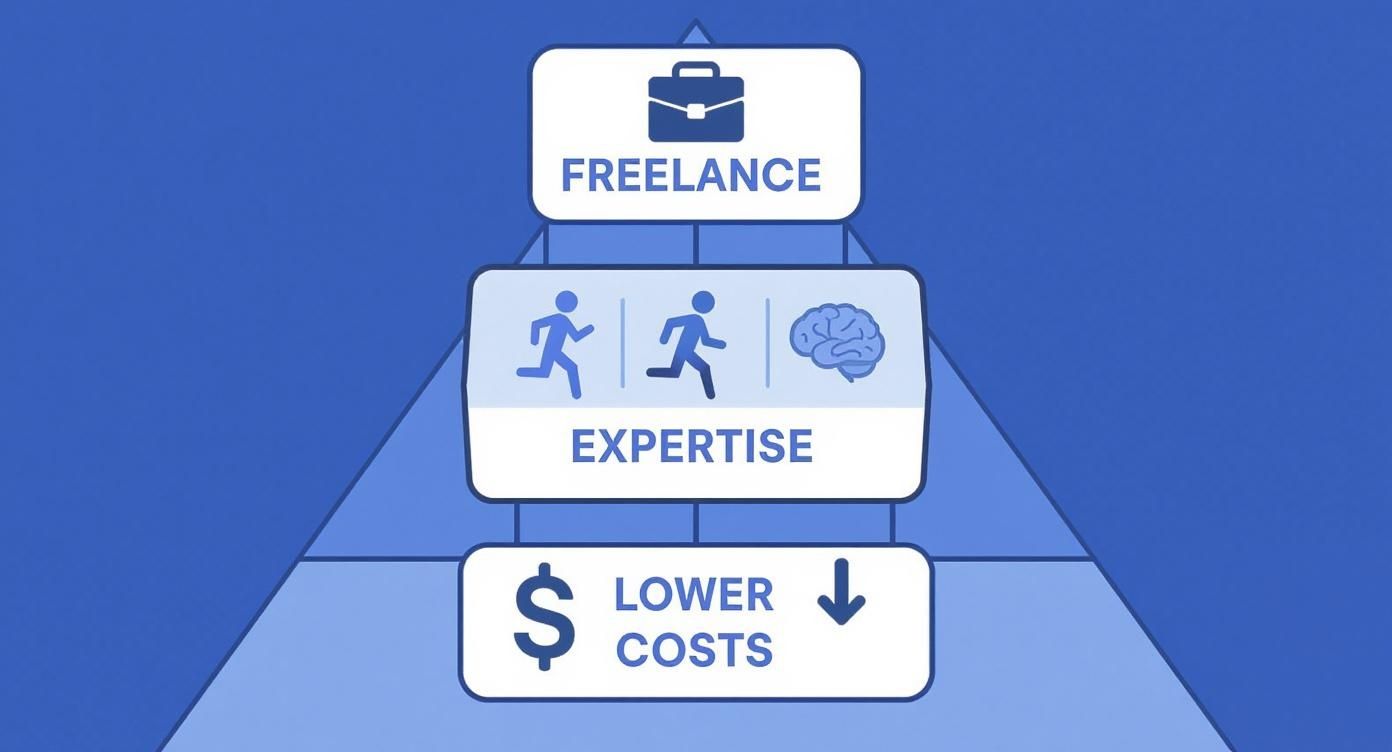
The big takeaway here is that agility and access to specialized knowledge are now just as important as cost savings. This signals a fundamental shift in how legal work is getting done.
Not every freelance gig involves high-stakes litigation or seven-figure corporate deals. In fact, some of the most consistent and in-demand freelance roles are all about keeping a busy firm’s operations running smoothly. Never underestimate these roles; a great freelance paralegal can be a solo practitioner’s secret weapon.
These professionals tackle the essential, time-consuming tasks that bog down lawyers. The latest data is frankly alarming: lawyers spend only about 2.9 hours per day on actual billable work. That’s a massive inefficiency that freelance support can fix.
When a lawyer is stuck managing calendars or chasing down invoices, they're not practicing law. They’re acting as a very expensive administrator. Freelancers fix this broken equation, letting attorneys focus on the high-value work that actually helps their clients.
A common task for freelance legal pros is handling routine but critical legal documents, like drafting cease and desist letters or preparing standard motions. Here’s a quick look at the most common operational roles:
To give you a clearer picture, this table breaks down what these roles typically involve and the kinds of clients who hire for them.
| Freelance Role | Typical Responsibilities | Experience Level | Primary Hirers |
|---|---|---|---|
| Contract Attorney | Appearances, depositions, motion drafting, due diligence | 5+ years | Mid-to-large firms, corporate legal depts |
| Freelance Paralegal | Legal research, discovery, trial prep, document management | 3+ years | Solo practitioners, small & boutique firms |
| Legal Document Reviewer | E-discovery review, contract analysis, compliance checks | 1-2+ years | Large firms, e-discovery vendors |
| Freelance Legal Assistant | Client intake, scheduling, billing, administrative support | 1+ years | Solo practitioners, small law firms |
As you can see, there’s a role for almost every experience level, from seasoned attorneys to organized administrative professionals looking for flexibility.
So, you know what kind of freelance legal work is out there. Now for the real challenge: finding gigs that won't make you question all your life choices. If your current strategy is just scrolling through generic freelance websites, you're signing up for a race to the bottom, competing with people willing to work for pennies.
Let's be honest. That approach means your new full-time job is dodging lowball offers and spending way too much time vetting potential clients. It's time to get strategic and start fishing where the quality clients actually are.
This isn't just about finding a job; it's about building a sustainable pipeline of high-value projects. The goal is to spend your time billing, not begging for work.

This image nails it. Your best bet is a mix of three core strategies, and you'll need all of them to build a career that lasts.
First things first: step away from the massive, do-everything freelance platforms. While you might land something, you'll be one of thousands, and the entire system is built to drive rates down. Instead, your time is much better spent on legal-specific marketplaces.
Platforms like UpCounsel, Montage Legal Group, and Hire an Esquire are designed for us. They vet both the legal professionals and the clients, which means you're connecting with serious law firms and corporate legal departments that already understand your value. They aren't hunting for the cheapest hourly rate; they're looking for the right expert.
The biggest upside to these niche platforms is pre-qualification. Clients on these sites are already sold on hiring freelance legal talent and are ready to pay fair market rates. You get to skip the whole song and dance of convincing them it's a good idea in the first place.
Passively waiting for jobs to land in your inbox is a rookie mistake. Some of the best, most interesting, and highest-paying projects are the ones you create for yourself through direct outreach.
Start thinking about the small to mid-sized firms in your niche that always seem swamped. They are your prime targets. These firms often don't have the budget for another full-time associate, but they're drowning in discovery requests or contract backlogs. A thoughtfully crafted email offering a specific solution—like handling overflow litigation support or managing their contract review pipeline—can feel like a lifeline to them and a goldmine for you.
Here's a simple, effective game plan:
This shows you've done your homework. It’s a targeted strike, not a scattergun blast, and it immediately positions you as a problem-solver.
Finally, never underestimate the power of the people you already know. I’m not talking about spamming your old law school classmates on LinkedIn with a generic plea for work. This is about genuinely reconnecting with former colleagues, bosses, and other professional contacts.
Let them know you've gone freelance and what you're specializing in now. The key is to make it a natural conversation, not a hard sales pitch. A simple message just to catch up that happens to mention your new venture is often all it takes to plant a seed.
Months down the road, when they suddenly find themselves buried in work, you'll be the first person they think of. This is especially true if you are looking for freelance attorney jobs, where a trusted referral is often the only way to get your foot in the door.
Alright, let's talk about the one thing that makes everyone sweat—money. Setting your rate as a freelance legal professional is a weird mix of art, science, and the sheer audacity to ask for what you’re actually worth.
Underprice yourself, and you’re leaving money on the table while signaling you’re a bargain-bin option. Overprice, and you’ll scare off great clients before you even get a chance to talk.
The goal isn't just to cover your bills; it's to build a profitable business. You're not an employee anymore. Your rate has to cover your salary, taxes (hello, self-employment tax), insurance, software, and the coffee that fuels your brilliance. Forget what you made as an hourly employee; that number is completely irrelevant now.
You’ve got a few arrows in your quiver when it comes to pricing. Picking the right one depends entirely on the project, the client, and how much you hate tracking every six-minute increment of your day. Most freelance legal gigs fall into one of three buckets.
The Hourly Rate: This is the classic model. It’s simple for clients to understand and great for projects where the scope is a bit fuzzy and might expand. The downside? You’re trading time for money, which puts a hard cap on your earning potential. It can also incentivize inefficiency, which savvy clients know all too well.
The Flat Fee: My personal favorite for well-defined projects. When you know a task—like drafting a standard motion or reviewing a set of contracts—will take you roughly X hours, a flat fee is perfect. It rewards your efficiency. If you get it done faster, you earn a higher effective hourly rate.
The Hybrid/Retainer Model: This is a fantastic option for ongoing work. A client pays a set monthly fee for a certain number of hours or for general availability. This structure provides predictable income for you and budget certainty for them. It’s the holy grail of freelance stability.
When you're first starting, it's smart to do some market research. Seeing benchmarks for paralegal hourly rates can give you a solid baseline, but remember to adjust upward based on your specific expertise and experience.
Now for the most important document in your entire freelance arsenal: your engagement agreement. If you’re working on a handshake deal, you’re not running a business—you’re playing a very risky game of chicken. A vague contract is an open invitation for scope creep, late payments, and endless headaches.
Your contract isn't just a legal document; it's a communication tool. It forces you and the client to get on the same page about expectations before any work begins. It’s the foundation of a professional relationship, not a sign of mistrust.
Think of it as your shield. It protects you from the chaos that inevitably comes with freelancing. It’s what separates a sustainable career from a stressful side hustle that slowly drains your will to live.
Don’t just download a generic template and call it a day. Your agreement needs to be tailored to the realities of freelance legal work. If your contract is missing any of the following, you’re leaving yourself exposed.
Here is the absolute bare minimum your engagement letter must include:
A Crystal-Clear Scope of Work: Define exactly what you will and will not do. Be painfully specific. "Assist with discovery" is a recipe for disaster. "Review up to 5,000 documents for responsiveness and privilege in the Smith v. Jones matter" is an ironclad scope.
Payment Terms: Don’t just list your rate. Specify when and how you get paid. Is it net 15? Net 30? Do you require a deposit upfront? (Spoiler: you absolutely should for larger projects). You should also include a clause for late payment fees.
Termination Clause: How does this relationship end? Define the process for both you and the client to terminate the agreement. This prevents you from getting stuck in a nightmare project with no way out.
Confidentiality: This is table stakes in the legal world, but it needs to be explicitly stated in writing to protect both you and the client.
Independent Contractor Status: Make it abundantly clear that you are a contractor, not an employee. This clause clarifies that you are responsible for your own taxes and benefits, which in turn protects the client from misclassification issues.
Get this document right, and you’ll sleep a lot better at night. It's the boring, unglamorous work that allows you to build a real, resilient business.
Going solo doesn't grant you a pass on professional conduct—it puts it under a microscope. Let’s be blunt: when you’re a freelancer, you are the compliance department. There’s no partner down the hall to gut-check a potential conflict, and no firm-wide software to flag it for you. It's all on you.
This isn’t the boring boilerplate section of your bar exam prep. This is the survival guide you need to protect your license, your reputation, and your business. Get this wrong, and the consequences are far more painful than just losing a client.

When you’re juggling multiple clients across different firms, the ethical minefield gets a lot more crowded. You need to be hyper-vigilant about three core areas that can trip up even the most seasoned professionals. One wrong step, and you could be facing a disciplinary board.
Here are the big three to watch:
Conflicts of Interest: This is the most obvious and dangerous trap. You might be doing contract review for Firm A, which is litigating against a company represented by Firm B, who just hired you for an unrelated project. You need a rock-solid, almost paranoid, system for tracking every party, client, and adverse party you touch.
Maintaining Confidentiality: Your home office isn't a secure law firm server room. Are you using a public Wi-Fi network at a coffee shop to review sensitive documents? Is your family computer properly secured? Client confidentiality is paramount, and the burden is on you to ensure your remote setup is a digital fortress.
Unauthorized Practice of Law (UPL): Working remotely across state lines is a fantastic perk, but it’s also an ethical minefield. If you're licensed in California but doing substantive legal work for a firm in New York on a New York matter, you could be sailing straight into UPL territory. Each state has its own quirky rules, and ignorance is not a defense.
Navigating these challenges requires more than just good intentions. It demands a proactive, systematic approach to risk management. Hope is not a strategy when your license is on the line.
Think of it this way: your legal skills get you clients, but your ethical diligence lets you keep them—and your career. It’s the boring, unglamorous backend work that makes a sustainable freelance practice possible.
Start with the basics. The American Bar Association provides the foundational rules that govern professional conduct for lawyers. This isn't just suggested reading; it's the rulebook. For freelancers, rules like Rule 5.3 regarding nonlawyer assistance become incredibly important when you start outsourcing your own administrative work.
Finally, let's address the elephant in the room: malpractice insurance. Spoiler alert: you absolutely need it. The idea that you’re "just a contractor" and covered by your client's policy is a dangerous and often false assumption.
Investing in your own errors and omissions insurance isn't an optional expense; it’s the cost of doing business responsibly. It protects your assets, your reputation, and your ability to sleep at night. Don't even think about taking on your first project without it.
Guess what? You just got a promotion. You’re now the Head of Marketing for your own freelance practice. But don't worry, you don't need a massive budget or a flashy ad campaign to land great freelance legal work. This is marketing for lawyers who would much rather be practicing law.
Let’s be honest—you went to law school to become a lawyer, not a social media guru. The good news is that building a powerful personal brand isn’t about slick advertising. It's about showing your value in a real, tangible way. It’s about becoming the obvious, go-to expert for the kinds of clients you actually want to work with.
Forget the old "spray and pray" method. A strong, focused brand acts like a magnet for your ideal projects and, just as importantly, repels the clients who will drain your time and energy.
In the freelance world, your online presence is everything—it's your business card, your reception area, and your corner office combined. If a potential client searches for you on Google and comes up empty, you essentially don't exist. You don't need a complicated, expensive website right out of the gate, but you do need a professional digital footprint.
Your top priority should be your LinkedIn profile. It has evolved far beyond a simple online resume; it’s now your professional headquarters. Treat it that way.
Sharing content isn't about going viral; it's about consistently proving your expertise. You could write short posts on LinkedIn about recent case law developments in your niche or share a quick tip on a common procedural headache. This simple act positions you as an authority, not just another lawyer looking for a gig.
To really draw in clients, you need to be findable. This means getting a handle on effective SEO strategies for lawyers so that firms actively searching for your skills can actually discover you.
The legal field is also changing fast. The World Economic Forum's Future of Jobs Report estimates that 39% of a legal worker's core skills could be disrupted by automation and AI. Weaving your tech skills and adaptability into your content is a brilliant way to future-proof your brand and show you're ahead of the curve.
Nothing sells your services better than a fantastic review from a happy client. Once you've knocked a project out of the park, don't be shy about asking for a testimonial you can use on your LinkedIn profile or website.
A great testimonial gets specific. "Jane was great to work with" is nice, but it's not helpful. "Jane's expertise in appellate brief writing was instrumental in our recent win; her research was meticulous and turned around in half the time we expected" is pure gold. It sells your skills for you.
Make it a habit to ask for feedback as you're wrapping up a project. Most clients are more than happy to help, especially when you’ve just delivered incredible results for them. This kind of social proof is the most powerful and credible marketing material you'll ever get.
Alright, let's cut to the chase. You've got questions, and I've heard them all before. Here are the quick-fire answers to the things legal professionals are usually wondering about when they consider freelancing.
This is the big one, isn't it? The honest answer is: it varies wildly. We're talking about a huge spectrum of roles, from paralegal support to highly specialized contract attorney work. A seasoned M&A attorney knee-deep in due diligence might bill at $200+ per hour, while a fantastic freelance legal assistant could be looking at $30-$50 per hour.
Your rate is a direct reflection of the value you provide. Are you handling basic administrative tasks, or are you offering niche expertise a firm desperately needs for a high-stakes case? The more painful the problem you solve, the more you can charge. And please, don't just divide your old salary by 2,080 hours. You're running a business now, not just collecting a paycheck.
Yes. Full stop.
Okay, let me elaborate slightly. You might hear that a client's policy will cover you, but relying on that is like playing Russian roulette with your license. You are an independent business owner, which means you are on the hook for your own work—and your own mistakes. Think of your own errors and omissions (E&O) insurance as a non-negotiable cost of doing business. It's your shield, your safety net, and the one thing that will let you sleep at night.
Technically, yes, but you need to walk this line very, very carefully. Starting a freelance practice on the side is a great way to test the waters without taking a massive leap. But it's also an ethical minefield.
Your current employer almost certainly has policies about outside work, and you must scrupulously avoid any conflicts of interest. The last thing you want is for your side project to endanger your main source of income. My advice? Start with small, clearly defined projects that you can tackle well outside your regular work hours. Be brutally honest with yourself about your capacity, because burnout is a very real danger when you're essentially working two jobs.
Thinking like an employee. Hands down, this is the most common pitfall I see. As an employee, you get a task, you do the work, and you get paid. Simple. As a freelance business owner, you are also the CEO, CFO, and the entire marketing department.
New freelancers often get so focused on the legal work itself that they completely neglect the business side—marketing, invoicing, client management, and contract negotiation. They undercharge, use flimsy agreements, and don't build a client pipeline until they're desperate. You have to run it like a real business from day one.


