

 21 minutes read
A legal memorandum has one job: to clearly answer a specific legal question for your internal team, backed by rock-solid research and analysis. It’s not a creative writing project. It’s not a persuasive brief meant for a judge. It’s a strategic internal document designed to inform decisions and, frankly, to prevent nasty surprises down the road.
Let’s be honest. The legal memo is the unsung workhorse of any law practice. It’s not glamorous, and it certainly won’t get framed and hung on the wall. But if you get it wrong, you’re basically navigating a high-stakes case with a blindfold on.
Too many attorneys treat a memo like a final exam essay. They just dump every case they found, hedge their bets with wishy-washy language, and bury the actual answer somewhere around page nine. Hope you enjoy spending your afternoon deciphering a novel when all you really needed was a map.
A busy partner doesn't have time for that. They need a clear, defensible answer without having to wade through a hundred pages of dicta. That’s the memo’s real-world job.
Forget the academic fluff. A great memo saves you from two things: embarrassing oversights and frantic, last-minute research. It’s the one document that forces you to confront the weaknesses in your case before opposing counsel gets the chance to.

A memo with weak research is like a house with no foundation—it’s going to collapse. Your goal isn't just to find a case; it's to find the case that controls the outcome, for better or for worse.
This isn’t about looking smart; it’s about being effective. The entire point is to provide an objective, unvarnished analysis so your team can build a winning strategy. Anything less is just noise.
In today's legal market, efficiency isn't just a buzzword; it’s a survival tactic. Midsize firms have seen demand grow simply because clients are shifting routine and moderately complex work to providers who charge less. This pressure cooker environment is exactly why precise, efficient memo writing is so vital—a well-structured memo can slash revision cycles by 30-50%, saving hours of non-billable frustration. You can explore more on the changing legal market dynamics and how efficiency plays a role.
This is also why outsourcing the initial draft to a seasoned paralegal isn't a luxury anymore; it's a sharp strategic move. Think about it: while a skilled paralegal handles the painstaking research and initial drafting, you're free to focus on high-level strategy and client relations. This is especially true for tasks that demand meticulous attention, a core skill you can learn more about in our guide on what a litigation paralegal does. It’s about keeping your practice lean, focused, and ready to compete without mortgaging the office ping-pong table.
Alright, let's get down to building this thing. A powerful legal memo isn't a creative writing project; it’s a feat of engineering where every piece has a purpose. If you get the structure wrong, a busy partner has to waste time hunting for the answer. But if you get it right, you’re handing them a strategic roadmap on a silver platter.
Forget the rigid, academic formats you learned in law school. In the real world, the structure has one job: deliver the answer quickly and back it up flawlessly. No detours, no fluff. Just a direct line from the core question to a solid conclusion.
This entire process, from that first keyword search to the final polished draft, is a well-trodden path. It’s what separates amateur work from truly professional analysis.
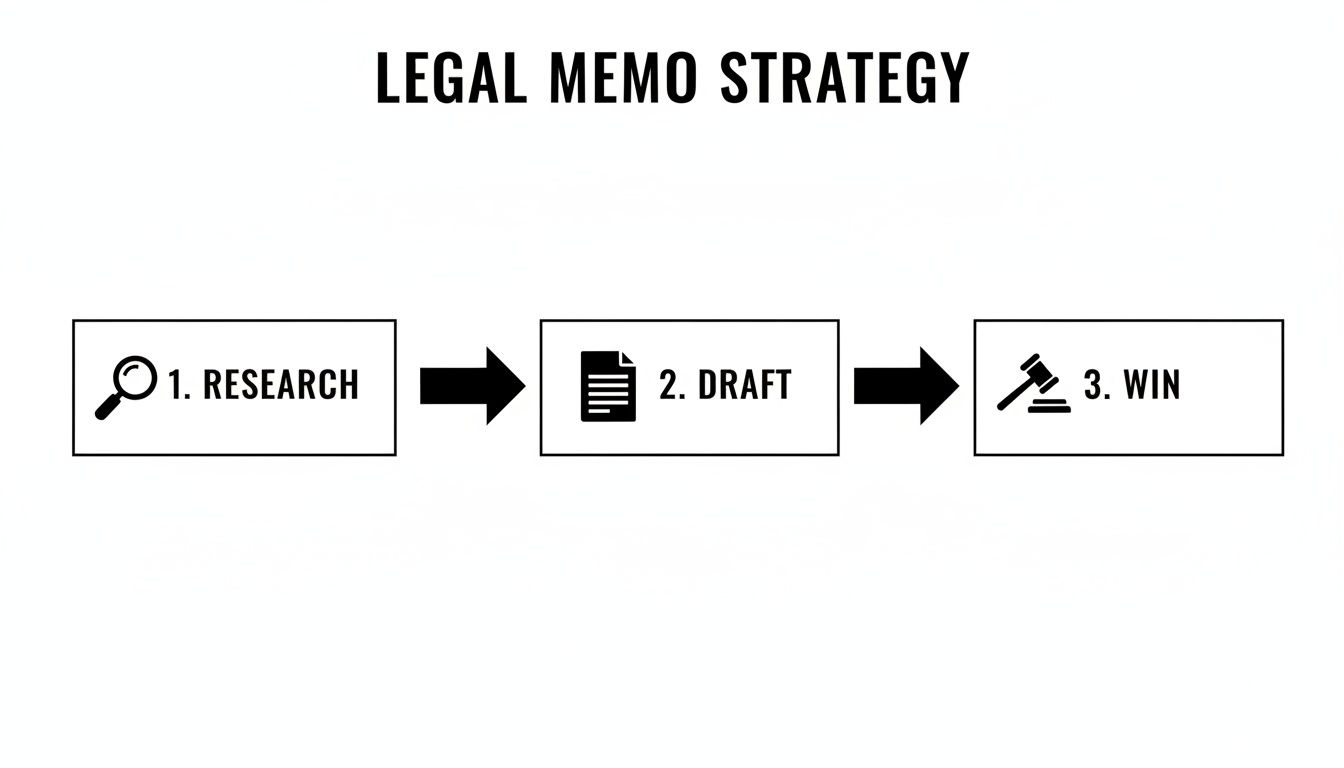
This visual boils it all down. The strategy is simple but incredibly effective: research, draft, and win. It’s the workflow that turns complex legal questions into clear, actionable advice.
Think of this as your mission statement. Mess this up, and the entire memo is a waste of everyone’s time. Your goal is to frame the legal issue so tightly that there’s zero room for misinterpretation.
A bad question is broad and lazy: "What are the client's options?" A good question is a surgical strike.
For example: “Under California Civil Code § 1714, is a social media influencer liable for negligence when a promotional post directly leads to a follower’s financial loss due to a fraudulent investment scheme?”
See the difference? Specificity is your best friend. It forces you to narrow your research and gives the reader instant context for everything that follows.
Your supervising attorney is busy. They do not want to read a mystery novel. The Brief Answer gives them the "yes," "no," or "it's complicated, and here’s why" in the first few sentences.
Treat it like an executive summary. Give the direct answer first, then follow it with a sentence or two that sums up your core reasoning.
Yes, the influencer is likely liable for negligence. California courts have consistently held that individuals with a significant public platform have a duty of care. Failing to perform basic due diligence on a promoted financial product almost certainly constitutes a breach of that duty.
That's it. In under 50 words, they have the conclusion and the gist of the argument. You just saved them 20 minutes, which makes you a hero.
This is where so many writers go wrong. The Statement of Facts is not the place for argument, spin, or dramatic flair. Your job is to present the narrative neutrally, including the facts that help and hurt your position.
Why? Because this is an internal, objective document. Hiding the bad facts now just means you'll be blindsided by them later. Stick to the legally relevant details:
Presenting a balanced view builds incredible credibility and allows for a much stronger analysis. It’s a skill that translates everywhere, even when crafting clear and impactful professional summaries in other contexts.
This is the main event. The Discussion (sometimes called the Analysis) is where you connect the facts to the law and meticulously show your work. You’ll be using the classic IRAC (Issue, Rule, Application, Conclusion) structure, but the trick is to do it without sounding like a first-year law student’s textbook.
Don’t just state the rule; explain why it applies to your specific set of facts. Don’t just jump to the conclusion; show the logical steps that got you there. This section is all about demonstrating your analytical muscle. Using plain language is a superpower here; you can find more tips in our guide on the importance of plain English in legal writing.
If you're dealing with a complex issue, break it down with sub-headings. If a negligence claim has three distinct elements, give each one its own IRAC analysis. This keeps the logic clean and makes your argument incredibly easy to follow.
Finally, the Conclusion. This is not the place to introduce new arguments or evidence. It’s a concise summary of your Discussion section, cleanly restating the bottom-line answer you already provided up top.
Briefly reiterate the key findings of your analysis for each issue, then synthesize them into one final, overarching conclusion. The goal is to leave the reader with a clear, confident understanding of the legal landscape and what the next steps could be. Think of it as the final, satisfying "thud" of a well-built argument landing squarely on the partner’s desk.
Let's be blunt: cases are won and lost long before anyone steps into a courtroom. They're won right here, in the research phase. A legal memorandum built on weak or incomplete research is like a house with no foundation—it’s just a matter of time before the whole thing comes crashing down.
We're not just talking about finding a case; we’re talking about finding the case. The one that controls. The one that makes your argument bulletproof, or—just as importantly—reveals the fatal flaw you need to know about now. This is the tedious, essential work that separates the pros from the amateurs.
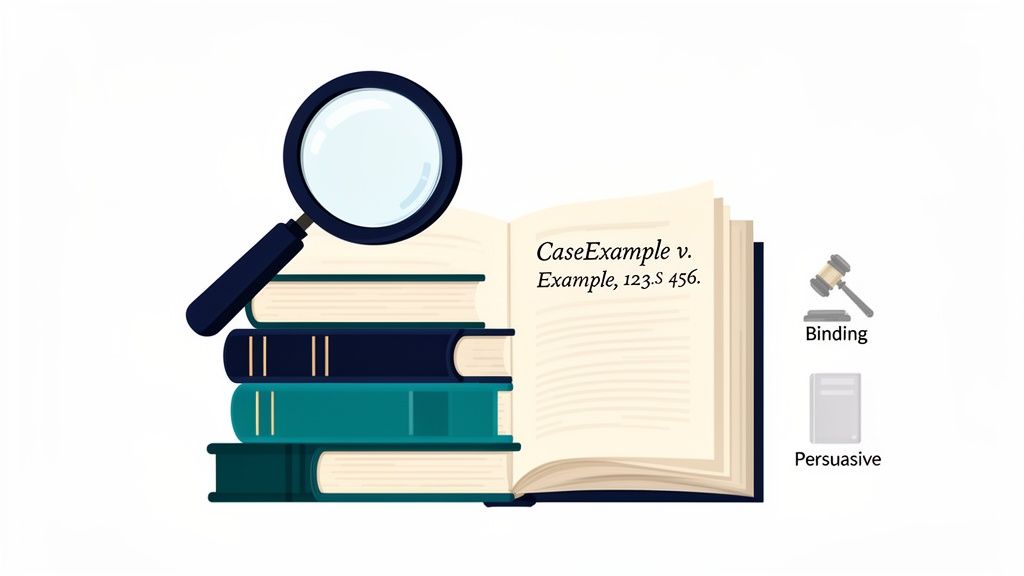
Get ready to spend some quality time with a search bar, because that’s where this all begins. But just plugging keywords into Westlaw or LexisNexis is a rookie move. The real art is refining that search until you’ve surgically extracted the most relevant authorities.
Think of it like this: your initial search is a wide net that catches everything. Your job is to systematically tighten that net, throwing back the junk until you're left with only the keepers. This means mastering Boolean connectors, searching within results, and diving into headnotes to find cases that are genuinely on point.
You also have to know when to stop. The goal isn’t to find every case ever written on a topic. It's to find the controlling and most persuasive authorities and then get out. Endless research is just a form of procrastination.
Once you have a handful of solid cases, the real fun begins. You have to figure out exactly what you're holding.
You need to care about this. Confusing these two is like confusing a direct order from a general with a friendly suggestion from a private. One you absolutely must follow; the other is… nice to have.
Knowing the difference is non-negotiable. Citing a case from another jurisdiction as if it's binding is a fast way to lose all credibility with the partner reading your memo—or worse, the judge.
Alright, let's talk about the soul-crushing, detail-obsessed world of legal citation. The Bluebook, ALWD, and a confusing web of local court rules—it’s a minefield practically designed to make you question your career choices.
But getting citations wrong isn't just a minor slip-up. It's sloppy. It screams, "I don't care about the details," which is the last message you want to send in a profession built on precision. Incorrect citations undermine your credibility before the reader even gets to your brilliant analysis.
This painstaking work is where a skilled paralegal becomes your secret weapon. Surveys of over 2,000 legal professionals show that 69% use legal research platforms for fact-heavy rule statements, which leads to 40% faster insights. As general counsels push for more cost-effective solutions, this data-driven efficiency is crucial.
A detail-oriented paralegal can leverage these tools to perfect citations and solidify research, potentially slashing firm costs by up to 80% while ensuring the memo's foundation is rock-solid. If you're interested in the data, you can read more about these legal tech and AI trends and what they mean for firms.
Seriously, offloading the citation formatting and verification process is one of the single best investments you can make. It frees you up to focus on the argument itself, which is where your brainpower is most valuable. To dive deeper, check out our guide on the best legal research databases that professionals use to get the job done right.
Let’s be honest: your first draft is going to be a mess. Mine is. Everyone's is. The real magic in writing a legal memorandum that gets taken seriously doesn’t happen during that initial brain dump. It happens when you take that disorganized, over-researched document and forge it into a sharp, persuasive tool.
This is where you switch gears. You stop being a frantic researcher and become a cold, calculating editor. It’s less about adding more information and more about ruthlessly cutting away anything that isn’t pulling its weight. The whole point is to transform a pile of research into a powerful instrument of influence.
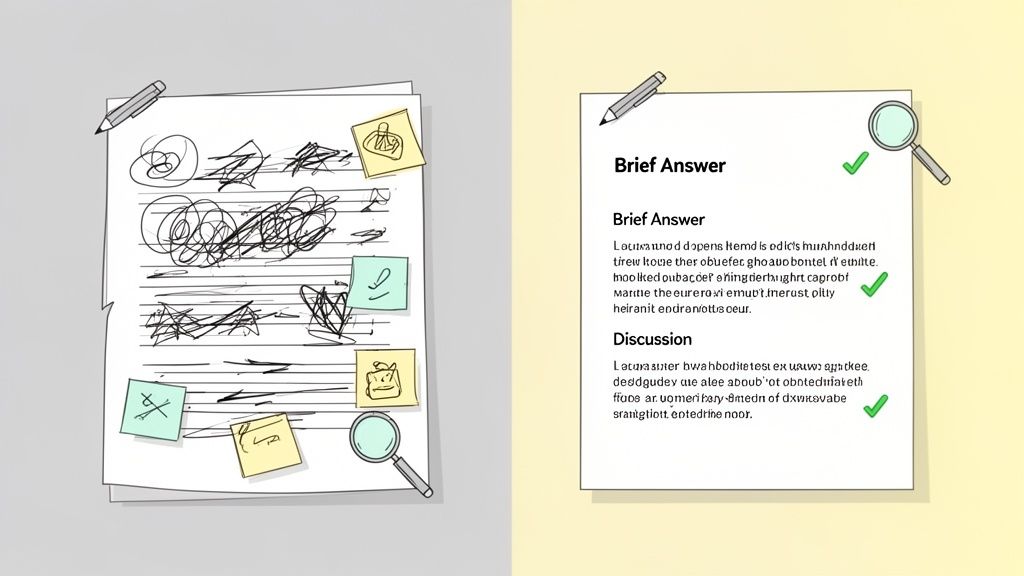
Time to put your ego aside. Writing objectively means analyzing the law dispassionately, even when—especially when—it hurts your case. Your primary job here is to find the weak spots in your own argument before opposing counsel gets the chance to point them out for you in public.
It's tempting to gloss over that one awkward precedent or that inconvenient fact. Don't do it. A memo is an internal strategy document, and hiding bad news is the fastest way to get blindsided in a deposition or, even worse, in front of a judge.
Acknowledge the counterarguments head-on. Analyze them, distinguish them, and show the supervising attorney that you’ve considered every angle—not just the ones that make you feel good about the case. This builds trust faster than anything else you can do.
No one is impressed by legalese anymore. Your goal isn't to sound like a 19th-century British barrister; it's to be understood quickly and completely by a very busy person. If a partner has to re-read one of your sentences three times to figure out what you’re trying to say, you’ve failed.
This means you need to hunt down and eliminate every single unnecessary word.
This isn’t just about stylistic preference. It’s about respecting your reader's time. A clear, concise memo gets read, understood, and acted upon. A bloated one gets skimmed and forgotten.
After you’ve let your draft sit for at least a day (seriously, step away from the keyboard), come back to it with fresh eyes and a critical mindset. Your mission is to critique your own work as if it were written by your biggest competitor.
Here’s a simple checklist to get you started:
Finally, after all your self-editing, you need to accept a hard truth: you've gone blind to your own mistakes. You’ve read that one sentence 47 times, and your brain now automatically corrects the typo you’ve missed every single time.
This is exactly why a second pair of eyes is non-negotiable. It could be a colleague, a mentor, or—and this is my preferred power move—a skilled remote paralegal. They aren’t emotionally invested in the draft. They haven't spent 20 hours agonizing over the research.
A fresh reader will catch the logical gaps, the awkward phrasing, and the glaring typos that have become invisible to you. This final quality-control step is what elevates a good memo to a great one. Whatever you do, don't skip it.
We've all seen them. The memos that make you wince—the ones that are way too long, hopelessly one-sided, or so tangled you can't make heads or tails of them. These are the blunders that can torpedo your credibility before the reader even gets to your analysis.
Think of this as your pre-flight checklist. Nailing the structure and research is a huge part of the battle, but dodging these common pitfalls is what truly separates a decent memo from a document that actually shapes decisions. Let’s make sure your work is polished, persuasive, and professional.
This is, hands down, the cardinal sin of legal writing. You’re asked to analyze a specific contract clause under Delaware law, and you come back with a ten-page history of contract formation. It might sound ridiculous, but you'd be surprised how easily writers can drift off-topic.
Your role here is to be a sniper, not to carpet-bomb the issue with every piece of vaguely related research you found. A busy partner asked a specific question for a reason—they need a specific answer. Failing to deliver it is the fastest way to signal you either didn't get the assignment or couldn't find the answer. Neither is a good look.
The Fix: Before you even start the Discussion section, go back and read the Question Presented one more time. Then, write out your Brief Answer. If the analysis you're planning doesn't directly build toward that answer, it doesn’t belong in the memo. Stay relentlessly focused.
This mistake usually comes from a place of insecurity. After spending hours buried in Westlaw, you feel this overwhelming urge to include every single case you unearthed to prove you did the work. But this "kitchen sink" method doesn't make you look thorough; it just makes it seem like you can't distinguish between what’s critical and what's just noise.
Your real value isn’t in finding a mountain of cases. It's in sifting through that mountain to find the few nuggets of gold—the binding precedents and the most persuasive authorities—and weaving them into a coherent argument. Tossing in irrelevant or redundant cases just buries your key points and, frankly, wastes the reader's time.
Never, ever write a sentence like, "Clearly, the plaintiff's claim has no merit." Why is it clear? What's the legal reasoning? Stating something is "obvious" or "clear" without immediately backing it up with evidence is a massive red flag for any experienced attorney. It suggests you’re either being lazy or, worse, you don't actually have the support for your claim.
A strong legal memo doesn't just tell the reader the answer; it shows them precisely how you got there. Every conclusion needs to be the logical endpoint of a clearly laid-out analysis. Your job is to connect the dots for the reader, not just gesture vaguely in the direction of the answer.
This one might feel minor, but its impact is deadly. A memo riddled with typos, inconsistent formatting, or citation errors sends a single, devastating message: "I don't care about the details." In a profession where the details are everything, that’s a catastrophic signal to send. It immediately erodes the reader's trust in your entire analysis.
This goes beyond just looking good; it's a matter of professional responsibility. A clean, well-structured memo is a defense against error. Historically, up to 20% of malpractice claims can be traced back to administrative slips and missed deadlines—exactly the kind of mistakes sloppy work invites. While 42% of legal professionals now use AI for document review, that final human check is still the most important line of defense. You can learn more about how the legal market is evolving from the experts at Thomson Reuters.
You’ve got the structure down, you’ve done the hard work of research, and you know the pitfalls to avoid. But a few nagging questions always seem to surface right when you're in the thick of it. Let's clear the air with some straight talk on the common "what ifs" that pop up for both attorneys and paralegals.
Think of it this way: an objective memorandum is the unvarnished, internal truth. It’s a frank assessment for your own team, laying out the strengths and, just as importantly, the weaknesses of a case. Your job is to be the scout who comes back and gives an honest report of the terrain ahead—the good, the bad, and the ugly.
A persuasive brief, on the other hand, is pure advocacy. It’s an external document filed with the court, designed with one goal in mind: to champion your client’s position and convince a judge to see things your way.
Mixing these two up is a classic rookie mistake, and it can be a costly one. You never want to be a cheerleader in a memo that demands objective analysis, and you definitely don't want to hand the court a road map to your case's biggest flaws in a persuasive brief. The memo is for building strategy; the brief is for executing it.
Here’s the only answer that truly matters: as long as it needs to be, and not one word more.
Honestly, there is no magic number. A memo analyzing a single, straightforward statute might wrap up in five pages. But one that has to untangle a complex fact pattern against a messy web of case law could easily push past twenty. Chasing a specific page count is a waste of time.
Efficiency is the real goal here. A supervising partner will always prefer a tight, well-reasoned 10-page memo over a fluffy 15-page one that meanders. Concentrate on hitting every sub-issue, analyzing the most important authorities, and giving a direct answer to the question presented.
If you catch yourself repeating arguments or summarizing a summary, take that as a sign to start trimming. Be ruthless. The most valuable resource you're managing is your reader's time.
Yes, absolutely—as long as you’re using a properly vetted service and not just taking a chance on a random freelance platform. The old-school hesitation about outsourcing always came down to a lack of quality control. Who is this person? Do they have real legal experience?
Today's specialized platforms have pretty much solved for that. You aren't just hiring a random individual; you're tapping into a network of professionals who have already been screened for their legal knowledge, practical experience, and meticulous attention to detail.
This isn’t about offloading your professional responsibility. It's about smart delegation. A skilled remote paralegal can handle the time-consuming initial research, draft foundational sections under your direction, and—most importantly—tackle the soul-crushing citation work. This frees you up to focus on high-level strategy and the subtle points of the analysis, which is where your expertise adds the most value.
For a more expansive look at the entire memo writing process, consider consulting a comprehensive guide on how to write a legal memorandum which offers additional perspectives.
Ultimately, it’s one of the most effective ways to build capacity for your firm. You reclaim your time, the firm reduces overhead, and the final work product is often stronger because of it. It’s just a better way to build a modern legal team.


