

 24 minutes read
When you hear "lawyer on demand," think of it as calling in a legal specialist for a specific mission. You’re not hiring a full-time employee or getting tangled in a pricey, long-term retainer. Instead, you get laser-focused expertise for a specific project, right when you need it.
This model lets you scale your legal firepower up or down based on your actual needs. The best part? You only pay for the work you need, when you need it. It’s the lean, agile answer for the chaos of modern legal work.
Let’s be brutally honest. The traditional legal retainer model is broken, especially for any business trying to stay lean and move fast. I’ve been there, staring at a five-figure invoice and wondering if our lawyer’s fancy office plant was getting a better ROI than we were.
You’re trapped in a painful choice: either commit thousands a month for legal support you might not even use, or get walloped with astronomical hourly rates every time you have a simple question.
The $5,000 Hello.
That's what I call it—the minimum check you have to write just to get a partner on the phone to say, "Let me look into that."

This old-school system doesn’t just drain your bank account; it kills your agility. It creates this bizarre pressure to invent legal tasks just to feel like you’re "getting your money's worth." Suddenly, you’re commissioning a 20-page memo on an issue that a quick chat could have solved. Madness.
The real killer isn't just the direct cost; it's the predictable waste baked into the model. You're paying for a lawyer's downtime, their mahogany desk, and their partner retreat. You're funding the entire infrastructure of a law firm, not just the legal advice you actually need.
Think about the opportunity cost. That bloated monthly retainer could be funding:
Every dollar wasted on unused legal hours is a dollar stolen from your growth. It’s a slow bleed that prevents you from investing in the parts of your business that actually move the needle. The model is fundamentally misaligned with modern business needs.

The core issue with retainers is the incentive structure. You pay for access, not outcomes. A lawyer on demand flips that script entirely—you pay for precise, targeted results.
This isn't just about finding a cheaper option. It’s a strategic shift. When you move to an on-demand model, you stop paying for overhead and start paying for pure output. You get the exact expertise required for a specific task, whether that’s drafting a complex motion or reviewing a new client agreement.
For firms navigating the complexities of their own operations, exploring different models for outsourced legal services can provide a roadmap to greater efficiency. It’s about building a legal function that serves your business, not the other way around.
The future isn’t about mortgaging your office ping-pong table to keep a law firm on standby. It’s about accessing elite talent when you need it and deploying your capital where it matters most. It's time to stop paying for the fancy plant.
Let's put some numbers on this. Here’s a side-by-side comparison of the real costs a typical startup faces in its first year with a traditional law firm retainer versus a flexible on-demand model.
| Expense Category | Traditional Law Firm Retainer | Lawyer On Demand Model |
|---|---|---|
| Monthly Retainer Fee | $5,000/month (minimum, often for unused hours) | $0/month (pay-as-you-go) |
| Initial Setup/Onboarding | $2,500 one-time fee | $0 (usually included in project scope) |
| Document Review (20 hrs) | Billed at $450/hr after retainer hours are used up | Flat project fee of $4,000 or hourly at $200/hr |
| Contract Drafting (15 hrs) | Billed at $450/hr | Flat project fee of $3,000 or hourly at $200/hr |
| Urgent Advisory Call (1 hr) | Covered by retainer, but eats into your monthly "allowance" | $200 for one hour of work |
| Annual Total Cost | ~$75,000+ (assuming some overage) | ~$10,000 – $15,000 (for the same work) |
The numbers don't lie. The on-demand model delivers the same, if not better, legal output without the crippling overhead and waste associated with traditional retainers. You gain predictability and, more importantly, control over your legal spend.
So, you're ready to ditch the traditional retainer and find a more flexible legal partner. Good call. But where do you actually find these on-demand legal pros?
It's not as simple as a quick Google search for "lawyer on demand." Doing that will just throw you into a sea of generic platforms and big-firm lawyers looking for a side gig. You're looking for a genuine partner, not a resume in a database.
Finding the right person takes a smart approach. Here's how I do it.
When it comes to sourcing, you have two main options: the massive online talent marketplaces and the smaller, more specialized legal staffing agencies. I've used both, and they are completely different worlds.
The big platforms are the Wild West. Sure, they boast thousands of profiles, but sifting through them to find a gem is practically a full-time job. Hope you enjoy spending your afternoons fact-checking bar admissions and trying to read between the lines of templated bios—because that’s now your full-time job. The quality is a total crapshoot.
Boutique agencies, on the other hand, offer a curated experience. They've already done the heavy lifting, vetting candidates for specific skills and experience. The downside? They can be more expensive, and their talent pool is naturally smaller. But if you need very specific expertise—say, a lawyer who lives and breathes SaaS contracts—they can be worth every penny.
Don't forget the third, and often best, option: your own network. Seriously, this is a goldmine. Ask other founders you respect. Ping your investors. A warm introduction to a lawyer who already gets the startup grind is the most valuable lead you can get.
Once you have a shortlist, the real work begins. A polished resume and a slick LinkedIn profile don't tell you squat about how someone operates in the real world. You need to know if they can move at your company's pace and give you a straight answer instead of a three-page memo filled with legalese.
Here are a few of my go-to vetting questions that cut right through the fluff:
This vetting process is so important because the on-demand model is a huge part of the $397 billion U.S. legal services market. The industry is built on smaller players—a staggering 78% of U.S. law firms are small to mid-sized, and about 35% of lawyers in private practice are solo practitioners. Many of these solos are the driving force behind this flexible, gig-style legal work. The trend is especially strong in the startup world, where 22% of lawyers report seeing more founders seeking this kind of agile counsel.
My Two Cents: You're not just hiring a service provider; you're auditioning a potential team member. How they fit into your company's culture is just as critical as their legal credentials.
When you're evaluating someone you found online, their digital footprint is a key part of their resume. A lawyer's professional standing is paramount, and understanding how they approach online reputation management for lawyers gives you a window into their credibility and professionalism.
Do they have thoughtful articles published? A history of positive client reviews? A professional, up-to-date online presence?
This isn't about vanity—it's about due diligence. A lawyer who is careless with their own reputation might be just as careless with your business. The goal is to find someone who not only has the legal expertise but also operates with a level of professionalism that gives you complete confidence.
Hiring an on-demand lawyer is meant to be fast, but "fast" can never mean "careless." I learned this the hard way. A bad legal hire—even a temporary one—can unleash more chaos and cost than just toughing it out with a slow one.
So, how do you move quickly without torpedoing quality? You use a checklist. Not some fluffy, theoretical one, but a battle-tested process that weeds out the pretenders and gets the right person productive from day one. This is my non-negotiable playbook. Toot, toot!
The process is actually simpler than you'd think, focusing on three core phases: sourcing, vetting, and partnering.
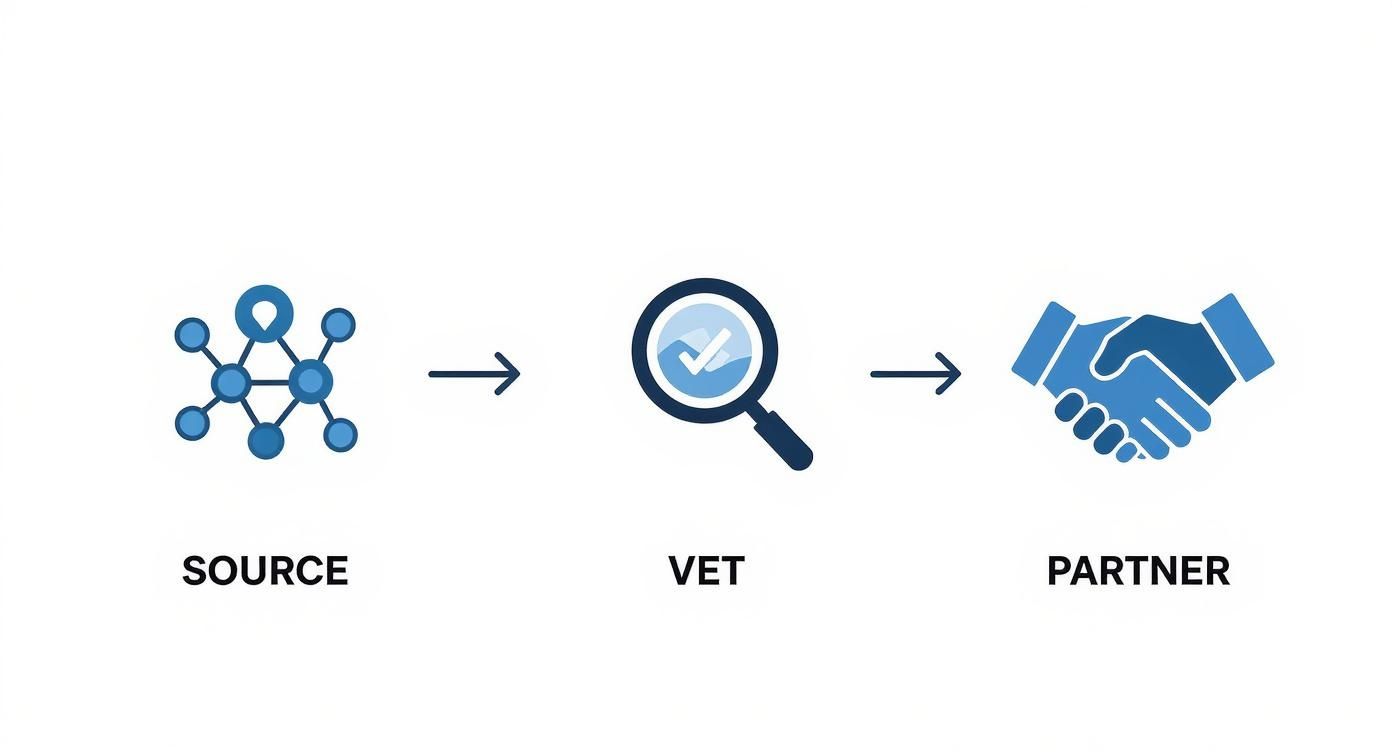
This breaks down the journey from "uh oh, we need a lawyer" to forming a solid working relationship. It's a reminder that a successful engagement is always built on a solid foundation of rigorous vetting.
First things first, let's get the basics out of the way. This isn't the exciting part, but skipping it is like building a house with no foundation. It's just dumb.
Forget asking, "Were they a good lawyer?" It’s a useless question. Of course, their hand-picked reference will say yes. You need to dig for the real story.
Instead, ask questions that reveal their working style. "Tell me about a time when you had to deliver difficult news on a tight deadline." Or, "How did they handle a situation where the project scope changed unexpectedly?"
These questions uncover how they operate under pressure, which is what really matters. For a deeper dive, our guide on how to conduct reference checks gives you a more detailed framework. You can find it here: https://hireparalegals.com/how-to-conduct-reference-checks/
Once you’ve made a hire, the clock starts. The first two days are absolutely critical for setting the tone and integrating them into your workflow. Get this right, and they’ll feel like part of the team from day one. Screw it up, and you'll spend weeks just trying to get them the right documents.
My onboarding sprint is simple:
The Goal: Your on-demand lawyer should know exactly who to talk to, where to find information, and how to define success within 48 hours. Anything less is a failure of your process, not theirs.
To put this all together, I’ve mapped out my must-have checklist. It’s a simple table, but it keeps me honest and ensures nothing falls through the cracks.
A checklist of essential steps for vetting and seamlessly integrating an on-demand lawyer into your workflow, ensuring alignment and security from the start.
| Phase | Action Item | Why It's Critical |
|---|---|---|
| Pre-Hire | Verify bar admissions & good standing | Confirms their legal credentials are valid and active. |
| Pre-Hire | Conduct a thorough conflicts check | Protects your firm and clients from ethical breaches. |
| Pre-Hire | Draft and sign a clear engagement letter | Sets explicit expectations for scope, payment, and communication. |
| Pre-Hire | Perform behavioral-based reference checks | Reveals their actual work style, not just their qualifications. |
| Onboarding | Provide secure, role-based system access | Prevents data breaches and protects sensitive information. |
| Onboarding | Set up a dedicated communication channel | Ensures efficient, centralized communication and avoids lost messages. |
| Onboarding | Hold a detailed kickoff meeting | Aligns everyone on goals, deliverables, and the definition of success. |
Following this table keeps the process tight and effective. It's about building a system that lets you move fast without making costly mistakes.
To get an even better feel for this, it's worth understanding client onboarding best practices from the other side of the table. Seeing how top-tier firms handle this will give you a benchmark for your own system. The key is to make your new hire feel empowered and integrated, not like an outsider you’re just tossing assignments to over a digital wall.
So, you’ve found your perfect on-demand lawyer. Vetting's done, agreement's signed, ready to go. Now what? This is where many teams stumble—actually plugging this person into your company’s day-to-day operations without creating a chaotic mess.
Let’s be honest, just forwarding a few emails and hoping for the best isn't a workflow. It’s a recipe for expensive miscommunications. Proper integration means building a process that makes your on-demand lawyer feel like a true extension of your team, not just a contractor you call in a panic.
This isn’t just about sharing files; it's about sharing context. The goal is to move beyond a transactional relationship and build a genuine strategic partnership. I’ve refined my own process over years of trial and (plenty of) error.
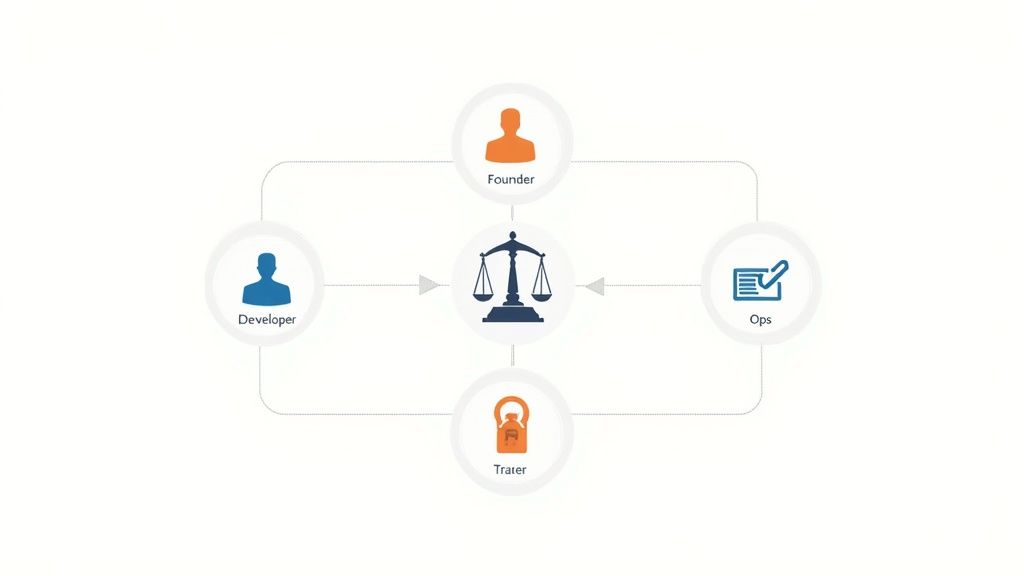
First things first: you need one place for all legal requests to go. If your team is hitting up your new counsel from every direction—Slack DMs, personal emails, text messages—you’re setting them up to fail. Information gets lost, context gets scattered, and you end up paying them to piece together a puzzle that shouldn't exist.
My solution is a dedicated legal request system. This doesn't need to be some complex, overpriced software. We run ours on a simple Asana board.
This creates a transparent and organized pipeline. Your lawyer on demand knows exactly what's on their plate, and you can see the status of every single task at a glance. It's the bedrock of an efficient workflow.
The rule is simple: if it’s not in our project management tool, it doesn’t exist. This single policy has saved us hundreds of hours and thousands of dollars in wasted time.
Next up is a shared knowledge base. Your on-demand counsel will inevitably have questions about your business, your risk tolerance, and past decisions. Answering the same questions over and over is a massive drain on everyone’s time—and your budget.
For this, we use a dedicated space in Notion. Our "Legal Hub" contains all the essentials:
This "shared brain" gives your counsel the context they need to provide advice that’s not just legally sound, but also commercially practical for your specific business. It’s a key part of an effective workflow and a core component of what many now call legal project management.
Tools are fantastic, but they’re useless without the right human processes. Technology can’t build trust or alignment; only clear communication can.
First, define who gets to make requests. Not everyone on your team should have a direct line to legal. We limit access to department heads, which prevents random requests and ensures every task sent to counsel is already a business priority.
Second, establish a regular check-in. We do a 15-minute sync every Monday morning. It’s not a deep dive into every project; it’s a quick-fire round to prioritize the week's tasks and flag any potential blockers. This keeps small issues from snowballing.
Finally, create a feedback loop. After a big project wraps up, ask your counsel for their thoughts. Was the process smooth? Did they get what they needed? At the same time, give them constructive feedback. This two-way street is what elevates the relationship from a simple vendor to a true partner.
So, you've brought your on-demand lawyer into the fold. Great. Now for the delicate part: How do you track their performance and ensure you're getting value without becoming a dreaded micromanager?
The whole point of hiring on-demand talent is their autonomy. These are seasoned professionals, not summer interns. The challenge is striking that perfect balance between trust and accountability.
Let's get one thing straight: the old-school yardstick of "hours billed" is completely broken. It measures activity, not results. Frankly, I don't care if someone spent 10 hours on a task if it should have taken two. Rewarding inefficiency is just bad business. It’s time to ditch the vanity metrics and focus on what actually moves your business forward.
My philosophy is simple: trust, but verify. I trust the experts I hire to do their job, but I need to see that their work is producing tangible outcomes. This requires a fundamental shift in thinking—from tracking time to tracking real-world impact.
Your key performance indicators (KPIs) should have nothing to do with how "busy" someone seems. They need to be directly connected to your strategic goals.
When I evaluate on-demand counsel, these are the only metrics I truly care about:
The goal is to measure the effectiveness of their counsel, not the duration. A single, brilliant insight that protects your company is worth infinitely more than 40 hours of boilerplate document review.
This data-driven mindset is more important than ever. The legal hiring market is incredibly tight—the lawyer unemployment rate was a minuscule 0.9% in early 2025, a stark contrast to the national average of 4.2%. This talent crunch has companies relying heavily on contingent roles, from contract managers to temporary in-house counsel, just to keep up. You can see more on this trend in Robert Half's report on legal roles in highest demand.
With talent so scarce, you can't afford an underperformer. It's not just about finding the right person; it's about managing them effectively once they're in place.
What do you do when a project misses a deadline or the budget balloons? This is where many founder-lawyer relationships fall apart—the inability to have a direct, professional conversation.
Don't let problems fester. Address them immediately, but lead with data, not emotion.
Instead of saying, "This is taking way too long," try this: "This project is now three days past our agreed-upon deadline. Can you walk me through the blockers you're running into?"
Instead of, "This seems really expensive," say this: "We budgeted 10 hours for this review, and the invoice shows 15. Can you help me understand what unexpected complexities came up?"
This approach removes any personal accusation and keeps the focus on the work itself. It also gives your counsel a chance to explain their side. Sometimes there's a legitimate reason for the extra cost. Other times, you'll uncover a performance issue that needs immediate attention.
Either way, you’re managing the outcome, not the person. You’re building a professional partnership based on mutual respect and clear, measurable goals—not one trapped by the tyranny of the six-minute billing increment.
Let’s be honest. The entire professional world has embraced remote work, flexible talent, and project-based teams. Yet, a huge part of the legal industry is still operating like it’s 1995—just with more expensive coffee machines.
This isn't just some startup trend. It's a fundamental change in how legal services are delivered and, more importantly, how they’re consumed. The old-school model simply can't keep up with the pace of modern business. It’s too slow, too rigid, and frankly, too expensive.
The data backs this up. The demand for legal work is hitting historic highs. Thomson Reuters reported that the third quarter of 2023 saw the fourth-highest demand for legal services in two decades, jumping 3.9% year-over-year. Midsize firms, the industry's engine room, saw demand surge by 6.1%, fueled by a massive 7.6% increase in M&A work.
This isn't a fluke. It's a clear signal that clients need more legal firepower, and the old ways of providing it are cracking under the pressure.
What do remote work, the gig economy, and hyper-specialized client needs have in common? They all point toward a future where value is delivered with surgical precision.
Think about it this way: you wouldn't hire a full-time plumber just in case a pipe bursts, right? So why do we still accept that model for highly specialized legal expertise?
The future is about assembling the perfect team for the task at hand, for exactly as long as you need them. It's about delivering precise value exactly when and where it's needed most.
For founders and firm leaders, embracing a lawyer on demand isn't just a clever cost-saving tactic anymore. It's a massive strategic advantage in a world that values speed and agility above all else.
Picture this. While your competitors are stuck waiting for their traditional law firm to schedule a kickoff meeting, you’ve already sourced, onboarded, and deployed a specialist who is halfway through the project. You’re moving faster, making decisions quicker, and seizing opportunities while they're still fresh.
This isn’t about replacing traditional law firms entirely. There will always be a place for them in high-stakes litigation or massive corporate transactions. But for the vast majority of day-to-day legal work, the agile model just makes more sense.
It’s about building a legal function that’s as dynamic as the rest of your business. It’s about having the right expertise on tap, ready to go, without the soul-crushing overhead. For those of us who have made the switch, this isn't the future of legal—it’s already the present.
The only question is how long everyone else will take to catch up.
Alright, let's get into the weeds. By now, you're probably seeing the potential but also have a few nagging questions. I get it. This is a big shift from how things have always been done.
Here are the straight-up, no-fluff answers to the questions I hear most often from other founders.
Not always, and frankly, if a lawyer is selling you on being "the cheapest," you should probably run. Top-tier talent costs real money, period. The real savings here aren't about finding a bargain-basement hourly rate; they're about eliminating catastrophic waste.
Think about it. You stop paying for a traditional firm's marble lobby, partner lunches, and—most importantly—lawyer downtime. With an on-demand lawyer, you pay for one thing: pure, unadulterated legal work. That ruthless efficiency almost always crushes a traditional retainer on total project cost.
You treat it with the exact same level of paranoia you would with any other outside counsel. This isn't amateur hour. Attorney-client privilege applies just the same, and any professional worth their salt will have their security protocols locked down tighter than Fort Knox.
Here’s the simple, non-negotiable checklist:
This model truly shines for project-based work that has a clear beginning and end. Think of things like overflow M&A due diligence, a major contract review cycle, or drafting a new set of employee agreements.
It’s also a total lifesaver for plugging temporary gaps, like when your in-house counsel goes on parental leave or you have a sudden spike in litigation matters.
For the day-to-day blocking and tackling that makes up 80% of a business's legal needs, this model is simply faster and more efficient. For that once-in-a-decade, "bet-the-company" lawsuit? Yeah, you might still want the army of associates from a traditional firm.
Absolutely. In fact, that's the holy grail. The goal isn't to find a new lawyer for every single project. It’s to find one or two amazing on-demand lawyers who learn your business, your risk tolerance, and your team's preferences.
You use them again and again, building up that crucial institutional knowledge without adding to your permanent headcount. They become a trusted, strategic partner you can spin up whenever you need them—the ultimate competitive advantage.


