

 23 minutes read
Let's be honest about legal support: the old model is a terrible fit for most growing businesses. You're stuck in a no-win situation. Either you hire a full-time lawyer you can't possibly keep busy, or you fork over a five-figure retainer to a big law firm just for the privilege of being their client. Turns out there’s more than one way to get elite legal help without mortgaging your office ping-pong table.
The traditional way of hiring legal help was designed for a different world—one with slow, predictable growth and massive, unchanging budgets. For a fast-moving, modern business, it’s a straight-up disaster. You're presented with two options, and frankly, neither of them is great.
First, there's the full-time hire. Hope you enjoy spending your afternoons fact-checking resumes and running interviews—because that’s now your full-time job. You pour months into the process, commit to a six-figure salary plus benefits, and then cross your fingers you have enough work to justify the expense. More often than not, you don't. This leaves you with a very smart, very expensive lawyer tidying up the supply closet because there isn't an urgent legal fire to put out that week. It's a textbook case of flawed workforce planning strategies, where fixed overhead eats into capital that should be fueling your growth.

Then there's the classic "Big Law" firm. They absolutely have the expertise, but getting their attention can feel like trying to get a last-minute reservation at a three-Michelin-star restaurant.

You're not just paying for a lawyer's time; you're funding their downtown high-rise, their partner retreats, and a whole team of associates who bill you for sneezing in the direction of your case file. That first invoice can be enough to make your CFO rethink their career path.
This isn't just a theoretical problem. I've been there, and I'm willing to bet you have, too. The old system creates predictable, maddening bottlenecks that actively get in the way of progress.
This isn't just a quirk of the legal world; it's a systemic problem we're seeing across many professional services. If you want to dive deeper into the forces behind this shift, you'll see interesting parallels in the challenges and benefits of a fractional CMO model, which also champions flexible expertise over rigid, full-time hires.
The reality is the old model forces you to overpay for capacity you don't use or locks you into partnerships that can't keep up. There had to be a better way. Thankfully, now there is. The rise of lawyers on demand isn't just another buzzword; it's a direct, necessary solution to this broken system.
So, you're tired of the old way of hiring legal help. Welcome to the club. The good news is that "lawyers on demand" isn't some complex, futuristic concept you need a degree to unpack. It's actually a brutally simple and effective model that aligns legal support with how modern businesses really work.
Think of it like cloud computing, but for legal expertise. You wouldn't buy and maintain a massive server farm just for a single traffic spike, right? You'd use AWS or Azure to scale your computing power up when you need it and scale it back down when you don't. That’s precisely what the lawyers on demand model does for legal work.

At its heart, this model connects businesses with a network of vetted, experienced independent lawyers for specific, project-based tasks. It's about getting the right talent for the right mission, right when you need it.
The model is basically a talent platform—a marketplace that removes the friction from finding and hiring top-tier legal professionals. But it’s not just some free-for-all job board where you cross your fingers and hope for the best. The best platforms are curated, meaning they do the heavy lifting for you.
Here’s the typical flow:
It’s a surgical approach. You bring in a specialist to perform a specific operation and then release them, rather than keeping a general surgeon on the payroll 24/7. This flexibility is what makes it so powerful for businesses that need to stay lean and agile.
Let's be clear: this isn't just about finding a random freelancer online. The value of a true lawyers on demand platform comes from the infrastructure and quality control it provides.
The real magic is in the curation. You're not just getting access to a list of names; you're tapping into a pre-vetted talent pool. These platforms have already done the grueling work of checking credentials, verifying experience, and weeding out the duds.
This entire approach is a core part of a broader shift in the legal industry. The global legal process outsourcing market, which includes these flexible services, is on track to hit $45.4 billion by 2028. That kind of growth isn't accidental; it’s driven by businesses demanding smarter, more cost-effective solutions. To better understand how this fits into the larger picture, check out our guide on what is legal process outsourcing.
Ultimately, the lawyers on demand model is about transforming legal support from a fixed, burdensome overhead into a variable, strategic asset. It gives you access to an A-team without the A-list price tag, allowing your business to punch well above its weight class.
Alright, so you get the concept. The old way is broken, and a flexible legal team sounds great in theory. But theory doesn't sign contracts or close funding rounds. Knowing this new weapon exists is one thing; knowing exactly when to deploy it is everything.
Let’s get practical. This isn't about replacing your entire legal function overnight. It's about surgical strikes—using specialized expertise at critical moments to gain a massive advantage. Hope you enjoy your newfound agility, because that's what this model delivers.
Some moments in a business's life are too important to mess up. These are the "bet the company" scenarios where bringing in a specialist isn't a luxury; it's a necessity. The problem is, these specialists often come with a Big Law price tag that could fund a small space program.
This is where lawyers on demand shine.
Not every legal need is a massive, one-off project. Sometimes, it’s about managing the relentless rhythm of the business without burning out your core team or letting things slip through the cracks.
Think of it as bringing in a relief pitcher in the seventh inning to face a tough batter. You don't need them for the whole game, just for that critical moment.
You’re not admitting your team is inadequate; you’re being a smart resource allocator. Using on-demand talent for overflow proves you’re focused on results, not on building an unnecessary internal empire. It's about capacity, not capability.
Common scenarios include:
Finally, let’s talk about the hyper-specialized stuff. The legal world is getting more complex, and you can’t expect one person to be an expert in everything. This is where the on-demand model is truly a game-changer, especially in fast-moving tech sectors.
The demand for specialized legal expertise is exploding. Cybersecurity and data privacy lawyers, for instance, are increasingly sought after, with demand growing over 30% annually since 2020. In fact, platforms report that over 40% of their on-demand legal service requests were for technology and cybersecurity-related matters. You can read more about the growing demand for specialized legal talent in Clio's comprehensive report.
This is where you call in the snipers:
In all these cases, the "before" picture is a choice between moving dangerously slow, paying an exorbitant price, or taking a risk with a non-specialist. The "after" picture? Fast, cost-effective, and precise. That's the power of lawyers on demand.
So, you’re sold on the idea. You see the power in having a legal special forces unit on speed dial. Now comes the hard part: navigating a market that’s suddenly flooded with platforms all promising to be the silver bullet for your legal woes. How do you spot the real deal from the glorified resume aggregators?
Let’s be blunt. Choosing the wrong provider is worse than sticking with the old model. It’s a fast track to wasting money, getting subpar work, and ending up with an even bigger headache than you started with. This is your no-nonsense vetting guide—the critical questions I wish I had asked when I first started exploring lawyers on demand.
Every platform looks great on the surface. They all have slick websites and testimonials from companies you’ve vaguely heard of. But the real difference isn't in their marketing budget; it's in the engine room. Your first job is to pop the hood and see what’s really going on.
The single most important question is: How do you actually vet your lawyers?
If their vetting process is weak, you'll be the one spending your afternoons fact-checking resumes and running interviews. That's not the goal here. You need to push past the vague claims of "top-tier talent" and dig into the specifics.
Ask them directly:
A good platform acts as a filter, not just a connector. They should be able to articulate a rigorous, multi-step process that weeds out 95% of applicants. If they can't, run. This process should be robust, almost like learning how to conduct reference checks but on a much larger and more specialized scale.
Next up, money. The whole point of this model is to escape the soul-crushing, opaque billing of traditional law firms. The last thing you want is to trade one set of surprise fees for another. Don’t get distracted by a low hourly rate; look at the total cost of engagement.
Beware the "$500 Hello" in a new disguise. Some platforms lure you in with attractive rates, only to hit you with hidden platform fees, project management charges, or mandatory minimums that bloat the final invoice.
Demand absolute transparency. A trustworthy provider will give you a clear, all-in cost upfront, whether it's a fixed project fee or a straightforward hourly rate with no hidden extras. If their pricing model requires a PhD in mathematics to understand, it’s a massive red flag.
This quick decision tree can help clarify when an on-demand lawyer is the right strategic move for a specialized need.
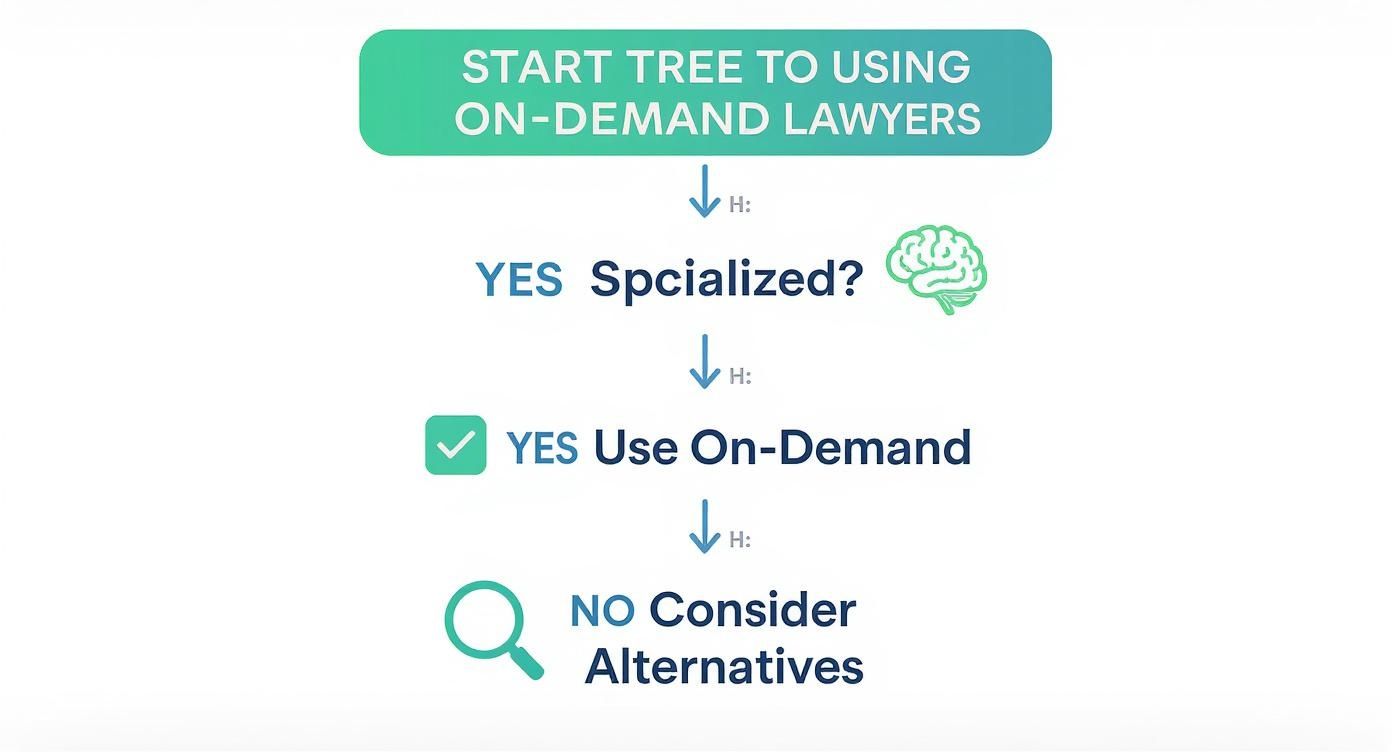
As the visualization shows, the value of on-demand talent is most pronounced when you have a specific, specialized legal requirement that doesn't justify a full-time hire.
Finally, let's talk about the two things nobody wants to discuss until it's too late: the technology platform and the legal safeguards.
Does their platform actually make your life easier? Or is it just a clunky portal you’ll have to fight with? A good platform should streamline everything—from secure communication and document sharing to time tracking and invoicing. If it feels like a piece of software from 2005, it will only add friction to the process.
And now for the really fun part: insurance and compliance. What happens if something goes wrong? Who is on the hook?
Choosing a provider isn't a quick decision. To help you compare your options at a glance, use this quick-reference checklist.
| Evaluation Criteria | What To Look For (The Good) | Red Flags (The Bad) |
|---|---|---|
| Talent Vetting | Multi-stage process, live interviews by legal experts, bar and background checks, skills testing for specific practice areas. They reject >95% of applicants. | Vague claims of "top talent," no clear process, relies solely on resume review or AI screening, acts as a simple job board. |
| Pricing Model | Fully transparent, all-in rates (hourly or fixed-fee). No hidden platform charges, project management fees, or mandatory minimums. | Low advertised rates with add-on fees, complex subscription models, unclear invoicing, surprise charges. |
| Technology Platform | Modern, intuitive interface for communication, document sharing, and time tracking. Secure, encrypted, and designed to simplify your workflow. | Clunky, outdated software. Requires multiple tools for communication. Lacks basic security features. |
| Compliance & Insurance | Guarantees all lawyers carry sufficient malpractice insurance. Clear policies on data security and attorney-client privilege. Ensures proper worker classification. | No clear answers on insurance coverage. Vague data security promises. Puts the burden of worker classification on you. |
| Service Level Agreement (SLA) | Clear, defined response times for matching talent and providing support. A dedicated point of contact. | No formal SLAs. Slow response times. You’re left to manage the relationship with the lawyer entirely on your own. |
Think of this checklist as your compass. It's about finding a true partner who de-risks the process of hiring lawyers on demand and gives you the confidence to focus on your business. Use it, ask the tough questions, and don't settle for anything less than clear, confident answers. Your budget—and your sanity—will thank you.
Let's talk numbers. Not the aspirational figures you slide into a pitch deck, but the real, hard numbers that actually move the needle on your P&L. Too many founders and GCs see legal as a pure cost center—a black hole where money just seems to disappear.
But what if I told you the real ROI of using lawyers on demand has very little to do with a lower hourly rate? It’s about flipping the script entirely. A flexible legal team isn't an expense; it's a strategic investment in speed and agility. And in this market, speed is everything.

Sure, let’s get the easy part out of the way. When you bring in on-demand legal talent, you neatly sidestep the massive overhead of a full-time hire. Forget the salary, benefits package, payroll taxes, or finding them a desk somewhere between the sales team and that perpetually broken printer.
Those savings are real and they add up fast. But honestly, they're just the tip of the iceberg. The real value is hiding in plain sight, and it’s called opportunity cost.
The most expensive legal advice is the advice you never get. It’s the stalled deal, the delayed product launch, or the unmitigated risk that blows up later because getting an expert felt too slow or too expensive.
Every single day a critical contract sits in a legal queue is a day you’re not booking revenue from that partnership. Every week you postpone your launch to get a final compliance sign-off is a week your competitor is eating your lunch. This is precisely where a flexible legal team pays for itself ten times over.
Let's stop thinking in hypotheticals and start talking dollars and cents. How does this newfound agility translate into actual, measurable ROI?
This isn't just a niche trend; it's a fundamental change in how smart companies operate. The US Online Legal Services market has already hit $15.2 billion as businesses increasingly seek out digital-first solutions that deliver clear, quantifiable value. The demand for better ROI is driving this market forward.
Ultimately, the ROI isn’t just about saving money—it’s about making money. A huge part of this comes from pairing on-demand talent with modern tools. For example, using advanced document automation software for lawyers can slash the time spent on manual work, freeing up expert time for high-value strategic advice.
By embracing lawyers on demand, you transform your legal function from a defensive cost center into an offensive growth driver. You can move faster, take smarter risks, and pounce on opportunities while your competitors are still waiting for their law firm to call them back.
That’s not just a better way to handle legal work. That's a genuine, sustainable competitive advantage. And you can take that to the bank.
Let's be candid. We didn't launch this company out of a deep love for the legal industry. We started it because we were frustrated—fed up with the broken, slow, and expensive traditional hiring model. After getting hit with one too many surprise invoices and waiting weeks for a simple contract review, we decided to build the solution ourselves.
This isn't just another platform with a nice-looking interface papering over the same old cracks. We built our solution from scratch to fix the exact pain points we, and so many other businesses, were experiencing. (Okay, a little toot of our own horn there.)
Let’s be real: unless you love spending your afternoons cross-referencing résumés and conducting technical interviews, the typical talent platform just makes you a part-time recruiter. That struck us as a complete waste of time. The entire point of getting on-demand legal help is to get work done, not to create more work for yourself.
That’s why our vetting process is, for lack of a better word, obsessive. It’s a multi-stage gauntlet designed to weed out everyone but the absolute best legal professionals. We don't just skim a CV; we conduct live interviews, independently verify credentials, and run thorough background checks.
We’re not claiming perfection. But we are committed to being more accurate, more often. Our process ensures that by the time a candidate’s profile reaches you, they’re not just qualified on paper—they’re ready to hit the ground running from day one.
The "billable hour" has always felt like a masterclass in opaque pricing. We decided it was time to kill it. The idea that a business should pay a five-figure retainer just to have a law firm on standby is absurd, and we refused to build a system that kept that outdated model alive.
With our platform, what you see is what you get. We operate on transparent, project-based pricing so you can actually budget with confidence. No hidden platform fees, no sneaky administrative charges, and definitely no need to sell the office ping-pong table to get a simple question answered. You get a clear, all-in cost before a single minute of work begins—a simple concept the legal industry has somehow managed to avoid for decades.
Finally, we built technology that gets out of your way. The goal was to let you focus on your business, not on managing lawyers and paralegals. It’s designed to simplify your workflow, not add another clunky tool to your software stack.
We built HireParalegals to be the partner we never had—one that provides top-tier talent, honest pricing, and a process that genuinely respects your time. It’s not just a sales pitch; it’s the result of solving our own problems. We’re confident it can solve yours, too.
Alright, let's get into the nitty-gritty. You’ve seen how the model works and understand the potential ROI, but I’m sure a few nagging questions are still bouncing around your head. Let's tackle them head-on.
The last thing you need is to trade one confusing billing model for another. Thankfully, most reputable platforms for lawyers on demand have ditched the traditional billable hour in favor of something much more predictable.
You'll typically find a few straightforward options:
The bottom line is transparency. If a provider can't give you a clear, confident cost estimate before any work begins, that’s a massive red flag.
This is the big one, isn't it? Is "on-demand" just a polite way of saying "couldn't get a job at a big firm?"
It’s actually the complete opposite. The best on-demand lawyers are often refugees from Big Law—seasoned experts who grew tired of the grueling hours and internal politics. They bring top-tier firm pedigrees and deep experience but now want the freedom to work on their own terms.
Think of a top-tier platform less like a job board and more like an exclusive, curated network. The vetting process should be absolutely ruthless, filtering for specific industry expertise, a proven track record, and experience at highly respected firms.
Handing over sensitive company information to an independent lawyer can feel like a leap of faith. Any platform worth its salt has this completely locked down. For starters, the attorney-client privilege applies just as it would with any traditional law firm.
But it goes beyond that. Look for platforms that enforce strict NDAs and use secure, encrypted channels for all communication and document sharing. Your data should never leave their protected digital environment. This isn't just a nice-to-have feature; it's a fundamental requirement for doing business.


