

 18 minutes read
Let's cut to the chase. You're a lawyer, which means you're drowning in admin work—the endless paperwork, the mind-numbing scheduling, the client follow-ups that never, ever stop. A legal administrative assistant is the person who digs you out. They are the operational backbone that lets you focus on high-value, billable work instead of playing office manager.
This isn't about just handing off your to-do list. It's about strategically buying back your time.

You know you need help. But the thought of a long, expensive hiring process probably makes you want to crawl under your desk. It’s a classic trap. Too many partners think growth means hiring more lawyers, but that just adds another layer of complexity to a broken system.
The real problem isn't a lack of legal talent. It's the mountain of non-billable grunt work suffocating your productivity. On average, attorneys only spend 2.9 hours a day on billable work. Let that sink in. That lost time is costing your firm a small fortune.
This is exactly why a killer legal administrative assistant isn't a luxury; it's a necessity.
First, let's get one thing straight. We are not talking about a "legal secretary." That term is as outdated as a flip phone. Today's role is strategic. A top-notch legal administrative assistant doesn't just answer phones and type dictation; they are an operational partner who owns your firm's entire workflow.
Think of them as the air traffic controller for your practice. They're ensuring every moving part—from client intake to final document filing—lands exactly where it needs to, on time, without drama. They turn your reactive, chaotic office into a well-oiled machine.

This isn't about finding someone to "help out." It's about installing a core operational system so your legal eagles can focus exclusively on practicing law. The right assistant makes the entire firm more profitable.
Modern law firms are also leaning on tech to supercharge these roles. It's worth exploring tools like AI receptionists tailored for law firms to handle inbound calls, freeing up your human assistant for higher-value tasks.
To put it all in perspective, here’s a quick and dirty summary of the role's impact.
| Area of Impact | Key Responsibilities | Value Proposition |
|---|---|---|
| Operational Efficiency | Calendar management, scheduling, document prep, and e-filing. | Frees up attorney time, crushes deadlines, and keeps cases moving smoothly. |
| Client Relations | Initial client intake, answering inquiries, managing communications. | Creates a killer first impression and keeps clients happy and informed. |
| Financial Management | Assisting with billing, invoicing, and chasing down expenses. | Improves cash flow, slashes billing errors, and makes sure you get paid. |
This table just scratches the surface, but it drives the point home. This role is central to your firm's success.
Ultimately, hiring a legal administrative assistant isn't an expense—it's an investment with an ROI you can see almost immediately. By offloading the admin weight, you create more bandwidth for the work that actually grows the business:
It all comes down to reclaiming your most valuable asset: your time. For any law firm that's serious about scaling, this is step one.
So, what does a top-tier legal administrative assistant really do all day? If you’re picturing someone just answering phones and making coffee, you’re stuck in a 90s legal drama. The modern role is far more critical.
They are the air traffic controller for your entire practice. While you’re in the cockpit flying the plane—practicing law—they’re on the ground managing every flight path, preventing collisions, and ensuring the whole operation runs on schedule. Without them, you’re flying blind into a storm of missed deadlines and angry clients.
This role isn't about filling a seat; it's about installing an operational command center for your firm.
The single biggest drain on an attorney's day is the chaotic influx of calls, emails, and scheduling demands. A great legal administrative assistant owns this chaos.
They don't just passively book meetings. They actively manage your calendar like a hawk, understanding that a "quick 15-minute call" can't be wedged in 20 minutes before a major filing deadline. They are the gatekeepers who fiercely protect your focus time.
Their core responsibilities here are mission-critical:
Beyond scheduling, a skilled legal administrative assistant becomes the power user of your firm’s tech stack. They’re the ones who truly master your case management software and billing tools. While you need to know how to use them, they make them sing.
They don’t just file documents; they organize them with an almost obsessive eye for detail. This precision is what allows you to find Exhibit C from a three-year-old case in 30 seconds, not 30 minutes.
A good assistant follows your instructions. A great assistant creates systems so fewer instructions are needed. They don't just solve problems—they prevent them.
This operational mastery is where you see a direct, tangible impact on your firm's efficiency.
Ultimately, the day-to-day work of a legal administrative assistant is a mix of high-stakes coordination and meticulous execution. They are the engine that keeps the non-billable parts of your practice running so you can dedicate your energy to what you do best.
Here’s a snapshot of their wider duties:
They aren't just an administrative helper; they are a direct extension of your ability to practice law effectively. Hiring the right person here is one of the highest-leverage decisions you can make.
Let’s be honest. In the legal world, “paralegal” and “legal administrative assistant” get thrown around like they’re interchangeable. This isn't just a mix-up; it's a fundamental misunderstanding that leads to hiring the wrong person and creating chaos.
It’s time to settle this. These are two distinct roles. Hiring the wrong one is like bringing a calendar to a court filing—both are useful, but only one solves your immediate problem.
Here’s the simplest way to think about it: A paralegal performs substantive, billable legal work. Think legal research, drafting initial pleadings, and preparing for depositions. They are a direct extension of your legal team.
A legal administrative assistant, on the other hand, is the operational backbone. They master the non-billable universe—scheduling, client intake, e-filing—to ensure the firm runs like a well-oiled machine. They free up your legal pros to actually practice law.
One role helps you win cases. The other creates the freedom to take on more cases in the first place. Diagnose your problem before you even think about writing a job description.
Confusing the two means you’re either paying a paralegal’s salary for admin work or asking an assistant to handle tasks they aren't qualified for. Both are expensive mistakes.
This flowchart shows where the divide truly lies.
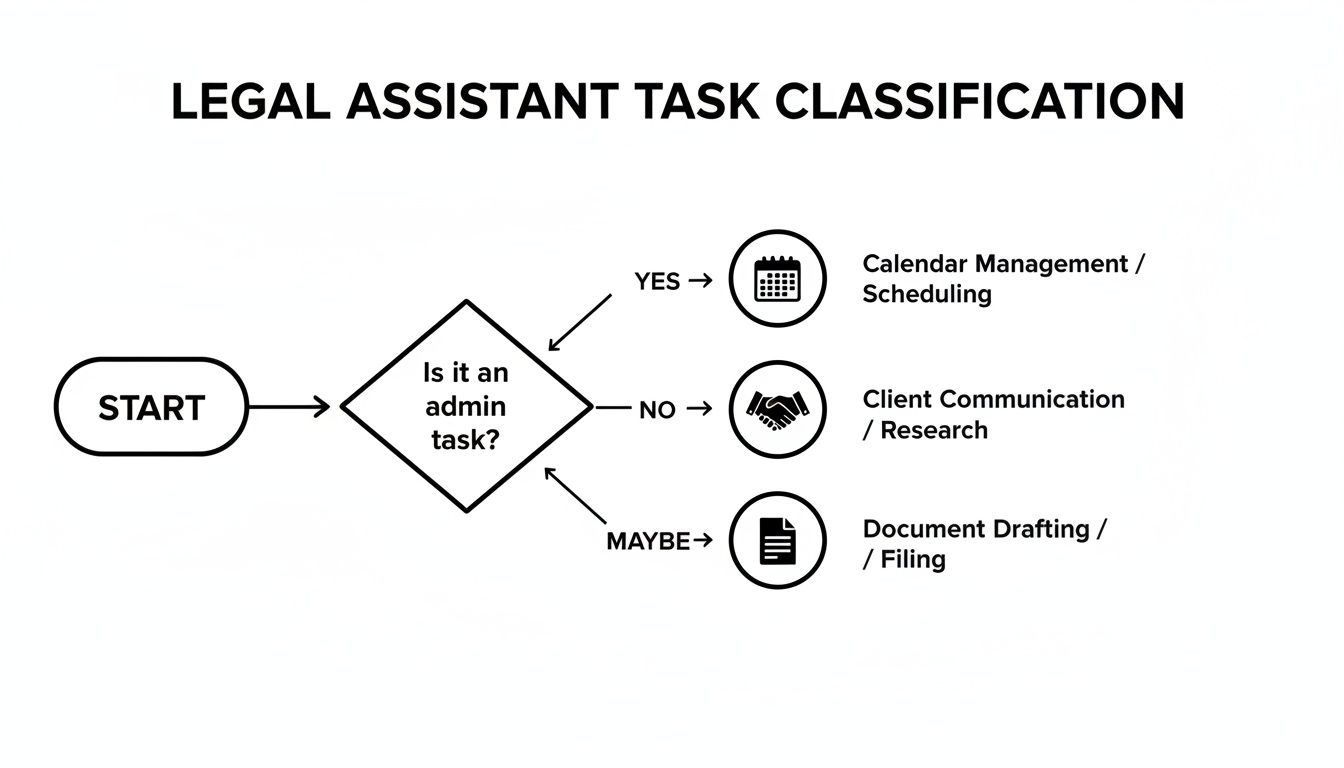
As you can see, there’s a clear separation between purely administrative functions and tasks that require deeper legal involvement.
To make it even clearer, let’s put the two roles side-by-side.
| Function | Legal Administrative Assistant | Paralegal |
|---|---|---|
| Primary Goal | Operational efficiency and admin support. | Substantive legal support and billable casework. |
| Core Duties | Scheduling, client communication, e-filing, billing. | Legal research, drafting motions, preparing for trial. |
| Billable Status | Almost exclusively non-billable. | Primarily billable work. |
| Required Skills | Organizational mastery, tech-savviness, communication. | Legal knowledge, analytical skills, research abilities. |
| Impact on Firm | Frees up attorney time, improves client service, prevents missed deadlines. | Increases legal capacity, improves case outcomes, generates revenue. |
Seeing it laid out like this makes it obvious: you can't hire one and expect them to do the other's job.
So, which one do you actually need? Ask yourself these questions:
Even the American Bar Association revised its definition of a paralegal in 2020 to officially separate it from "legal assistant." For a deeper dive, learn more about the critical differences between paralegals and legal assistants to make the right hire.
Getting this right isn’t just semantics. It’s about optimizing your payroll and freeing up your time. Don't hire a paralegal to manage your calendar.
Alright, let’s talk numbers. What’s a quality legal administrative assistant actually going to cost? If you’re hiring in the US, the sticker shock is real.
We’ve all seen the job postings. The salaries can make you sweat, especially when you’re trying to run a lean firm. The cost isn't a single figure; it’s a moving target influenced by geography and experience.
A top-tier assistant in New York or Los Angeles will command a premium. And frankly, they should. But that doesn’t make writing the check any easier.
Location, location, location. It’s the biggest variable in your hiring budget. The salary disparities across the US are staggering, and for firms paying attention, this creates a massive strategic opportunity.
2023 data from the Bureau of Labor Statistics shows a legal administrative assistant in the New York metro area earns an average of $68,550. Compare that to Lafayette, Louisiana, where the average is $39,120. That’s a nearly 70% price difference for the same role, driven almost entirely by cost of living. You can dig into the numbers yourself in the official BLS occupational employment statistics.
This "geography tax" puts firms in major cities at a serious disadvantage.
So, what's the move? Bite the bullet and accept the high cost? Or is there a better way to get the talent you need without mortgaging your office ping-pong table?
After years of building legal teams, I can tell you the answer is to stop limiting your search to your own zip code. This is where you flip the script on hiring costs.
The old model forced you to choose between quality and cost. The new model lets you have both by tapping into a global, pre-vetted talent pool that operates on your timezone, understands US legal standards, and costs a fraction of the price.
This isn't about outsourcing to some random freelancer. It’s a deliberate strategy to access highly skilled professionals from talent-rich regions like Latin America. We’ve built our entire business on this principle (toot, toot!), curating a network of over 10,000 remote legal professionals ready to integrate with US law firms.
The result? You can slash your payroll costs for a legal administrative assistant by up to 80%. No, that’s not a typo. You can explore the numbers for yourself and check out our virtual paralegal rates to see the financial impact.
This is more than just a cost-saving measure; it’s a competitive advantage. It’s time to stop thinking in terms of budget constraints and start thinking in terms of smart, sustainable growth.
So, you’re ready to hire a legal administrative assistant. Hope you enjoy spending your afternoons fact-checking résumés and running endless interviews—because that’s now your full-time job.
Or is it?
The traditional hiring process is a soul-crushing time sink. It's a game of posting on a dozen job boards, sifting through résumés that all look suspiciously similar, and then blocking out your calendar for interviews that go nowhere. There is a much, much better way.
Let’s be blunt: DIY hiring is broken. You write a job description, cross your fingers, and wait. The candidates often lack the specific legal industry experience you need, forcing you to train them from day one.
You’re a lawyer, not a professional recruiter. Your time is more valuable spent on case strategy, not playing HR detective. Every hour you spend vetting is an hour you’re not billing.
This is especially true for small practices, where a tight job market can make finding the right person a painfully slow process. And while understanding strategies for hiring remote employees that thrive is smart, it still requires a massive time investment you probably don't have.
What if you could skip that entire tedious process? Imagine having access to a pool of candidates who have already been rigorously screened, interviewed, and tested for the exact skills you need.
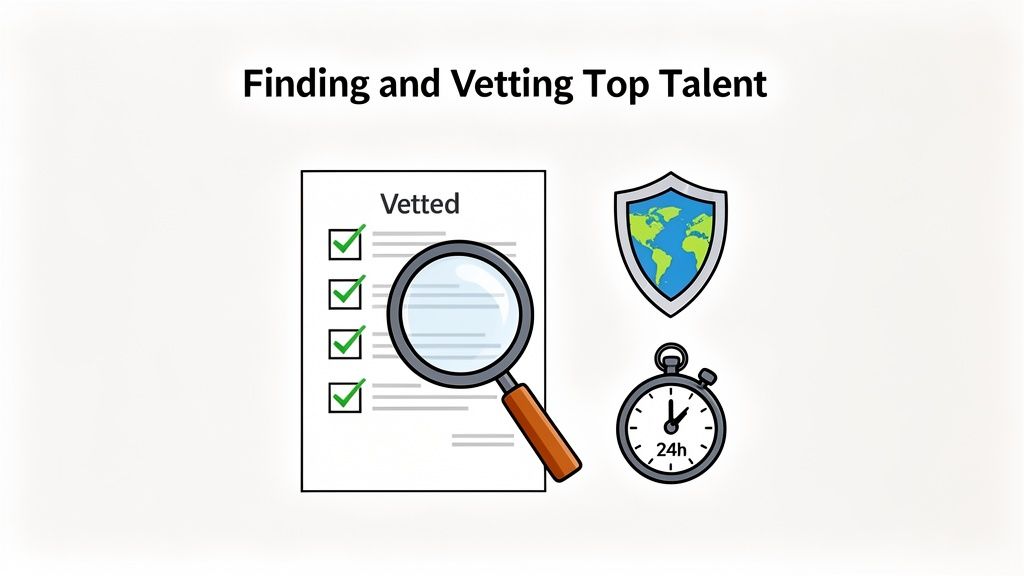
That’s the entire philosophy behind what we do. Instead of you spending weeks trying to find a qualified legal administrative assistant, we’ve already done the heavy lifting. We bring the top talent directly to you, so you can go from decision to hire in as little as 24 hours.
This isn’t just about speed; it’s about de-risking the entire process. When you’re choosing from a pre-vetted pool, you’re not taking a gamble—you’re making a calculated investment.
So how do we find these people? We’re pretty proud of our four-step vetting gauntlet. It’s designed to weed out the talkers from the doers, ensuring only the most dedicated professionals make it to your shortlist.
Here’s the breakdown:
By the time a candidate’s profile lands in your inbox, they’ve already been put through the wringer. You just get to pick the best of the best.
This rigorous process is a game-changer. Our model gives you 24-hour access to a network of over 10,000 remote professionals, each with at least four years of experience and AI-matched to your specific practice area. This approach slashes both hiring time and risk, giving you immediate productivity without the bloat of domestic employment.
Hiring a top-tier legal administrative assistant doesn’t have to be a second full-time job. It’s about hiring smarter, not harder.
Let's bring this home. The reality is painfully simple: every hour you or your attorneys spend on admin work is an hour you’re not practicing law. That’s billable time, lost forever.
The traditional hiring model is a trap. It’s sluggish, it’s expensive, and a single bad hire can set you back months. For a modern law firm that needs to stay nimble, this system is fundamentally broken.
The path to a more efficient, more profitable practice is clear—it's about thinking globally to solve a local problem. This isn't just "outsourcing." It's about bringing elite talent into your firm without the geographical and financial handcuffs.
For US law firms feeling the squeeze of rising payroll, this approach is a game-changer. By tapping into a vetted network of over 10,000 remote professionals from Latin America, firms can cut staffing costs by up to 80%. Better yet, they can have an assistant with 4+ years' experience ready to go in as little as 24 hours. This model sidesteps hefty domestic salary premiums while ensuring full timezone alignment. You can find more data by checking out the latest legal assistant salary trends on virtuallatinos.com.
This is how you stop letting administrative drag dictate your firm’s growth. It’s not about finding a cheaper person; it’s about finding a smarter way to build your team.
When you use a platform like ours, you’re getting much more than just a legal administrative assistant. You’re getting a cost-effective, scalable, and pre-vetted partner. We’ve already done the soul-crushing part of hiring—the vetting, the background checks, the skill assessments. You just get to meet the best of the best.
The choice is yours. You can keep letting admin tasks chip away at your revenue and your sanity, or you can get the right support, right now. It’s time to work smarter, not harder.
Let's dive into some of the most common questions we get. These are the same questions that pop up right before a firm realizes how much an efficiency boost a remote legal administrative assistant can provide.
This is usually the first question, and for good reason. The simple answer is yes, absolutely—but only if they've been properly vetted. Security isn't something you can leave to chance.
That’s why our screening process is so intense. We run comprehensive background checks and validate every candidate's understanding of client confidentiality and US data security standards. You wouldn't bring someone into your office without checking their background, right? Same principle.
When a thoroughly vetted professional uses your firm's secure tools—like encrypted cloud storage and a VPN—they become just as secure as any in-office employee.
It’s probably much faster and simpler than you think. You aren't teaching a newcomer the basics. You're bringing on an experienced professional who already speaks the language of law.
The secret is a structured 90-day plan that hits three key areas: your firm’s systems, your people, and your procedures. You just need to show them your way of doing things, not how to do them.
A straightforward plan looks like this:
Because you’re pulling from a pool of pre-vetted talent, you get to skip the painful learning curve. They already know how a law firm operates; they just need to learn your firm’s rhythm.
This is actually an advantage, not a hurdle. We specialize in sourcing talent from Latin America, which gives you fantastic timezone overlap with the US. This isn't about managing someone halfway across the world who works while you sleep. It’s about having dedicated support during your busiest hours.
Managing them comes down to two things: setting clear expectations and using the right communication tools. A daily check-in on a platform like Slack and a quick weekly video call is usually all it takes to keep everything running smoothly.
The result is that work moves forward during your workday, not overnight. It really is that straightforward.


