

 16 minutes read
Let’s be honest. The thought of hiring a legal consultant firm usually pops up right after a moment of pure, unadulterated panic.
Think of them as the special forces for your biggest legal headaches. They parachute in with hyper-specialized skills for a specific, high-stakes mission, solve the problem, and then get out—leaving your in-house team to fight the daily battles.

So, you're staring down a problem that makes your company’s general counsel break out in a cold sweat. Maybe it’s a merger more tangled than a drawer full of old headphones, or a new compliance regulation that reads like an alien language. This is the moment when whispers about bringing in a legal consultant firm start echoing in the boardroom.
These aren't your everyday lawyers handling routine contracts. They're the strategists, the specialists, the people you call when the stakes are absurdly high and "standard legal advice" just won't cut it.
Unlike a full-time hire, you’re not on the hook for their benefits, their parking spot, or their opinion on the new coffee machine. You’re paying for a very specific, high-impact outcome. It's a surgical strike, not a long-term occupation.
They also exist outside your company’s political drama. This outsider status means they can give you the unvarnished truth without worrying about whose toes they might be stepping on. And let's be real, sometimes that brutal honesty is exactly what you need to dodge a massive bullet.

A legal consultant is a skilled pro who offers advice and strategic guidance on a wide range of legal matters. While they don't represent clients in court, they help clients make sound legal decisions and ensure compliance.
This model is clearly catching on. The global market for legal consulting was valued at over $25 billion in 2021 and is projected to explode to nearly $86 billion by 2033. It’s not just big corporations farming out extra work; it’s a fundamental shift in how businesses access elite legal brainpower.
It's often part of a smarter, more flexible strategy that includes things like legal process outsourcing. This lets companies scale their legal muscle on-demand, without having to mortgage the office ping-pong table for another full-time salary.
Let's cut the jargon. What are you really buying when you hire a legal consultant? It’s not a subscription service for a lawyer on call. It’s more like renting a very specific, very sharp mind to solve a very specific, very expensive problem.
You're not just paying for advice. You’re paying for a specialized skill set that your in-house team—as brilliant as they are—probably doesn't have. It's the difference between your trusted family doctor and a top-tier neurosurgeon. Both are great, but you wouldn’t ask one to do the other's job.
So, what’s on this pricey menu? Legal consultant firms don't just sell "help." They package their expertise into distinct services. Knowing the lingo is half the battle.
Here’s a look at the heavy hitters:
To deliver that value, modern legal consultants often bring powerful tech to the table. They use specialized tools like legal document automation software to speed things up and eliminate human error. This is a huge part of how they justify their fees—by making your entire operation more efficient.
Beyond these common services, you'll find firms that specialize in incredibly specific, high-stakes scenarios. Think of them as the Navy SEALs of the legal world, called in when the situation is critical.
This is where you find the true specialists—experts in IP strategy who protect your company’s secret sauce long before a competitor even thinks about stealing it. Or a team to navigate the legal minefield of an IPO. These aren't just hypothetical problems; they are company-defining moments.
The demand for this expertise is massive. Specialized legal consulting firms serve over 85,000 law firms and 38,000 major corporate clients every year. A staggering 45% of their work is in corporate law, which shows just how essential this strategic support has become.
Knowing these categories helps you walk into a conversation with a clear head. Instead of vaguely saying, "Uh, we have a legal problem," you can confidently state, "We need an expert in pre-litigation e-discovery for a cross-border dispute." Now you sound like someone who knows exactly what they need—and won't be taken for a ride.
So, you’ve hit a legal wall and admitted you need help. That’s the first, and often hardest, step. Now for the real challenge: figuring out who to call without setting your budget on fire. While a legal consultant firm might seem like the go-to, they’re not the only game in town.
Honestly, every option comes with its own unique flavor of headache. The goal is to pick the one you can live with—the classic business tug-of-war between cost, control, and expertise.
When you're weighing your options, you're not just hiring help; you're picking a partner to solve a critical problem. It's about more than just finding a warm body with a law degree.
You really have four main choices:
The right choice almost always boils down to the problem you're facing.
This decision tree gives you a good visual for how to think through it.
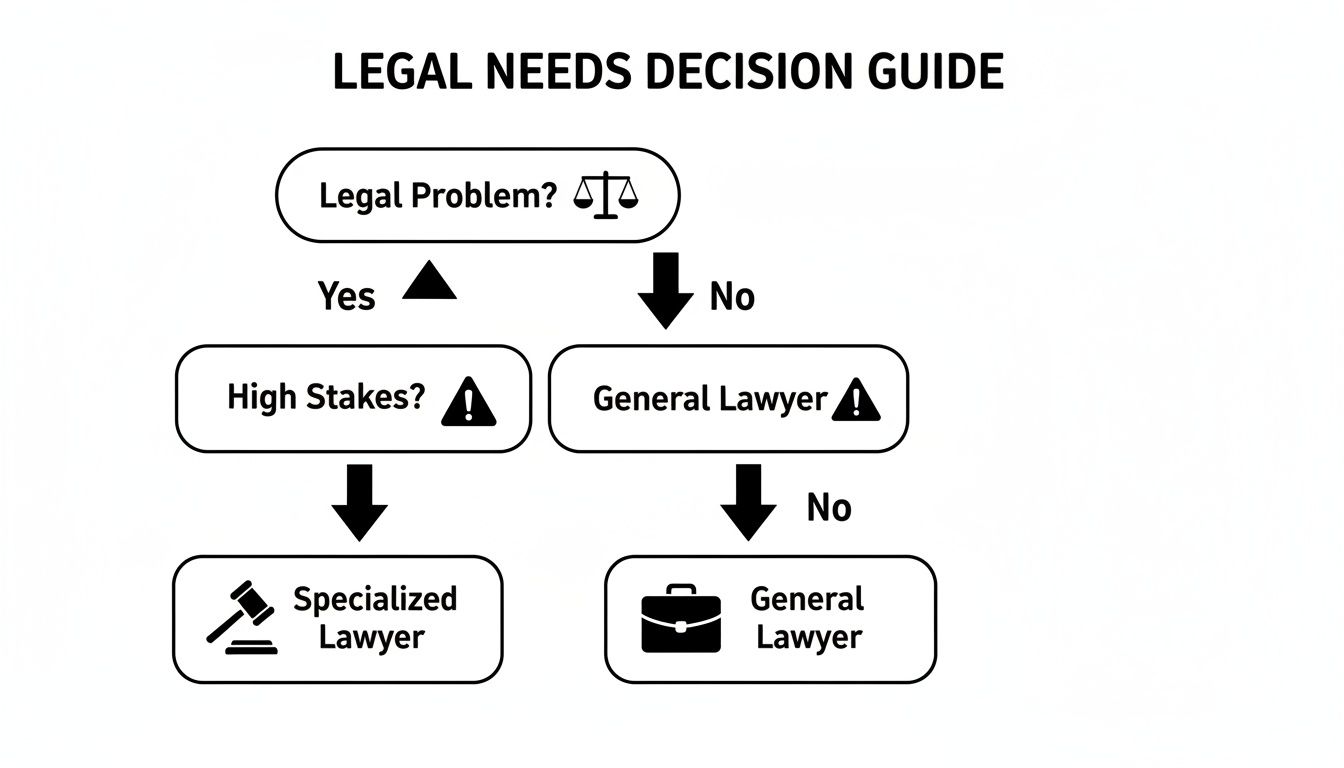
The takeaway is simple: as the stakes and complexity ramp up, so should your need for specialized expertise.
Let’s put these options head-to-head. Forget the glossy brochures. This table breaks down how they actually stack up on the factors that matter to your business.
| Factor | Legal Consultant Firm | In-House Hire | Temp Lawyer | ALSP |
|---|---|---|---|---|
| Cost | Highest per hour, but project-based | High fixed salary + overhead | Moderate hourly rate | Often lower, process-based pricing |
| Expertise | Elite & hyper-specialized | Generalist or single-specialty | Variable; often generalist | Specialized in process, not strategy |
| Commitment | Project-based; short-term | Long-term; high integration | Short-term; low integration | Varies; often project or contract |
| Speed to Hire | Fast (days/weeks) | Slow (months) | Very Fast (days) | Fast (weeks) |
| Best For | "Bet-the-company" strategic issues | Ongoing, daily legal needs | Sudden workload spikes | Repetitive, high-volume tasks |
The choice isn't about which option is "best," but which is the smartest tool for the job. Using a top-tier consultant for routine contract review is like using a sledgehammer to hang a picture frame—expensive, excessive, and you’ll probably break the wall.
Match the solution to the problem. An in-house counsel is your first line of defense, an ALSP is your assembly line, a temp is your reinforcement, and a legal consultant firm is your special forces unit. Choose wisely.

Let’s be honest. Choosing a legal consultant firm feels like a high-stakes bet, because it is. Get it right, you’re a hero. Get it wrong, and you’ve just torched a mountain of cash for little more than a slick PowerPoint deck while the original problem is still smoldering.
Vetting these firms is an art. It goes way beyond scanning a client list or being impressed by their fancy office. You have to look for the signals that show they’ve actually been in the trenches and know how to solve real problems, not just talk about them.
The best consultants don’t hide behind jargon; they make complex issues simple. They’ve seen a problem like yours a dozen times and have the battle scars to prove it. They spend less time on their proprietary "methodology" and more time discussing the measurable results they’ve delivered for businesses just like yours.
Here are the signs you’re talking to a winner:
On the other hand, some firms are masters of disguise. They look the part, talk a great game, but the only thing they deliver is a massive invoice. I’ve been burned before, and these are the warning signs I now watch for like a hawk.
Watch out for the "one-size-fits-all" pitch. If a consultant presents a cookie-cutter solution before they’ve even finished diagnosing your unique problem, show them the door. Your business is not a template.
Here’s what should make you immediately skeptical:
In the end, it comes down to trust. A great legal consultant firm feels like an extension of your own leadership team. A bad one just feels like another vendor you have to manage.
Alright, let's talk money. Because if you’ve ever seen an invoice from a top-tier legal consultant firm, you know it can look like a phone number. Their pricing models can be as clear as mud, and if you’re not careful, you can end up with a nasty case of sticker shock.
This isn't about nickel-and-diming; it's about making sure you get the value you paid for.
You'll almost always encounter one of these three structures. None are perfect. Your job is to pick the one that gives you the least anxiety.
The Billable Hour: The classic. It’s simple, but it’s also a direct incentive for inefficiency. Every phone call, every email, every thought they have about your problem starts a ticking clock. It’s death by a thousand cuts.
The Project-Based Flat Fee: My personal favorite for well-defined projects. You get predictability, which is great for budgeting. The risk? If the project is simpler than anticipated, you might overpay.
The Retainer: Great for ongoing advisory needs, but a potential cash-flow killer if you don't use it. You’re paying for access, which is great until you realize you paid five figures for a single 30-minute phone call last quarter.
The fee structure isn't just a line item; it defines the relationship. A billable hour makes you hesitate to pick up the phone. A flat fee encourages collaboration. Choose the model that supports the partnership you want.
The engagement letter—the contract—is where the real traps are hidden. Don't skim it. This document dictates the rules of the game.
Ask the tough questions before work begins. What happens when the project scope balloons? Who owns the final work product? And, crucially, what’s the exit strategy if things go south? Defining the "breakup clause" upfront can save a world of pain.
This level of specialized support doesn't come cheap. The global litigation consulting services market alone is projected to grow from $61.3 billion in 2025 to a staggering $104.7 billion by 2035. While the rates are high, it’s worth comparing them to other legal support; for instance, you can check out different virtual paralegal rates for a baseline on other specialized help.
Think of negotiating the contract as your first test. A good firm will welcome the clarity; a bad one will get defensive. That tells you everything.
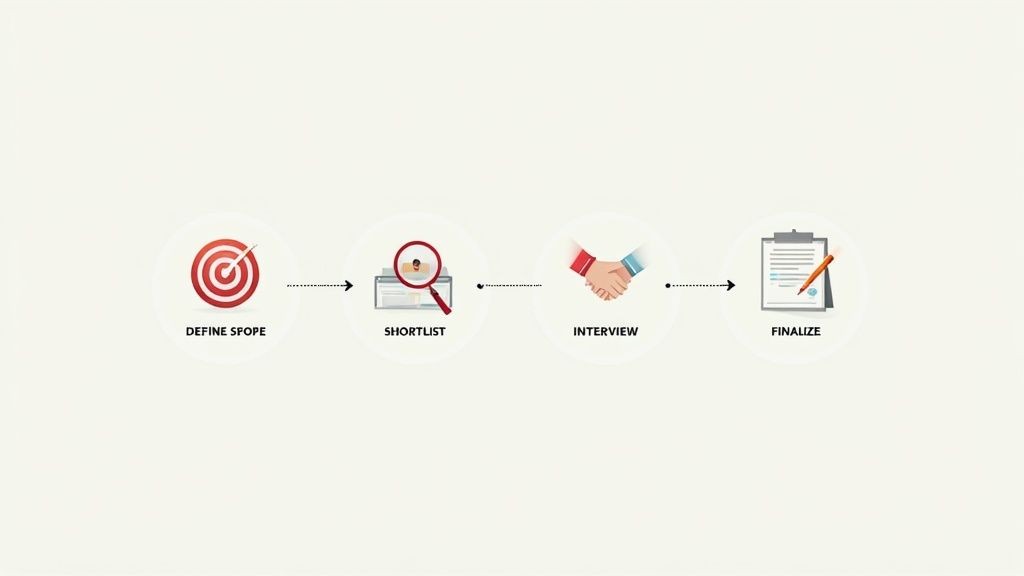
Alright, enough theory. Let’s get practical. It’s time to move from "I think we need help" to "Welcome aboard," without the headaches and wasted budget.
This is a strategic sequence, not a to-do list. Get step one wrong, and the rest won't save you.
1. Define the Mission with Brutal Clarity
This is the moment of truth. An estimated 90% of consulting gigs that go sideways fail right here. Write a one-page brief outlining the exact problem, the measurable outcome you expect, and a realistic timeline. If you can't articulate this clearly, you aren't ready to hire anyone.
2. Build a Shortlist of Three
That's it. No more than three. Lean on your network, not just Google. Your goal is to find firms that have tackled your exact problem before. Ask peers, "Who is the absolute best person you've ever worked with for a complex Series B financing round?" Be that specific.
A great referral is gold. A cold call is a lottery ticket. Place your bets accordingly.
3. Run the Gauntlet (The Interview)
In the interview, your job is to listen more than you talk. Hand them your one-page brief and ask one direct question: "How would you approach this?" Their answer reveals everything—their process, their expertise, and whether they're just selling you a canned solution.
4. Check References Like a Detective
Don't just call the glowing references they hand you. Dig deeper if you can. This disciplined approach is crucial for any high-stakes legal hiring. In fact, it's the same principle people use when they need to choose a personal injury attorney—thorough vetting and asking the right questions.
Finally, trust your gut. After all the due diligence, if something still feels off, it probably is. Walk away.
You’ve made it this far, so you’re clearly taking this seriously. Smart. But you probably still have a few questions bouncing around. Let's tackle them.
Ah, the million-dollar question. Literally. The honest answer is: it varies wildly, but it's never cheap. You're paying for specialized expertise, and that comes at a premium.
For top-tier talent, expect rates from $300 to over $1,000 per hour. A major project like M&A due diligence can easily run into the five or even six figures.
The key is to avoid surprises. Insist on a painstakingly detailed scope of work with crystal-clear deliverables before you sign anything. Get a cost range, but also ask what could push the final bill toward the higher end of that estimate.
It’s not picking the wrong firm—it’s failing to define the problem. The single biggest mistake is having a vague objective.
Hiring a top-flight team and just saying, “Help us with compliance,” is a recipe for burning through a mountain of cash with nothing to show for it.
A vague problem statement is an invitation for a vague—and expensive—solution. You need to be specific enough to explain the mission clearly and concisely.
Get laser-focused. A better approach is: "We need to achieve full GDPR compliance for our new European product launch within six months. This must include a complete data mapping audit and a rewrite of our customer-facing privacy policies." Specific problems get specific solutions.
Look, AI is a fantastic tool. It's brilliant for high-volume tasks like initial contract review or legal research. In fact, the best legal consultant firms are already using these tools to work faster. (Toot, toot!)
But AI can't replace strategic judgment. It can't read the subtle cues in a high-stakes negotiation or devise a creative legal strategy that thinks outside the box.
Think of AI as a hyper-efficient paralegal, not a seasoned partner. You hire a firm for its human wisdom and experience, not just its ability to process data.


