

 18 minutes read
Let’s be real. You didn't slog through law school to become a master of calendar invites, chase down unpaid invoices, or format documents until your eyes glaze over. But for way too many lawyers, that's the job. A legal office assistant is supposed to be the administrative backbone of your firm, but finding a great one feels like a full-time job you don't have time for.
Think of them as your first line of defense against the chaos. If you can find one that's actually good.
You’re a lawyer. Your time is literally money, measured in six-minute increments you probably forget to log. So, how much of your day is spent on tasks that have absolutely nothing to do with practicing law? Answering the phone, scheduling consults, wrestling with your case management software—it’s death by a thousand administrative cuts.
Every minute you spend on that stuff is a minute you aren't billing, strategizing, or winning. It’s the slow, painful leak that drains your firm's profitability. You feel it. That constant context-switching kills your focus, and the mountain of nagging tasks creates a low-grade hum of anxiety that follows you home.
This isn't just a feeling; it's the single biggest obstacle keeping small firms from scaling. You can't grow if you're permanently stuck in the operational weeds.
"I'll just handle it" might be the most expensive phrase in a solo practitioner's vocabulary. You think you're saving money, but you're actually burning your most valuable asset: your time. This self-inflicted admin overload creates a clear hierarchy of inefficiency, where the highest-paid person in the room is doing the lowest-value work.
This diagram shows how that inefficiency cascades through a firm, delegating the wrong tasks to the wrong people and kneecapping your potential.
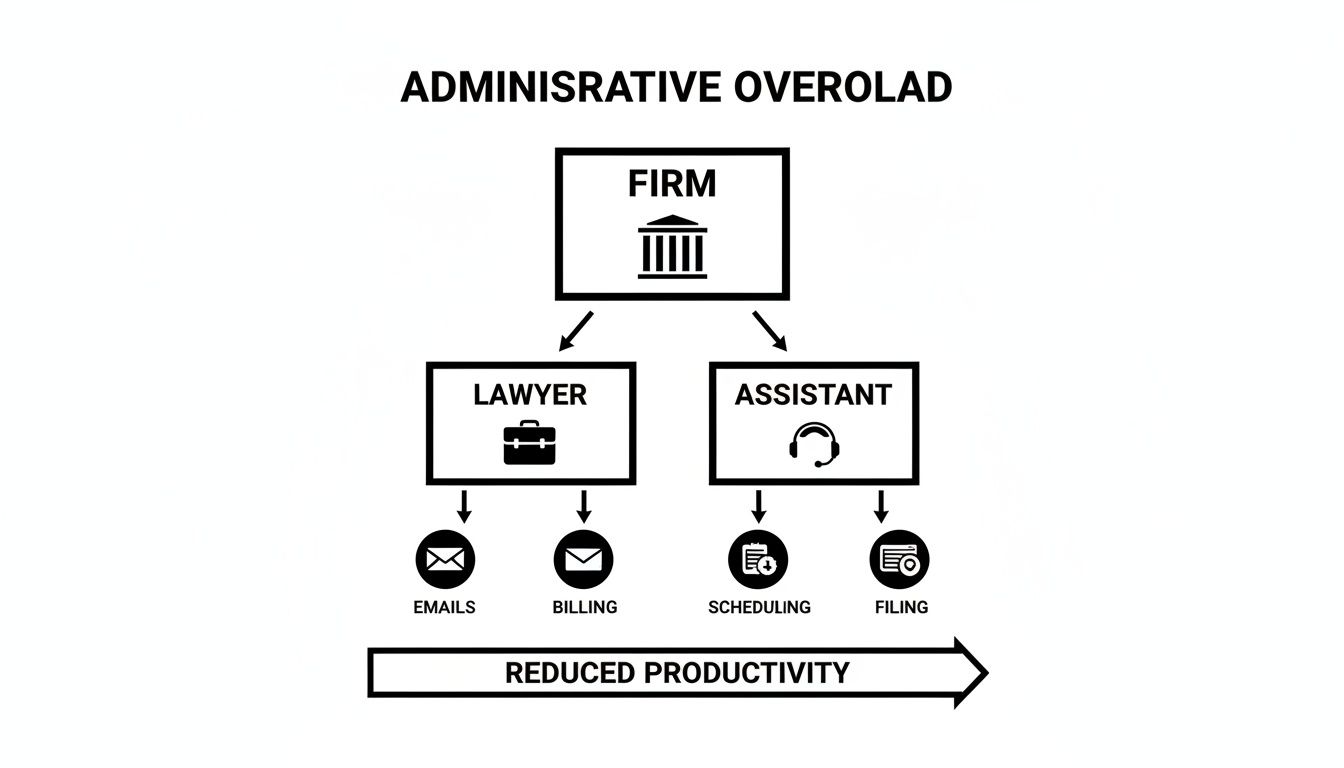
The picture makes it painfully clear: when lawyers handle admin, the whole firm slows down. A dedicated legal office assistant rebalances this structure, freeing you up to do the only thing that actually matters—billable work.
If you're feeling this pressure, you're not alone. The demand for skilled legal support is surging. Recent reports show a staggering 62% of legal hiring managers plan to expand their teams because they just don't have the skills or headcount to manage the workload.
This isn't a temporary spike; it's a fundamental shift. Admin support isn't a luxury—it's a necessity. With nearly 19,000 legal office assistant positions nationally, the talent is supposedly out there. The challenge, of course, is that sifting through it all is another full-time job you don't have.
This is where a legal office assistant becomes your strategic weapon. They aren't just an expense; they're the person who reclaims your schedule and restores your sanity. For firms ready to get smart about this, exploring virtual legal assistant services is a ridiculously effective way to get top-tier support without the overhead.
So, what does a great legal office assistant actually do? If you’re picturing someone who just answers the phone and makes coffee, you’re thinking about five decades too small. The right assistant is the central nervous system of your firm—the operational hub that keeps everything moving.
This isn’t just a glorified receptionist role. A top-tier legal office assistant is a master of controlled chaos, an organizational force of nature who owns the admin side of your practice. Let’s break down what separates the true pros from the seat-warmers.

First and foremost, your assistant is your firm's voice. This goes way beyond "ABC Law, how can I help you?" They are your first impression, your client relationship manager, and your gatekeeper. Hope you enjoy your afternoons being interrupted by sales calls—because that’s now their job to filter.
A great assistant handles:
This isn't about being friendly; it's about being a strategic buffer. They protect your focus.
Ever double-book a client meeting with a court deadline? Of course you have. We all have. A skilled legal office assistant makes that a thing of the past. They don’t just manage your calendar; they own it, anticipating conflicts and ensuring your schedule is a tool, not a source of panic.
But their organizational kung fu doesn't stop there. They are also responsible for the endless river of paperwork that defines legal work.

A truly great assistant doesn't just file documents; they create order from chaos. They can find a specific clause in a client agreement from three years ago faster than you can find your car keys.
This includes flawless document prep, proofreading for those tiny but catastrophic typos, and managing digital and physical filing systems so everything is instantly accessible. This alone is worth its weight in gold when you’re up against a deadline.
Beyond the daily admin fires, an elite legal office assistant steps into roles that directly impact your firm's cash flow and operational smoothness. They aren’t accountants, but they are the frontline soldiers in your battle for profitability.
This is where you see the real value:
In short, a superstar legal office assistant does more than just assist. They take ownership. They aren't a cost center; they're a force multiplier.
Let's be blunt. You’re staring at a stack of resumes, and every single one lists "Proficient in Microsoft Office" and "Excellent Communication Skills." How helpful. That’s like a pilot bragging they know how to use a seatbelt.
Resumes are marketing documents, designed to hide weaknesses. So, how do you cut through the fluff and find a legal office assistant with skills that actually predict success? You have to look past the self-reported praise and focus on concrete evidence.
We’ve hired enough people—and made enough mistakes—to know what really counts.
Think of hard skills as the price of admission. If a candidate doesn't have these, the interview is over. Wasting billable hours training someone on the absolute basics is malpractice for your bottom line.
Your candidate needs to be fluent in the tech of a modern law office.
If a resume is hazy on these, press them hard in the interview for specific examples.
This is where the A-players separate themselves. Hard skills can be taught. But the right temperament? That's much harder to find.
Frankly, I’d rather hire someone with an obsessive personality and teach them Clio than hire a Clio expert who’s sloppy. It's the soft skills that protect your firm from costly mistakes.
A great legal office assistant doesn't just manage tasks; they manage risk. Their attention to detail prevents a typo from turning into a malpractice claim. Their discretion protects your firm's reputation.
Forget vague resume terms like "team player." Instead, look for proof of these high-impact traits:
So, what about certifications, like the NALS Professional Legal Secretary (PLS)? Are they a golden ticket or just an expensive piece of paper?
Here’s my take: they’re a nice-to-have, not a must-have.
A certification shows initiative, which is a good signal. But I’ve seen certified assistants who were disorganized and uncertified assistants who were absolute rock stars. Real-world experience and a proven track record will always trump a credential.
Don't automatically filter out candidates without one. Use it as a conversation starter, not a hiring prerequisite.
Let's talk numbers. Because hiring a full-time, on-site legal office assistant can feel less like a strategic investment and more like mortgaging your office ping-pong table. You’ve seen the market rates, and your calculator is probably starting to smoke.
You're not just paying a salary. You're covering benefits, payroll taxes, office space, equipment, and coffee. When you add it all up, the "fully-loaded" cost of one assistant can easily make your eyes water.
Don't just take my word for it. The average annual salary for a legal office assistant hovers around $50,097, but seasoned pros often command upwards of $74,181.
For a boutique firm in a competitive market, it’s not unusual to offer $50-56k for an assistant with 3+ years of experience. You can dig into the factors that influence legal administrative assistant pay to see how the numbers stack up.
But here’s the real kicker: that salary is where your costs start.
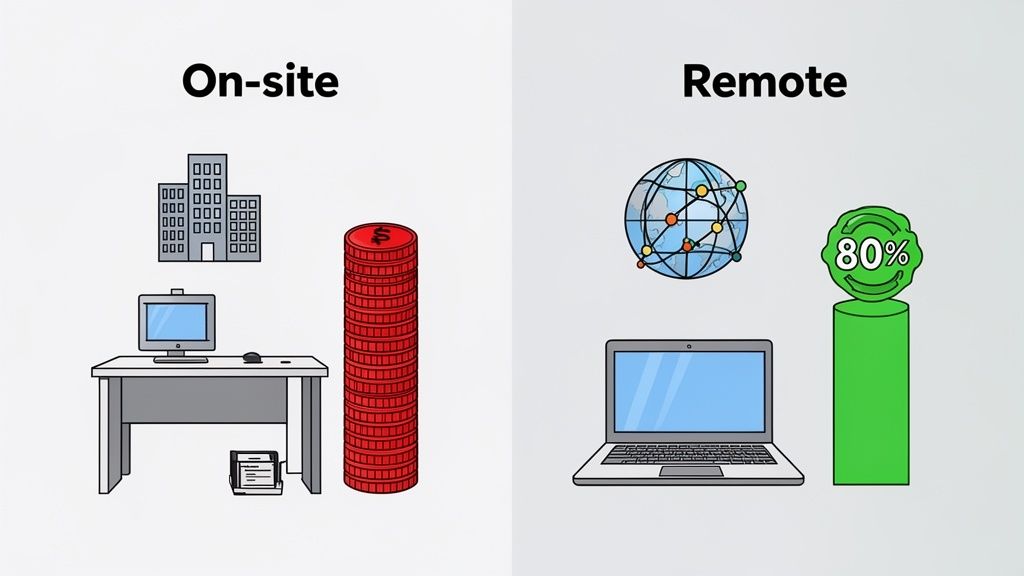
Now, let's introduce the game-changer. By tapping into a global talent pool, we’ve seen firms cut their operational costs by up to 80% without sacrificing quality. This isn't about finding the cheapest possible labor. It’s about recognizing that top-tier talent isn't confined to a 20-mile radius around your office.
So, how is an 80% reduction even possible? Simple: global talent arbitrage.
When you hire a pre-vetted remote professional from a region like Latin America, you get access to a massive pool of skilled, experienced assistants. These are professionals with comparable skills and fluent English who operate in an economy with a lower cost of living.
Here’s a quick look at how the annual costs compare.
| Cost Factor | On-Site US Assistant (Average) | Remote HireParalegals Assistant |
|---|---|---|
| Base Salary | $52,000 | $12,000 |
| Payroll Taxes (10%) | $5,200 | $0 |
| Benefits (Insurance, 401k) | $8,000 | $0 |
| Overhead (Office, Equipment) | $5,000 | $0 |
| Total Annual Cost | $70,200 | $12,000 |
The math doesn't lie. You get the same—or better—level of support, but your cost structure is completely transformed.
The savings aren't just a rounding error; they're substantial enough to fund another associate or a big marketing campaign. And by streamlining your hiring, you also lower your overall recruitment cost per hire.
This is the new reality for smart firms that are more interested in results than in maintaining a fancy downtown office lease. It's about paying for talent, not geography.
Hiring a legal office assistant feels like a massive gamble. You post a job, get swamped with a hundred nearly identical applications, and pick the person who gave the most polished answers.
Three months later, you discover they organize files by color and think "urgent" is merely a suggestion.
It’s time to stop the cycle of bad hires. This is a practical playbook for finding someone who will genuinely make your firm run smoother.
Your job description is your most powerful filter. A generic post attracts generic candidates. Don’t just list duties—sell the role and be brutally honest about what it takes to succeed.
Use language that weeds people out for you. Phrases like "obsessive attention to detail is non-negotiable" or "must thrive when priorities shift daily" will scare off the faint of heart. That's what you want. You’re looking for the person who reads that and thinks, "Finally, a place that gets it."
A great job description doesn't just attract talent; it actively repels the wrong candidates. Think of it as the bouncer at the front door of your hiring process.
For more templates and strategies, check out our complete guide to legal assistant hiring.
(Sample Job Description Snippet)
Legal Office Assistant – Litigation Boutique
We are a fast-growing litigation firm looking for an unflappable Legal Office Assistant to be the operational backbone of our practice. You are the type of person who finds a typo in a contract and feels a genuine sense of victory. You see a chaotic calendar and instinctively know how to create order. Your mission, should you choose to accept it, is to manage our administrative world so our attorneys can focus on winning cases.
Standard interview questions are useless. "What's your biggest weakness?" The answer is always fake, like "I'm a perfectionist." It’s a complete waste of time.
Instead, ask situational questions that force candidates to draw on real experience. You want the story, not the script. The demand for assistants is steady, employing around 18,900 professionals nationally. The talent is out there, but you need to identify top performers quickly. Tapping into pre-vetted talent pools of over 10,000 professionals can cut hiring time down to 24 hours. You can learn more about these trends in the legal support job market to get a handle on the landscape.
Here are the kinds of questions you should be asking:
"Describe a time you caught a critical error in a document right before a deadline. What was it, and what did you do?" This tests their real-world attention to detail under pressure.
"Imagine two partners give you urgent, conflicting tasks at the same time. Walk me through, step-by-step, how you would handle that." This reveals their prioritization skills and ability to manage senior staff.
"Tell me about the most complex scheduling challenge you've ever managed. What made it so difficult, and what was the outcome?" This gets to the heart of their organizational and problem-solving abilities.
Stop guessing. Use a process that forces A-players to reveal themselves through experience, not just interview performance.
So, we've walked through the what, the why, and the how-much. We've talked about the admin quicksand swallowing your firm whole. Now, let’s get to the good part: the shortcut.
It's time for a little self-promotion (toot, toot!). After laying out all the headaches of traditional hiring, it would be cruel to leave you stranded. Instead of navigating that maze alone, you can tap directly into our curated network of over 10,000 pre-vetted legal professionals.
This isn't just a database. Think of it as an ecosystem of top-tier talent we've already put through the wringer, so you don't have to.
We’ve all seen what happens when you cut corners on a hire. That’s why we built a rigorous, four-step vetting process that filters out the amateurs. Frankly, it’s the process you would use if you had an extra 40 hours a week.
Here's how we find your next legal office assistant:
By the time a candidate’s profile lands in your inbox, they’ve been thoroughly vetted. You’re not getting a resume; you’re getting a pre-qualified professional ready to make an immediate impact.
Hope you enjoy spending your afternoons fact-checking resumes and running skills tests—because that’s now our full-time job. We handle the entire filtering process so you can skip straight to the final decision.
We turn a month-long hiring marathon into a 24-hour sprint. You tell us what you need, and we deliver a custom shortlist of top candidates, complete with video introductions and detailed CVs.
No more sifting through hundreds of unqualified applicants. No more endless interviews that go nowhere. We give you back your time so you can focus on what you do best: practicing law. This is how smart firms scale.
Alright, let's tackle some of the common questions we get. My team and I have heard it all, so here are the straight-up answers.
Honestly? The lines have blurred so much that the titles are practically interchangeable these days.
Historically, a "legal secretary" was a more traditional, clerical role. The modern legal office assistant is an evolution of that. They're a more well-rounded pro who handles everything from client communications and scheduling to billing. Think of it as the same core function, just upgraded for a modern law practice.
This is a big one. The answer is a firm yes—if you have the right person and systems. Security isn't a feature; it's a fundamental requirement.
At HireParalegals, every professional we work with is rigorously vetted for their understanding of client confidentiality. They work from secure home offices and are trained on best practices. More importantly, you're always in control. You can and should implement your firm’s own security protocols, like requiring a VPN and using secure, cloud-based document management systems.
That’s one of the biggest advantages of this model. You're not stuck with the 40-hour-per-week commitment of a traditional employee.
Services like ours are built for flexibility. Whether you need just 10 hours a week to manage client intake or a full-time assistant to run your entire back office, you can find a professional who fits your needs. This gives small firms incredible agility, letting them scale their support up or down as their caseload changes.
Great question. We don't just throw a pile of resumes at you.
When you start with us, we dive deep into your firm. We want to know your practice area (litigation, family law, etc.), your workflow, and the exact headaches you're trying to solve. Our system then pinpoints candidates from our vetted talent pool who have relevant, hands-on experience. This ensures you’re connected with an assistant who can hit the ground running, not someone who needs a crash course in your area of law.


