

 20 minutes read
A legal outsource company is supposed to be your firm's on-demand talent bench. The pitch is simple: get access to pre-vetted legal pros—paralegals, legal assistants, you name it—who work remotely when you need them. It’s a model that lets you add firepower without the soul-crushing overhead and recruiting cycles of a traditional hire.
But let's be honest, most of the pitches are garbage.
Let's get straight to the point: the old way of hiring for law firms is broken. You’re either sinking a fortune into salaries and benefits for full-time staff you might not need in six months, or you're wasting your own billable hours drowning in a sea of resumes, just hoping to find a candidate who knows their stuff.

This isn't just a minor hassle; it’s a direct drain on your profits. Every hour you spend on admin or a painstaking hiring process is an hour you’re not billing a client. It’s a slow, quiet way to set your money on fire.
The traditional model forces a terrible choice: either commit to a costly full-time hire you might not have work for in three months, or turn down lucrative cases because you simply don't have the bandwidth. Hope you enjoy spending your afternoons fact-checking resumes and running interviews—because that’s now your full-time job.
This isn't a sustainable path to growth. There's a reason the legal process outsourcing market is exploding. It shot up from $17.02 billion to $29.81 billion globally and is expected to hit a staggering $85.48 billion by 2030. American law firms have already saved more than $1.5 billion by outsourcing legal tasks, and that figure is only going up. The writing is on the wall.

A legal outsource company isn't about finding cheap labor. It's about plugging your firm directly into a bench of specialized, pre-vetted talent, ready to work now. It's about turning your capacity into a flexible asset, not a fixed cost.
This approach completely changes the economics of running a practice. You can instantly scale up for a massive discovery project and then seamlessly scale back down when it’s over, all without the headaches of hiring and firing.
The numbers don't lie. Let's look at a quick comparison of the true investment required for each path.
| Factor | Traditional In-House Hire | Outsourced Professional |
|---|---|---|
| Recruitment Cost | $4,000 – $7,000 (job boards, recruiter fees) | $0 (Included in provider's service) |
| Onboarding Time | 4-6 weeks (interviews, background checks, training) | 1-3 days (Ready to start immediately) |
| Overhead Costs | 18-26% of salary (benefits, office space, equipment) | $0 (Included in hourly or project rate) |
| Total Time to Productivity | 2-3 months (full ramp-up period) | Under 1 week (Experienced and pre-vetted) |
| Flexibility | Low (fixed salary, long-term commitment) | High (scale up or down as needed) |
The contrast is stark. Outsourcing vaporizes the hidden costs and time sinks that silently eat away at a firm's profitability, letting you focus resources where they actually matter.
But the real win here isn't just about saving money. It's about the doors that open when you're not constantly constrained by headcount.
Think about what an agile, on-demand team makes possible:
Of course, with any remote work, security is everything. For law firms, knowing how to protect your data online is non-negotiable. Any decent outsource company gets this and builds secure workflows into their DNA, protecting you from breaches that could torpedo your reputation.
Ultimately, it’s about shifting your firm from a rigid, high-cost machine into a nimble practice that can punch far above its weight. No more holding your breath and hoping you can afford the next hire.
So, you’re ready to get off the traditional hiring treadmill and stop burning cash. Great decision. But now you’re looking at a dozen different options, and every single legal outsource company claims to be the magic bullet.
Let's be real: they’re not all the same. Not by a long shot.
Picking the right outsourcing model is like choosing a vehicle. You wouldn't use a monster truck to grab groceries, and you wouldn't take a scooter on a cross-country road trip. The trick is matching the model to the job, not just falling for slick marketing.
Some firms just need an extra set of hands for a one-off document review. Others are looking for a dedicated paralegal who becomes a true extension of their team. Let's cut the jargon.
First, you have the classic Legal Process Outsourcing (LPO) providers. These are the giant, established players that handle huge, process-driven tasks. Think large-scale eDiscovery, managing thousands of contracts for a Fortune 500, or taking over an entire billing department.
Their whole operation is built for volume, not for the nuances of your small practice or integrating a single person into your firm’s unique culture.
For a solo practitioner or a small firm, signing with a massive LPO is like bringing a cannon to a knife fight—total overkill and the wrong tool for the job. To get a better handle on the specifics, our guide on what is Legal Process Outsourcing breaks down the model in more detail.
Think of managed services as a step down in scale from a full LPO, but a step up in integration. A managed services provider takes over a specific, ongoing function, like running your client intake process or handling routine compliance filings.
They bring the people and the process, wrapping it all into a tidy monthly package. This can be great if you have a well-defined, consistent need.
The downside? It’s often a one-size-fits-all solution. You have to adopt their process, their tech, and their people. If you like doing things your own way, you might find yourself fighting their system.
Finally, we have the model we've poured our blood, sweat, and (toot, toot!) tears into perfecting. On-demand talent platforms are the modern solution for agile, growth-minded law firms. Instead of outsourcing a process, you’re bringing a specific, highly-vetted person onto your team.
This model is for the firm that needs a litigation paralegal with five years of personal injury experience, who is a native English speaker, and can start next Monday. It’s all about precision.
This isn't about finding the cheapest labor; it's about finding the right talent, fast, without mortgaging your office ping-pong table for another full-time salary. You get the expertise of a senior professional without the long-term financial handcuffs.
With a talent platform, you're in the driver's seat. You interview the candidates, you choose who you work with, and they plug directly into your firm's existing workflows and software. It’s the best of both worlds: the cost-efficiency of outsourcing with the control of an in-house hire. It's the flexible, scalable model built for firms that need to punch above their weight class.
Everyone hypes up the cost savings. And yeah, saving money is great, but that’s just the price of entry. Frankly, if a legal outsource company only offers you a cheaper hourly rate, they’re missing the entire point.

The real magic happens when you stop seeing outsourcing as a cost-cutting tool and start seeing it as a strategic weapon. We're talking about fundamental changes to how you run your firm, the cases you can take, and frankly, whether you get to see your family before bedtime.
I’ve seen this play out time and again. A small litigation firm, drowning in discovery for a single massive case, suddenly finds the bandwidth to not only manage it but also take on a second, equally lucrative client. How? They brought on two experienced paralegals in 48 hours, not the six weeks it would have taken to hire.
That’s agility. That’s the freedom to say "yes" to opportunities you previously would have been forced to pass on.
This is about transforming your firm from a rigid, high-overhead machine into a nimble practice that can punch way, way above its weight class. It’s about building a firm that can scale on a dime without having to worry about layoffs three months later.
This shift isn't just a trend; it's a fundamental change in how legal services get delivered. The market for Alternative Legal Service Providers (ALSPs) has ballooned to $28.5 billion, driven by firms realizing there's a better way. In fact, 79% of law firms report better cost-efficiency and client satisfaction after outsourcing, while 65% scaled their operations faster without hiring more full-time staff. You can explore the data behind the dramatic growth in legal process outsourcing to see just how widespread this movement has become.
Let’s be honest about recruiting. You need a paralegal with deep experience in H-1B visa petitions who also knows their way around specific immigration case management software. Good luck finding that person in your local market in under a month. And for a price that doesn't make your eyes water.
With a global talent pool, however, you can find that exact specialist almost overnight. This isn't a hypothetical; we’ve connected firms with niche experts in everything from intellectual property to complex international commercial law.
Here’s what that instant access really means:
You stop being limited by who you can hire locally and start building your team based on who the best person for the job is, period.
Here’s the one they never mention in the glossy brochures: you get your life back. The endless administrative muck, the late nights spent catching up on paperwork, the constant low-grade anxiety of being understaffed—it evaporates.
When your team is properly supported, you get to focus on being a lawyer again. You can dedicate your energy to strategy, client relationships, and the high-value work you actually enjoy. That's not just a quality-of-life improvement; it's a direct boost to your bottom line.
Ultimately, it's about sustainability. Burnout is rampant in the legal field, driven by the "do more with less" mentality. Outsourcing breaks that cycle. It provides the support structure that allows you and your team to thrive, not just survive. And that, more than any cost saving, is the true return on investment.
Alright, you see the potential. You're ready to stop setting cash on fire with the old hiring model. Now comes the hard part: choosing a partner in a market flooded with companies all screaming they have the “best” talent. It’s noisy, and frankly, a lot of them are full of it.
Finding the right legal outsource company feels a lot like navigating a minefield. One wrong step, and you’re stuck in a long-term contract with a team that creates more problems than they solve. I’ve been there, and I’ve learned the hard way what separates the pros from the pretenders.
So, let’s cut the fluff. Here’s a battle-tested checklist to help you vet any provider without losing your mind.
Forget the glossy sales pitch about "synergy" and "seamless integration." Your job is to poke holes in their process until you’re confident it can hold water. If they get defensive or give you vague, jargon-filled answers, run.
Start with the absolute non-negotiables. If a provider fumbles on these, nothing else matters.
Here’s a visual of our own multi-layered vetting process, because we believe in showing, not just telling.
A rigorous process has multiple stages, from initial screening to skills validation. It’s the only way to ensure only top-tier candidates make it through.
A provider worth their salt will have a clear, documented system they can walk you through. Here are the core areas to grill them on:
Talent Vetting: "Walk me through your vetting process, from start to finish." If they can’t explain it in painful detail, they don't have one. How do they verify legal experience? Do they conduct skills tests? How do they check English fluency and communication skills?
Data Security: This is non-negotiable. Ask about their security protocols. Are they SOC 2 compliant? How do they enforce NDAs? Do they use encrypted platforms? Don't accept "we take security seriously" as an answer. Demand specifics.
Timezone and Culture: "We have people all over the world" sounds great until you’re trying to coordinate a 3 AM call. Ask specifically how they ensure timezone alignment. Sourcing talent from regions like Latin America is a massive advantage here, as it aligns perfectly with US business hours.
While you’re asking the right questions, keep an eye out for the classic red flags. These are the signs that you’re dealing with an amateur operation.
Think of this as your pre-flight check. Spotting any of these should give you serious pause.
The biggest red flag is a lack of transparency. If a provider is cagey about their pricing, their vetting process, or their client references, it's because they have something to hide. A confident partner will open their books because they stand behind their service.
Here are the warning signs to watch for:
Beyond initial vetting, establishing ongoing oversight is crucial; explore resources on effective SOC 2 vendor management practices to ensure your partners remain compliant over the long term. Choosing the right partner isn't just about the initial hire; it's about building a secure, scalable extension of your team. Don't settle.
Alright, let's cut through the marketing fluff and talk numbers. Vague promises of "up to 80% savings" sound great on a landing page, but what does that actually mean for your bank account? Most law firm partners are rightfully skeptical until they see the math.
So let’s do the math. When you hire a full-time, US-based paralegal, you’re not just paying their salary. You’re paying for benefits, payroll taxes, insurance, office space, a new laptop, and a slice of that fancy espresso machine. This is the "fully-loaded" cost, and it's almost always way higher than you think.
I've seen firms get sticker shock when they realize their $65,000-a-year paralegal is actually costing them closer to $85,000. That’s a $20,000 difference that just evaporates into thin air.
Now, let's compare that to bringing on a remote professional through a legal outsource company. Instead of a mountain of hidden costs, you get one clear, predictable rate. You pay for their expertise and their time. Period.
This is where the ROI becomes impossible to ignore. A top-tier remote paralegal from a region like Latin America, with the same (or better) qualifications, often comes at a fraction of that fully-loaded US cost. It’s not at all uncommon for a small firm to save over $50,000 annually per hire.
Think about that. What could you do with an extra $50,000? Invest in marketing to attract higher-value clients? Upgrade your case management software? Maybe even give yourself a long-overdue raise? That's not just cost-cutting; it's fuel for growth.
The financial case is rock solid. Industry data shows US law firms are on track to save over $1.5 billion by outsourcing legal work, with some corporate legal teams saving up to $1.2 million each year. When you consider that typical US legal processes can cost around $200 per hour, the savings are substantial. You can find more details in this legal process outsourcing market report.
To really bring this home, let’s put the numbers side-by-side. This table breaks down the typical expenses for a US-based, in-house paralegal versus a remote professional from an outsourcing partner. This isn't an exaggeration; it's a realistic look at where your money actually goes.
| Cost Item | Annual US In-House Paralegal (Fully Loaded) | Annual Remote Paralegal |
|---|---|---|
| Base Salary | $65,000 | $36,000 (included in flat rate) |
| Payroll Taxes (FICA, FUTA) | $5,500 | $0 |
| Health Insurance | $8,000 | $0 |
| 401(k) Contribution | $2,000 | $0 |
| Workers' Comp/Disability | $1,000 | $0 |
| Office Space & Utilities | $4,000 | $0 |
| Equipment & Software | $2,500 | $0 |
| Bonuses & Perks | $2,000 | $0 |
| Recruiting & Onboarding | $5,000 (one-time) | $0 |
| TOTAL ANNUAL COST | $95,000 | $36,000 |
| ANNUAL SAVINGS | N/A | $59,000 |
The savings aren't a rounding error—they're big enough to fundamentally change your firm's profitability. You’re eliminating nearly $60,000 in overhead while getting the same high-quality support.
You don't have to take my word for it. You can build a business case that will win over even the most skeptical partner in your firm. It's a surprisingly simple calculation.
The core idea is simple: stop paying for empty chairs and expensive benefits. Start paying for productive, billable work. That's how you shift from a high-overhead cost center to an agile, profit-focused machine.
A proper provider handles the heavy lifting, vetting for critical elements like security protocols, language fluency, and timezone alignment to ensure a seamless fit.
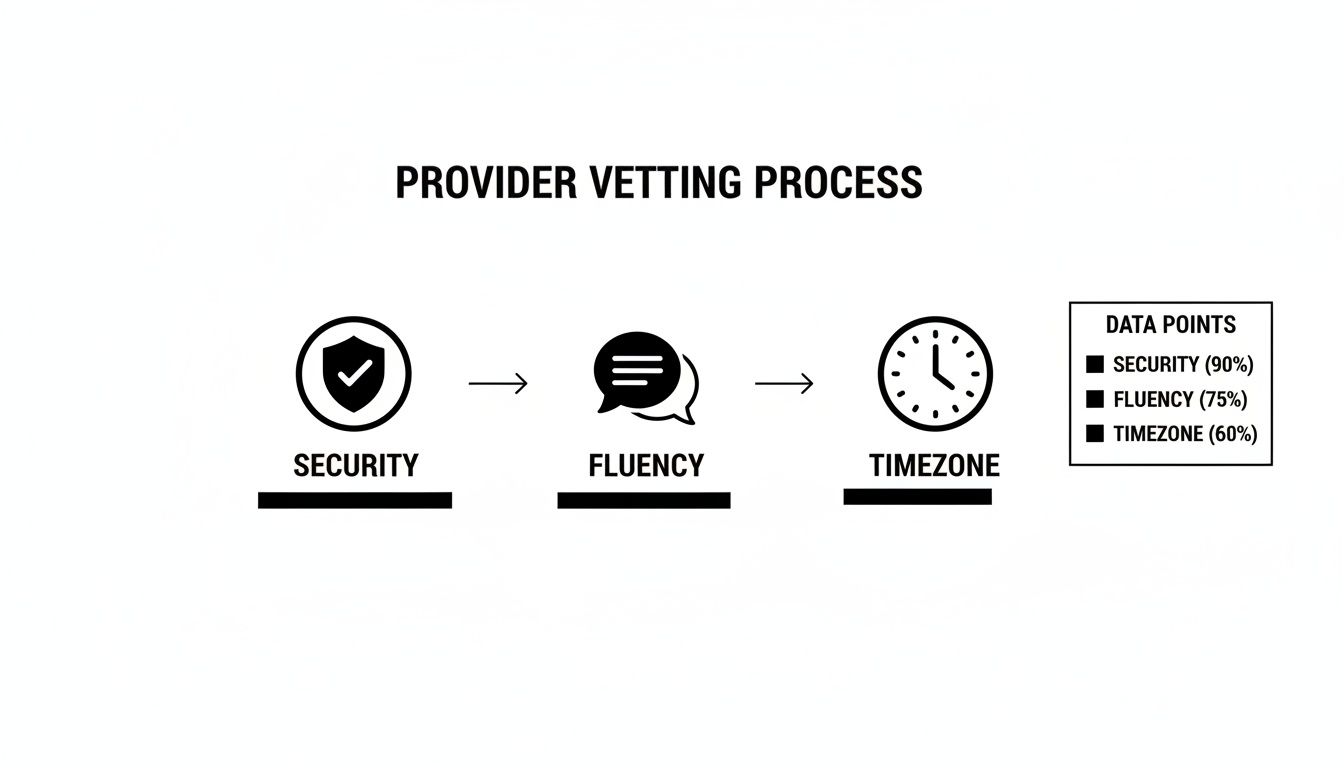
This kind of multi-faceted vetting ensures you're not just hiring anyone, but the right person with the right skills and compatibility for your team.
Here’s a quick framework to calculate your own potential ROI. Grab a calculator and be brutally honest with your numbers.
When you lay out the numbers like that, the decision becomes a no-brainer. You're not just saving a few dollars; you're making a strategic investment that pays dividends in cash, time, and flexibility.
Let's tackle the questions that are probably bouncing around in your head. I get it. This is a big shift, and a healthy dose of skepticism is a good thing. Here are the straight, no-BS answers to the most common concerns I hear from law firm owners looking into a legal outsource company.
This is always the first question, and it should be. The idea of sensitive client info leaving your direct control is unnerving. But let's be blunt: the risk isn't about geography; it's about process.
A reputable legal outsource company won't just say, "Don't worry, we're secure." They'll show you how. They should have ironclad protocols, including end-to-end encrypted platforms for every communication and file transfer. They’ll also have mandatory, legally-binding NDAs for every person who even glances at your work.
The reality is, a vetted remote professional operating within a secure, monitored ecosystem is often a much lower risk than a distracted in-office employee checking their email on public Wi-Fi at a coffee shop. It's the system, not the zip code, that ensures security.
Demand specifics. Ask about their data handling policies, their access controls, and their compliance certifications. If they can't give you a clear, confident answer, well, that’s your answer.
"Great, so I have to wake up at 3 AM for a status update?" This is a legitimate fear, but it's one that’s been completely solved by smart sourcing.
The whole point of a modern outsourcing platform is to make your life easier, not to turn you into an international logistics coordinator. This is exactly why sourcing talent from Latin America has become such a game-changer for so many US firms. The timezones align almost perfectly with US business hours, which means your remote team is online and working when you are. No 3 AM calls.
As for quality, it all comes back to one thing: the vetting process.
A flimsy provider glances at a resume and calls it a day. A serious partner puts candidates through the wringer. This should include:
Unless you enjoy fact-checking resumes and running technical interviews, a good partner does that grueling work for you. Quality isn't an accident; it's the result of an obsessive, multi-stage screening process.
If you're already picturing yourself buried in international wire transfer forms and trying to decipher foreign tax law, relax. You shouldn't have to touch any of that. If a provider tries to push that complexity onto your plate, it's a massive red flag.
A modern legal outsource company, especially one using a platform model, is designed to absorb all that backend messiness. They are the employer of record or the direct contractor, meaning they handle the international payroll, the local compliance, and all the administrative headaches.
Your side of the transaction should be painfully simple: you get one clear, itemized invoice. That's it.
This structure typically classifies the remote professional as an independent contractor from your firm's perspective. This dramatically simplifies things, stripping away the obligations of a W-2 employee. You get the talent and the productivity without the HR nightmare. The entire point is to make adding world-class talent as easy as paying for a software subscription.


