

 16 minutes read
Let's be honest. The thought of hiring a legal outsourcing company probably crossed your mind after a 14-hour day buried in discovery—one of those days that makes you question every life choice that led you there. But what is it, really? Think of it as a specialized, on-demand extension of your own team, built to handle the grind so you can focus on strategy, clients, and maybe even leaving the office before the sun comes up again.
Because you’re drowning in work that doesn't move the needle, and you’ve heard whispers of this seemingly perfect solution: elite legal talent without the soul-crushing overhead. Is it too good to be true? Sometimes. But when you find the right partner, it’s a genuine game-changer.

The legal process outsourcing (LPO) market is exploding for a reason. Firms like yours are hitting a breaking point. The global LPO market, currently valued at around $19 billion, is projected to rocket past $132.6 billion by 2033. This isn't some fringe trend; it's a fundamental shift in how modern law firms survive, driven by the brutal need to deliver more for less.
Look, this isn’t just about saving a few bucks—though that’s a nice perk. The real cancer in most firms is misallocated talent. You have brilliant, high-priced partners and associates spending their days fact-checking documents or chasing down signatures. It’s madness.

The goal isn’t just to offload work. It’s to reclaim your best minds from the administrative abyss so they can do the high-value, client-facing work they were actually hired for. It’s about buying back time—your only non-renewable asset.
This guide is designed to cut through the marketing B.S. We’ll break down what a true legal outsourcing company should deliver, beyond the buzzwords. We’re not talking about just another vendor; we're talking about finding a partner that acts like an extension of your own team.
A great partnership delivers real results:
We've been in these trenches. We've seen what works and what spectacularly implodes. (Toot, toot!) This deep dive into legal outsourcing services is a great place to start understanding what’s actually possible. Let’s get into it.
Alright, let’s get real. Not every legal task is a good candidate for outsourcing. In fact, shipping the wrong work offshore is a recipe for a five-alarm fire. Thinking about handing off your most complex, high-stakes advisory work to a team you just met? Bad idea. But having your top attorneys burn billable hours on a first-pass review of 10,000 documents? Even worse.
The key isn't just to offload work; it's to be surgical. You need a hit list of tasks that are repetitive, time-consuming, and quietly bleeding your firm dry.
Some tasks are practically built for this. These are the functions that are essential to get right but are also repetitive and process-driven. They demand precision but don't require a partner-level attorney to personally babysit every step.
Simple rule of thumb: if it’s more about volume and process than bespoke legal strategy, it’s a prime candidate.
These are the no-brainers to start with:
The explosion of Alternative Legal Services Providers (ALSPs)—a fancy term for every type of legal outsourcing company—is proof this model works. The ALSP market has ballooned to an estimated $28.5 billion, with over 57% of corporate law departments now using them for these exact tasks. This isn't a trend; it's the new normal. You can see the full breakdown of ALSP market growth to understand just how mainstream this has become.
To help you visualize where to start, let's break it down.
| Task Type | Outsourcing Suitability (Low/Medium/High) | Why It Works (Or Doesn't) | Potential Cost Savings |
|---|---|---|---|
| High-Stakes Litigation Strategy | Low | This is core advisory work. Outsourcing it is like letting a stranger drive your car off a cliff. Too risky. | None |
| eDiscovery & Document Review | High | Highly standardized, process-driven work. Outsourcing drives massive efficiency gains. | 40-60% |
| Contract Lifecycle Management | High | Repetitive tasks like tracking renewals are perfect for a dedicated team. | 30-50% |
| Routine Legal Research | Medium | Great for initial research (e.g., state surveys), but final analysis must be done in-house. | 20-40% |
| IP Docketing & Renewals | High | An administrative, deadline-driven task that requires meticulous attention but not deep legal strategy. | 40-50% |
| Core Client Relationship Management | Low | This is the heart of your business. If you outsource this, you don't have a business. | None |
As the table shows, the sweet spot is in high-volume, process-oriented tasks that don't touch the core strategic function of your firm.
Once you've tested the waters and confirmed your partner isn't a disaster, you can think bigger. Outsourcing isn't just for clearing backlogs; it's for scaling your capabilities without the fixed cost of new hires.
You can delegate more specialized functions, but only after you’ve built a solid relationship and they have a proven track record.
Your outsourcing partner should feel like a specialized department just down the hall, not a faceless vendor in another time zone. When you hit that sweet spot, the possibilities expand dramatically.
Consider these next-level tasks for a mature relationship:
The trick is to start small. Don't try to boil the ocean on day one. Start with document review, build trust, and then maybe talk about your entire IP docket. It's a marathon, not a sprint.
So, you know what to outsource. Great. Now comes the part where most firms screw up—picking a partner.
Let’s be brutally honest: every legal outsourcing company website looks the same. They’re all dripping with corporate jargon about ‘synergy,’ ‘value-add,’ and ‘paradigm shifts.’ It’s meaningless. Your job is to ignore the slick brochure and peek behind the curtain.
This is my battle-tested checklist for seeing who’s for real and who’s just good at PowerPoint.
This isn't fun, but it's non-negotiable. A data breach from your LPO provider is still your data breach. If they mess up, your reputation is toast. Don’t just take their word for it; demand proof.
Start with these two questions, and don't accept fuzzy answers:
Vetting any vendor means understanding Third Party Risk Management (TPRM). Knowing this framework helps you ask smarter questions about how they handle your firm’s confidential data.
A legal outsourcing company is just a collection of humans. The slickest tech can’t fix an undertrained, overworked, or poorly managed team.
Don't be shy. Ask the tough questions.
I once worked with a provider that had a fantastic sales pitch and abysmal quality control. We spent more time fixing their mistakes than it would have taken to do the work ourselves. Don't learn that lesson the hard way.
Effective reference checks are crucial. Don't just ask for happy clients; learn how to conduct reference checks that give you real insight. It's an art, and it can save you from a world of pain.
I cannot stress this enough: never sign a long-term contract without a trial run. Think of it as a first date before the marriage. A small, paid pilot project is the single best way to test everything.
Choose a self-contained, low-risk project. A small doc review set, drafting a few standard contracts, or research for a single motion.
This isn't about the deliverable; it’s about the experience:
A pilot tells you more than any sales pitch ever could. If a legal outsourcing company pushes back on a paid trial, walk away. They’re either not confident in their work or their model is too rigid. Either way, they’re not for you.
So you’re ready to pull the trigger. Now you’ve hit the biggest fork in the road: where on Earth should your new team be? This is the classic onshore vs. offshore debate, and it’s usually framed as a simple choice between cost (offshore) and quality (onshore).
That’s a lazy oversimplification, and it will lead you straight into a bad partnership.
Yes, a legal outsourcing company in India or the Philippines can slash direct labor costs by 50-70%. No one is debating the math. But that sticker price doesn't account for the 3 a.m. conference calls, cultural nuances lost in translation, or the management overhead your own team absorbs.
On the flip side, onshore providers in the US offer perfect alignment but come at a premium that can make the whole exercise feel pointless. Then there are nearshore options in places like Latin America, which strike a compelling middle ground.
The global outsourcing sector is a behemoth for a reason, pulling in $280.6 billion in 2023. What's telling is the spread; South America is forecasted to contribute $0.87 billion to legal outsourcing, while the Middle East & Africa will add another $0.83 billion. Smart firms are looking beyond the usual suspects.
Location also has major compliance implications. For example, understanding the nuances of Canadian data privacy laws is critical if your provider operates there or handles data from there.
Forget onshore versus offshore. The smartest firms practice "right-shoring"—placing specific tasks in the location best suited to handle them. It's about building a blended, global team.
Think of it this way:
This simple workflow shows how to vet any provider, regardless of location, by focusing on security, process, and a pilot project.
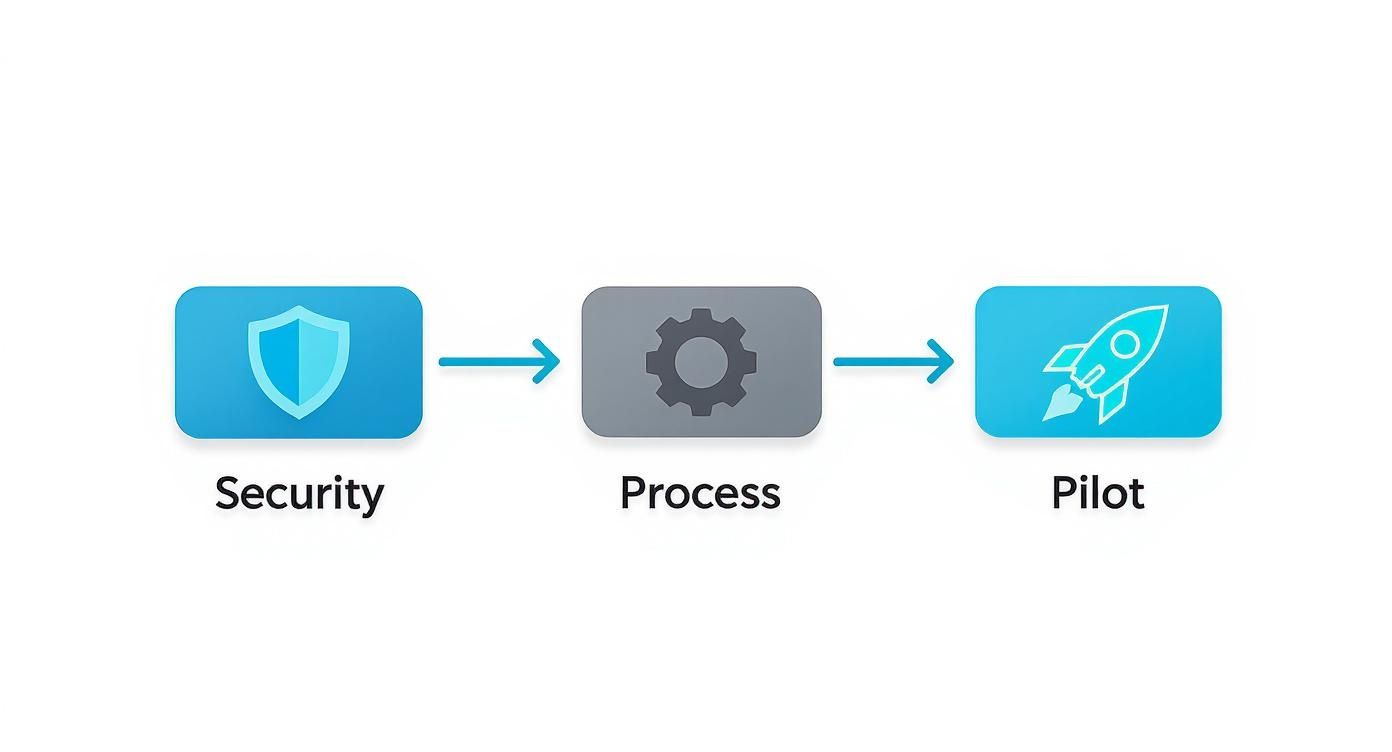
The key takeaway is that a structured vetting process is the only way to truly validate a partner's capabilities, no matter where they are on the map.
The question isn't "Which location is cheaper?" It's, "What is the total cost of engagement?" That includes your team's time spent managing, clarifying, and fixing things.
A cheaper hourly rate is worthless if you spend five extra hours a week re-explaining assignments. That's not savings; that's just shifting the cost from your balance sheet to your sanity.
Let's cut the noise. Here’s a pragmatic look at the pros and cons beyond the price tag.
| Factor | Onshore (e.g., USA) | Nearshore (e.g., Latin America) | Offshore (e.g., India, Philippines) |
|---|---|---|---|
| Cost Savings | Low (Highest Cost) | Medium (Moderate Savings) | High (Significant Savings) |
| Time Zone Alignment | Excellent (Same Time Zone) | Good (Minimal Difference) | Poor (Major Difference) |
| Cultural/Legal Proximity | Excellent (Same System) | Good (High Affinity) | Fair (Requires Management) |
| Talent Pool | Large, but Expensive | Growing, Strong Bilingual Skills | Massive, Highly Educated |
| Management Overhead | Low | Low to Medium | Medium to High |
Ultimately, there is no single "best" answer. An offshore partner might be perfect for high-volume, asynchronous tasks. A nearshore legal outsourcing company is often ideal for firms needing a scalable team that feels like a genuine extension of their office. Make a conscious choice based on your needs, not a knee-jerk reaction to a low hourly rate.
Signing the contract is the easy part. That’s the celebratory handshake. The real work—the part that determines whether this succeeds or becomes a cautionary tale—starts now.
The dirty secret of legal outsourcing is that most relationships don't fail because of competence; they crumble due to poor integration. You can't just throw tasks over a digital wall and hope for the best. Treating your new team like a faceless vendor is a one-way ticket to frustration.

This isn't fluffy HR talk. It's the pragmatic, in-the-trenches secret to making this work. Let’s build an actual integration plan.
Before a single task is assigned, establish crystal-clear communication protocols.
This isn’t about micromanagement. It’s about creating a predictable framework so everyone can focus on the work, not the logistics.
Your outsourced team is only as effective as the tools you give them. Managing a complex caseload through scattered emails is like trying to build a house with a butter knife.
Get everyone on the same platforms from day one. The initial setup is a small price to pay for operational sanity.
Treat your outsourced team with the same respect and resources you give your in-house staff. A team that feels valued and connected will always deliver better work.
This is where most firms drop the ball. They treat their outsourced team like hired guns. Fatal mistake. Your goal is to make them feel like part of your firm’s mission.
Give them context. Don't just assign a task; explain the "why." A paralegal who understands how their doc review fits into the broader case strategy will be far more engaged. Period.
Invite them to relevant virtual team meetings. Include them in weekly case updates. This small gesture fosters a sense of belonging. A thoughtful onboarding process is key, as our guide on how to onboard remote employees explains.
Ultimately, a legal outsourcing company provides people, not just services. How you integrate those people will define your success. It’s the difference between a frustrating cost center and a powerful competitive advantage.
We get it. Pulling the trigger on a legal outsourcing company is a big decision. You've got questions, and you deserve straight answers, not corporate jargon.
Let's tackle the ones rattling around in your head.
This is the big one. The question that keeps partners up at night. Any reputable provider uses a multi-layered security approach. Hope is not a strategy.
Look for providers with heavy-duty certifications like ISO 27001 and SOC 2 compliance. These aren't just fancy badges; they're proof of independent audits. They should have robust physical and network security, strict access protocols, and ironclad NDAs with every employee.
Always ask for their latest security audit report. If they hesitate, you walk.
"It depends" is the laziest answer, so let's skip that. Models generally fall into three buckets:
Absolutely. In fact, small firms and solos often get the most out of legal outsourcing. It’s the ultimate equalizer.
Outsourcing gives you immediate access to specialized expertise and the ability to scale capacity without the crippling overhead of hiring. Suddenly, you can compete with much larger firms.
You're not just offloading tasks; you're buying the operational muscle to punch well above your weight class.


