

 21 minutes read
Let's be blunt: hiring a legal secretary often feels like a high-stakes gamble. You're sifting through a mountain of resumes, trying to find someone who's more than just a glorified admin. The core legal secretary job requirements are a unique mix—part specialized administrative wizard, part eagle-eyed proofreader, with the unflappable calm needed to thrive in a high-pressure law firm.
You’re not just looking for someone to answer phones. You need the organizational backbone for your entire practice.

Let’s be honest, unless you enjoy spending your days running endless interviews and double-checking every resume detail, you need to get this right the first time. This is exactly where many firms stumble. They either dumb the role down to a generic receptionist position or they write a job description for a mythical "unicorn" who simply doesn't exist.
Both mistakes lead to the same painful outcome: a bad hire.
We're cutting through the noise to give you the real story on what actually matters. After vetting thousands of candidates, the patterns are impossible to ignore. A great legal secretary is part project manager, part client-facing diplomat, and part human firewall against the daily chaos of a busy legal practice.
Bringing the wrong person on board isn't just a minor headache; it's a direct blow to your firm's finances and reputation. A disorganized secretary can lead to missed deadlines, improperly filed documents, and frustrated clients. That’s not just a drain on productivity—it's a genuine malpractice risk.
The cost of recruiting, hiring, and retraining can easily exceed $50,000, and that doesn't even begin to account for the potential damage to your firm's good name.

We’ve seen firms lose major cases over simple filing errors that a competent legal secretary would have caught in their sleep. It's a painful, expensive lesson in the importance of getting this hire right the first time.
Think of this guide as your practical playbook for finding and hiring a legal secretary who will make your firm more efficient from day one. We’re providing a clear, actionable breakdown of the essential job requirements.
Here's what we'll cover:
By the time you're done, you'll have a solid framework for identifying, interviewing, and onboarding a legal secretary who doesn't just fill a seat, but becomes a true asset to your firm. Let's get to it.
Let's be honest: figuring out the "right" educational background for a legal secretary can feel like nailing Jell-O to a wall. One resume might show a high school diploma paired with five years of stellar, in-the-trenches experience. The next could have a shiny associate's degree but zero real-world courtroom exposure. It’s a mix that often leaves hiring managers stuck.
Unlike the paralegal field, which has a more defined career track, the path to becoming a legal secretary is more like the Wild West. You’ll see candidates from all sorts of backgrounds, which is both a blessing and a curse. The talent pool is incredibly wide, but you can't just glance at a degree to know if someone is truly competent.
So, should you automatically favor the candidate with an associate's degree over the one with a decade of on-the-job training? Not so fast. I’ve seen seasoned secretaries with only a high school education run circles around recent grads. They possess something you can’t learn in a classroom: an intuition for deadlines and procedure forged in the fires of actual litigation.
The educational requirements for legal secretaries have always been flexible. While many top-tier professionals build their careers with a high school diploma and experience, a formal education provides a structured foundation. The most common routes include a 2-year associate's degree or a concentrated certificate program (often lasting one or two semesters) that focuses on the essentials—legal terminology, office procedures, and advanced word processing. For a closer look at these options, you can explore more about legal secretary training programs.
The goal isn’t just to check an "education" box on a form. It’s to understand how a candidate's specific background—whatever it may be—translates into the practical, day-to-day skills your firm needs to function smoothly.
Now, what about those extra letters after a candidate’s name? Certifications, like the Certified Legal Secretary Specialist (CLSS) from organizations such as NALS (the association for legal professionals), can be a valuable signal. But they aren't a magic bullet.
Think of it this way: a certification is like a driver's license. It proves the person passed a standardized test, but it doesn't tell you if they're a calm, collected driver in rush-hour traffic or someone who panics at the first sign of pressure.
Here’s when a certification should really catch your eye:
Ultimately, education and certifications are just pieces of the puzzle. They provide important context, but they're no substitute for vetting a candidate’s actual ability to manage a chaotic calendar, draft a flawless motion, or handle a panicked client call without breaking a sweat. Those are the real legal secretary job requirements that will make or break your team.
Let's get down to what really matters. A polished resume or an impressive degree doesn't mean much if the candidate can't handle the pressure. Hope you enjoy spending your afternoons fact-checking resumes and running interviews—because that’s now your full-time job if you hire based on paper qualifications alone.
A truly great legal secretary does more than just complete tasks; they act as a force multiplier for your attorneys. To find one, you have to look at their skills in two distinct categories: the technical hard skills they can't function without and the crucial soft skills that determine if they'll sink or swim.
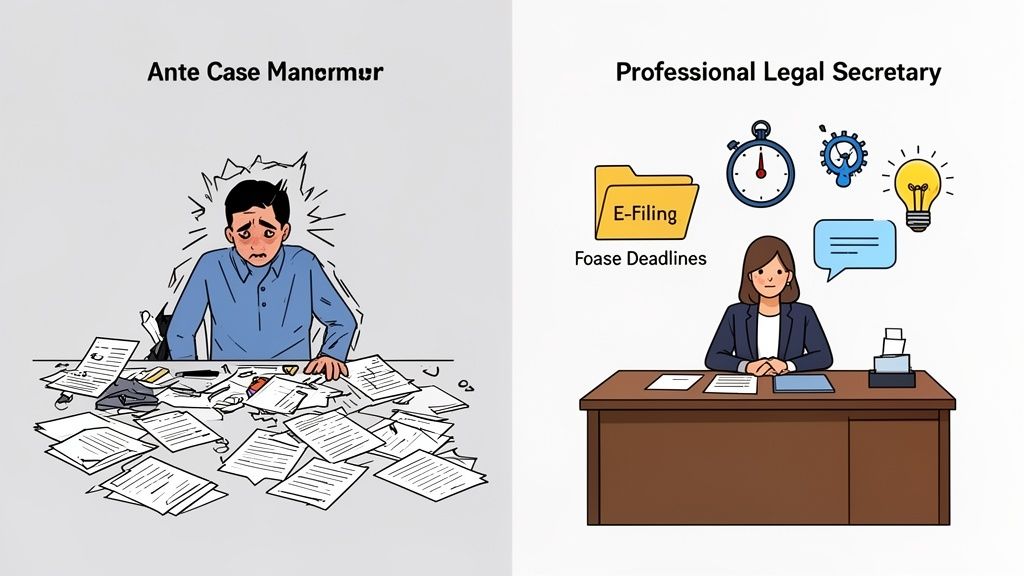
We're not just talking about whether they can type 80 words per minute—that's table stakes. We're talking about the real technical horsepower that keeps a modern law practice from coming to a screeching halt. A candidate who lists "Microsoft Office" as a top skill in this day and age might as well list "knows how to use a telephone."
You have to dig deeper.
A top-tier legal secretary needs hands-on experience with the specific tools that run your firm. They must be fluent in the language of legal tech, not just vaguely familiar with the software names.
Here’s what you should be screening for:
A candidate who can’t confidently explain how they’d file an emergency motion electronically in your jurisdiction isn’t a legal secretary. They’re an administrative assistant who happens to work at a law firm. There’s a huge difference.
This is precisely where most hiring managers miss the mark. They see a buzzword like "detail-oriented" on a resume and check the box. But you're not hiring a buzzword; you're looking for behavioral traits that prove a candidate can thrive in the controlled chaos of a legal environment.
These aren't just "nice-to-haves." They are the very core of what makes a legal secretary effective.
You need someone who doesn’t just follow a checklist but actively anticipates what’s coming next. You want the person who brings you solutions, not just problems. It's the fundamental difference between an employee who costs you time and one who saves you time.
Look for real evidence of these traits during the interview process:
Beyond the legal world, understanding the essential skills for a compelling CV gives you a broader lens. It helps frame these soft skills not just as industry requirements but as universal markers of a high-caliber professional. Your goal is to find someone who thinks like a partner in the firm's success, not just an employee completing a task.
Let's get one thing straight: if you’re picturing someone who just takes dictation and answers the phone, you’re about 30 years out of date. Clinging to that outdated image isn't just old-fashioned; it’s a recipe for hiring an administrative anchor that will drag your entire firm down.
The modern legal secretary is your practice’s central nervous system. They are a tech-savvy administrative strategist who doesn't just complete tasks but anticipates needs.
The difference between a good legal secretary and a great one is massive. A good one ticks off boxes on a to-do list. A great one clears an attorney's plate, freeing them up to focus on the only thing that actually makes the firm money: billable work. This isn't about support; it's about leverage.
Think about how much time your top litigator wastes on calendar invites and scheduling headaches. A recent survey found that the average professional wastes the equivalent of 46 full workdays a year just wrestling with their schedule. That's a staggering amount of billable time circling the drain.
At its heart, the job is about mastering the relentless flow of information and deadlines that define legal work. We’re not talking about simple clerical tasks. We’re talking about owning entire operational domains where one slip-up can spell disaster.
A truly effective legal secretary isn’t just waiting for instructions. They are proactively managing the three critical pillars of your practice:
A top-tier legal secretary doesn’t just manage a lawyer’s calendar; they manage the rhythm of a case. They know when a motion is due, when discovery closes, and what needs to happen next, often before the attorney even has to ask.
But the job doesn't stop there. The role has expanded dramatically. The best candidates today are more like quasi-operations managers, handling tasks that used to be pushed off to other departments or, worse, back onto an attorney’s desk.
If your secretary can't handle these advanced tasks, guess who will? That work inevitably lands back on your plate, or your paralegal's, or an expensive associate's.
Here’s what separates the modern pros from the old-school administrators:
In the end, a modern legal secretary is the operational hub of your practice. They don’t just "assist" attorneys; they build the structure and create the efficiency that allows lawyers to practice law at their highest level. Finding the right person for this role isn't just filling a seat—it's one of the smartest investments a firm can make.
Let’s talk numbers. Guessing on salary is one of the fastest ways to lose a great candidate before you even get started. The good news is you don’t have to mortgage the firm to afford top talent, but you absolutely need a realistic budget. Underpaying is a surefire recipe for a revolving door of unqualified staff, while overpaying needlessly eats into your bottom line.
Finding that sweet spot isn't magic; it's about understanding the market. When you're weighing the core legal secretary job requirements against compensation, it's critical to learn how to determine effective salary ranges that will both attract and keep the right person.
So, what does a competitive salary actually look like these days? The truth is, it varies wildly depending on location, the candidate's experience, and the size of your firm.
According to the latest Bureau of Labor Statistics data, the median annual salary for a legal secretary is around $54,140. Most positions fall somewhere in the $35,000 to $60,000 range. But geography is a massive factor. For example, an entry-level spot in Irvine, California, might command between $51,240 and $65,880, which really shows how much location can move the needle. You'll find more insights on these salary demographics when comparing different legal support roles.
The key takeaway? A generic national average is a terrible starting point. You need to zero in on your specific market and the experience level you're targeting to make an offer that’s both attractive and sustainable for your firm.
The role has evolved far beyond basic administrative duties, and that complexity is what justifies a competitive salary.
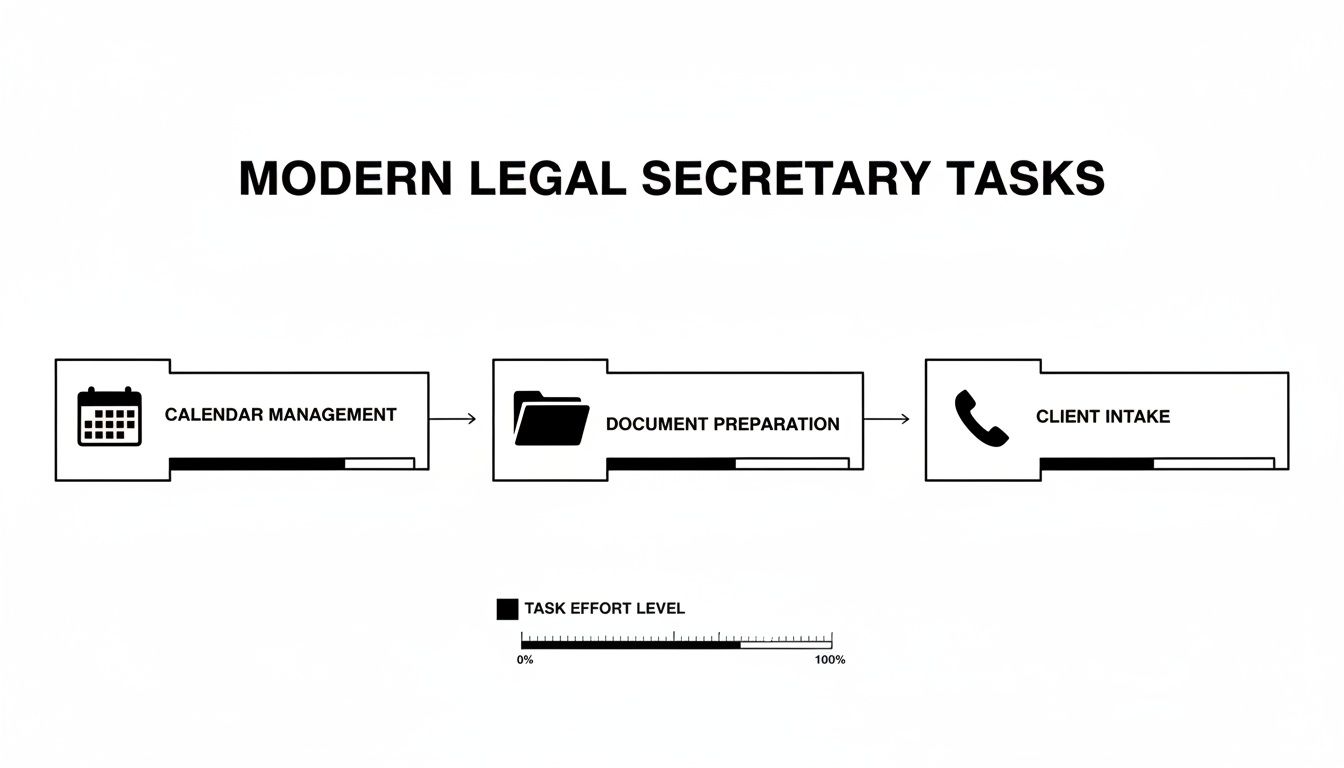
As you can see, today’s legal secretaries are operational hubs, managing critical workflows from the moment a client calls to the final document filing.
Now, let's get real about the total cost. That $54,140 median salary is just the starting line; it’s not what you're actually paying.
Once you factor in payroll taxes, health insurance, retirement contributions, and overhead like office space and equipment, that number easily inflates by another 20-30%. All of a sudden, you're looking at a true annual cost that’s much closer to $70,000.
This is where the math starts to get really interesting, especially for small to mid-sized firms. For many, the smarter financial play is shifting from a full-time, in-house employee to on-demand remote talent. You get access to a pre-vetted professional without the long-term financial commitment and all the associated overhead.
By hiring a remote legal secretary, you can often secure a more experienced professional for a fraction of the fully loaded cost of a traditional hire. It’s a direct comparison of a fixed, predictable expense versus a salary bloated by all those hidden costs. If you want to dive deeper into this model, check out our guide on how paralegal hourly rates can transform your firm's budget. It's a game-changer.
Alright, we’ve covered the theory. Now, let’s get practical. How do you actually apply all this information during the interview process? Think of yourself as a detective, because your job is to separate the candidates who just talk a good game from the ones who can actually play it.
This is your hiring toolkit. We're ditching the generic, "what's your greatest weakness?" nonsense. Those questions are a waste of everyone's time and only invite canned, rehearsed answers. Instead, we’re arming you with scenario-based questions designed to cut through the fluff and see how a candidate really performs under pressure.
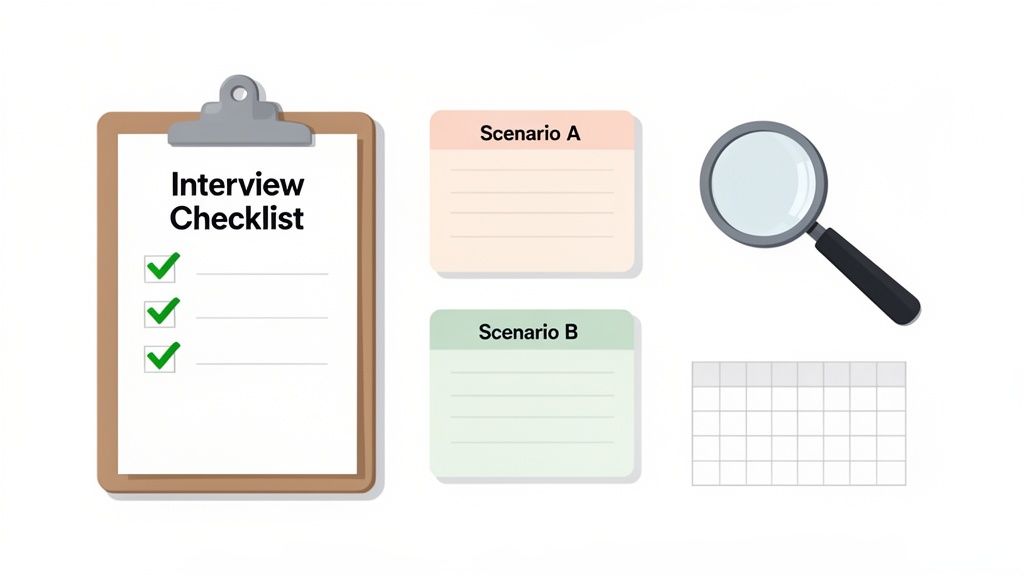
Your goal isn't to make a new friend; it's to simulate the controlled chaos of a typical Tuesday afternoon and see how they react. You need to test for the specific skills and temperaments we've been discussing. The right questions will show you how they think, prioritize, and communicate when things inevitably get messy.
Here are the kinds of questions that will get you real answers:
Listen closely to their responses. These questions don't have a single "right" answer. What you're really looking for is their thought process. Do they ask clarifying questions? Do they communicate their plan clearly? Do they stay calm or sound flustered just describing the scenario?
This isn't about finding a perfect candidate. We’re not saying we’re perfect, either. It’s about finding the candidate whose problem-solving style best aligns with the realities of your firm.
To make this process even more structured and less subjective, we’ve created a simple, downloadable checklist of the core legal secretary job requirements. Use it during your interviews to score each candidate consistently across the key competencies we've discussed.
[Download Your Legal Secretary Interview Checklist Here] (Link to a downloadable PDF)
This tool helps you move beyond a vague "gut feeling" and forces you to rate candidates on tangible skills—from their proficiency in case management software to their ability to handle confidential information. It’s about making your hiring process smarter, faster, and far more effective.
And once you’ve narrowed it down, don’t forget the final step. For a deeper dive, our guide on how to conduct reference checks will help you verify that your top choice is as good as they seem.
Alright, we've covered a lot of ground. But let's be real—hiring is rarely a straight line, and there are always a few lingering questions that can trip you up.
So, let’s tackle some of the common curveballs that pop up when you’re trying to find the right person for this crucial role.
Ideally, yes. But is it a dealbreaker? Not always. A sharp legal secretary with a decade of experience in, say, family law can likely get up to speed in your personal injury practice much faster than a recent graduate with the "right" certificate but no real-world experience.
The core skills—meticulous calendar management, court filing prowess, and professional client communication—are highly transferable across different legal fields. It's often better to prioritize finding someone with a proven track record of thriving in a high-pressure legal environment first. Specific procedural knowledge can be taught; raw competence and a cool head under fire cannot.
This one trips up more firms than you'd think. It's a classic case of hiring for the wrong role and then wondering why things aren't clicking.
Think of it this way: the legal secretary is the operational hub of your practice, managing the administrative and logistical workflow that keeps everything moving. A paralegal, on the other hand, is more involved in the substantive legal work itself, like conducting legal research and drafting documents under an attorney's supervision.
If you're still fuzzy on the details, you need to understand the critical difference between a legal secretary and a paralegal before you post a single job opening. Getting this wrong is a costly mistake.
This is the big one for firms new to the world of remote hiring. There’s often this nagging fear that if you can't see your team, they aren't actually working. That’s just old-school thinking.
Effective remote supervision isn't about surveillance; it's about clear communication and managing by results.
Ultimately, you have to trust the people you hire. If you've vetted for the right skills and a strong work ethic, a great remote secretary will quickly become one of the most productive members of your team.


