

 22 minutes read
Let's be honest. You need to hire a paralegal, so you dust off a job description from 2012, post it, and hope for the best. What happens next is painfully predictable: a mountain of resumes from people who are a terrible fit, which means you're stuck doing resume reconnaissance instead of billable work.
Here’s the thing—a job description isn't just a boring list of duties. It’s a sales pitch. It’s your first and best shot at convincing a top-tier paralegal that your firm is the one place they should build their career. A generic, copy-pasted description just screams, "we don't really know what we want," and that’s a massive red flag for any serious candidate.

The market for skilled legal pros is ridiculously competitive. You aren't just up against the firm across the street; you're competing with every firm offering a better culture, more compelling work, or a clearer career path. A lazy job post suggests your firm might be lazy in other areas, too. Just saying.
Hiring the wrong person is more than just an annoyance—it's a massive drain on your firm's resources. You lose a fortune on recruitment, waste billable hours on training that goes nowhere, and watch team morale sink when a new hire can't handle the heat.
The $500 Hello.
The only way to consistently avoid this is by starting with a solid foundation. That means a comprehensive pre-employment screening process to vet candidates thoroughly before an offer is ever made. It’s your best defense against a hiring mistake that costs you thousands.
Despite what you might hear, the paralegal field is anything but stagnant. The U.S. Bureau of Labor Statistics pegs the median annual wage at $61,010 as of May 2024. More importantly, high turnover means there’s a constant demand for talent, with an estimated 39,300 openings expected each year for the next decade. You can see the full breakdown on the BLS website.
This means the best paralegals have options. Lots of them. They can afford to be picky, and they will absolutely scroll past your vague, uninspired job posting without a second thought.

This guide is the antidote. Forget generic templates. We’re going to walk through what a great paralegal actually does, pinpoint the skills that truly matter, and show you how to write a description that attracts the exact candidates you want—and gently weeds out those you don’t.
Think of this as your playbook for hiring a paralegal who will become a genuine asset to your team, not just someone filling a chair. It’s time to create a job description that works as hard as you do.
Let's get one thing straight. If your paralegal job description still lists "makes copies" and "files documents" as primary duties, you’re not just behind the times—you’re actively recruiting for mediocrity. The days of paralegals being glorified administrative assistants are long, long gone.
Today’s top paralegals are strategic partners. They function as the operational engine of a modern law firm, managing complex projects, liaising directly with clients, and handling sophisticated legal tech with ease. Forget the old image of someone buried under paper; think of them as the air traffic controller for your entire caseload, making sure nothing crashes while you're focused on high-level legal strategy.
That phrase—"assists attorneys"—is perhaps the most useless line item in the history of job descriptions. It's a lazy shortcut that tells a great candidate absolutely nothing. It’s an open invitation for anyone who knows how to open a Word document to apply.
A high-impact paralegal job description cuts the fluff and gets specific about the substantive, high-value tasks they will own.
This evolution isn’t just a trend; it's a market reality. The legal field is facing a serious talent crunch. The unemployment rate for paralegals was a mere 1.9% in early 2025—way below the national average. This tight market has forced savvy firms to expand the paralegal role into project management and client relations. You can learn more about how these legal industry shifts are reshaping responsibilities.
Beyond managing cases, a modern paralegal is a crucial part of your firm's risk mitigation strategy. They are on the front lines, handling enormous volumes of sensitive client information. A single mistake here doesn't just create a headache; it can trigger an ethics complaint or a malpractice suit.
This is precisely why a critical part of their job involves maintaining rigorous law firm data security protocols. Your job description needs to reflect this serious responsibility. It sends a clear signal that you’re looking for a professional, not a paper-pusher.
A great paralegal isn't just a cost center; they are a force multiplier for your firm's profitability. They free up attorney time for high-value billable work, improve client satisfaction, and implement the systems that allow your practice to scale without imploding.
So, the next time you write a paralegal job description, ask yourself: are you hiring a helper, or are you hiring a partner? The way you define the role determines the caliber of talent you attract. It’s time to ditch the outdated language and focus on the strategic value they bring.
When you're building out that job description, it's easy to list the basics. But what truly separates an average paralegal from a great one? It's a specific blend of hard skills and intangible soft skills. Here's what's non-negotiable.
| Skill Category | Essential Skills | Why It's Non-Negotiable |
|---|---|---|
| Technical & Legal Acumen | Legal Research (Westlaw, LexisNexis), E-Discovery Software (Relativity, Disco), Case Management Systems (Clio, MyCase), Legal Document Drafting | This is the foundation. Without this, they can't do the substantive work that frees up your time. Period. |
| Organizational Prowess | Project Management, Deadline Tracking, Meticulous Calendaring, File System Architecture, Trial Preparation Logistics | A great paralegal brings order to the chaos. They don’t just manage tasks; they build the systems that keep everything from catching fire. |
| Communication & Interpersonal | Client Communication, Witness Interviewing, Inter-Departmental Coordination, Professional Demeanor, Active Listening | They are often the primary point of contact for clients. Their ability to communicate with clarity and empathy directly impacts your firm's reputation. |
| Critical Thinking & Problem-Solving | Proactive Issue Identification, Analytical Skills, Resourcefulness, Independent Judgment, Attention to Detail | This is what elevates them from a "doer" to a "thinker." They spot problems before they escalate and find solutions without constant hand-holding. |
Remember, you're not just looking for someone who can follow a checklist. You're hiring a professional who can anticipate needs, manage complex workflows, and contribute directly to winning cases. These are the skills that make that happen.
Let's get straight to it. Hiring a brilliant corporate paralegal for a high-stakes litigation role is like asking a master chef to fly a helicopter. They might be incredibly talented, but you’re setting them—and your firm—up for a spectacular crash. One of the most common mistakes I see is using a generic, one-size-fits-all paralegal job description.
Frankly, it's lazy. And it’s a great way to waste time and money.
You can't just look for a "paralegal." You need a specific type of paralegal whose skills and temperament are precisely aligned with the demands of your practice area. The required skill sets aren't just a little different; they’re often polar opposites.
To understand why, you have to appreciate that the modern paralegal role is incredibly multifaceted. They are key operators in three distinct domains.
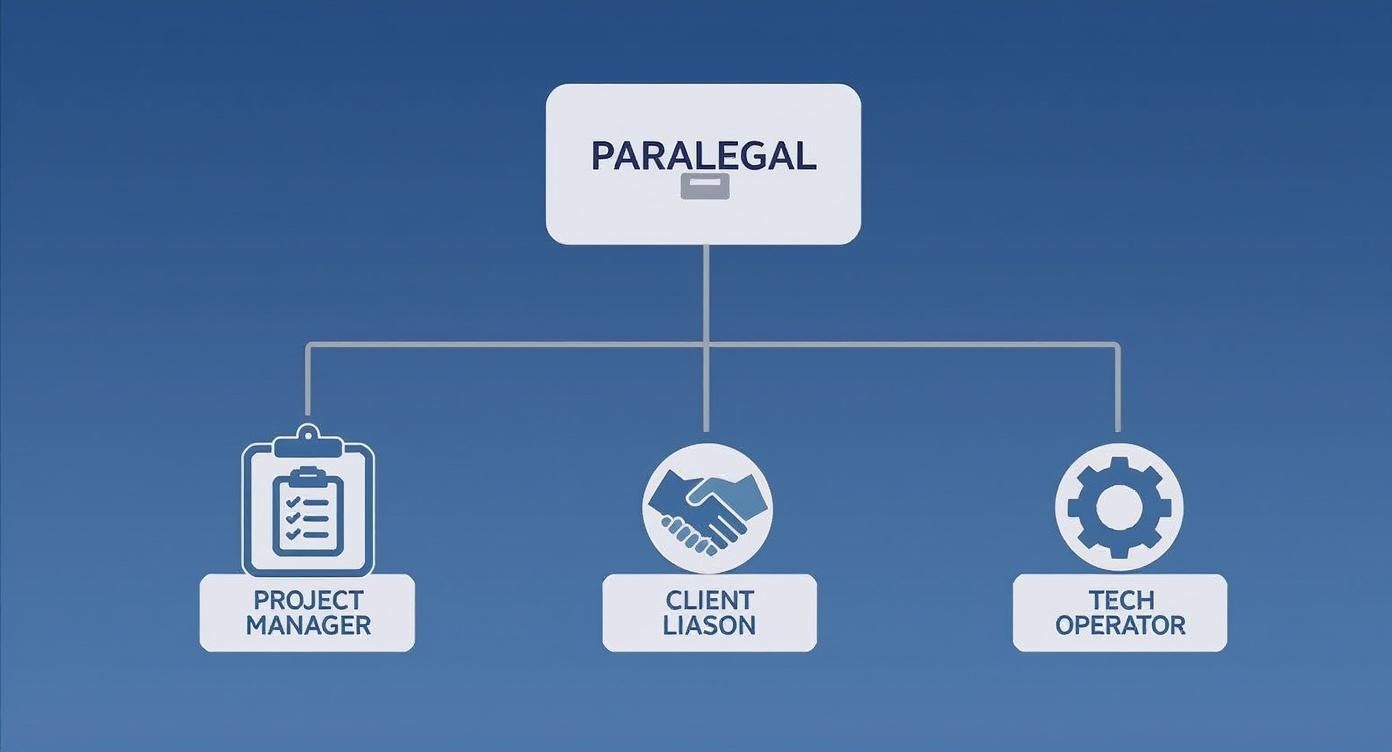
This chart drives the point home. You're hiring for a project manager, a client liaison, and a tech operator all in one—and the emphasis changes dramatically depending on the practice area.
Litigation is a battle, and a litigation paralegal is your sergeant-at-arms. This is not a role for the faint of heart. They live and breathe by the court's calendar, where a single missed deadline can be catastrophic.
Their world revolves around discovery, trial prep, and managing an avalanche of documents that would make a librarian weep.
When you write this job post, emphasize:
A great litigation paralegal thrives under pressure. They have a certain grit and an uncanny ability to find the one key document buried in 100,000 files. To get a deeper look, check out our guide on what a litigation paralegal does.
Now, shift gears completely. A corporate paralegal operates in a world of precision, compliance, and meticulous record-keeping. While a litigator thrives on chaos, a corporate paralegal’s mission is to eliminate it.
There is zero room for error here. A misplaced comma in a merger agreement can cost millions. You're hiring for an obsession with accuracy.
Key elements for this job description:
A top-tier corporate paralegal finds deep satisfaction in perfect organization. They are the guardians of your clients' corporate health, and they take that responsibility seriously.
While litigation and corporate law demand specific technical skills, areas like family law and immigration require a different—and arguably more complex—competency: exceptional emotional intelligence.
These paralegals deal with clients at the most vulnerable points in their lives. They need to be empathetic listeners and patient communicators while remaining professional and ruthlessly organized.
This trend toward specialization is only accelerating. The market is seeing explosive growth in niche areas like ESG compliance and data privacy. The takeaway is simple: stop writing generic job descriptions. Get specific, be demanding, and tailor your post to the unique battlefield of your practice area.
Alright, let's talk about the actual job post. This isn't a legal filing; it's your firm's first handshake with a potential hire. It’s a sales pitch. You're selling your firm, your culture, and the chance to do meaningful work.
If your post reads like a dry, soul-crushing discovery request, you’re going to attract candidates who are just as uninspired.
The goal is to be clear, compelling, and unapologetically human. Get this right, and you'll spend far less time sifting through resumes and more time interviewing genuine contenders.
Forget the bland, corporate templates you've recycled for years. A high-impact paralegal job post has a specific structure designed to grab attention and hold it.
Think of it in four simple parts:
This structure flips the traditional model on its head. Instead of leading with your demands, you lead with what’s in it for them. It’s a subtle shift that makes all the difference.
Your firm's culture is your biggest selling point, so let it shine. Are you a scrappy boutique or an established practice? The tone has to reflect that reality. Trying to sound like something you're not is the fastest way to attract a candidate who will quit in six months.
Let's look at two examples.
Example 1: The Scrappy Boutique Firm
Title: Litigation Paralegal Who Thrives in the Trenches
The Hook: Are you a litigation paralegal who’s tired of being a tiny cog in a giant machine? Do you crave direct client contact and the chance to truly own your cases? We’re a boutique PI firm that fights for the underdog, and we’re looking for a paralegal who wants to be in the thick of it with us.
You Are: A detail-obsessed, proactive problem-solver with at least 3 years of personal injury litigation experience. You see a looming deadline as a challenge, not a crisis. You have a knack for keeping attorneys organized—even when they try their best not to be.
You Will: Manage a caseload of 40+ PI files in Clio, draft substantive discovery, and serve as the main point of contact for our clients. You’ll also coordinate depositions, manage expert witnesses, and help prepare our trial teams for war.
See the difference? It's direct, a little cheeky, and paints a crystal-clear picture of the work environment. For roles with a transactional focus, you can adapt this same energy; our guide on crafting a standout corporate paralegal job description offers more specialized examples.
Example 2: The Established Mid-Size Firm
Title: Senior Corporate Paralegal, M&A and Governance
The Hook: Join a highly respected corporate law practice where you will play a key role in high-stakes M&A transactions. If you are a seasoned paralegal seeking sophisticated work within a collaborative, team-oriented environment, we encourage you to apply.
You Are: A meticulous professional with 7+ years of corporate law experience, specifically in M&A due diligence and entity management. You possess exceptional organizational skills and a deep understanding of corporate formalities. You are a clear communicator who excels at coordinating with clients and internal teams to drive deals to closing.
You Will: Manage the due diligence process for multi-million dollar transactions, prepare and file corporate formation and dissolution documents, maintain corporate minute books, and assist with SEC filings. You will be a vital resource for our attorneys and a trusted point of contact for our sophisticated corporate clients.
This version is more formal but still compelling. It emphasizes stability and sophistication. It’s a completely different sales pitch for a completely different—but equally valuable—candidate.
Alright, let's get down to business. You’ve crafted the perfect paralegal job description and have a few promising resumes on your desk. Now it's time to talk money. If you think you can lowball your way to elite talent in this market, I have some bad news for you. That strategy will get you exactly what you pay for.
Underpaying is one of the biggest rookie mistakes a firm can make. It sends a clear signal that you don't value the role, and top-tier candidates can smell that a mile away. You'll either attract someone who is underqualified, unmotivated, or just using you as a stepping stone. Either way, you'll be right back here in six months, wondering why you have to pay another recruiting fee.
So, what's the magic number? The truth is, it isn't magic—it's market data. A paralegal's compensation isn't one static figure; it’s a range that shifts based on geography, experience, and specialization.
According to the U.S. Bureau of Labor Statistics, the national average wage for paralegals is just over $56,000. But you should treat that figure as a starting point, not the final word. Hot specializations like cybersecurity and complex regulatory compliance are creating entirely new compensation tiers. Paralegals with niche skills and strong tech proficiency are set up for much higher wage growth. To get a better handle on these trends, you can explore the data on paralegal compensation.
Once you've nailed down a competitive salary range, you need a way to figure out who's actually worth it. Here’s a hint: you won’t find out by asking, "What's your biggest weakness?" That question is a complete waste of time.
You need to probe for critical thinking, resilience, and real-world problem-solving skills. Standard questions just confirm a candidate can recite their own resume. These questions test their ability to think.
The goal of an interview isn't to confirm what's on their resume. It's to uncover what isn't—how they handle pressure, solve unexpected problems, and communicate when the stakes are high.
Here are a few questions I've seen work wonders at cutting through the fluff.
Move beyond standard interview questions to uncover a candidate's real-world problem-solving abilities and fit for your firm.
| Question Type | Sample Question | What You're Actually Assessing |
|---|---|---|
| Problem-Solving | "Walk me through a time you discovered a significant error in a legal document right before a deadline. What was the error, what did you do, and what was the outcome?" | Their attention to detail, ability to perform under pressure, sense of ownership, and communication skills. Do they panic, or do they solve? |
| Prioritization | "Imagine two partners give you urgent, competing tasks, both due by EOD. Partner A is senior. Partner B's task is for a major client. How do you handle it?" | Their ability to manage competing priorities, communicate proactively, and navigate internal politics without dropping the ball. |
| Resilience & Grit | "Tell me about the most difficult attorney or client you've ever worked with. What made them challenging, and how did you manage the relationship to get the job done?" | Their emotional intelligence, professionalism, and ability to stay focused on the objective despite interpersonal friction. |
| Proactiveness | "Describe a process or workflow in a previous role that you improved. What was the problem, what was your solution, and what was the result?" | Whether they are a passive task-doer or an active contributor who looks for ways to make the firm better. |
There isn't a single "right" answer. You're listening for the thought process. Do they outline a structured approach? Do they communicate clearly? Do they take ownership? Their answers will tell you everything.
And once the interview is done, don't skip the final step. Our guide on how to conduct reference checks will help you confirm what you've learned.
You did it. You waded through the resumes, nailed the interviews, and found the perfect candidate. Now comes the critical part: making sure they stick around. Don't fumble the handoff right at the goal line. A disastrous first week can send that star hire straight back to the job boards.
Hiring well isn't just about finding the right person; it's about setting them up for success from day one. Tossing them a laptop with a quick "good luck" is a surefire way to make them feel lost and undervalued. You need a game plan.

Before you even map out their first day, you need to tackle the elephant in the room: where are they actually going to work? The post-pandemic push and pull between remote, hybrid, and full-time office work is a real battle, and the legal world has clearly chosen a side.
Recent data shows a whopping 62% of legal job postings are for fully on-site roles. Hybrid positions make up about 31%, while fully remote jobs are a tiny 7% slice of the pie. It’s a clear signal that firms still value face-to-face collaboration. Still, the firms that do offer flexibility often have their pick of top-tier talent. You can read more about these legal workplace trends to see where things are headed. Just be crystal clear about where your firm stands.
A well-thought-out onboarding process tells your new hire that you're a professional, organized firm—not a chaotic free-for-all. It’s your chance to make them feel welcome and get them contributing quickly.
Week 1: Welcome and Foundation
Don’t just email them a document and call it a day; talk it through. The whole point is to build connection and clarity, not drown them in information. You want them to feel like part of the team.
Weeks 2-4: Integration and Contribution
This isn’t about micromanaging. It's about setting clear expectations. Get this part right, and in 30 days, you’ll have a productive paralegal who feels like they belong. Get it wrong, and you’ll find yourself right back here, writing another job description.
Alright, you've made it this far, which means you're serious about this. Good. Let's tackle the questions we hear all the time from firms tired of the hiring hamster wheel.
Vagueness. Hands down. You wouldn't file a vague motion, so why post a vague job description? Using generic fluff like "assist attorneys" or "manage case files" is a complete waste of time. It tells a high-performer nothing.
Be ruthlessly specific. Instead of "manage case files," try, "Manage a caseload of 50+ personal injury files in Clio, from intake through settlement, including calendaring all discovery deadlines and drafting initial responses." Specificity is your best filter; it attracts the pros and repels the pretenders.
Yes. Full stop.
In today's market, not including a salary range is a massive red flag. Why would anyone go through three rounds of interviews only to find out your budget and their expectations are on different planets?
Be transparent. It shows you respect a candidate's time and that you’re a serious firm. You'll get higher quality applicants who know their worth and aren't just kicking tires.
Stop the song and dance. Putting a clear, competitive salary range in your job description is the fastest way to signal that you’re a professional firm looking to hire a professional. It’s that simple.
Crucial. Don't just say "tech-savvy"—that means nothing. If your firm runs on MyCase, Relativity, or Asana, name them.
Listing your specific tech stack does two powerful things:
Not necessarily, and being too rigid on this can cost you a fantastic hire. Some of the best paralegals I’ve ever worked with learned their craft in the trenches, not in a four-year university program.
An associate's degree or a paralegal certificate combined with five years of intense, relevant experience is often far more valuable than a recent grad with a bachelor's and zero real-world exposure. Focus on demonstrated skills and a proven track record, not just academic boxes.


