

 21 minutes read
Let's be honest. A great paralegal job description isn't a wish list for a legal magician who can juggle e-discovery, draft flawless motions, and calm anxious clients all at once. You're not hunting for a unicorn. You're trying to hire the central processing unit of your legal team—a highly skilled professional who brings order to the glorious chaos of a law practice.
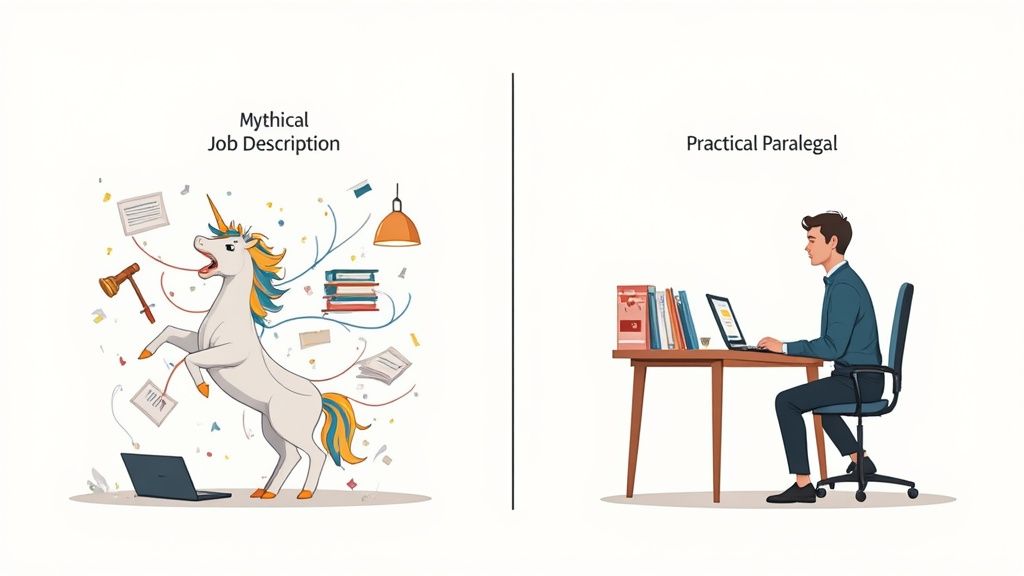
I’ve seen hundreds of job postings that look like they were pieced together from a corporate jargon dictionary and a senior partner’s fever dream. The result is always the same: you attract candidates who are either wildly underqualified or so intimidated by the impossible laundry list of demands they just scroll on by.
Hope you enjoy spending your afternoons fact-checking resumes—because that’s now your full-time job.
This is about more than just a few wasted hours. A poorly written job description costs you talent and money. Full stop. Every unqualified applicant you have to screen and every great candidate you scare away is a direct hit to your firm's productivity. You’re not just hiring an assistant; you’re investing in an operational backbone. Get it wrong, and the whole skeleton collapses.
The goal here is to attract the right people, not all the people. That means being brutally honest about what the role actually involves day-to-day. Before you even think about writing, get crystal clear on the difference between a paralegal and a legal assistant. It's the first step to setting expectations that exist in this reality.

A great job description is a filter, not a net. It should repel the wrong candidates just as effectively as it attracts the right ones. Your goal is a small pool of high-quality applicants, not an ocean of mediocrity.
This guide is here to cut through the fluff. We're going to break down the common mistakes that keep great paralegals from ever finding you and build a practical framework for writing a job description that actually works. It's time to find the professional you really need, not the unicorn you think you want.
Let's cut right to the chase. If your current job description for a paralegal is a laundry list of 27 bullet points all starting with "assist attorneys," you're doing it wrong. That phrase is just corporate speak for "do all the tasks we don't want to." It’s vague, uninspired, and the best candidates will see right through it.
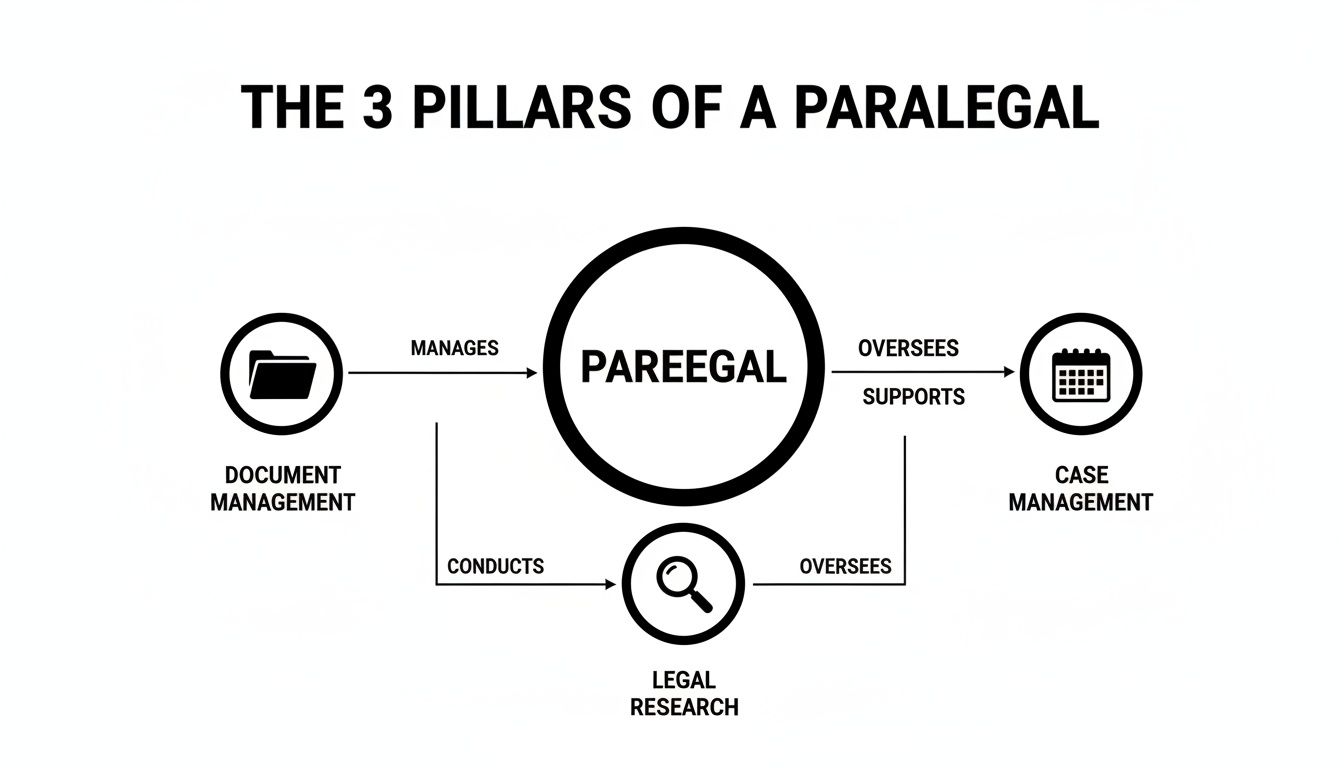
Forget that endless list for a moment. A truly top-tier paralegal—the kind who becomes the central nervous system of your entire practice—is built on three fundamental pillars. Get these right in your job description, and you’ll attract people who thrive on precision and proactive problem-solving, not just anyone looking for a paycheck.
Think of a great paralegal as the air traffic controller for your caseload. They aren't just following a flight plan; they're anticipating collisions, clearing runways, and making sure every case lands safely and on time.
First up is meticulous document management. And no, this isn't just about saving files into the right folder. This is about being the undisputed master of the paper trail, both digital and physical. A great paralegal doesn’t just file documents; they build an ironclad fortress of information that's perfectly organized and instantly accessible.
This pillar covers a lot of ground:
Your job description needs to reflect this level of ownership. Instead of a passive phrase like "manages documents," try something powerful: "Owns the entire lifecycle of case documentation, from initial client intake to final trial exhibits." See the difference? One is a task. The other is a responsibility.
Next, we have sharp legal research. This is the art of finding that one critical needle in a giant legal haystack—and doing it without billing eight hours. Your paralegal is often your first line of defense, the one who uncovers the case law, statutes, or public records that can make or break an argument. They need to be more than a competent user of a search engine.
A paralegal's research skill is the ultimate force multiplier. They can save an attorney hours of work, turning a vague idea into a well-supported legal argument before the attorney has even finished their morning coffee.
They have to understand the context of a query, sift through mountains of irrelevant results, and distill complex information into a clear, concise memo. A core competency of the profession is knowing how to conduct legal research like an expert, turning abstract legal questions into concrete, actionable answers. It demands both technical proficiency and a heavy dose of critical thinking. For a deeper look at the specific skills that matter here, exploring the essential requirements for paralegal jobs can give you a solid baseline.
Finally, there's proactive case management. If document management is about the past and research is about the present, then case management is all about the future. This is the pillar that prevents deadlines from being blown and stops cases from going off the rails. It’s about seeing around corners.
This is so much more than just keeping a calendar. It’s about:
When you write your job description, frame this responsibility around true ownership. You aren't just looking for a scheduler. You're hiring a project manager who ensures the entire legal process runs like a well-oiled machine, preventing small oversights from turning into catastrophic malpractice claims.
The work of a great paralegal directly translates into efficiency, reduced risk, and better outcomes. Here’s a quick breakdown.
| Core Responsibility | What It Actually Involves | Why It Matters to Your Firm |
|---|---|---|
| Document Management | Drafting, organizing, and maintaining all case-related documents, from pleadings to trial exhibits. | Reduces Risk: Prevents lost documents and ensures a clean, admissible record. Saves Time: Attorneys can find what they need instantly. |
| Legal Research | Finding and summarizing relevant case law, statutes, and public records using legal databases. | Improves Outcomes: Uncovers critical information that can strengthen a case. Increases Profitability: Frees up attorney time for high-value strategic work. |
| Case Management | Tracking deadlines, coordinating with all parties, and preparing for key case events like depositions or hearings. | Avoids Malpractice: Ensures no critical deadlines are ever missed. Boosts Efficiency: Keeps cases moving forward smoothly without delays. |
Ultimately, investing in a paralegal who excels in these three areas isn't just about hiring support; it's about making a strategic investment in the operational backbone of your practice.
Let's get one thing straight. Posting a generic "paralegal wanted" ad is like walking into a restaurant and just ordering "food." You have no idea what you're going to get.
Hiring a corporate paralegal for a messy litigation case is like asking a classical violinist to shred a metal guitar solo. Sure, they’re both talented musicians, but they play completely different instruments. The day-to-day reality of what they do couldn't be more different.
While most paralegal jobs revolve around the same core pillars, the application of these skills is where the specialization really kicks in.
Every paralegal juggles documents, research, and case files. But the tools, pressures, and specific knowledge required in a family law practice are worlds away from those in an intellectual property firm.
Litigation is a different beast entirely. A job description for a litigation paralegal needs to scream "deadline-driven" and "unflappable under pressure." These folks live and breathe by the trial calendar.
They aren't just organizing a few files; they're managing massive e-discovery productions using platforms like Relativity or DISCO. Their "document drafting" isn't a quiet afternoon of contract work—it's churning out interrogatories, requests for production, and motions to compel, all under the gun. They need to know the Federal Rules of Civil Procedure in their sleep.
A deep dive into this field quickly reveals why your practice area is so important, clearly defining the specialized the roles of a litigation paralegal and their unique responsibilities. Forget asking for a generic "team player." You need someone who thrives in a war room and sees a 500,000-document production as a challenge, not a nightmare.
Now, let's pivot to the corporate world. Here, a paralegal’s life is governed by closing checklists, not trial dates. They are the architects who help build and maintain the very structure of a business.
Their key tasks often include:
The skills here are less about courtroom battles and more about extreme organization and precision. They need to be fluent in platforms like Carta for equity management. Your job description should focus on meticulous attention to detail and an ability to manage complex, multi-step projects.
In the world of IP, paralegals are on the front lines of protecting a company's most valuable assets: its ideas. They are meticulous guardians of trademarks, patents, and copyrights.
An IP paralegal spends their days filing and tracking applications with the U.S. Patent and Trademark Office (USPTO), managing extensive dockets, and coordinating with foreign associates for international filings. They live in specialized docketing software and are masters of a process that is famously unforgiving of missed deadlines. You're looking for someone who is part project manager, part librarian, and entirely obsessed with accuracy.
The table below breaks down how these responsibilities and skillsets differ across some of the most common legal specializations.
A look at the different responsibilities and required skills across major legal practice areas.
| Practice Area | Key Responsibilities | Essential Skills and Software |
|---|---|---|
| Litigation | Managing discovery, drafting pleadings, preparing for trial, calendaring deadlines, cite-checking briefs. | eDiscovery platforms (Relativity, DISCO), case management software (Clio, MyCase), deep knowledge of civil procedure rules. |
| Corporate | Entity formation, maintaining corporate records, M&A due diligence, contract management, securities filings. | Equity management (Carta), CLM systems, proficiency with state corporate filing portals, meticulous organizational skills. |
| Intellectual Property | Filing and prosecuting patent/trademark applications, docketing deadlines, conducting IP searches. | USPTO filing systems, specialized IP docketing software (Anaqua, Pattsy), extreme attention to detail. |
| Real Estate | Reviewing title commitments, preparing closing documents (deeds, HUD-1s), coordinating with lenders and title companies. | Real estate closing software, understanding of title insurance, zoning regulations, and property survey analysis. |
| Family Law | Drafting divorce petitions and custody agreements, financial disclosures, client communication, trial preparation. | Strong interpersonal skills, empathy, proficiency in calculating child support, familiarity with local court rules. |
As you can see, while the title "paralegal" is the same, the actual job can be wildly different. Thinking about these distinctions is the first step to finding the right person for your team.
Alright, let's talk about the money. If there's one surefire way to hamstring your firm, it's by lowballing a paralegal offer. You'll get exactly what you pay for, and you'll find yourself trapped in a frustrating cycle of high turnover and constant retraining.
Too many firms pull up a generic national salary average, plug it into an offer letter, and then act surprised when they only attract lukewarm candidates. That national number is practically useless. This isn't about just throwing money around; it's about making a smart, strategic investment in the people who keep your firm from catching on fire.
The market for skilled paralegals is always tight. The profession currently employs around 376,200 people, with an estimated 39,300 new job openings projected each year through 2034. That isn't just a sign of growth; it reflects a constant churn, which keeps demand for true talent consistently high.
Let's be perfectly clear: a paralegal in Manhattan, Kansas, and a paralegal in Manhattan, New York, are not going to command the same salary. It seems obvious, but you’d be surprised how often firms miss this. The local cost of living isn't just some abstract economic data point; it directly shapes the salary required to attract and keep a professional.
Think of it like commercial real estate. You know you can't lease an office in downtown San Francisco for the same price as one in Omaha. The exact same logic applies to your talent.
A salary offer isn't just a number; it's a message. A lowball offer tells a top candidate you don't understand their value or the market they live in. Either way, it’s a bad look.
Hiring remotely gives you flexibility, but it doesn't make you immune to these market forces. A highly skilled remote paralegal living in a high-cost city knows their value and won't take a massive pay cut just for the privilege of working from their spare bedroom.
Not all experience is created equal. A decade spent filing basic documents is worlds away from a decade spent managing complex, multi-state litigation. When you're building your compensation package, you have to account for the real value of specialized skills.
Here are a few key factors that will drive salaries upward:
If you don't budget for these differentiators, you'll end up sifting through candidates who are a decade behind the curve. For a detailed breakdown, our guide on paralegal hourly rates can help you build a much more competitive offer. Don't make the mistake of cheaping out on expertise—it will always cost you more in the long run.
Alright, let's get down to brass tacks. We’ve covered what makes a great paralegal and what the market looks like—now it's time to actually write a paralegal job description that works. The goal is to create something that acts like a magnet for top talent and a filter for everyone else.
First, forget those generic templates. They’re stuffed with corporate jargon like "seeking a dynamic, results-oriented team player," which is exactly the kind of fluff that makes a seasoned professional’s eyes glaze over. We're going to build this piece by piece, using clear, direct language that shows you actually understand the role.
This isn’t a literary masterpiece. It’s a practical hiring tool that saves you countless hours of screening and brings better people through the door.
Think of your job summary as your firm’s elevator pitch. It’s the very first thing a candidate reads, and it’s what makes them decide whether to keep scrolling or hit the back button. This is your chance to sell the opportunity, not just list the requirements.
Don't lead with, "Our firm is seeking a Paralegal." That’s as uninspired as starting a novel with, "This is a book."
Instead, frame the role in a way that speaks to a professional's ambition.
The second version doesn't just describe a job; it describes a mission. It signals to a great candidate that they won’t just be a cog in the machine—they’ll be a crucial part of the engine.
This is where most job descriptions fall apart. They dissolve into a vague list of bullet points. The cardinal sin here is using phrases like "Assist attorneys." Of course they will assist attorneys. Be specific about how.
Think in terms of action verbs and concrete outcomes. Every bullet point should describe a tangible responsibility.
A great job description reads like a clear blueprint, not a grocery list. Each responsibility should be a specific, measurable function that a candidate can immediately recognize as something they have or haven’t done.
Try organizing these responsibilities logically. A solid structure might look like this:
See how specific that is? A candidate knows the expected caseload, the type of documents they'll handle, and the level of client interaction. No guesswork.
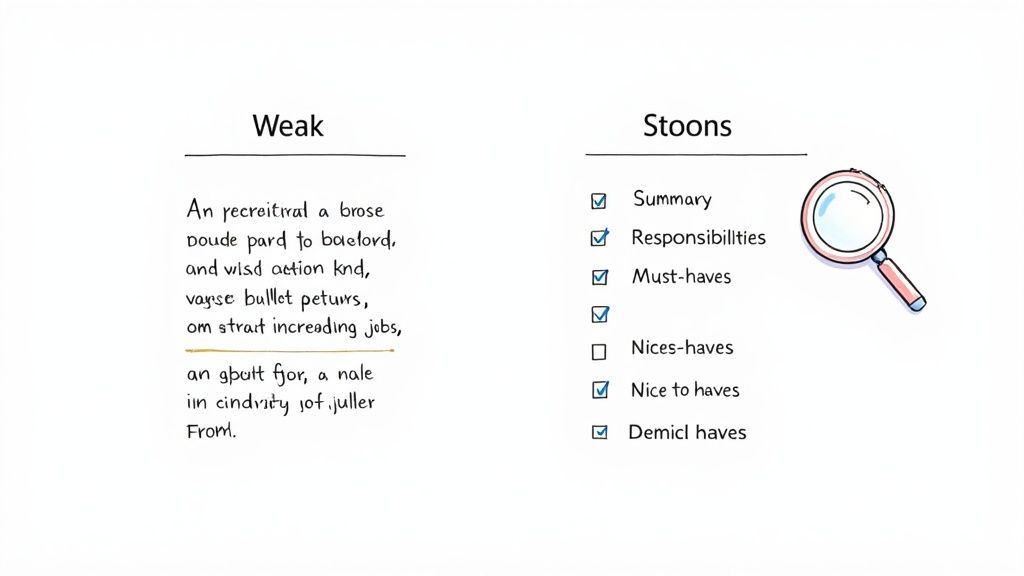
Next up is qualifications. This is not a wishlist for a legal unicorn who speaks three languages and has 20 years of experience with software that was released last Tuesday. Be realistic. The most effective way to do this is to divide your requirements into two clear buckets: Must-Haves and Preferred Qualifications.
Must-Haves (The Dealbreakers): These are the absolute, non-negotiable requirements. If a candidate doesn't have these, they are not qualified. Keep this list short.
Preferred Qualifications (The Tie-Breakers): These are the skills that would make a candidate stand out but aren't strictly essential. This is where you can list a specific certification, experience in a niche practice area, or familiarity with your firm’s case management software.
This simple separation signals to strong candidates—who might not check every single box on a long, intimidating list—that they should still apply. It broadens your pool of qualified applicants while still effectively filtering out those who are truly a bad fit.
Alright, you've drafted the job description. It feels pretty good, but you've still got a few questions nagging at you. That’s a good sign. Let's walk through the most common questions I hear from hiring managers who are in your exact position.
The single biggest mistake? Being simultaneously vague and overly demanding. It’s a terrible combination that kills your applicant pool before it even has a chance.
I’ve seen job posts that use generic fluff like “assist attorneys with various tasks” and then, in the very next line, demand ten years of experience on a software platform that’s only been around for three. It’s a perfect recipe for attracting crickets.
The fix is simple: be clear and realistic. Stop trying to hire a mythical creature. Instead, define the top 3-5 core functions of the role with absolute precision. Get brutally honest about what's a "must-have" versus a "nice-to-have." I'll always take a sharp candidate with 80% of my wishlist and a real hunger to learn over waiting for a perfect-on-paper candidate who doesn't actually exist.
It’s not just important; it's non-negotiable in today's market. Refusing to post a salary range is a massive red flag. It immediately signals one of two things: either you're completely out of touch with market rates, or you're looking to lowball the first person who bites. Neither is a good look.
When you hide the salary, you waste everyone’s time—including your own.
Posting a competitive, data-backed salary range is the fastest way to attract more qualified candidates. It filters out those who are out of your budget and kicks off the conversation with transparency and respect. It shows you're serious.
Don't play games. Put a realistic number out there, and you will immediately improve the quality of your applicant pool. It’s really that simple.
My advice is to focus on demonstrated experience over rigid educational requirements. While a paralegal certificate from an ABA-approved program is a solid baseline, it’s often far less valuable than five years of proven, hands-on expertise in your specific practice area.
I've seen brilliant, self-taught paralegals run circles around their formally educated peers. Experience in the trenches counts.
Of course, there are exceptions. For a highly technical role like e-discovery, a specific certification can be a major differentiator. To keep your options open, I always recommend phrasing the requirement as "Bachelor's degree or equivalent experience." This simple tweak ensures you don't automatically screen out a seasoned professional who learned their craft by doing the work.
You can’t just ask about them. Asking "Are you organized?" is like asking a fish if it can swim. The answer is always going to be yes, but it tells you nothing useful. You have to see the skills in action.
The best way to do this is to give candidates a short, practical exercise during the interview.
This approach reveals far more about their real-world capabilities under a bit of pressure than any interview question ever could. It’s how you separate the talkers from the doers.


