

 23 minutes read
Let’s be honest, the old way of hiring paralegals is a time-sucking, budget-draining nightmare. Stacks of resumes, endless interviews, and the constant fear of a bad hire leave you wondering if it’s even worth the trouble.
Turns out, there’s a much better way to find elite paralegals for hire without having to mortgage your office ping-pong table.

If your hiring process feels like a full-time job you never signed up for, you’re not alone. I’ve been there. You post a job opening, get buried in a mountain of resumes, and spend weeks trying to find a signal in the noise. It’s a slow, expensive grind that pulls you away from billable hours and, you know, actually practicing law.
The whole charade is built on a broken model. You're either paying hefty recruiter fees or spending your own valuable time playing HR, all for a coin-flip chance at finding someone who might be a good fit.
Why are we still hiring like it’s 2004? The legal world has evolved, but our approach to staffing has been stuck in neutral. We cling to the idea that the best talent lives within a 20-mile radius, forcing us into a tiny, overpriced talent pool.
This old-school thinking costs more than just money. It costs you:

The real cost of a bad hire isn't just their salary—it's the lost productivity, the strain on your team, and the cases you couldn't take on because you were understaffed. It’s a silent firm killer.
The table below starkly illustrates the difference between sticking with the old, cumbersome hiring process and embracing a more agile, modern approach.
| Metric | Traditional In-House Hiring | Modern On-Demand Hiring |
|---|---|---|
| Time to Hire | 6-8 weeks (or more) | 24-72 hours |
| Hiring Cost | $5,000 – $15,000+ (recruiter fees, ads) | $0 (platform-based) |
| Onboarding | 4-6 weeks of intensive training | 1-2 weeks for system integration |
| Financial Risk | High (salary, benefits, overhead) | Low (pay-per-hour, scalable) |
| Talent Pool | Limited to your local area | Global, pre-vetted professionals |
| Flexibility | Low (locked into full-time) | High (scale up or down as needed) |
The contrast is clear. The on-demand model isn't just about saving money upfront; it’s about agility and risk mitigation, two things every modern law firm needs to survive.
The new reality of legal staffing is about strategy, not geography. It’s about tapping into a global network of pre-vetted professionals who can step in and contribute from day one. To make this shift successfully, it's essential to first get a clear handle on different employment models. A great place to start is understanding 1099 employees.
This change isn't just a "nice to have"; it's a strategic necessity. The legal market is surprisingly fluid. In the US, the Bureau of Labor Statistics projects about 39,300 paralegal positions will open up each year until 2034, mostly due to turnover.
This constant movement creates a massive opportunity for firms ready to adapt. You can tap into this talent stream to slash hiring time and payroll costs by leveraging pre-screened professionals who are ready to hit the ground running.
Consider this your wake-up call. It's time to ditch the broken system and adopt a hiring model that actually works for a modern law firm.
Let's be honest. If your entire strategy for finding a top-tier paralegal is just posting on LinkedIn and Indeed, you're fishing in a pond that's been picked clean for years. The best candidates aren't doom-scrolling job boards; they're already busy, either happily employed or working with platforms that bring quality opportunities directly to them.
Hope you enjoy spending your afternoons fact-checking resumes and running first-round interviews—because that’s now your full-time job. If you'd rather be practicing law, it's time to change where you're looking.
When you start looking for remote talent, you'll quickly find there are two main paths. First, you have the massive, generalist freelance marketplaces. Think of them as the big-box stores of hiring. They have a bit of everything, which usually means they have a lot of nothing you actually need.
You'll spend hours sifting through profiles, trying to figure out if "experience with legal documents" means someone once notarized a form for their cousin. It’s a numbers game where the odds are rarely in your favor, and it’s a fast track to hiring mediocrity.
Then you have the specialized talent networks. These are the boutique shops. They focus on one thing and do it exceptionally well—in our case, connecting law firms with pre-vetted legal professionals. The candidate pool is smaller, sure, but it’s packed with actual experts who’ve already been through a rigorous screening process.
The goal isn't just to find a paralegal. It's to find the right paralegal without dedicating a quarter of your year to the search. Specialized platforms cut through the noise by doing the initial 90% of the vetting for you.
To truly fix your hiring process and consistently find the best people, you need to think bigger. It's about building a system, not just filling a seat. A great place to start is with a modern playbook for recruiting top talent that can be adapted for your firm's specific needs.
I’m going to let you in on a secret that completely changed our staffing game: looking beyond the US border. Specifically, to the incredible pool of legal talent in Latin America.
Forget every outdated notion you have about "outsourcing." This isn’t about finding cheap labor; it’s about finding exceptional value and a massive strategic advantage. I'll admit, I was skeptical at first, too. Then I saw the results.
Here’s why this works so well for US law firms:
This isn't about cutting corners. It's about getting more value for every dollar you spend on staffing. You gain access to a dedicated, highly skilled professional who becomes an integrated part of your team, all while keeping your overhead lean.
It's the ultimate strategic advantage for firms that want to scale intelligently. Stop fighting over the same small, overpriced local talent pool and start looking where your competitors aren't.
Let's be blunt: a generic job description gets you generic candidates. It’s that simple. When your job post reads like a dry, corporate laundry list of duties, you're essentially advertising that you’re a dull firm looking for an uninspired applicant.
The best paralegals—the ones who can genuinely move the needle for your practice—are hunting for an opportunity, not just another job.
Think of your posting as your first sales pitch. This is your chance to sell the role, the firm, and the future to a professional who has plenty of other options. If you drop the ball here, get ready to spend weeks sifting through resumes from people just looking for any port in a storm.
Here's a hard truth: top-tier paralegals don't need a primer on what their job entails. They already know how to draft pleadings, manage discovery, and organize client files. Listing these basic tasks is like telling a surgeon their job involves using a scalpel. It’s obvious, and frankly, a little insulting.
Instead, your entire job post needs to answer the one question every A-player is silently asking: “What’s in it for me?”
You have to shift your focus from what you need to what you offer. That means talking about things that actually matter:
Think of your job description less as a classified ad and more as a landing page for your firm's brand. Every single word should be crafted to attract the right person and politely repel the wrong one.
This approach is your first and most effective filter. For a deeper dive into structuring these descriptions, our guide on crafting a compelling paralegal job description offers a framework that has consistently helped us attract fantastic talent.
Let’s get practical. A job post for a litigation paralegal should feel completely different from one for a corporate paralegal. Why? Because specificity signals expertise and shows you actually know what you’re looking for.
Instead of this (Generic Litigation):
“Seeking a litigation paralegal to assist with all phases of litigation, including discovery, trial preparation, and case management.”
Try this (Specific & Compelling):
“We’re looking for a battle-tested Litigation Paralegal to be the organizational backbone for our trial team. You'll be instrumental in managing complex e-discovery for high-stakes commercial disputes and will have direct ownership of trial exhibit preparation. If you thrive under pressure and live for the details that win cases, this is your chance to play a key role in our most challenging work.”
See the difference? The first is a task list. The second is a mission.
Here’s another example, this time for a different specialty:
Instead of this (Vague Corporate Law):
“Corporate paralegal needed to handle entity formation, corporate governance, and general corporate matters.”
Try this (Specific & Compelling):
“Join our fast-paced corporate team as the go-to Paralegal for our emerging tech clients. You’ll manage everything from Series A financing rounds to complex M&A due diligence, working directly with founders and venture capital firms. This role is perfect for a highly organized professional who loves the energy of the startup world and wants to help build the next big thing.”
This approach doesn't just attract better candidates; it attracts the right candidates—people who are genuinely excited by the specific work your firm does. It shows you're a serious, modern firm looking for a partner, not just another pair of hands.
A great resume is the start of a conversation, not the end of it. I’ve seen enough perfectly polished CVs from candidates who couldn't draft a simple motion to know that what looks good on paper often falls apart in practice.
This is where the rubber meets the road. If you don't have a vetting process that systematically separates the talkers from the doers, you're just gambling with your firm's payroll.
You could spend all day fact-checking credentials and running interviews—or you can build a machine to do it for you. This is my battle-tested playbook for hiring paralegals, designed to pinpoint the true A-players. (Toot, toot!)
Here's a simplified look at our attraction process, which breaks down how we define the role, showcase the opportunity, and filter for the best fits.
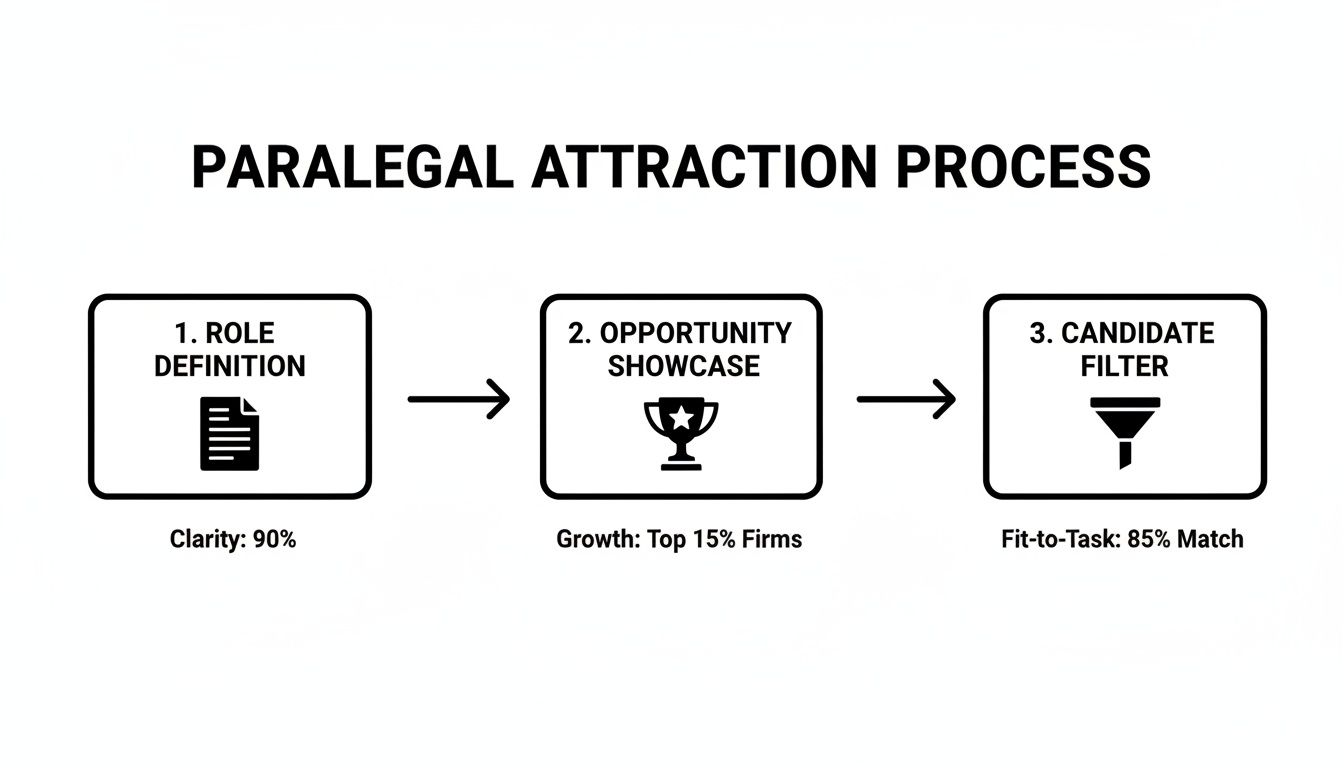
The key takeaway is that a successful hire is the result of a deliberate, multi-stage filtering system—not a single, lucky interview.
We break our vetting down into four non-negotiable stages. Skipping a step is like skipping due diligence in a multi-million dollar deal—you just don’t do it.
This multi-step approach is more important than ever. Remote work has exploded, with one 2023 survey showing that 42% of freelance paralegals work remotely full-time. This shift is powered by widespread tech adoption—83% of law firms use legal tech, and 90% are on cloud-based systems. You need a process that proves a candidate can thrive in this environment.
Generic questions get rehearsed answers. Asking "What are your greatest strengths?" is a waste of everyone's time. You need questions that force candidates to think on their feet and reveal how they actually operate.
Here are a few of my go-to questions:
The goal of an interview isn't to confirm what's on a resume. It's to discover everything that isn't. You’re testing for critical thinking, proactivity, and resourcefulness—the skills that define an elite paralegal.
When you can’t see someone across the office, how do you know if they're a proactive communicator or a ghost who only surfaces when a deadline is on fire? You have to test for it.
During the skills validation stage, pay close attention to how they handle the process.
And when you get to the final stage, reference checks are your best friend for confirming these traits. For practical advice, our guide on how to conduct reference checks provides specific questions to ask former employers to get the unvarnished truth. Stop guessing and start hiring with a process that proves who the best candidates really are.
So you've run the gauntlet, vetted the candidates, and finally made the hire. Time to celebrate, right? Not quite.
This is the exact moment where so many law firms drop the ball. After investing all that time and energy to find a star performer, they throw them into a chaotic, sink-or-swim environment with almost no guidance. A great hire can't possibly succeed if you set them up to fail from day one.
Onboarding isn't just sending over some login credentials and calling it a day. It's the critical 90-day period that determines whether your new paralegal becomes a long-term asset or just another costly turnover statistic.
The first two days set the entire tone for the working relationship. Your goal is simple: make your new remote paralegal feel welcomed, equipped, and absolutely clear on their purpose. Don't just fire off an email with a password and expect magic to happen.
Your immediate checklist needs to be ruthlessly practical:
This initial phase is all about building momentum. Get these small but crucial steps right, and you create a foundation of confidence that pays dividends later.
Don't mistake a quiet new hire for a self-sufficient one. Silence in the first week often means confusion, not competence. Proactive communication from your end is non-negotiable.
Once they're set up, you need to define the rules of the road. With a remote team member, clarity isn’t just important; it’s the whole game.
This has nothing to do with watching their every move with tracking software—that’s just a trust-killer. It’s about establishing a clear framework for autonomy and accountability so you can focus on results, not keystrokes.
From my experience, a simple “First 90-Day Plan” document works wonders. It should clearly outline:
A well-structured onboarding process is the single best management tool you’ll ever have. For firms looking to build out a more detailed plan, our guide on how to onboard remote employees provides actionable templates and checklists you can implement right away.
Now for the part that makes everyone nervous: compliance and payroll, especially when you hire someone internationally. I’ve seen firms get so bogged down in the perceived complexity that they give up on finding fantastic paralegals for hire from outside the US.
That’s a huge mistake.
The truth is, handling this doesn't have to be a nightmare. When you work with a reputable talent platform, they do all the heavy lifting. They manage the international payroll, ensure you're compliant with local labor laws, and roll it all up into a single, simple invoice for your firm.
This approach effectively de-risks the entire process. It makes hiring a top-tier expert in Latin America just as easy as hiring someone in the next state over. You get the talent you need without the administrative headache. This is how you turn a great hire into an indispensable, long-term part of your firm.
Let's be honest about the "generalist" paralegal. They can handle the basics—managing a calendar, drafting a standard letter, keeping files in some semblance of order. They’re fine. But “fine” doesn’t win tough cases or give you an edge when competition is breathing down your neck.
In today's legal market, settling for a jack-of-all-trades is a huge strategic mistake. When you’re staring down a tight deadline on a complex environmental compliance issue, do you really want someone whose last task was a routine family law filing? Probably not.
The real value, the kind that shows up in better client outcomes and a more efficient firm, comes from specialization. A paralegal with deep experience in your specific practice area isn't just another pair of hands; they're a force multiplier for your entire team.
Think about it this way: a specialist in intellectual property law already lives and breathes the USPTO filing system. They can spot a potential trademark conflict a mile off and don't need a primer on the difference between a patent and a copyright. They just know.
This translates into less hand-holding from you and a higher caliber of work from them. It’s the difference between just delegating a task and truly offloading a responsibility with confidence.
The moment you hire a specialist is the moment you stop managing tasks and start leveraging real expertise. They don’t just do the work; they improve it, often anticipating needs you haven’t even thought of yet.
I remember one e-discovery project that was an absolute train wreck. We were completely drowning in data. We brought in a paralegal who specialized in litigation support and e-discovery, and she didn't just save us time—she built a review protocol that uncovered critical evidence we would have absolutely missed. That’s not a luxury; it’s a game-changer.
And this isn't just for the old-school practice areas anymore. As the legal field gets more complex, the demand for very specific expertise is exploding in some of the fastest-growing sectors.
In fact, the demand for specialized paralegals for hire is surging. We've seen IP specialization alone jump by 25% in just five years. The ever-increasing complexity in finance and environmental law means these niche experts can command a premium. This is why platforms that vet and curate specialists give firms a massive leg up—they offer on-demand access to this deep talent pool. You can dig into the latest hiring trends to see just how critical this has become.
It's time to stop looking for someone who can do everything “okay.” Your firm's growth hinges on finding professionals who can do a few critical things exceptionally well. That’s your secret weapon.
Alright, you've seen the playbook, but I'm willing to bet a few questions are still rattling around. That's completely normal. Shifting how you build your team is a big deal, so let's tackle the most common "what-ifs" I hear from managing partners every day.
Let’s get straight to the numbers, because that’s what really matters. When you post an opening for a paralegal in the US, you're realistically looking at a $61,000+ annual salary. And that's just the starting point—it doesn't even touch benefits, payroll taxes, or the cost of an extra desk in your office.
It adds up incredibly fast.
By contrast, firms that tap into the vetted talent pool in Latin America are consistently cutting their direct payroll expenses by up to 80%. You get a dedicated, top-tier professional who is fully bilingual and works on your time zone, all without the staggering overhead of a domestic hire. This isn't about finding a "cheap" option; it's about making a strategically sound financial decision for your firm's growth.
I know what you're thinking. "International compliance? Cross-border payroll? Sounds like a massive administrative headache." Honestly, it would be if you tried to manage it all yourself.
This is exactly why you don't go it alone. A specialized talent platform exists to handle all the messy stuff for you. They manage the international payroll, ensure you're compliant with all local labor laws, and consolidate everything into one simple monthly invoice. It completely removes the legal risk and administrative burden from your plate.
The entire point of this model is to reduce your workload, not create more. A great talent partner makes geography irrelevant by handling the cross-border complexities so you can stay focused on practicing law.
Data security is non-negotiable, but it’s also a solved problem in the remote world. The security of your firm's sensitive information begins with your systems. You're likely already using secure, cloud-based practice management software, mandating VPN access, and enforcing clear data handling protocols.
Your remote paralegal simply plugs into the secure infrastructure you've already built.
Reputable platforms add another critical layer of trust. They conduct extensive background checks on every candidate and require them to sign robust, iron-clad NDAs before they ever see a single client file. You grant them access and set permissions just as you would for any team member sitting in your office. Their physical location doesn't change a thing.


