

 17 minutes read
So you want to do high-stakes legal research from your home office? Good news: the market is on fire. And I'm not talking about a temporary, post-pandemic blip. This is a real, structural shift in how the legal world operates, and it puts skilled researchers like you in a ridiculously strong position.
If you play your cards right, you can build a flexible, high-value career with more autonomy than you ever thought possible. Let's break down what's happening, why this is your moment, and how to avoid the common pitfalls.
Not long ago, the idea of doing complex legal research without a physical office seemed like a fantasy. Today, it’s a thriving corner of the industry. If you’re seeing more remote legal research roles, your eyes aren't deceiving you. This is a fundamental shift, not just a few hip law firms trying something new.
What's the real story? Simple supply and demand. Law firms finally woke up and realized their talent pool doesn't have to end at the city limits. Why restrict a search to a 30-mile radius when the perfect researcher might be three states away? The talent pool is now national, and the smart ones are taking full advantage.
This isn't just about convenience; it's about survival. The job market for top-tier legal support is tighter than a drum.
Let's look at the numbers. One recent analysis found over 4,000 active job board listings for "remote legal research." At the same time, the unemployment rate for paralegals and legal assistants sat at a jaw-droppingly low 1.9%. Add the fact that 65% of legal departments planned to hire more contract pros, and the picture becomes crystal clear. You can dig into the full research on legal job market trends if you enjoy nerding out on data as much as I do.
This perfect storm of high demand and scarce local supply is practically forcing firms to embrace remote talent.
This flow chart nails it—the well of on-site talent is running dry, and high employer demand is pumping life into remote opportunities.
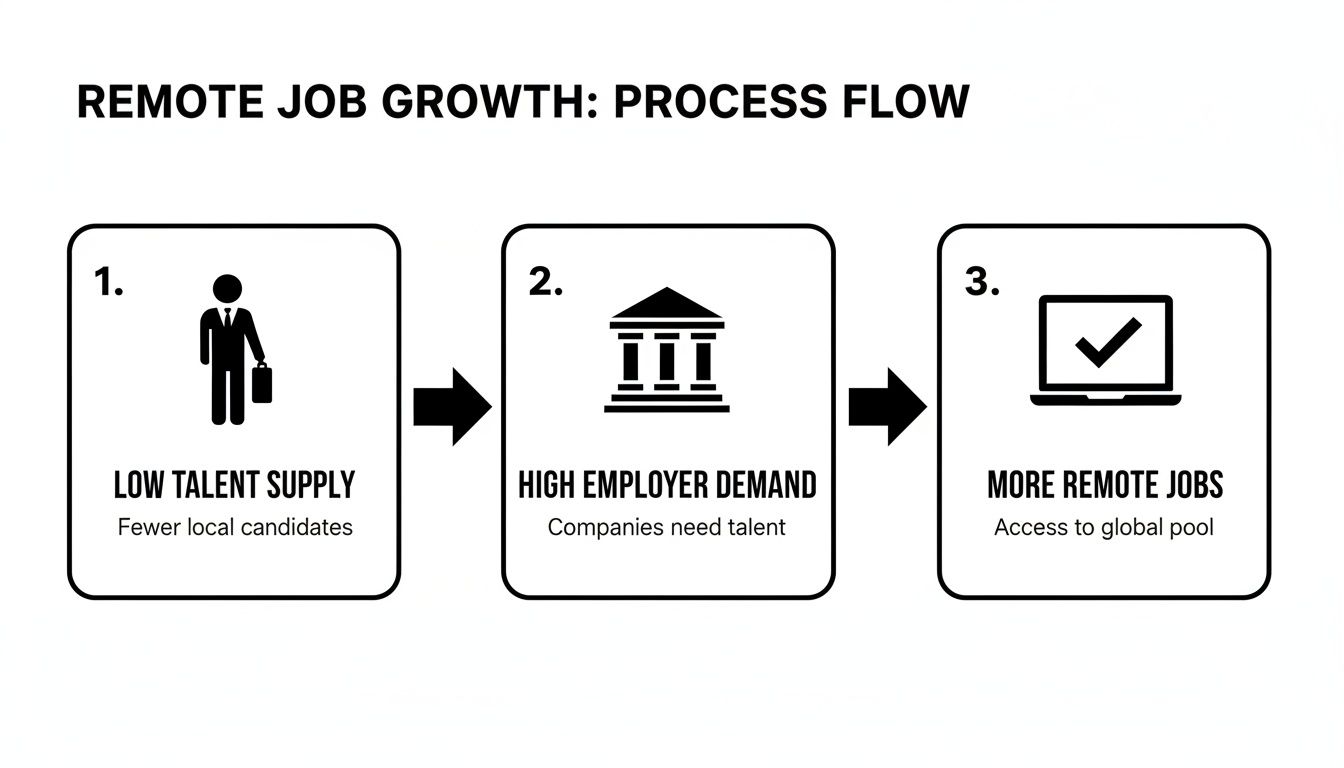
For many firms, remote hiring isn’t a perk anymore; it's a core strategy to find the expertise they need to stay in the game.
To put it simply, the market is tilted heavily in your favor. This table breaks down why.
| Market Factor | What It Means for You | The Bottom Line |
|---|---|---|
| Record-Low Unemployment | Firms are desperate. They can't find qualified local talent. Your skills are a hot commodity, no matter where you live. | More opportunities, better negotiating power. Simple. |
| High Employer Demand | Legal departments are swamped. They need your brain now, not in six months after a painful hiring process. | A steady stream of project-based and long-term work is yours for the taking. |
| Shift to Contract Hiring | Firms want on-demand expertise without the overhead of another full-time hire. They don't want to pay for your healthcare. | You can build a diverse client list and call the shots. More control, less office politics. |
These aren't just abstract trends. This is the foundation of a lucrative career path for anyone ready to work differently.

Forget any old-fashioned ideas about 'temp work.' This is about building a strategic, high-value career on your terms. You're leveraging a market that desperately needs your skills, whether you're in a major legal hub or a town with one stoplight.
This new reality puts you squarely in the driver's seat. Firms need sharp researchers who can deliver exceptional work without needing a dedicated desk and a pot of stale coffee. This is your chance to prove that world-class legal analysis depends on a sharp mind and a great internet connection—not a specific zip code.
Let's get one thing straight. Calling yourself a "legal researcher" is like a doctor saying they "do medicine." It's true, but it's not going to land you the best remote legal research jobs. The truly interesting work—and the money that comes with it—is in the niches.
Firms aren’t looking for another generalist who can pull up a case on Westlaw. They’re hunting for the wizard who navigates complex patent databases in their sleep or the go-to expert for deep dives into convoluted immigration case law. When a partner has a high-stakes environmental compliance question, they want the person who already lives and breathes that stuff.
This is where you find your leverage.
You might be thinking, "My experience is all over the place." That’s fine. Most of us start there. The trick is to stop listing what you’ve done and start framing what you’re an expert in. It’s a subtle but powerful shift from a laundry list of tasks to a compelling, specialized story.
Did you spend two years on a messy commercial real estate dispute? You’re not just a researcher; you’re a specialist in title and zoning litigation support. Did you handle a ton of discovery for a tech company? Boom. You’re an expert in e-discovery for intellectual property matters. See the difference?
It’s about connecting the dots in your background to solve a specific, expensive problem for a law firm. Generalists are a dime a dozen. Specialists get hand-picked.
The Founder's Take: We pay a premium for specialists because they eliminate risk and save us time. When I hire a niche expert, I’m not just buying research; I’m buying their judgment and the confidence that they won’t miss the one obscure ruling that could blow up our entire case. I can trust them from day one.
The goal is to become the obvious choice for a particular type of work. This means mastering the tools of that trade. Knowing your way around a foundational platform like Westlaw is just table stakes.
Knowing the major databases is the bare minimum. Your niche expertise is what actually gets you hired. Being certified in a platform relevant to your specialty is a massive credibility boost.
Ready to move beyond the basics? Look at the work you actually enjoyed and were good at. Focus on profitable and in-demand areas like these:
Pick one. Own it. This is how you stop competing on price and start competing on expertise.
Let’s be honest. Your resume is a fact sheet. It’s the boring, black-and-white list of where you’ve worked. Your portfolio is the proof—it’s the technicolor evidence that you can actually deliver.
When you're going for a remote legal research job, you don't get a firm handshake or a sharp suit to make your first impression. You get a PDF. That’s it. Your portfolio is what separates you from the dozens of other resumes piling up in an inbox. Its job is to make them feel like they're taking a risk by not hiring you.
This is your evidence locker. Let’s make sure it’s organized to win the case.
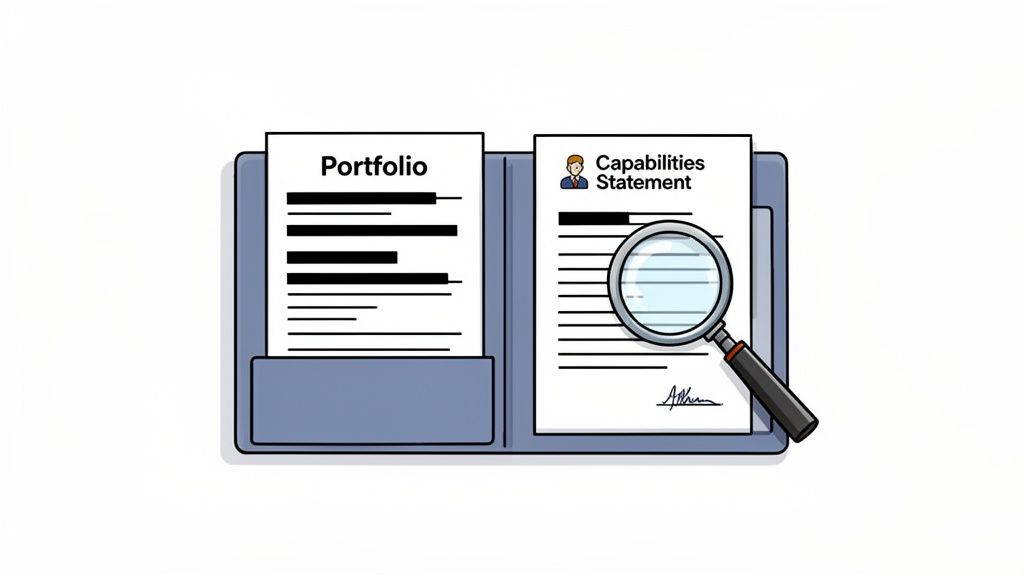
First rule of portfolio club: redact, redact, redact. You absolutely cannot use prior work without meticulously scrubbing every last piece of confidential information. I'm not just talking client names; I mean case numbers, judges, specific locations, and unique facts.
A single slip-up is an instant disqualifier that screams, "I don't understand attorney-client privilege." It's a non-starter.
Once everything is clean, your samples need to showcase both your range and your precision. Don't just toss in five of the same kind of document. Curate a small, powerful collection that shows off your brain from different angles.
The Complex Research Memo: This is your heavyweight champion. Pick a memo that tackles a thorny issue. It should show your ability to synthesize complex law into a clear, actionable recommendation.
The Concise Case Summary: Can you distill a 50-page opinion into a one-page summary a busy partner can read in three minutes? This proves you respect their time.
The Persuasive Motion or Brief: Including a section of a persuasive document shows you can do more than just report on the law—you can weaponize it.
Your portfolio should feel like a highlight reel, not a data dump. Three to five exceptional samples are infinitely more powerful than a 20-page document of mediocrity. Quality over quantity, always.
Now for my favorite tool: the Capabilities Statement. Forget the flowery cover letter nobody has time for. This is a one-page, skimmable document that acts as your professional calling card. It’s part resume, part marketing slick, and 100% focused on solving their problems.
It needs to include:
This one page shows you get the business of law. To make it even better, show you're forward-thinking. Mentioning your familiarity with various legal use cases for document automation and data extraction signals you’re thinking about efficiency, not just billable hours.
So, where do you look? If your strategy is endlessly scrolling through Indeed, you're doing it wrong. That's like shouting into a void and competing with thousands of others for the same handful of listings.
The best remote legal research opportunities aren't always posted on mainstream sites. They’re found through smarter channels where your expertise can shine. It's time to stop digging through the digital slush pile and start hunting where serious firms are looking.
Think of general freelance sites as a massive, noisy bazaar. Sure, there's a lot happening, but most of it is noise. You’re stuck competing with a global talent pool, which inevitably turns into a race to the bottom on price. That’s a game you don't want to play.
Specialized legal talent platforms, however, are more like a private club. They connect pre-vetted legal pros with firms willing to pay for real expertise. It’s a curated environment built on quality, not quantity.
The pre-vetting process is the secret sauce. Once a platform has confirmed your skills, you're no longer just another random applicant. You're a qualified, verified candidate, which immediately puts you in a different league.
These platforms are exploding because they solve a huge headache for law firms. Recruiting is a nightmare. In fact, 96% of legal leaders say they struggle to find skilled talent. This forces them to use on-demand professionals to fill gaps. A platform that delivers a shortlist of vetted candidates in 24 hours is a lifesaver for them.
You can read more about how firms are leveraging on-demand talent to see how big this trend is. It’s exactly why you should focus your energy here first. Our own platform connects firms with top-tier remote talent (toot, toot!), and you can explore more in our guide to remote law jobs.
Now, let's talk about an underrated but killer strategy: targeted outreach. This isn't about spamming every partner on LinkedIn. It’s about surgical precision.
Identify ten boutique firms that operate squarely in your niche. Find the managing partner or head of the practice group. Then, craft a short, sharp email that speaks their language.
Here’s what a great outreach email looks like:
This approach reframes the entire dynamic. You’re not a job seeker asking for a handout. You’re a strategic resource offering a valuable solution. It’s a power move. And it works.
Alright, let’s talk about money. Underselling yourself is the fastest way to burn out and resent your clients. So let's tackle the dreaded question, "What's your rate?" without just pulling a number out of thin air.
Forget what your friend’s cousin charges. We need real data.
The pay for remote legal research jobs is all over the map, but it's not a complete mystery. Job sites show advertised rates from $12 to $76 per hour. That’s a huge range, but for U.S. firms, an experienced paralegal or junior attorney should be commanding contract rates in the $25–$45 range. You can dive into the latest salary data for remote legal research to get a feel for the market.
This is your baseline, not your destiny. It's the starting point before you factor in your actual value.

Your niche expertise is your biggest lever. If you're a generalist, you're competing with everyone. If you're the go-to expert in patent research for biotech firms, you're in a category of one.
Complexity matters, too. A simple case summary isn't worth the same as a multi-state regulatory analysis that could save a firm from a seven-figure fine. Are you just a pair of hands, or are you a strategic partner? Your price should reflect the latter. Our guide on virtual paralegal rates gives a deeper look at how these factors influence pricing.
Stop anchoring your rate to what you think someone will pay. Anchor it to the value of the problem you solve. A well-researched memo that shuts down a frivolous lawsuit isn't worth $35/hour; it's worth thousands.
You're not stuck with just one way to bill. The structure you choose can dramatically impact your income. Let's break down the options.
| Pricing Model | Best For | Potential Downside |
|---|---|---|
| Hourly Rate | Projects with undefined scopes or ongoing support. It's simple and protects you from scope creep. | It penalizes your own efficiency. The faster you get, the less you make for the same task. Lame. |
| Project-Based Fee | Clearly defined tasks like a research memo or a 50-state survey. Great for selling value, not time. | You have to be ruthlessly accurate in your time estimates. Screw it up, and you're working for free. |
| Retainer | Firms that need consistent, ongoing support. It gives you predictable revenue, which is nice. | You must set clear boundaries on hours and tasks to avoid becoming an on-call employee without benefits. |
Each model has its place. Sometimes you'll use a mix. The key is confidence. Present your rates clearly and be ready to explain the value behind them. This isn’t just about getting paid; it’s about getting paid what you’re worth.
Alright, let's get down to brass tacks. You see the opportunity, you've thought about your niche, but the practical questions are probably rattling around in your head. No fluff, just the straight answers we give people when they ask what it really takes to succeed.
Think of this as the final gut check.
You don’t need a command center, but you cannot skimp on the basics. Trying to do this on a glitchy laptop and spotty coffee shop Wi-Fi is a recipe for getting fired.
Here’s the non-negotiable list:
Most importantly, you need to be a pro on platforms like Westlaw or LexisNexis. While many firms provide subscriptions, having your own certifications is a massive plus.
This is the question that keeps managing partners up at night. You need a bulletproof answer. Protecting client data is just as important as your research skills.
First, never use public Wi-Fi for client work. Period. Your home network must be secure and password-protected. A VPN (Virtual Private Network) is highly recommended.
Your physical space matters, too. Your screen shouldn't be visible to family or roommates, and you must lock your computer every time you step away. When you proactively bring up your security protocols in an interview, you're showing you’re a professional who understands the stakes.
Your home office needs the same sanctity as a law office. Sloppy security is a career-ending mistake.
A paralegal certificate or a J.D. is the price of admission. In a competitive remote market, tech credentials give you a real edge.
Westlaw or LexisNexis certifications are table stakes—they prove you know the core tools. To really stand out and justify a higher rate, look at niche credentials. An e-discovery certification like CEDS is in high demand. If you're in a privacy niche, a CIPP designation makes you an incredibly attractive candidate.
To stay ahead, get familiar with AI-powered research tools. It shows you’re focused on efficiency and delivering maximum value, which is exactly what clients are looking for.


