

 17 minutes read
Let's be real—payroll compliance isn't just some boring business term. It’s the tightrope every founder walks between paying their team correctly and getting buried in fines from government agencies you didn't even know existed. Nail it, and everything just… works. Get it wrong, and you’re looking at audits, penalties, and a whole lot of expensive, soul-crushing paperwork.

So, what is payroll compliance? In short, it’s the complete rulebook—federal, state, and local—dictating every single detail of how you pay your people. Think of it as a game where the referees are humorless, and the penalties are steep. It’s not just about cutting a check. It’s about navigating a twisted maze of regulations covering:
Trying to "figure it out as you go" is a rookie move. It's a bet that almost always ends with a nasty letter from a government agency and a check you really don't want to write.
This is not some administrative chore you can pawn off on an intern. When I first started my business, I honestly thought payroll was just simple math. A few spreadsheets, some basic calculations—how hard could it be? It didn't take long for reality to slap me in the face.
The truth is, the goalposts for payroll compliance are always moving. Tax codes get "simplified" into oblivion, new labor laws pop up, and what was perfectly legal last quarter could get you fined today. It’s no surprise a recent survey found 57% of global payroll professionals see local compliance as their single biggest headache. Staying on top of it isn't just good practice; it’s a matter of survival.

At its core, payroll compliance is about ensuring every dollar that leaves your business for an employee is calculated, taxed, and documented perfectly according to the law. No shortcuts, no excuses, no "we'll fix it later."
To give you a clearer picture, here's a quick rundown of what you're really juggling.
This isn't just a table; it's a map of all the landmines you need to avoid.
| Compliance Pillar | What It Covers | The 'Oops' Consequence |
|---|---|---|
| Wage and Hour Laws | Minimum wage, overtime pay, meal breaks, and final paychecks. | Back-pay liabilities, hefty fines from the Department of Labor, and employee lawsuits that’ll ruin your year. |
| Tax Withholding & Filing | Accurately calculating, withholding, and remitting federal, state, and local taxes (income, Social Security, Medicare). | Eye-watering penalties from the IRS and state tax agencies. They don't play around. |
| Recordkeeping | Maintaining meticulous records of hours worked, pay rates, taxes withheld, and personal employee data. | Inability to defend yourself in an audit. You're basically presumed guilty. |
| Worker Classification | Correctly identifying workers as either employees (W-2) or independent contractors (1099). | Fines for misclassification, plus liability for back taxes, benefits, and unemployment insurance. The big one. |
This is precisely why a "good enough" approach to payroll is a recipe for disaster. One miscalculation or one misclassified paralegal can set off a chain reaction of penalties and legal headaches. To really get a handle on it all, you can learn the essential steps to manage payroll effectively. Understanding the mechanics is the first step toward not getting burned.
Think you've got the rules down? Cute. Payroll compliance isn't a single set of guidelines. It’s a three-layer cake of bureaucracy where federal, state, and local governments all get a slice. Getting one layer right doesn’t mean a thing if the others are wrong.
This isn’t just a list of laws; it's a survival guide. The federal government sets the floor, but then states and cities start building their own crazy additions on top.
Let's start with the big leagues—the federal laws that apply to pretty much everyone. These are the non-negotiables.
Getting these right is the absolute minimum. It’s like putting air in your tires before a road trip. It doesn’t guarantee you won’t get lost, but you’re definitely not going anywhere without it.
Now, this is where things get messy. States take the federal baseline and crank it up to eleven, creating a patchwork of rules that can make your head spin. What’s perfectly legal in Texas could land you in hot water in California.
I once saw a law firm get hammered with a massive penalty over their meal break policy. They were following federal law perfectly, but they’d completely missed California's much stricter rules. It was an honest mistake that cost them five figures. States don’t care about federal guidelines; they only enforce their own.
And it’s not just one or two weird regulations. States have their own unique, and often maddening, rules for things like:
This regulatory minefield is especially dangerous for firms hiring remote paralegals or staff across state lines. To get a better handle on these issues, it's worth diving deeper into the broader world of employment law.
Just when you think you’ve finally got it sorted, a city or county can drop yet another layer of complexity on you. That's right—local governments love to get in on the action with their own payroll ordinances.
These hyper-local rules are the banana peels that trip up even the most careful businesses. We’re talking about city-specific minimum wages that laugh at the federal level, or paid leave laws that only apply within certain zip codes. A paralegal working from Denver is subject to different rules than one living just 20 miles away. It’s nuts, but it's the reality.
Let’s talk about the siren song of the 1099 contractor. It sounds so simple, doesn’t it? All the talent, none of the payroll taxes, benefits, or withholding headaches. What could possibly go wrong?
Turns out, everything.
Misclassifying an employee as an independent contractor is one of the most common—and catastrophically expensive—mistakes you can make. I’ve seen it happen. A firm gets a little too cozy with its team of "consultants," and suddenly the Department of Labor shows up. And let me tell you, they are not there for a friendly chat.
Forget the legalese for a second. The whole employee-vs-contractor debate boils down to one simple question: Who has the right to control the work? It has nothing to do with what you call them or what their contract says. It’s about the reality of the relationship.
The IRS and labor departments have their little checklists, but they all circle back to this one idea.
If you dictate how, when, and where someone does their job, you’re almost certainly dealing with an employee. Period. This is where so many companies get it wrong. They hire a "freelance" paralegal but then manage them like a full-time staffer.
This helpful infographic shows the hierarchy of laws that govern payroll, each with its own strict rules on worker classification.
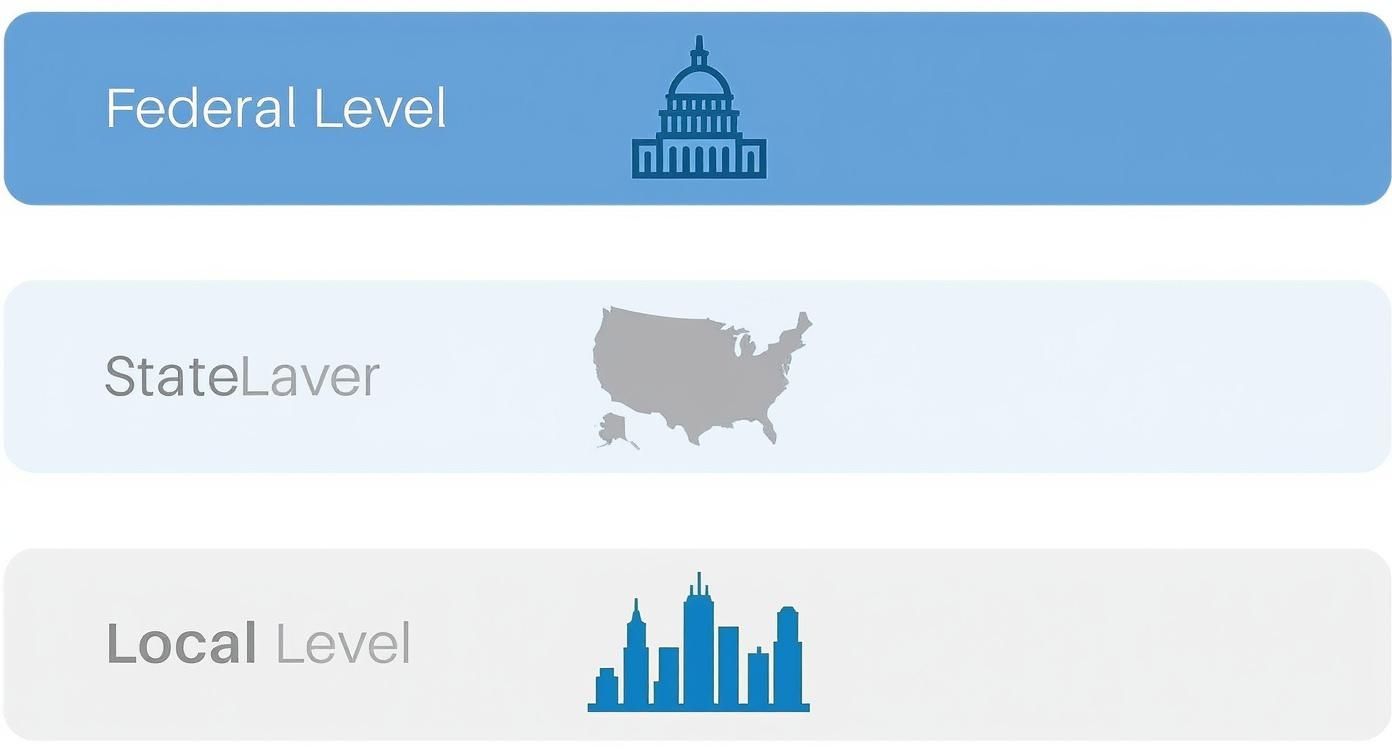
As you can see, compliance isn’t just a federal issue. State and local authorities pile on their own definitions and penalties, adding dangerous new layers of risk.
So, what does "control" actually look like? It’s rarely one single thing. It’s the whole vibe of the relationship. That said, some things are basically giant, flashing neon signs for auditors.
Here are the signs you might have an employee, not a contractor:
Getting this wrong isn't a slap on the wrist. It’s back taxes for Social Security and Medicare, unemployment insurance, workers' comp, and a mountain of penalties. It’s the kind of hit that can sink a small business. This is the heart of what payroll compliance is all about, because the entire system depends on you getting this right.
Misclassification isn't just a payroll error; it's a fundamental misunderstanding of your workforce. The cost isn't just the back taxes—it's the operational chaos that follows an audit.
Managing this distinction is critical. For a deeper look, our guide on what is contingent workforce management can help you structure your team the right way from the start.
Alright, let's get to the real fun: the endless cycle of paperwork that makes you wish you’d become a professional dog walker instead. This is where the game gets real. Paying your team is one thing; meticulously tracking, withholding, and reporting every single dollar is another beast entirely.
Think of yourself as a reluctant banker for both your employees and the government. You’re holding their money in trust, and they both expect flawless records. A shoebox of receipts won't cut it.
First, let’s clear something up. People throw around "withholding tax" and "payroll tax" like they’re the same thing. They are not. Confusing them is a rookie mistake with painful consequences.
Mishandle withholding, and you’re basically playing with someone else's money—something the government frowns upon. Fail to pay your own payroll taxes, and they'll come for you just as hard. Both paths lead to a bad time.
The moment you hire your first employee, you become a tax collector. It’s not an optional side hustle; it’s a core responsibility. The IRS doesn't care if you're busy or confused—they just want their money. On time. With the right forms.
Once you've got the money sorted, you have to tell everyone about it. This means an alphabet soup of forms, each with its own deadline.
Form 941 is your quarterly report card to the IRS. Form 940 is your annual unemployment tax report. Then you have the year-end madness of W-2s for employees and W-3s to summarize it all.
And don’t forget Form W-4, which each employee fills out. This one little document dictates how much tax you withhold. An outdated W-4 can lead to a surprise tax bill for your employee and a compliance headache for you. This should be a key part of your process for how to onboard remote employees.
So, what do you actually have to keep, and for how long? Rule of thumb: keep everything. But the FLSA and IRS have some specific demands.
You must maintain these for at least three to four years (I’d say keep them longer, just in case):
This isn’t about being organized; it’s about building a fortress of proof. If an ex-employee files a wage claim or the DOL comes knocking, these records are your only defense. Without them, you're toast.
Alright, enough theory. Let's get tactical. Audits are won with action, not good intentions. This is your battle plan for getting your payroll house in order, starting now.
Think of this as your quarterly self-audit. Be brutally honest, and plug the leaks before they sink the ship. This is the stuff that lets you sleep at night.
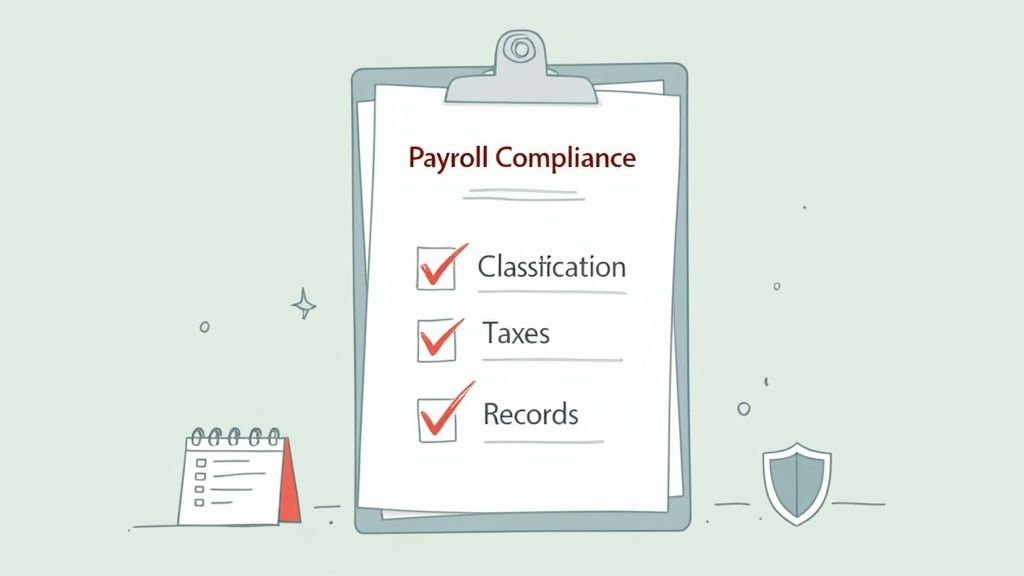
This is ground zero. Get this wrong, and everything else is a waste of time. It’s the mistake that keeps on giving—in the form of back taxes, fines, and penalties.
Your ability to pull up the right document at the right time is your best defense. A messy paper trail is an admission of guilt to an auditor.
An auditor doesn't care about your side of the story. They care about documentation. If you can't prove you paid someone correctly, in their eyes, you didn't.
Your immediate to-do list:
"I forgot" is not a legal defense. Government agencies run on deadlines, and missing one is an unforced error with automatic penalties.
For a more detailed, downloadable resource to keep everything straight, you might find a comprehensive checklist helpful for tracking all these moving parts.
Remember that three-layer cake of doom? This is where you double-check that you haven't missed a weird local ordinance. Federal compliance is just the price of entry.
To put this all into practice, a regular self-audit is your best friend. Use this table as a starting point.
| Audit Area | Key Checkpoint | Status (Compliant / Needs Review) |
|---|---|---|
| Worker Classification | Are all independent contractors correctly classified according to IRS/DOL tests? | |
| New Hire Paperwork | Is a completed Form I-9 and W-4 on file for every new employee? | |
| Tax Withholding | Are federal, state, and local income tax withholdings calculated correctly? | |
| Tax Deposits | Were all payroll tax deposits made on time for the previous quarter? | |
| Recordkeeping | Can you access pay records for any employee from the last 3 years? | |
| State/Local Laws | Are you compliant with minimum wage and overtime rules for all locations? | |
| Reporting Deadlines | Have all quarterly reports (Form 941, etc.) been filed on schedule? |
By making this a routine, you turn payroll from a source of anxiety into a well-oiled machine. This isn't just about avoiding penalties; it's about building a solid foundation.
Of course, you could just skip all this. We built HireParalegals to handle the pain of payroll and compliance for remote talent, so you can focus on running your firm instead of becoming a part-time payroll clerk. (Toot, toot!)
You’ve got questions, I’ve got answers. After years of watching founders stumble through this minefield, I’ve heard it all. Let’s get straight to it.
Hands down, the biggest one is misclassifying employees as independent contractors. It's the payroll equivalent of hitting "reply all" on a sensitive email—the damage is immediate and widespread.
Close behind is screwing up overtime pay. Either calculating it wrong or just not paying it at all. Other greatest hits include missing tax deadlines, using ancient W-4 forms, and keeping records so messy they look like a conspiracy theorist's wall map.
Constantly. It feels like you blink and some new city has passed a minimum wage hike or a state has invented a new paid leave requirement.
While the big federal laws are pretty stable, state and local rules are always in flux. This is why a "set it and forget it" approach to payroll is so dangerous. You have to stay on your toes.
You can, but the real question is, should you? Modern payroll software is great for crunching numbers and filing forms, but it’s a tool, not an expert. It will only ever be as smart as the information you feed it.
If you tell the software that a full-time employee is a 1099 contractor, it will happily execute your mistake with ruthless efficiency.
The software won't know that your new hire in Colorado needs a paid 10-minute rest break for every four hours worked. A good platform is essential, but it doesn't replace human oversight—especially when you start hiring across state lines. The software handles the how, but you're still on the hook for the what and the why.


