
 14 minutes read
When you’re drowning in legal work, your first instinct is to type "contract attorney near me" into a search bar. It feels safe, right? Like ordering from the local pizza place you’ve known for years. But that comfortable habit, a relic from a world before video calls and cloud docs, is probably costing you a fortune.
Turns out there’s more than one way to hire elite legal help without mortgaging your office ping-pong table.
Let's get straight to it. When you hire the lawyer down the street, you're paying for more than their legal brain. A slice of your fee covers their swanky office lease, the mahogany desk, and all that other traditional overhead. It's a business model built for a different century, and you're footing the bill.
But the sticker price is only half the story. The real kicker is the ridiculously small talent pool. What if you need a specialist who actually understands the labyrinth of international data privacy laws or has deep experience negotiating enterprise SaaS contracts? The odds of that exact person being in your zip code are laughably slim. So you settle for a generalist—someone who’s fine, but not the razor-sharp expert you desperately need.
This chart lays it all out. No fluff.
The message is clear: clinging to geography shrinks your options and inflates your costs. Opening your search to the entire planet, on the other hand, gives you access to a world of specialists and keeps your budget from spiraling out of control.
Look, the legal industry itself is already over the "local-first" model. The 2026 State of the US Legal Market report found that even as legal demand skyrocketed, midsize firms grew by nearly 5%. Their secret? Outsourcing routine contract work to more cost-effective remote providers. This is why platforms connecting businesses with vetted remote lawyers aren't just a quirky alternative anymore; they're the new standard. You can get more details about the legal market from this report.

The perceived safety of a local hire is an illusion. The real risk isn't geography; it's hiring a B-player with the wrong expertise because your options were limited to whoever was nearby.
Let's be real—the "near me" search is a costly reflex. You're trading access to a global network of A-list specialists for a face-to-face meeting that could have been a video call. It’s time to think bigger than your city block.
The true cost of legal help isn't just the hourly rate. It's about what you get for your money. When you stack a traditional local search against a modern remote one, the difference in value, expertise, and opportunity is night and day.
| Factor | Traditional 'Near Me' Search | Modern Remote Search |
|---|---|---|
| Talent Pool | A shallow pond. Limited to your city or region. Finding a niche specialist is a nightmare. | A global ocean. Access to top-tier experts in any legal specialty you can dream of. |
| Overhead Costs | You’re subsidizing their office lease, admin staff, and that fancy espresso machine. | Minimal to none. Remote attorneys have lower overhead, and those savings get passed to you. |
| Flexibility | Rigid. Locked into local business hours and the hassle of in-person meetings. | Total. Attorneys work across time zones, offering insane flexibility and faster turnarounds. |
| Value for Money | Lower. You pay higher rates for a smaller pool of (often generalized) talent. | Higher. You pay for pure expertise, not office décor, and get access to specialized skills. |
Bottom line: a remote search puts you in the driver's seat. It lets you find the right person for the job, not just the closest one.
So, your "contract attorney near me" search was a bust. Now what? Let's be honest, the best legal talent isn't mingling at stuffy bar association mixers or hiding in a sea of unverified LinkedIn profiles. For modern legal needs, the real pros are on specialized platforms built for on-demand legal work.
But here’s a dose of reality: not all of these platforms are created equal. Some are just glorified job boards, dropping a mountain of resumes on your desk and forcing you to play recruiter. Hope you enjoy spending your afternoons fact-checking resumes and running technical interviews—because that’s now your full-time job.
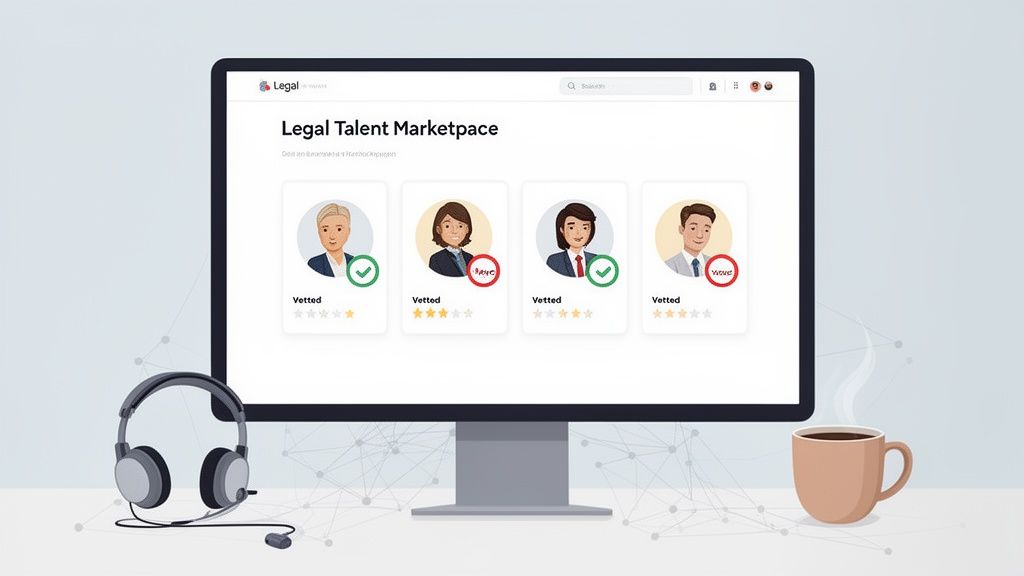
The platforms actually worth your time do the heavy lifting for you. They get that your goal isn’t to find an attorney; it’s to find the right one, yesterday. This means their entire system is built around quality control, not just vanity metrics.
A top-tier marketplace is your first line of defense. It filters out the noise so you only see candidates who have already cleared a high bar. We're talking about services that handle the tedious, high-stakes work before a profile ever hits your screen.
Here’s what separates the pros from the posers:
The real value of a great legal talent platform isn't just access—it's trust. It’s the confidence of knowing every candidate you see has already survived a professional gauntlet.
When you're shopping around, focus on their process, not their promises. The right service saves you an insane amount of time and, more importantly, mitigates the risk of a bad hire—an expensive mistake I’ve learned to avoid at all costs. You can learn more about finding the right lawyers on demand in our detailed article.
Look for a marketplace that’s transparent about how they vet people. If they can’t clearly explain their qualification process, run. Your time is too valuable to spend doing their job. The goal here is to plug elite, reliable talent into your workflow, not to create a new one.
So, a promising resume landed in your inbox. Great. Now, unless you have a rock-solid system, get ready for your new side hustle: fact-checking credentials and running interviews. I’ve wasted countless hours on candidates who looked perfect on paper but crumbled under the pressure of a real project.
This is my playbook for vetting a contract attorney without torching your week.
First, forget asking them to "walk you through their resume." That’s just an invitation for a well-rehearsed monologue that tells you nothing. We need to cut through the fluff and get straight to what matters.
Your goal is to test for practical experience, not just claimed experience. I like to kick things off with a simple, direct question about their workflow.
"What case or project management software are you most familiar with, and what do you like or dislike about it?"
Their answer immediately reveals if they’ve worked in a modern legal environment or if they’re still using carrier pigeons. After that, I throw a couple of curveballs to see how they think on their feet.
These aren't trick questions. They’re designed to reveal the subtle "tells" that separate a seasoned pro from someone who just writes a good resume. It's a tough market out there—a staggering 58% of legal organizations now say finding qualified people is their biggest challenge. You can read more about these legal industry statistics to see just how tight things are.
A great candidate answers with specific examples and a clear process. A weak one gives you vague, theoretical nonsense. The difference is immediately obvious.
Ultimately, the best shortcut is to use a platform that does this for you. Services with a rigorous, multi-step vetting process—interviewing, background checks, skills validation—build a bench of pros you can trust from day one. It turns vetting from a week-long migraine into a quick confirmation call.
And while this process is key, don't forget the final step. You can learn more about how to conduct reference checks in our detailed guide.
Alright, let's talk about the part everyone hates: the money. Figuring out a fair rate for a contract attorney can feel like trying to nail Jell-O to a wall. Rates are all over the map, and it's shockingly easy to overpay—or worse, cheap out and get legal work that’s worth exactly what you paid for it.
The $500 Hello. The biggest mistake I see founders make is obsessing over the hourly rate. Think about it: a $150/hour attorney who takes ten hours to review a simple contract is way more expensive than a $400/hour specialist who knocks it out, perfectly, in one. You’re paying for an outcome, not just their time. The goal is to negotiate based on value, not the number on their rate sheet.
I’ve watched friends overspend on a "local" attorney, only to realize they were mostly paying for the firm's downtown office view. When you need specialized expertise, like in intellectual property or complex litigation support, expect to see rates from $250 to $500+ per hour for top-tier remote talent.
For more general work, like reviewing standard business contracts, the range often falls between $150 and $300 an hour. For a more detailed breakdown, our guide on contract attorney hourly rates gets into the nitty-gritty.
Just remember the old saying: if a rate seems too good to be true, it is.
Once you agree on a rate, the engagement agreement is your bible. It’s not a formality; it’s the rulebook for your entire relationship. A vague contract is just a future argument waiting to happen.
Make sure your agreement absolutely nails these points:
To truly run your legal ops like a pro, it's also worth understanding how specialized tools handle various legal document processing use cases, which can create massive efficiencies. Getting the contract right is how you lock in A-list talent without breaking the bank.
You did it. You navigated the search, dodged the "contract attorney near me" trap, vetted your candidates, and made the hire. Don't pop the champagne just yet—the game isn't over.
The difference between a contract attorney who delivers value on day one and one who spends a week just finding the bathroom is decided in the first 48 hours. A sloppy onboarding process is the fastest way to burn through your budget and kill a project's momentum before it even starts.
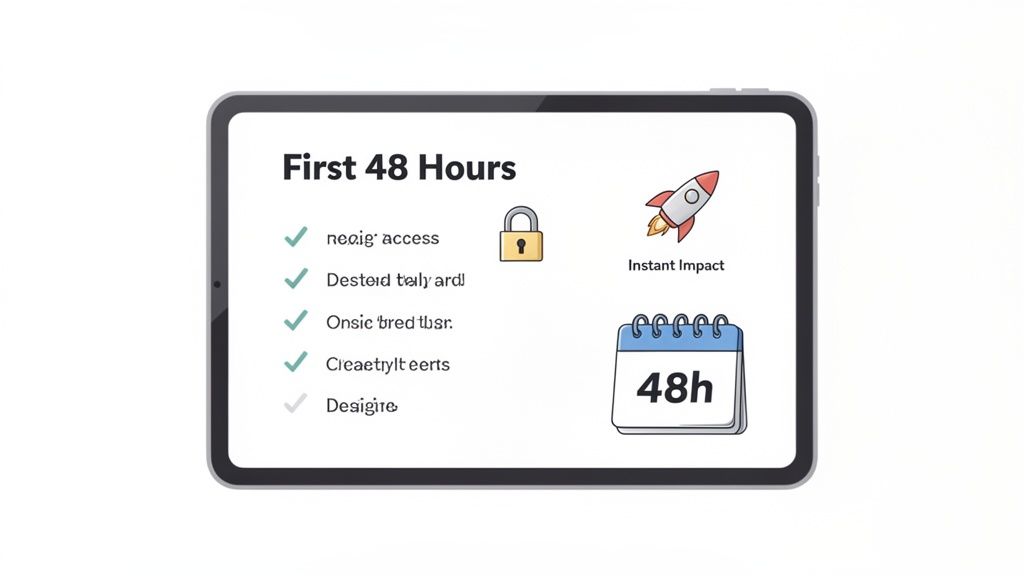
Forget the generic welcome packet. Your new attorney needs immediate, actionable clarity. I learned this the hard way after a few painful—and expensive—false starts. You need a "plug-and-play" setup ready to go before they even log in.
This isn’t just about being organized. It’s about setting a professional tone that top-tier talent respects.
Grant System Access Now: Don't make them waste their first morning begging for passwords. Have all logins for your case management software, document repositories (Dropbox, Google Drive), and communication channels (Slack, Teams) ready to go.
Assign a Clear First Task: Hand them a well-defined initial project. Give them all background docs, key contacts, and a specific, measurable goal. Make sure they know exactly what success looks like.
Set the Communication Rhythm: How will you work together? Decide if you'll use Slack for quick questions and email for formal updates. I highly recommend a brief, 15-minute daily check-in for the first week to get in sync.
A seamless onboarding sends a clear message: you value their time as much as your own. It's the bedrock of a productive and repeatable working relationship.
Getting this right means your new hire delivers value from hour one, not day five. It turns a simple hire into a strategic weapon.
Alright, let's cut to the chase. When I talk to other founders about ditching the "contract attorney near me" search, the same questions always come up. Here are the quick, no-BS answers I've learned from being in the trenches.
Let’s flip this around. Is it safe to limit yourself to a tiny local talent pool and hope the best person for the job just happens to live within a 10-mile radius? The biggest risk in hiring isn't geography; it's hiring someone without the specific skills you need.
A good remote platform mitigates this better than you ever could. Their entire business model depends on rigorous vetting that’s way more thorough than a busy founder has time for. With secure tech and ironclad contracts, a remote attorney is often more accountable, not less.
Look, good management is about clarity and tools, not hovering over someone's shoulder. I’ve seen more work get done by a remote attorney across the country than by someone sitting ten feet away.
It boils down to three things:
It’s less about watching them work and more about trusting a professional to be a professional.
The old fear of remote work was about losing control. The reality is, it forces you to become a better, clearer manager—which is a win for your entire business.
To ensure your remote attorney can make an instant impact by maintaining seamless client communication and avoiding missed leads, consider solutions like the best AI receptionist for law firms.
Finally, what kind of work is best for this model? Honestly, almost anything project-based. Think overflow work during a busy quarter, large-scale document review, drafting standard agreements, or tapping a specialist for a single, high-stakes project. If it doesn't require a full-time headcount, it’s prime for a contract attorney.