

 20 minutes read
Let's get straight to it: are online legal jobs actually legal? The short answer is yes, absolutely—but only if you do it right. Get it wrong, and you're walking your firm straight into a minefield of unauthorized practice of law (UPL) violations, crippling misclassification lawsuits, and data breaches that will nuke your reputation.

You’ve seen the chatter. Firms are snagging top-tier remote paralegals, slashing overhead by as much as 80%, and tapping into a global talent pool that was once impossible to reach. Turns out there’s more than one way to hire elite talent without mortgaging your office ping-pong table.
But let's be real. This isn't as simple as finding someone on Upwork and sending them your Clio login.
The whole concept of remote legal work sits on a razor's edge. On one side, you have insane efficiency, scalability, and serious cost savings. On the other? A very expensive, very painful lesson in cross-border employment law, state bar ethics, and international data privacy.
The difference between those two outcomes isn't luck. It's a rock-solid plan.
We've been in these trenches for years, watching firms either nail this or fail spectacularly. The ones who thrive don't just cross their fingers and hope for the best. They build a framework for the worst-case scenarios, because they understand that hiring remote talent isn't a casual gig—it's a fundamental operational shift.
Success boils down to getting three things right from day one:
Before we dive deeper, let's put these risks on the table. Here’s a quick summary of what you’re up against.
| Legal Risk Area | What It Means in Plain English | The Potential Nightmare Scenario |
|---|---|---|
| Unauthorized Practice of Law (UPL) | Your non-lawyer team member gives legal advice, which they aren't licensed to do. | Fines, sanctions from the bar, loss of your license, and voided client agreements. |
| Employment Misclassification | You call someone a contractor when the law says they're an employee. | Huge bills for back taxes, payroll contributions, overtime, and benefits, plus hefty government penalties. |
| Data Security & Privacy Breaches | Client data gets exposed or stolen because of an insecure remote setup. | Malpractice lawsuits, client loss, reputational ruin, and regulatory fines (think GDPR or CCPA). |
| Cross-Border Compliance | You ignore the labor laws and tax rules of your remote team member's home country. | Fines from foreign governments, legal battles in another country, and being barred from hiring there again. |
This isn't just a list of hypotheticals; these are firm-killers.

This isn't fear-mongering. It's pragmatism. The goal is to build a remote team that becomes your firm's biggest asset, not its biggest liability.
Think of this guide as your pre-flight checklist. We're skipping the vague optimism and giving you the straight-up advice you need. This is your playbook for tapping into a global workforce without blowing up your firm.
First up: the UPL maze.

Ah, UPL. The two letters that keep managing partners up at night. You’re pumped about the cost savings of a remote paralegal, but then the late-night paranoia creeps in. Is the work they're doing from another country accidentally the unauthorized practice of law on your watch?
Valid concern. But the answer isn’t to bury yourself in decades of ethics opinions. It’s to build a rock-solid system of supervision and delegation. Get that right, and UPL is a non-issue.
The entire UPL risk boils down to one question: is your remote team member providing legal advice or legal support? One requires a law license. The other requires your direct supervision. Firms get torched when they blur that line.
Think of it like a surgeon and a surgical tech. The tech is indispensable—they prep the tools, manage the OR, and assist under the surgeon's guidance. But they aren't making the diagnosis or the final cut.
Your remote paralegal is your surgical tech. A force multiplier, not a substitute.
UPL isn't just about what your paralegal tells a client. It's about the tasks you delegate, the autonomy you give them, and the final work product that goes out the door. The buck always, always stops with the supervising attorney.
"Just supervise them" is lazy advice. What does that actually look like when your paralegal is 5,000 miles away? It means creating documented guardrails that leave zero room for interpretation. If the state bar ever comes knocking, this is your proof of compliance.
Here’s a playbook that works.
1. The "Never Ever" List
Your remote paralegal needs to understand, in writing, what they are explicitly forbidden from doing. This isn't about distrust; it's about clarity.
2. The Detailed Task Delegation Protocol
Vague instructions like "handle discovery for the Smith case" are an invitation for trouble. You need to break it down into concrete, non-discretionary action items.
Instead of vague, try this:
This creates a paper trail. It proves the work was ministerial and performed under your direct supervision—the core of a compliant online jobs legal framework.
3. The Mandatory Attorney Review Checkpoint
No substantive work product leaves your firm without your eyes on it. Period. This is your single most important defense.
Your workflow must have a non-negotiable checkpoint where a licensed attorney reviews, modifies, and approves any client-facing document. That final approval is what transforms it from a paralegal's work into the firm's legal work. It’s a simple step that keeps your license safe.
Let's be honest. One of the oldest temptations in business is calling everyone an independent contractor to save a few bucks. No payroll taxes, no benefits, no fuss. It’s also one of the fastest ways to get a deeply unpleasant letter from the IRS.
When you bring remote work into the mix, the lines get even blurrier. Does giving a remote paralegal a software license count as "control"? What about setting deadlines? These aren't trivial details; they're what regulators fixate on.
Get this wrong, and you're facing back taxes, interest, and penalties that can be absolutely crippling. Let’s make sure that doesn't happen.
Whatever you think you know about worker classification, hit refresh. In many states, the old, flexible "right to control" test is dead. It’s been replaced by the far more rigid ABC test, which assumes your worker is an employee unless you can prove otherwise.
Think of it as guilty until proven innocent. To classify someone as a contractor, you have to prove all three of these things:
For law firms, Part (B) is a killer. Good luck arguing that a paralegal’s work is "outside the usual course" of a law firm's business.
Here's the bottom line: Regulators don't care what your contract says. They care about the economic reality. If it looks, walks, and quacks like an employment relationship, they'll treat it as one.
Theory is one thing; day-to-day operations are another. Firms think a well-drafted contractor agreement is an ironclad shield. It’s not.
Your daily interactions define the relationship. To keep your online jobs legal and compliant, you have to nail the operational differences. Here’s a quick breakdown of what screams "employee" versus "contractor."
| Screams "Employee" (High Risk) | Screams "Contractor" (Lower Risk) |
|---|---|
| Setting their specific work hours (e.g., must be online 9-5 EST). | Paying them per project or for a block of hours to be used flexibly. |
| Providing them with a firm-owned laptop and software licenses. | They use their own equipment and subscribe to their own software. |
| Managing the "how" of their work process step-by-step. | You define the desired outcome, but they determine the process. |
| Integrating them into your firm's hierarchy and org chart. | They operate as a distinct business entity (e.g., an LLC) and send invoices. |
| The relationship is ongoing and indefinite, with no clear end date. | The engagement is for a specific, defined project with a clear scope. |
This isn't just about one hire; it's about your entire talent strategy. If you're building a flexible team, you better understand what contingent workforce management actually involves.
The choice isn’t about which model is "better." It's about which one reflects reality. Don't try to force a square peg into a round hole to dodge FICA taxes. That’s a gamble that almost never pays off.
The $500 Hello. That's what you'll get from a good international lawyer when you call them in a panic because you just realized you're an accidental employer in another country. Let's avoid that.

So you did it. You found a rockstar paralegal in Bogotá with killer credentials, ready to start tomorrow at a rate that makes your accountant weep with joy.
But hold on. You’re now an international employer. Hope you enjoy your new crash course in Colombian labor law, cross-border tax treaties, and international data transfer rules. Turns out there’s more to it than a Zoom call and a wiring instruction.
Let’s be clear: hiring internationally is one of the smartest moves a modern firm can make. But diving in without a plan is like trying to cross the ocean in a rowboat. You're probably going to sink.
When hiring outside your home country, you're at a fork in the road. Do you hire them directly and figure it all out yourself? Or do you partner with someone who has already figured it out?
This isn’t just a logistical choice; it’s a strategic one.
Option 1: The DIY Direct Hire
Going direct means you’re on the hook for everything. Registering a legal entity in that country, setting up local payroll, figuring out mandatory benefits, and ensuring your contracts comply with local labor laws.
Good luck with that. One wrong move with Brazil’s notoriously complex labor code, and you could find yourself in a very expensive, very foreign legal battle.
Option 2: The Employer of Record (EOR) Lifeline
An Employer of Record is a third-party company that legally hires your chosen candidate on your behalf. Think of it as compliance-as-a-service.
They handle the messy stuff: payroll, taxes, benefits, and local compliance. Your paralegal in Colombia technically works for the EOR, but they are fully dedicated to your firm. You get the talent without the legal migraine.
For 99% of small to mid-sized firms, using an EOR is a no-brainer. The cost is a fraction of what you'd spend on legal fees to set up a foreign entity yourself. It’s the difference between scaling your team in days versus months (or never).
Whether you go direct or use an EOR, you can't ignore the core compliance issues that come with international online jobs legal frameworks. These are the big three.
1. Payroll and Benefits
You can’t just pay an international team member via PayPal and call it a day. Every country has rules about payroll deductions, tax withholding, and social contributions.
2. Termination Rules
Firing an employee isn't always straightforward. In the U.S., "at-will" employment is common. In many other countries, you need a legally valid reason ("just cause") to terminate someone, and failing to provide one can trigger hefty severance payments. An EOR manages this to keep you compliant.
3. Data Privacy and Security
When client data crosses borders, so do your legal obligations. Hire someone in Europe, and you're suddenly subject to GDPR. In Latin America, you're dealing with laws like Brazil's LGPD.
The global online job market has exploded, but legal frameworks haven't kept pace. This rapid growth has outpaced safeguards, creating a gray area where firms must tread carefully. You can explore the latest statistics about remote work trends and their legal implications to stay informed.
Ultimately, global hiring is about managing risk. Ignoring international law isn't a strategy; it's a gamble.
Let’s talk about the elephant in the room. You’re about to have your client's most confidential data flying across a residential Wi-Fi network in another country. What could possibly go wrong?
Oh, just about everything.
Hiring remote team members exponentially expands your firm's surface area for cyberattacks. Trusting that a new paralegal’s home network is "secure" is a recipe for a data breach, a malpractice claim, and a catastrophic loss of client trust. I hope you enjoy explaining that to the ethics board.
This isn’t an IT problem; it's a risk management issue. Building a digital fortress isn't optional—it's your professional duty.
Forget the fancy bells and whistles. To make your online jobs legal and secure, you need a baseline of security protocols that are non-negotiable. If a candidate can't comply, they aren't the right fit. Period.
This is just the starting point. The explosion in online jobs has created a massive surge in remote work, but legal frameworks are struggling to keep up. This lag makes having your own strict internal policies even more critical. The latest state of remote work statistics show just how fast these trends are outpacing regulations.
Here’s a fun question for your insurance broker: does my malpractice policy cover a data breach caused by a remote paralegal in another country?
Don't be surprised by the long, awkward silence.
Most standard policies were written for a world without a global, remote workforce. Pick up the phone—today—and confirm your coverage. You'll likely need a specific cyber liability rider. Assuming you're protected is a massive, and potentially firm-ending, gamble.
Theory is great, but a checklist is better. Review this with your IT team and insurance broker to cover your digital and legal backside.
Key Takeaway: The goal isn't to prevent remote work; it's to enable it securely. A documented security protocol is your best defense.
This checklist is your starting point:
Answering these questions isn't just a box-ticking exercise. It’s how you build a resilient firm that can confidently hire global talent.
Enough theory. We’ve walked through the minefields. Now, let’s build a system you can rely on to hire safely and get back to practicing law.
Think of this as a chronological, battle-tested process. Skip a step, and you're rolling the dice. Follow it, and you'll build a compliant, scalable remote team that's a genuine asset, not a lurking liability.
Getting this right prevents 90% of future headaches. I’ve seen too many firms rush this part, and it almost always bites them.
1. Craft a UPL-Proof Job Description
Clarity is everything. Your job description must spell out that the role is for a non-lawyer assistant under the direct supervision of a licensed attorney. Use language that focuses on administrative work. Instead of “manage case files,” try “organize and summarize documents for attorney review.”
2. Define the Classification from Day One
Before posting the job, decide: employee or contractor? Base your decision on the ABC test and the reality of the role. Don't just default to "contractor" because it feels easier.
3. Set Non-Negotiable Security Standards
Your job post should lay out your baseline security requirements. Be explicit. Mention the need for a private, secure home office and compliance with your VPN and device policies. This weeds out candidates who can't meet your essential standards from the start.
Okay, applications are in. Now, separate the pros from the risks.
4. Conduct Scenario-Based Interviews
Ditch the generic questions. Ask things that probe their understanding of ethical boundaries.
"A client calls in a panic asking for a quick update on their case strategy. I’m in court and unreachable. What do you do?"
The only right answer is some version of taking a detailed message and reassuring the client that an attorney will call them back—and absolutely nothing more. Their answer tells you everything.
5. Run Comprehensive Background Checks
This is not optional. For any role touching sensitive client info, run a criminal background check and verify their employment history. Skipping this to save a few hundred bucks is asking for trouble.
6. Verify Technical and Language Proficiency
If a candidate claims expertise in your practice management software, give them a short test. If clear English is critical, assess their written and verbal skills. Trust, but verify.
You’ve found your person. Now, formalize the relationship and embed compliance from day one.
7. Draft an Ironclad Agreement
Your contract is your safety net. It must explicitly cover:
8. Implement a Security-First Onboarding
Day one is all about security. Before they see a single client file, they must be set up on your VPN, have their devices secured via MDM, and complete your data security training. This sets a clear precedent.
Our own process for remote data security boils down to secure access, data encryption, and risk insurance.
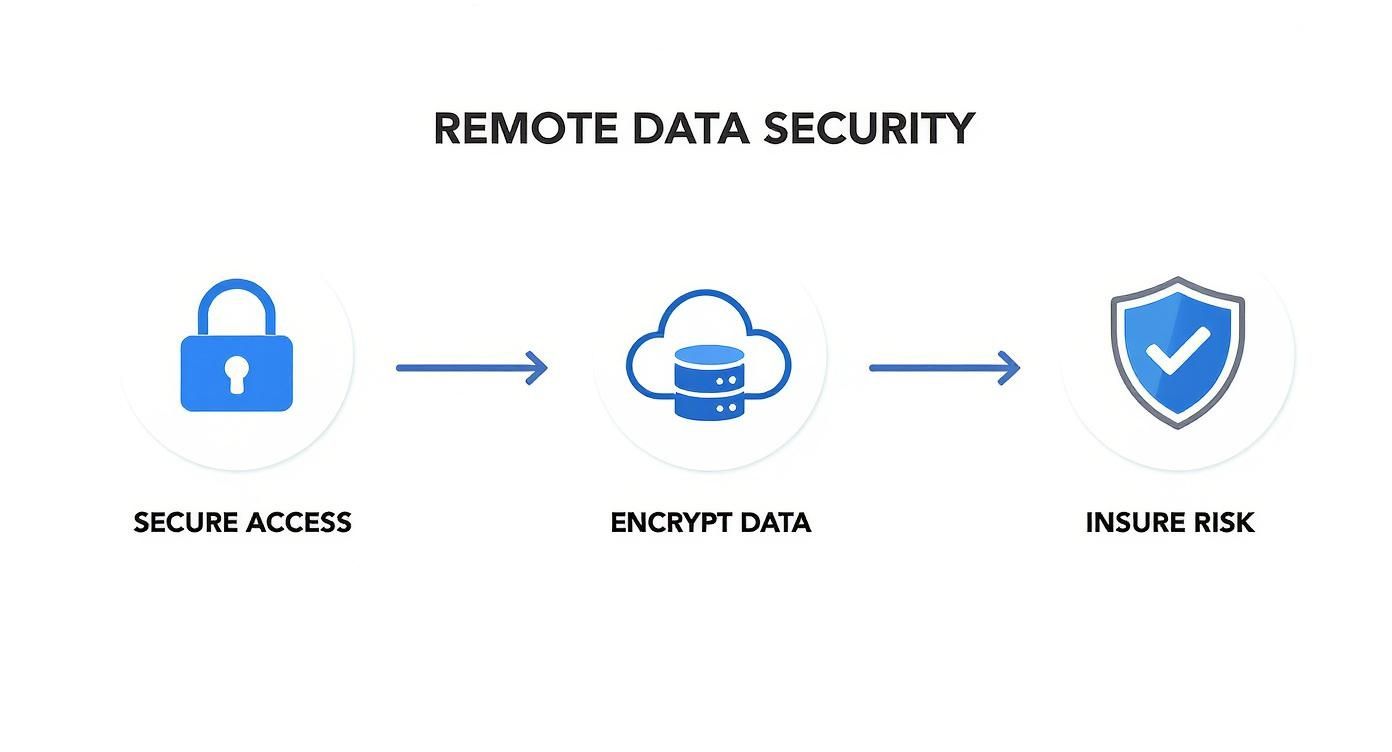
This drives home that security isn't a one-time task but a continuous process. It's about protecting client data at every turn, a framework any firm should adopt when considering virtual paralegal employment.
9. Schedule Regular Check-Ins
Finally, get into a rhythm. A quick daily huddle or a standing weekly check-in is crucial. It ensures you maintain the active supervision that serves as your best defense. This is how you make online jobs legal, safe, and a powerful tool for your firm's growth.
We've covered a lot of ground, but a few practical questions are probably still bouncing around your head. Let's tackle them.
Yes, but be extremely careful. The absolute key is supervision. A paralegal in another state must be directly supervised by a licensed attorney in your firm. This is your primary defense against UPL accusations.
Think of their role as preparatory. They can draft documents for your review and organize case files. They cannot, under any circumstances, provide legal advice. Your contract must make this crystal clear.
Without a doubt, it's misclassifying an employee as an independent contractor. It's an old trick to avoid payroll taxes, and regulators are cracking down hard.
If you control how, when, and where they work, they are almost certainly an employee. Don't guess. The legal tests are specific, and getting it wrong leads to staggering penalties. It's a costly, amateur mistake that's entirely avoidable.
The single biggest risk in building a remote team isn't UPL or data security—it's getting lazy with worker classification. Regulators are not forgiving on this.
Absolutely. You can't just assume they'll use their personal email and a free cloud drive. That’s a recipe for a data breach. To keep your online jobs legal and secure, you need a professional tech stack.
Your baseline should include:
Failing to provide these isn't just bad practice; it's a potential violation of your ethical duty of technological competence. Don't cut corners here.


