 12 minutes read
You're probably doing the same thing everyone else does. Refreshing Indeed, poking at ZipRecruiter, maybe glancing at LinkedIn, then wondering why legal assistant jobs Wichita KS keep turning into application black holes. That's not because you're doing something wildly wrong, it's because the Wichita market rewards people who understand the local game, not the people who spray résumés around like confetti.
Here's the blunt truth. Wichita firms don't care that you can “support a busy office” in the abstract. They care whether you can keep a case moving, handle documents without making a mess, and work with enough precision that nobody has to babysit you. If you're smart, you stop searching like a tourist and start searching like a local.
You know the feeling. Ten tabs open, the same three listings refreshed again, and still nothing that feels like a real shot. That's because a lot of Wichita candidates are shopping the title, not the job. The title says “legal assistant,” but the actual work can range from basic support to handling the kind of file work that keeps a case from falling apart.
The market tells the same story. Robert Half's Wichita benchmark puts a legal assistant at $43,160 to $59,138 in typical pay, while Zippia shows 48 local jobs with annual pay between $31,000 and $60,000 in Wichita, KS, which is a pretty clear sign that this isn't some giant, chaotic pay jungle, it's a fairly tight market with a real ceiling and floor (Robert Half Wichita legal assistant benchmark). That's useful because it tells you where to aim, and where not to waste your time.
It isn't. Robert Half describes the role as document drafting, legal research, client and court communications, scheduling, discovery support, and case-file management, which is a lot closer to legal production work than simple admin support (Robert Half Wichita legal assistant benchmark). That's why the pay sits above a basic office role. If you've been selling yourself as “organized and dependable,” fine, but that's table stakes. Wichita employers want proof you can keep legal work on the tracks.

Practical rule: if your résumé reads like an office coordinator wrote it, you're probably underselling yourself for Wichita legal support roles.
The other thing to remember is scale. This is a stable but modestly sized market, not a giant ocean of openings. That means you're not winning by shouting louder. You're winning by looking more useful than the next applicant, especially on software, accuracy, and actual legal support experience.

The local pay spread is the part that trips people up. Zippia lists 48 openings in Wichita, KS with annual pay from $31,000 to $60,000, while Robert Half shows a typical Wichita range of $43,160 to $59,138 (Zippia Wichita legal assistant jobs, Robert Half Wichita legal assistant benchmark). Those numbers don't describe one neat salary band. They describe a market where the title hides a lot of variation.
The variance comes from job scope. A legal assistant who drafts routine correspondence and keeps calendars is not in the same lane as someone handling discovery, filings, client communication, and court deadlines. Robert Half's job description makes that clear, and the pay range backs it up (Robert Half Wichita legal assistant benchmark). In plain English, the more a role looks like legal operations instead of office support, the more money usually shows up.
That's why you can't compare jobs just by title. A family-law role, a litigation role, and a public-sector support role can all say “legal assistant,” but the daily workload and compensation are different animals. Wichita's market doesn't reward title worship. It rewards specificity.
Bottom line: if a posting sounds vague, assume the pay is trying to hide something.
You also need to think about market size. Zippia's 48 jobs figure suggests a real but limited pool, which means strong candidates get noticed when they look concrete, not generic (Zippia Wichita legal assistant jobs). That's why I'd rather see a candidate with clean, narrow experience and strong software fluency than one with a fancy summary and no usable skills.
One more thing. If you're only watching the biggest job boards, you're already late. A smarter search also includes targeted career pages and niche recruiting channels, including resources like the paralegal job websites guide. That's where the less noisy opportunities tend to surface first.
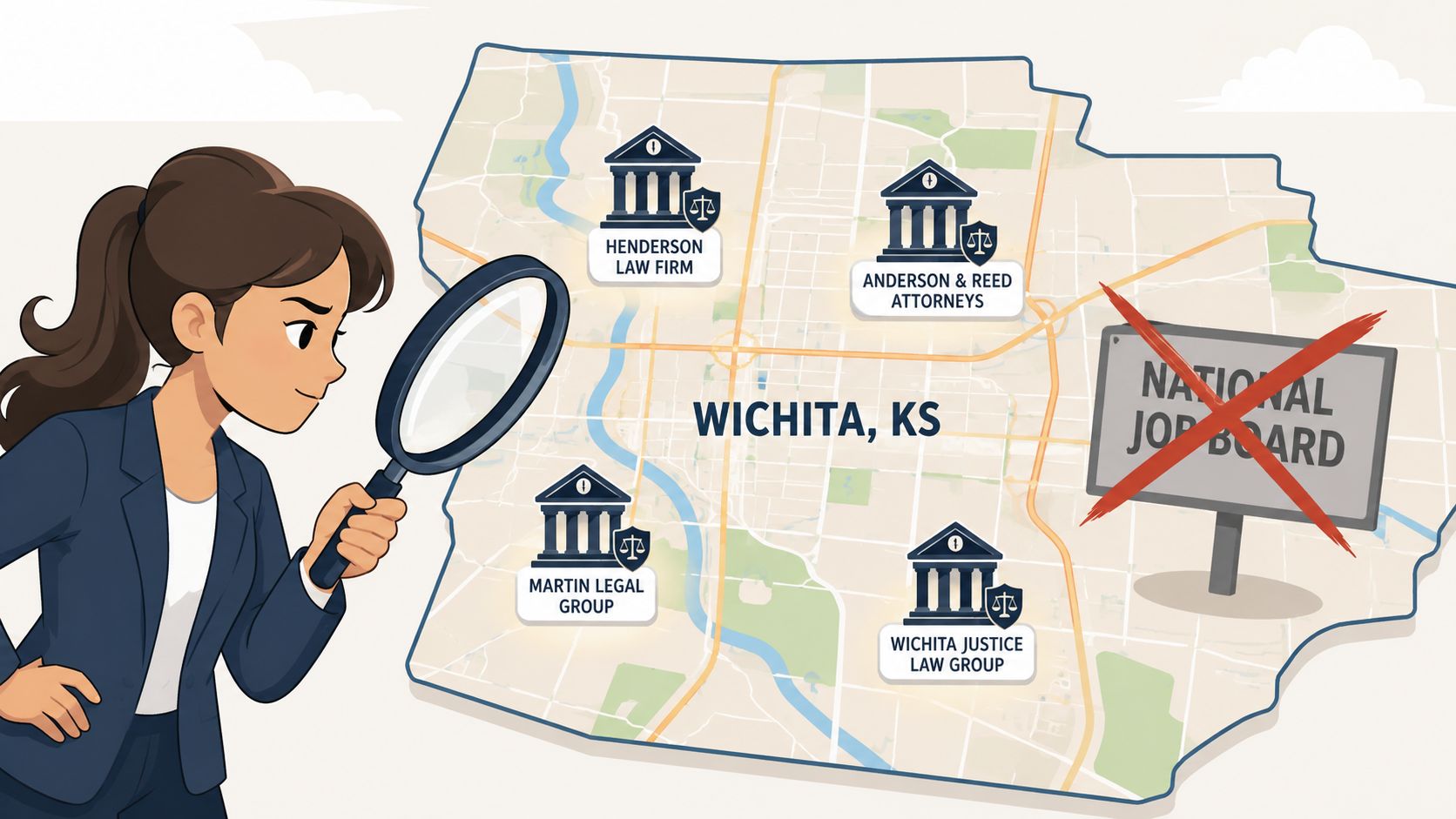
The people who only check national boards usually end up competing in the loudest room. Wichita hiring is smaller and more relationship-driven than that. A lot of firms would rather see a candidate come through a referral, a career page, or a recruiter they already trust than filter through a stack of anonymous applications.
Don't treat law firm websites like dusty brochures. Treat them like active pipelines. Wichita family-law firms, litigation shops, and smaller general-practice firms often post directly when they need somebody who can move quickly and doesn't need a month of hand-holding. The trick is checking those pages consistently, not once a week when you remember.
You should also watch firms with visible Kansas hiring activity, especially family-law outfits that keep legal support positions in rotation. Stange Law Firm's Kansas careers page, for example, publicly lists Wichita among its Kansas locations for legal staff openings, which is exactly the sort of signal you want to track when you're narrowing your search. Firms like that aren't subtle about their needs, and you shouldn't be subtle about monitoring them either.
If you want fewer dead-end applications, focus on places where the job never gets swallowed by general traffic. That means local recruiters, legal staffing agencies, and the smaller professional circles where people refer candidates. It also means checking channels where Wichita employers post support roles before they get blasted to everybody with a pulse.
You don't need ten hundred options. You need three good ones and the discipline to use them every day.
If you want a more structured way to build that pipeline, the requirements-to-be-a-legal-assistant guide is a useful benchmark for how employers tend to think about the role.
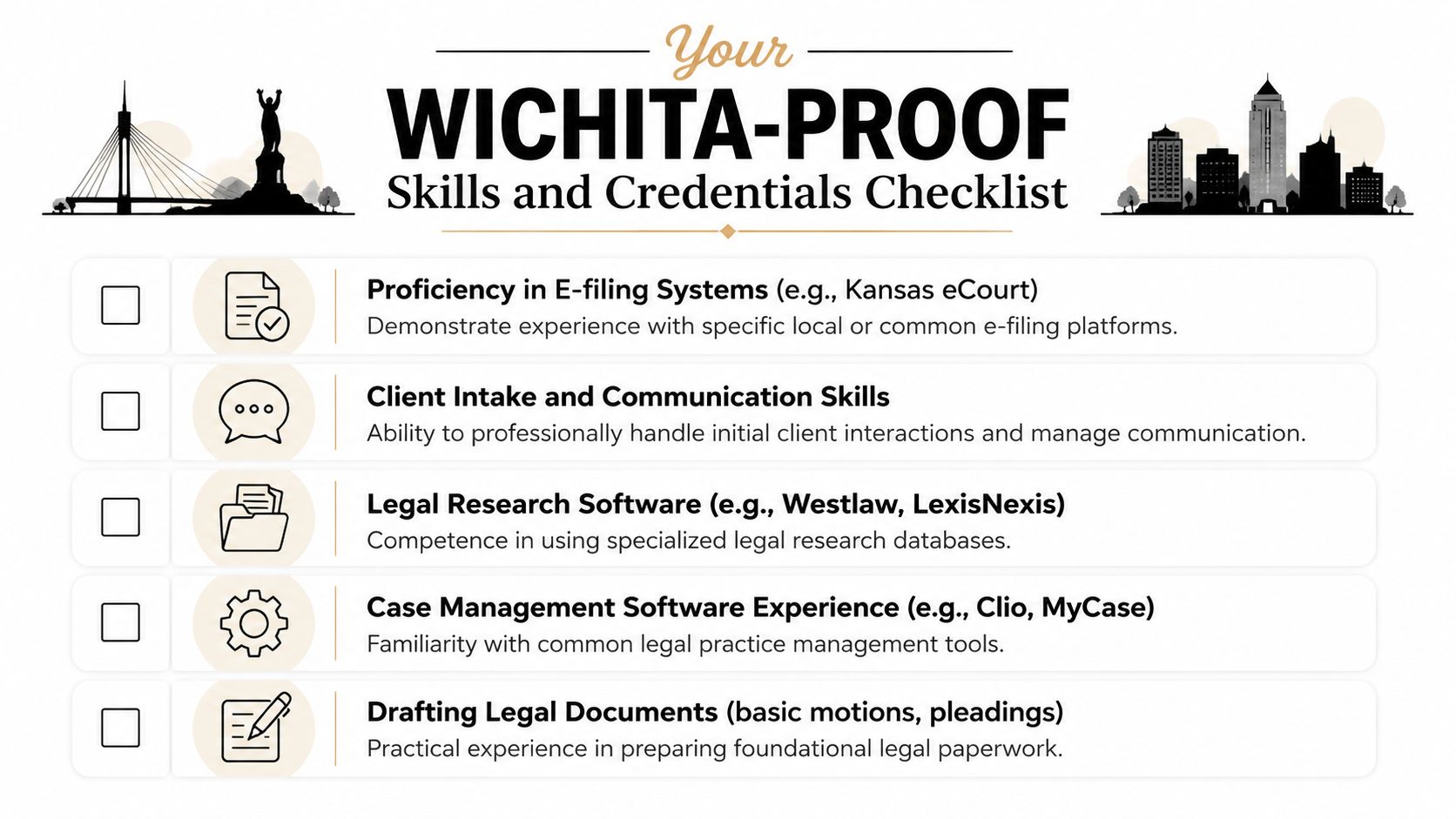
Many candidates often get lazy at this stage. They write “proficient in Microsoft Office” like that's a trophy. It isn't. Wichita employers assume you can use Word and Outlook. What they really care about is whether you can step into a legal workflow without creating extra work for everyone else.
Indeed's Wichita listings commonly ask for 2 to 5 years of experience, familiarity with Westlaw, LexisNexis, and Tabs3, and a preference for formal paralegal education or NALA or NFPA credentials (Indeed Wichita legal assistant jobs). That's the hiring signal. Experience plus legal software plus some kind of proof that you can work with limited supervision.
Lead with actual legal work, not general admin filler. If you've handled client communication, draft prep, scheduling, or file organization in a legal setting, say so plainly. If you've used Westlaw or LexisNexis, name it. If you've touched Tabs3, put it on the page. Generic office language gets ignored because it doesn't separate you from anybody else with a receptionist background.
A local legal support assistant posting made the point even more sharply by specifying processing discovery materials as part of the job, which is exactly the sort of task that separates real legal support from ordinary admin work (Indeed Wichita legal support assistant jobs). Discovery isn't inbox cleanup. It's procedure, timing, and accuracy. If you've done it, that's worth more than three lines about being a team player.
Short version: legal software and discovery work beat polished fluff every time.
For candidates building out their toolkit, I'd prioritize these items:
One practical note. HireParalegals is one option firms use for remote legal support matching, which matters if a local office is trying to fill work fast without building a long sourcing process from scratch. That's not a magic wand, just a channel worth knowing exists.
Your résumé has one job, get past the first glance and make the reviewer stop. If it reads like a list of unrelated office tasks, you're toast. Wichita legal hiring managers don't need poetry, they need evidence that you can do the work.
The best résumés translate chores into legal outcomes. “Managed case files” is weak. “Maintained active litigation files, tracked deadlines, and supported discovery and filing workflows” is much better because it shows process, judgment, and legal context. You don't have to fake complexity, you just have to describe the work like someone who understands what it was for.
Try this kind of framing:
Weak: Answered phones and scheduled appointments.
Stronger: Managed client intake calls, scheduled attorney calendars, and coordinated follow-up communication across active matters.
Weak: Organized files.
Stronger: Maintained case files, supporting deadline tracking, document control, and attorney access to current records.
Weak: Helped with legal paperwork.
Stronger: Drafted routine correspondence and supported legal document preparation for active matters.
That's the difference between sounding helpful and sounding hireable. Wichita firms are scanning for people who understand the machinery of the job.
The discovery angle matters too. A legal support assistant posting in Wichita specifically called out processing discovery materials, which is a strong clue about what local employers value when they're trying to fill support roles (Indeed Wichita legal support assistant jobs). Put that language in your résumé only if you've performed it, because hiring managers can smell fake confidence from a mile away.
If you want a practical look at how screening works on the employer side, the practical guide for HR teams is worth a read because it shows why simple, explicit phrasing tends to survive automated review better than cute formatting ever will.
You got the interview. Good. Now don't waste it by talking like a person who memorized a generic answer blog last night. Wichita interviewers want to know whether you can keep pace, stay organized, and handle the details without spiraling.
The best answer to “tell me about your experience” is not a biography. It's a tight, role-matched story. Talk about the legal tools you've used, the types of files you've handled, and how you manage deadlines and communication. If you've worked with Westlaw, LexisNexis, Tabs3, or discovery materials, say that plainly. If you've supported attorneys with court filings or client communication, that's the good stuff. Put the spotlight on usefulness, not personality quirks.
Pay and pace change fast depending on where you land. ZipRecruiter's Wichita data shows a district attorney's assistant might start at $19.53 per hour, while a private family-law assistant can earn $22 to $27 per hour plus bonuses that can reach $10,000 annually (ZipRecruiter Wichita legal assistant jobs). That spread tells you exactly what to expect. Public-sector work and private-firm work are different lanes, and specialization changes your earning power.
So when you interview, don't just ask, “What does the job pay?” Ask what kind of matters the office handles, how much independent work the assistant is expected to own, and what tools the team uses every day. Those answers tell you more than the title ever will.
Ask about workflow, not just salary. The way a firm talks about deadlines and support tells you how your days will actually feel.
Do your homework on the firm and the people in the room. Family law, litigation, and corporate work all pull different skills out of a legal assistant. If the office leans family law, understand the pace and sensitivity of that work. If it leans litigation, expect more file discipline and deadline pressure. If you sound like you already understand that difference, you're ahead of half the field.
For interview prep, the legal assistant interview questions guide is a solid check against the obvious mistakes people make when they wing it.
If you want to break into legal assistant jobs Wichita KS, stop searching like everyone else. Target firms directly, lead with legal tools and real workflow experience, and be ready to talk like someone who can make an attorney's life easier. Start by tightening your résumé today, then apply with purpose to the Wichita firms and support channels that match your experience.