 15 minutes read
You just hired a sharp remote paralegal in another country, the offer is out, and everyone's feeling clever. Then the practical questions show up, one by one, like invoices nobody budgeted for. Which law applies, where does payroll live, who handles benefits, and what happens if this person moves before you've even finished onboarding? That's cross border employment law, and it's the stuff that turns a cheap hire into a very expensive administrative hobby.
The scale is not theoretical. By 2019, the EU-27 had about 8.9 million long-term movers aged 20 to 64 and 1.3 million cross-border workers living in one member state and working in another, with 58% of movers coming from just five sending countries, led by Romania at 22% and Poland at 15% (EU labor mobility study). Globally, the ILO counted 167.7 million international migrant workers in destination labor forces in 2022, equal to 4.7% of total global employment (ILO benchmark via cross-border employment overview). This isn't a niche issue for giant multinationals. It's a structural reality of remote hiring, and legal teams that treat it like a footnote usually end up mortgaging their office ping-pong table to fix the mess.
You find a brilliant remote paralegal abroad. The rate looks good, the CV is clean, and the offer letter goes out before lunch because everyone wants to feel fast. That is usually the moment the real work starts, because the country where that person sits can matter more than the country where your firm sits.
Cross-border employment law is the full stack of rules that shows up when work happens in one country and the employer is based in another. It touches labor law, payroll, tax, immigration, social security, and benefits access, all at once. If that sounds annoyingly broad, that's because it is.
A remote hire is not just a people decision. It is a compliance architecture decision. If the worker is in another country, the firm has to think about where the employment relationship lives, where withholding happens, which protections attach, and whether the agreement you drafted on a Thursday afternoon can survive contact with local law.
A firm that misses this usually misses the same three traps. First, the worker's day-to-day location starts drifting away from the one written in the offer letter. Second, someone moves before onboarding is even finished. Third, benefits look fine on paper, then fall apart because the employee does not have access to what the firm assumed was available. Those are operational problems, but they turn into legal ones fast.

Practical rule: If the person's chair is in another country, assume the legal risk is there too until someone proves otherwise.
Firms love clean contracts. Contracts are comforting. They make everyone feel like the issue is solved. But the contract does not erase mandatory rules that attach through the work location, the person's residence, or the factual center of their working life. That is where the expensive part starts.
For a US law firm, the danger is simple. You cannot treat a foreign remote hire like a slightly weird version of a domestic freelancer. If you do, you will eventually face payroll questions, tax registration questions, termination questions, and a benefits access gap that shows up after the hire is already in place. By then, the firm is not just fixing paperwork. It is cleaning up a cross-border employment problem in a country where nobody planned to operate.
A lot of firms write “governed by New York law” and call it done. That clause is useful, but it does not erase the law that attaches to where the person works. In cross-border employment law, local rules often control the day-to-day employment relationship, especially when the worker's real base is outside the United States. The contract matters. The work location matters more.
The cleanest answer is usually the one firms try to avoid. If your remote hire sits in another country, assume that country's labor rules, tax rules, and social protections are in play unless someone has checked the local position and proven otherwise. A Cambridge analysis of cross-border remote workers explains why the worker's habitual place of work carries so much weight, and why a contract clause rarely gets the last word (Cambridge analysis of cross-border remote workers).
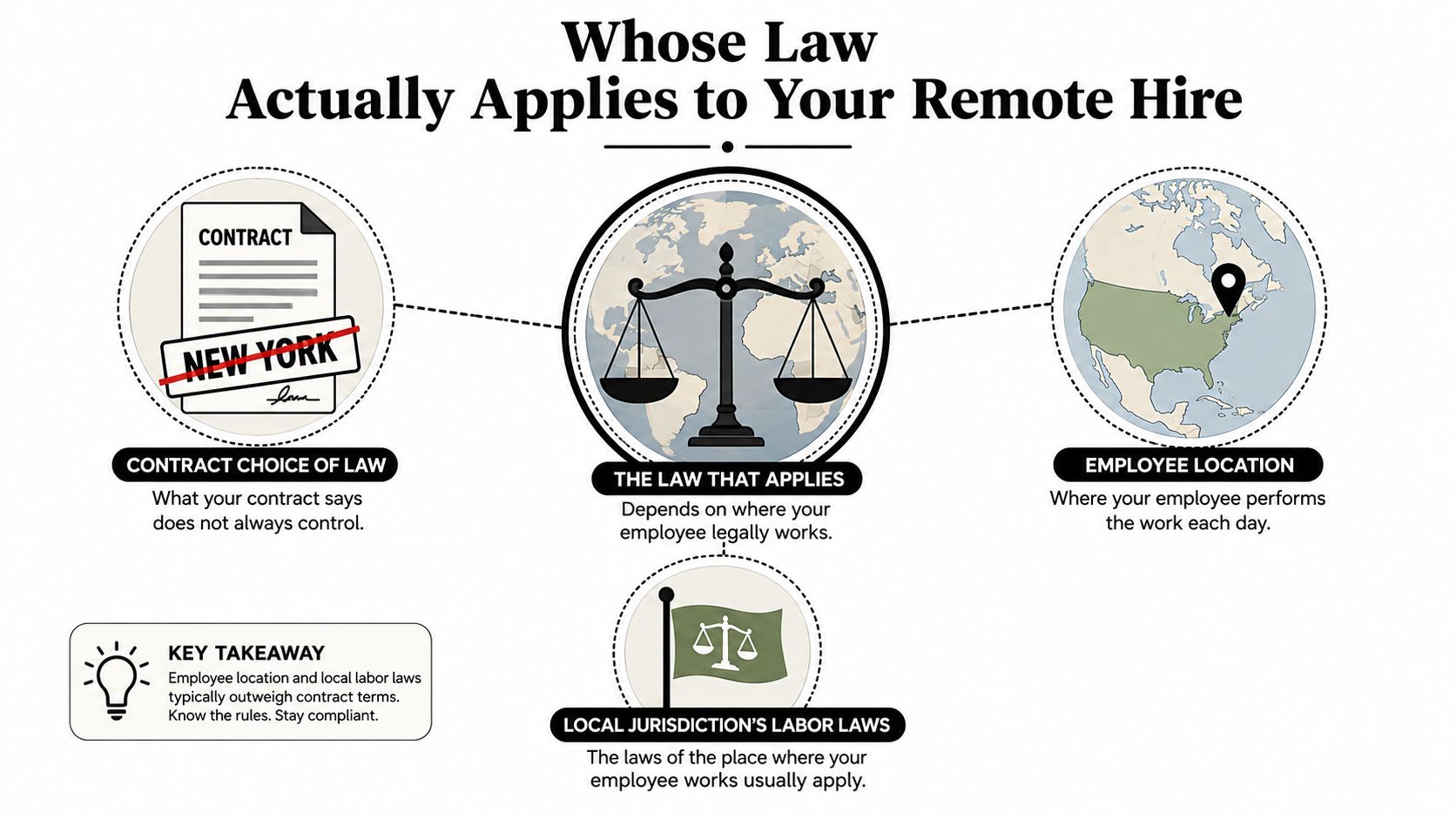
Courts do not care where your main office sits as much as founders do. They look at where the employee lives, works, and builds their working life. That standard is unfriendly to firms that assume the contract's mailing address solves everything. If your paralegal is working from another country, that country may matter more than the city where the managing partner keeps a corner office.
Remote work makes this messier, because the location can drift. One week the person is in their home country, the next week they are working somewhere else for a few months, and the firm keeps treating the original setup as if it never changed. That is how a tidy hire turns into a local-law problem without anyone noticing until the paper trail is already ugly.
The choice-of-law clause helps, but it does not wipe out mandatory local labor protections, tax obligations, or social-security rules tied to the worker's location and the real facts of the relationship.
A US law firm also has to deal with the home-front rules. Federal coverage can still reach across the table when the business has enough employees, so the firm ends up with one set of obligations from the worker's country and another from the US side. The payroll compliance for remote hires question is never just payroll. It is a full setup issue, and the mechanics start with understanding what payroll compliance covers.
The cheapest mistake in cross border hiring is calling someone a contractor because the label feels easier. The expensive mistake is getting that label wrong and learning that the local government sees the relationship differently. Classification drives payroll, withholding, social contributions, benefits, and litigation exposure.
The US contractor mindset does not travel neatly. Other countries use their own standards, and those standards often care more about control, dependence, integration, and economic reality than the label on the agreement. So if you're hiring a remote paralegal in another country and saying, “We'll just keep them 1099,” you are setting yourself up for a compliance problem.
Once the worker is classified as an employee, the payroll stack shows up fast. You may owe withholding, employer social-security contributions, pension-related obligations, and foreign registration work. That is a lot of admin for one hire, and it is the part founders underestimate.
There are only a few workable paths. You can hire through your own foreign entity, use an employer of record, or use a platform that handles payroll and compliance for the region. Each route shifts the burden, but none of them makes the burden disappear.
If you want a practical checklist for the mechanics, the payroll compliance for remote hires resource from Allied Tax Advisors is a solid companion because it forces you to deal with the boring parts before they become expensive. And if you want the domestic baseline first, the firm's own explainer on what payroll compliance means is a useful reset.
Don't confuse convenience with correctness. A contractor label won't protect you if local law treats the arrangement as employment.
You also need to think about benefits, tax filings, and the paper trail that shows you understood the setup. Miss the filings, and the back taxes are bad. Miss the classification, and the dispute can land in a country where you have no counsel and no local playbook.
A remote paralegal is hired in Colombia. Six months later, they're working from Portugal on a digital nomad visa and never mention it. That's not rare enough to ignore, and it's exactly the kind of thing that makes a clean contract look like a decorative document.
The core issue is location drift. The habitual place of work test works only if the work location is knowable and stable. Academic analysis says cross-border telework is governed mainly by where the employee performs work, and if that can't be clarified, the employer's place of business may apply, with an escape clause for a closer connection elsewhere (Cambridge brief on cross-border remote workers).
That's the trap. A location starts as a short-term arrangement, then becomes the worker's real working base. Once that happens, your legal exposure can shift without a neat cutoff point. The tax, labor, and social-security consequences don't wait for a ceremonial announcement.
The Canadian evidence brief on this problem says the framework is fragmented and that habitual place of work does not adequately deal with cross-border remote work. That's the part most mainstream guides skip, because it's messier than a simple rule and less marketable than a tidy checklist. Unfortunately, mess is the job here.
Firms need to stop being precious and start being operational. Your contract should require disclosure before a worker changes country, not after payroll notices the new reality. Your onboarding should include a location baseline, and your HR process should flag prolonged work from a new jurisdiction as a compliance event, not a lifestyle choice.
A useful internal rule is blunt: if the working country changes, the legal analysis gets reopened. No drama, no debate, just a fresh review. That's how you keep a “temporary” relocation from becoming the reason you owe a new tax authority a very awkward explanation.
US founders like at-will employment because it feels tidy. Most countries do not work that way. Termination usually comes with notice periods, documentation, and rules that turn a quick firing into a legal process.
Canada shows how fast US habits break down. A practical summary of Canadian employment law says employers generally need legal justification or a written agreement defining departure terms, and otherwise owe reasonable notice or pay in lieu of notice (Craig Levey on U.S. and Canadian employment law differences). That is the kind of rule that turns an offboarding decision into a line item you should have planned for.
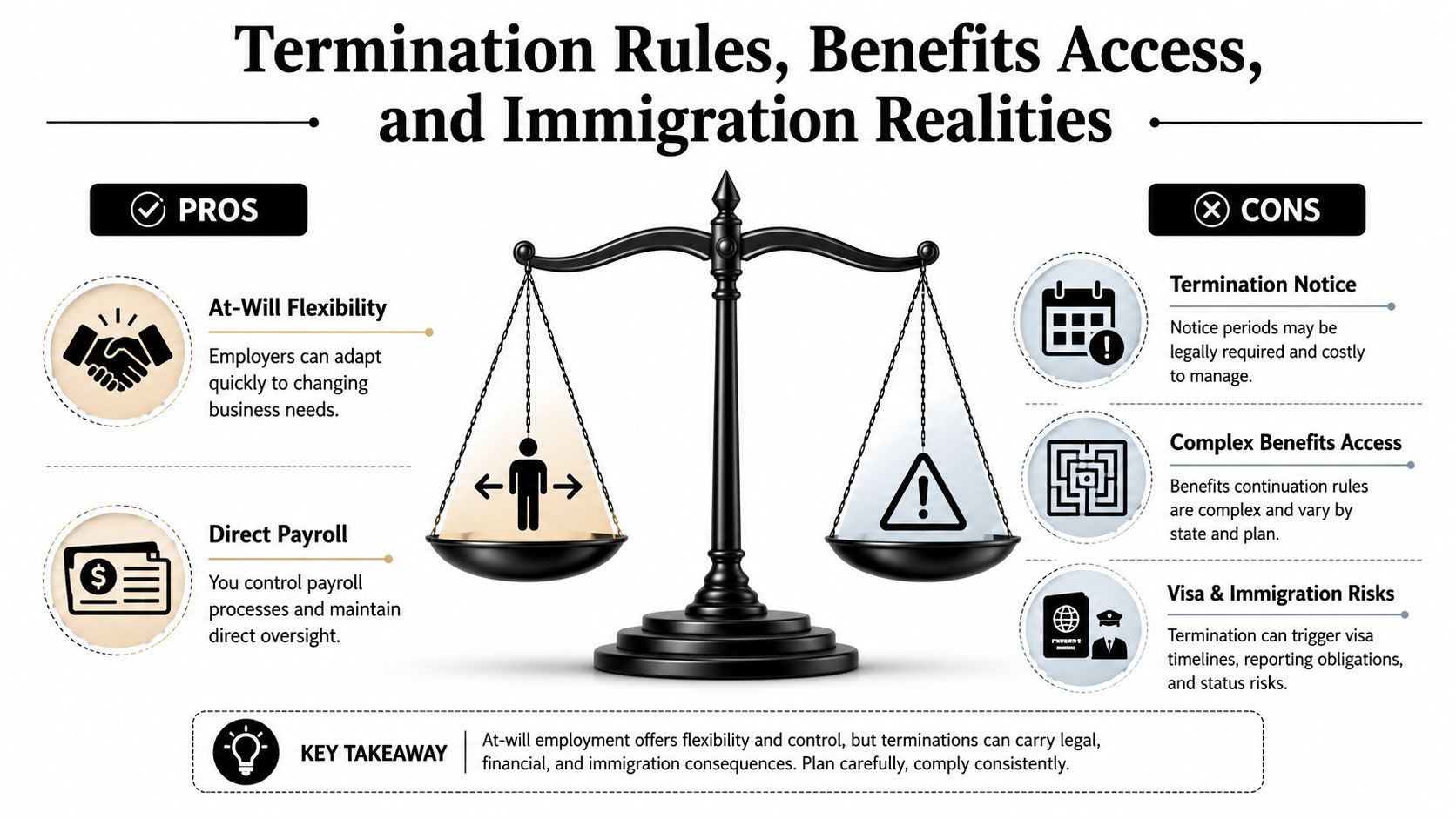
The bigger issue is whether the worker can realistically access the benefits and protections you thought you provided. Cross-border employment gets messy around social security, pensions, sick leave, qualification recognition, and administrative procedures, especially in border regions. The European Parliament has flagged those barriers in its work on border-region employment issues (European Parliament study).
A contract line that says “benefits included” is not enough. If the worker cannot use the system, the promise has no value. That gap is where disputes start.
A person may be allowed to work in one country and not another. That sounds obvious until someone moves and keeps logging in from the new country. Then the firm is dealing with authorization questions, visa status risk, and local rules the team never planned for.
The ILO also describes cross-border or transnational litigation as a worker filing or continuing a claim in the country of employment after leaving it for their country of origin or a third country (ILO Justice Across Borders). That is the legal boomerang nobody wants, because the dispute does not stay neatly where it started.
If you are checking mobility options, the practical immigration side matters too. A useful starting point for location-specific due diligence is Spain residency for US citizens, especially if a worker is already there or plans to move there while still tied to your firm. For a closer look at the operations side, the guide on immigration paralegal services is worth keeping in your process folder.
The ugly truth: the biggest risk is often not the governing-law clause. It is whether the worker can actually access the protections and forum you thought you provided.
Remote legal work means client data is moving across borders, sometimes through devices, networks, and work habits you don't control closely enough. That's where data privacy becomes a real operational issue, not a policy page nobody reads.
If a remote paralegal handles client files from another country, you're suddenly dealing with data protection rules that may be stricter than your firm's default habits. The obvious fix is contractual, but contracts only work if they're paired with actual process. You need access controls, documented handling rules, and audit trails that show the firm treated the data like client data, not shared notes from a group project.
IP ownership deserves the same seriousness. If the hire drafts motions, prepares templates, or builds process improvements, your agreement should make it clear the firm owns the work product to the extent local law allows. Otherwise you're leaving room for a nasty little debate about who owns what after the relationship goes south.
A practical compliance stack is boring in the best way. It starts with documented confidentiality terms, moves into data handling and transfer rules, and ends with a clean record of who created what, when, and under which agreement. That record matters more than people think, because once there's a dispute, the team with the clean trail usually sleeps better.
For teams working across Latin America, a nearshore payroll compliance guide can be useful because payroll and compliance tend to fail together, not separately. And if your firm is formalizing controls, the internal page on data security protocols is the kind of operational reference that saves headaches later.
Start with one blunt question. If this person sits in another country, can you explain, in writing, why the hiring structure you chose is legally safe there? If the answer is “kind of,” you're not ready.
If the hire sits in a jurisdiction you don't know well, use local counsel. If the role is simple and the region is familiar, an employer-of-record model or a compliance platform may be enough. For US firms hiring remote legal support, HireParalegals is one option that combines pre-vetted legal talent with payroll management and compliance guidance for Latin American hires, which can reduce the amount of DIY guesswork.
The rule is simple. Don't scale speed before you've priced the legal risk. A fast bad hire is still a bad hire, just with better Wi-Fi.
If your firm is hiring across borders this quarter, stop treating the offer letter as the finish line. Build the classification memo, confirm the work location, check payroll and immigration, and get local counsel involved before the first invoice goes out. If you want remote legal talent without improvising your way through foreign compliance, make the structure boring first, then make the hire.