
 12 minutes read
You are already doing the job of three people. You are the rainmaker, the crisis manager, and somehow the unpaid help desk for a printer that hates Tuesdays. A paralegal request sits in someone's inbox, the cloud login keeps failing, and a new hire needs onboarding yesterday. That is not a law firm strategy. That is slow-motion chaos with a nicer logo.
Managed Services for Law Firms is what smart firms use when they stop pretending every problem deserves a partner's personal attention. A key advantage is not just IT or security. It is people. On-demand paralegal support, overflow document work, intake help, and other back-office labor keep the firm moving without forcing you to hire for every spike in demand. Translation, firms use managed services because the old way is expensive, brittle, and a lousy use of lawyer time.
The warning signs are never dramatic. They show up as a stack of unread tickets, a payroll headache for one more hire, and an afternoon spent chasing document versions like you're in a scavenger hunt designed by a grudge-bearing intern. At some point, you look up and realize your calendar is packed with everything except legal work.
That is the point where the job changes. You stop pretending every operational problem deserves a partner's personal attention, and you start running the firm like a business that has to stay profitable, steady, and sane. Managed services fits that reality because it shifts recurring work to people whose job is to keep the machine running.
The market is already there. The legal managed services market was estimated at $10.58 billion in 2024 and is projected to hit $19.29 billion by 2032 (Verified Market Research). That kind of growth happens because firms are done paying senior lawyers to babysit low-value operational problems.
What does that mean for you? Fewer interruptions. Less babysitting. More time on the work clients pay for. And yes, fewer afternoons wondering whether you should have stayed in college and become a barista.

Practical rule: if a task keeps showing up on a partner's desk twice, it probably belongs in a managed service.
The highest-return move is usually the one firms ignore first. People matter more than hype about servers and security tools. On-demand paralegal support, overflow document work, intake help, and other back-office labor keep the firm moving without forcing you to hire for every spike in demand. That same logic shows up outside legal work too, as seen in how to outsource accounting in the UAE, where the point is getting recurring work handled by people who do it all day.
Forget the jargon. Managed services means someone else owns the ongoing responsibility, not just the emergency response. If break-fix support is the plumber you call after the pipe bursts, managed services is the team that inspects the pipes, tightens the fittings, and keeps the flood out of your conference room.
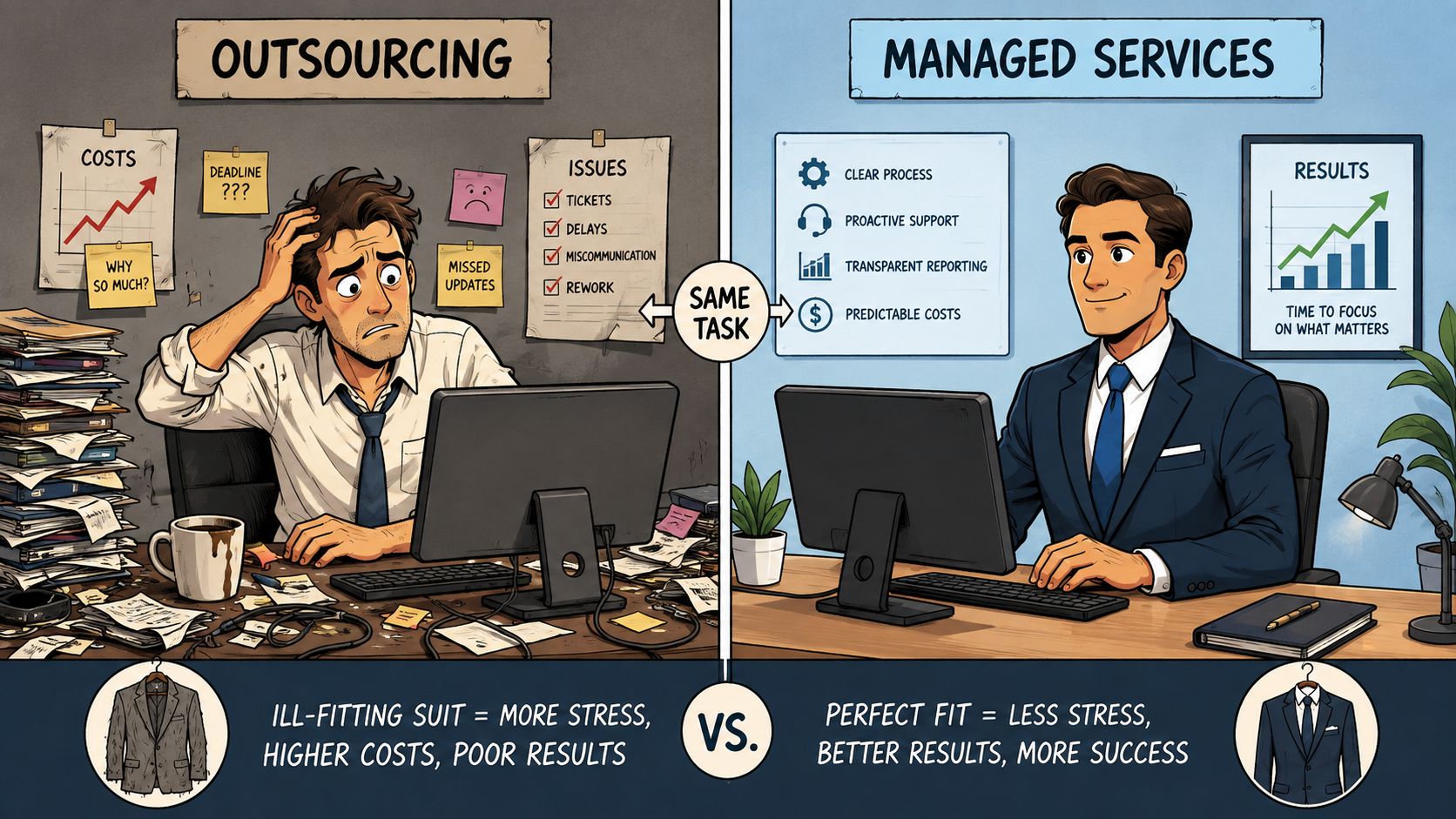
The provider doesn't wait for disaster. It takes ongoing responsibility for support, maintenance, security monitoring, and backup oversight, which shifts the firm from reactive troubleshooting to continuous control over its operations (Uptime Legal). That's the difference between constantly patching a leak and having a system.
A decent managed service should make your firm feel calmer, not more complicated. That means continuous monitoring, user management, vendor coordination, legal-application support, and planning that keeps tomorrow from becoming a fresh mess.
It also means predictable costs and fewer surprise fires. You're not buying a hero. You're buying a process.
For firms comparing service types, there's a useful parallel in AITS cloud document solutions. The point isn't the logo, it's the operating logic, put the routine work into a system that behaves consistently instead of hoping someone remembers the workaround.
And because law firms often mix operational work with legal support, it helps to think beyond IT. A managed service can be a platform, a process, or a person. The common denominator is that the provider owns an outcome, not just a task.
A lot of firms obsess over servers and security because those are easy to sell and easy to fear. Fine. Keep the lights on. But if you stop there, you're overlooking the substantial benefits. To gain a clear perspective, consider managed services for law firms in three categories.
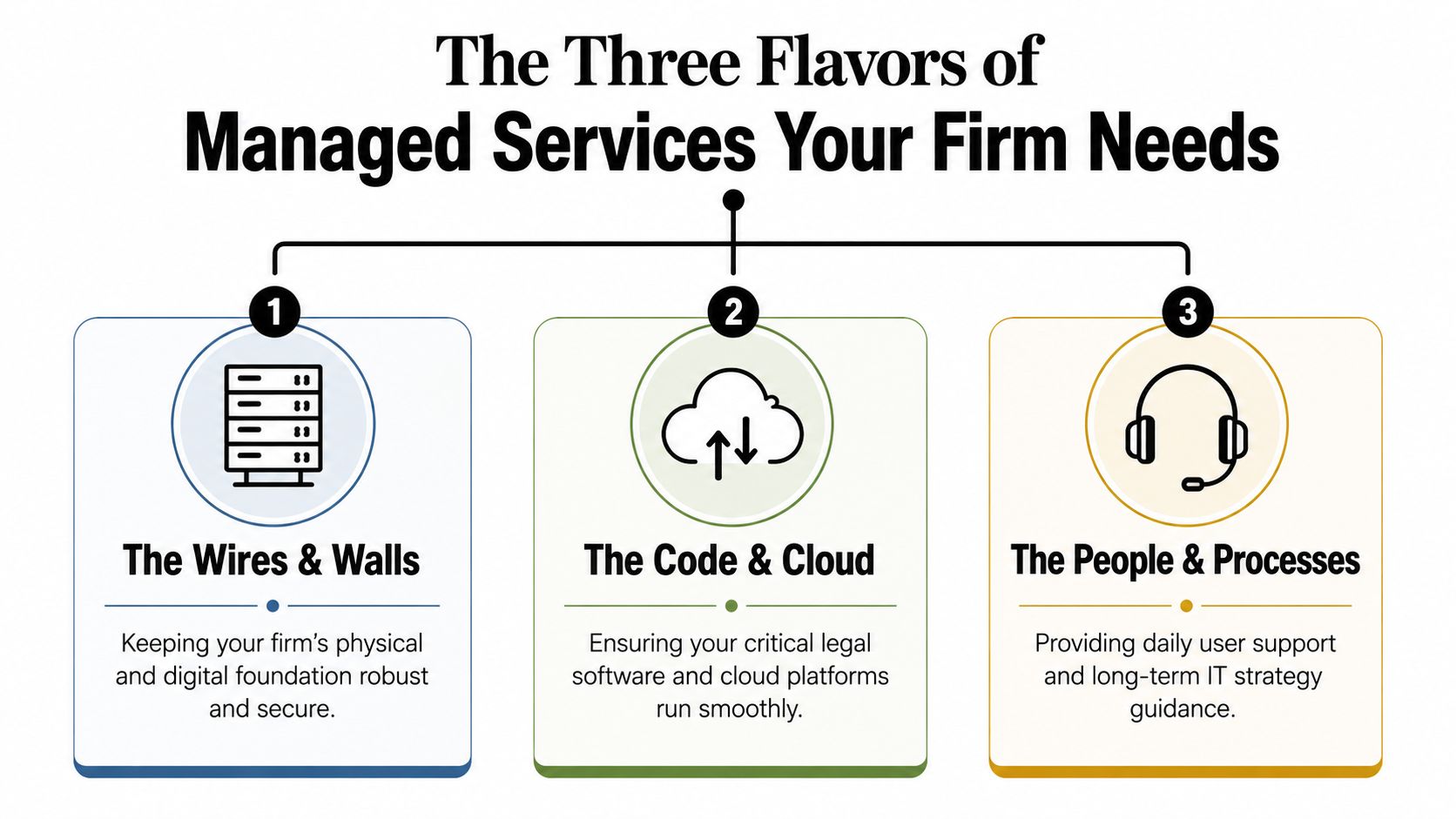
This is the part everyone remembers to buy after something catches fire. It covers infrastructure, cybersecurity, cloud services, help desk support, disaster recovery planning, and compliance consulting. In plain English, it's the plumbing, wiring, and locks.
That layer matters because a broken foundation ruins everything above it. But let's not kid ourselves, this is table stakes, not differentiation. You need it. It's just not where the competitive edge lives.
The firm transitions from thinking like it lives in one office with one stack of paper to acting like a modern business. Managed cloud, legal apps, Microsoft 365 administration, remote access, backup oversight, and vendor coordination are all integral parts of this transformation.
That's also where a lot of firms waste time. A platform can be technically “working” while still being a daily nuisance. If the support model can't keep users moving, it's a liability dressed as a solution.
Here's the part too many firms underinvest in. The highest ROI move often isn't a new tool. It's on-demand legal talent, especially paralegal support, legal assistants, and admin help that can absorb real work without turning your office manager into a triage nurse.
Thomson Reuters reported that 79% of law firms were using ALSPs in 2021, and the average firm was using them for 3.7 different service lines (Thomson Reuters). That tells you something simple, firms aren't just outsourcing back-office chores anymore, they're folding managed services into core workflows.
If you want a practical example of where legal process outsourcing sits in the mix, the internal guide on legal process outsourcing companies is worth a look. It's the same basic idea, use external support where it saves time without poisoning quality.
The mistake is treating all three flavors as equal. They're not. The wires and walls keep you safe. The code and cloud keep you fast. The people and processes keep you profitable.
Reality sets in fast. Vendor decks disappear when the invoices land.
A qualified in-house IT professional with law-firm experience usually earns $65,000 to $95,000 in salary, and the fully loaded cost rises to $85,000 to $125,000 annually once benefits, payroll taxes, and paid time off are added. For a mid-sized firm, that is not a rounding error. That is a line item that deserves a chair and a vote.
The table below is the cleaner way to look at the decision. It shows why one hire rarely covers the full support load, while a managed model spreads the work across coverage, escalation, security, and planning.
| Cost Factor | In-House IT Professional (Annual) | Managed IT Service (Annual) |
|---|---|---|
| Salary and employment load | $85,000 to $125,000 fully loaded | Predictable per-user or bundled fee |
| Help desk coverage | One person, one set of hours | Shared service coverage and escalation |
| Security oversight | Depends on that one hire | Included in the managed model |
| Planning and maintenance | Often squeezed between emergencies | Built into the service |
For small to mid-sized firms, a common managed-IT budget is $150 to $300 per user per month, typically bundling help desk, advanced security, and strategic technology planning (Attorney at Work). That is a cleaner budget story than hoping one good hire can do the work of an entire support stack.
Your return on investment improves when you stop thinking only in IT terms. Every hour a partner spends formatting, sorting, chasing, or delegating badly is an hour not spent on billable work. Every week spent recruiting the wrong support person is a week you have paid for twice, once in salary, again in distraction.
The highest ROI move is often on-demand legal support. A remote paralegal can absorb actual legal workload without the overhead of a permanent hire. HireParalegals is one option in that category, a platform for sourcing remote legal support for U.S. law firms, but the bigger point stays the same, flexible staffing beats bloated payroll when the work changes from week to week.
For firms trying to cut waste without cutting quality, the internal guide on how to reduce operational costs makes the logic plain. Remove the expensive idle time first. Keep the work covered.
The ugly truth is that firms overpay for permanence when what they really need is coverage. That is not strategy. That is inertia with a budget.
Half the vendors in this space sound polished. That's the problem. The pitch deck is never the issue. The issue is whether they understand how a law firm runs when things are messy, urgent, and confidential.
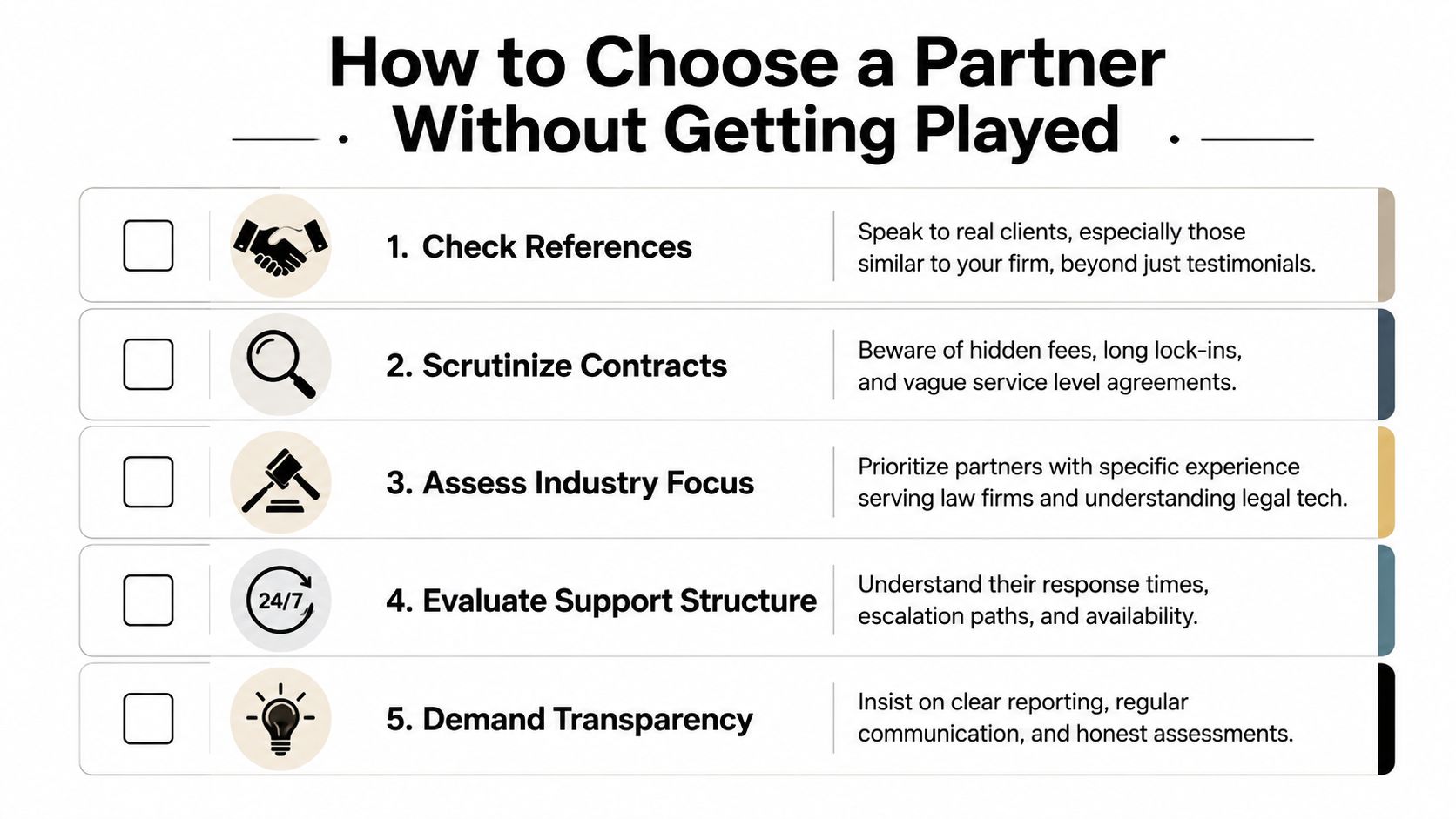
A real provider should speak fluent law firm. That means they can talk about permissions, offboarding, document access, remote work, security reviews, and why a “small” access issue becomes a deadline problem by lunch.
They should also be able to show references from firms that look like yours. Not just any legal client. Your size, your practice mix, your pain points. If they can't do that, they're probably selling generalist comfort, not legal competence.
Practical rule: if you can't explain the SLA to a skeptical partner in one sentence, it's probably not good enough.
Ask how they handle user setup and offboarding. Ask what their response path looks like during a breakdown. Ask how they report on performance. Ask what happens if you decide to leave.
And don't let them dodge confidentiality questions, especially with remote talent in the picture. A firm that treats access control like a side issue is a firm that will eventually create one.
If you want a related benchmark for legal talent sourcing, the internal page on legal outsourcing company shows how to think about third-party support without turning it into a trust exercise. Good vendors earn trust by showing process, not by smiling harder.
The fastest way to ruin a good idea is to try to fix everything at once. Pick one pain point, prove value, then move.
Start with the problems that waste the most lawyer time. For many firms, that means help desk support, access issues, backup oversight, and the security holes that have been sitting there for too long.
The goal is visibility. Get a baseline, clean up the biggest risks, and make it easier for attorneys and staff to get help without sending five emails and hoping someone notices.
Pick a process that eats time and forces rework. Managed document review for a specific matter is a strong candidate. Better cloud access or cleaner shared matter handling can work too.
That is where clients and staff feel the difference. One workflow gets smoother, the interruptions drop, and the firm stops pretending that ordinary friction is just part of the job.
The highest-return move is usually people, not software. Bring in on-demand paralegal support for a concrete task stream, and let that person take work off the desk of someone more expensive.
Use the predictable managed-services cost model to free up time, then put that capacity where it earns revenue or protects margins. A firm that still keeps a senior associate buried in admin work is not saving money. It is hiding waste.
A good 90-day rollout should leave you with three things. Cleaner systems. Less partner interruption. More time spent on legal work and less on furniture-moving disguised as management.
Can client confidentiality survive remote support? Yes, if you choose a provider that takes access controls, backups, and user management seriously. No, if you hire the cheapest person with a laptop and a nice voicemail.
Is this only for larger firms? Not even close. Smaller firms still handle privileged information, still need reliable access, and still suffer when systems wobble. “We're small” is not a security plan.
What if you want flexibility instead of a permanent hire? That's the point. Managed services work because they let you match support to actual demand instead of locking yourself into payroll that looks efficient only until the work slows down.
What if a provider turns out to be a pain? Then you switch. Good contracts make that possible. Bad ones trap you, and you should treat that as a warning sign before you sign, not a surprise after.
If you're still running critical work through one overworked person, that's your real risk. Pick one operational mess this month, fix it with a managed service, and stop donating lawyer time to problems a competent provider should own.