
 14 minutes read
A partner notices the pattern on a Tuesday afternoon. A paralegal seat is still empty, a deadline is approaching, attorneys are doing work they shouldn't be doing, and the “quick hire” has become a three-month saga. Meanwhile, the firm is congratulating itself for avoiding an agency fee. That's not saving money. That's just moving the expense to a less visible column.
Law firms reduce hiring costs by managing the full cost of staffing, not just salary or recruiter invoices. That means measuring vacancy drag, controlling cost per hire, choosing the right talent model, and building a process that doesn't force senior attorneys to become part-time recruiters. Turns out there's more than one way to hire capable legal support without mortgaging the office ping-pong table.
Most managing partners start with the wrong question: “What salary can we afford?” The better question is, “What does this empty seat cost us every day?”
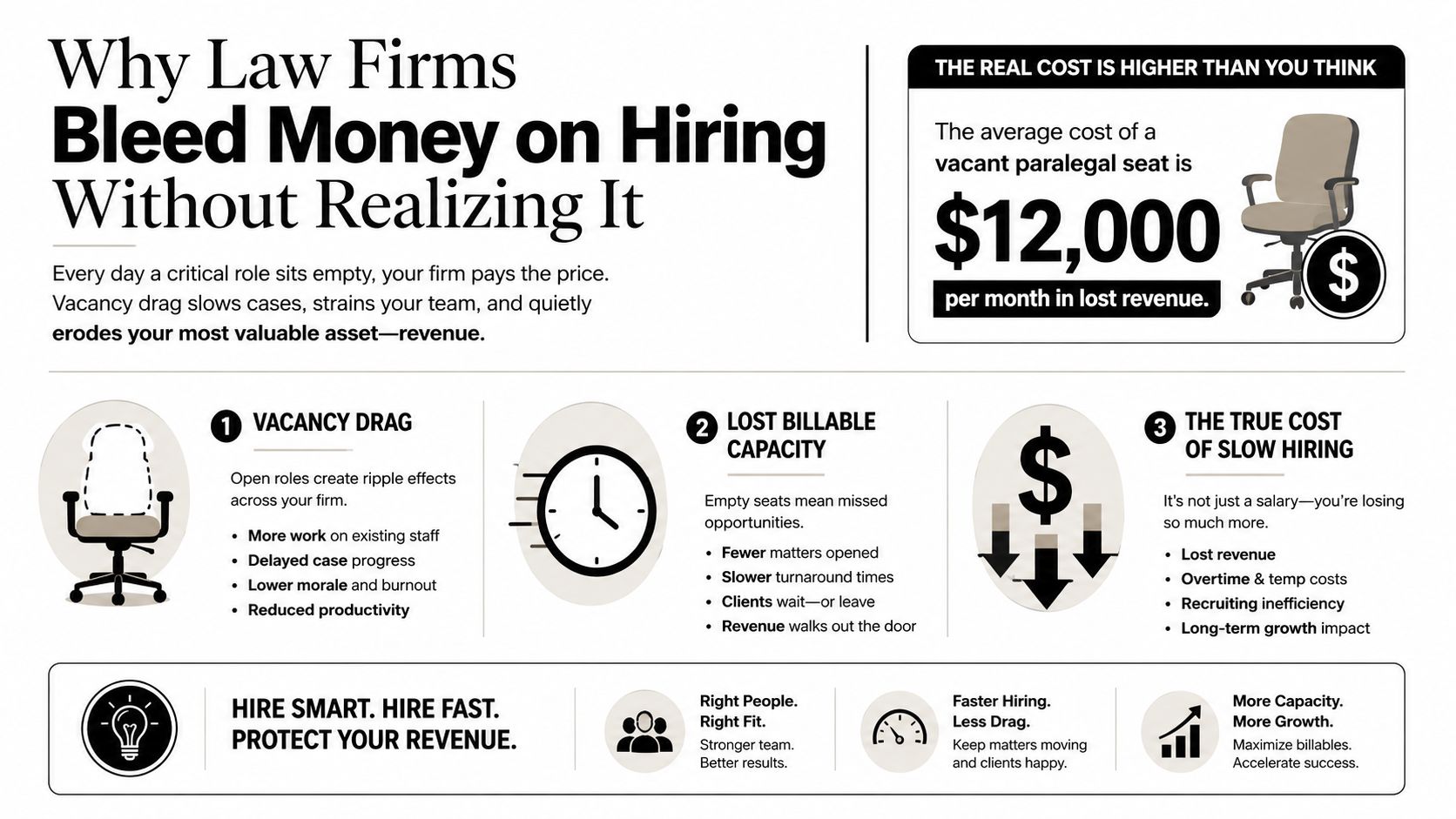
A vacant paralegal role can push attorneys into administrative work, leave case files waiting for attention, increase overtime, and slow client communication. The recruiting team also spends more time sourcing, screening, scheduling, and restarting searches when candidates disappear. The firm may avoid a visible hiring expense while paying for lost capacity everywhere else.
Independent hiring-benchmark summaries place average U.S. time-to-fill at roughly 42–44 days, and report that an unfilled role can cost about $500 per day in lost productivity. Those figures appear in recent time-to-hire and cost-per-hire benchmarks. For a law firm, the practical effect is straightforward: a slow search can erase the apparent savings from using a cheaper sourcing channel.
SHRM's 2026 recruiting benchmark reports a median time-to-fill of 39 calendar days for nonexecutive roles. The same benchmark reports a 67% increase in median requisitions per recruiter at extra-large organizations, a useful warning for firms that keep adding open roles without adding recruiting capacity. See the SHRM recruiting benchmarking data.
Every extra week gives the vacancy more time to create secondary costs. A partner reviews documents that a trained paralegal should have prepared. An associate handles filing administration. A matter waits for records, and a client waits for an update. None of those costs appears neatly beside “job advertisement.”

Practical rule: Track vacancy cost beside cost per hire. A channel that costs more but fills a critical seat faster may be cheaper for the firm overall.
The same principle applies beyond legal recruiting. Firms reviewing operational roles can also borrow practical bookkeeper hiring tips from Bookkeeping and Accounting to tighten role definitions, screening, and onboarding. The lesson is universal: unclear hiring creates expensive rework.
Salary is only the headline. A firm's actual cost includes payroll taxes, benefits, software access, malpractice coverage, professional dues, continuing education, recruiting time, onboarding, and the productivity gap while the new hire learns the firm's systems.
Neutral market summaries place the median U.S. paralegal salary at $61,010 per year. Total employment cost for many firms reaches roughly $82,000–$95,000 after adding payroll taxes, benefits, software, malpractice coverage, dues, continuing education, recruiting, and turnover costs, according to this paralegal hiring cost research. If your partner dashboard shows only salary, it's not showing the cost of the seat. It's showing the easiest number to remember.
Use a fixed measurement window, quarterly or annually, and count hires by start date, not offer date. Then apply this formula:
Cost per hire = (internal recruiting costs + external recruiting costs) ÷ total hires
The cost-per-hire benchmark methodology from Pin emphasizes the need to include recruiter time, interview time, job boards, agencies, background checks, and related expenses. Mixing internal transfers with external hires, excluding attorney interview time, or comparing different periods will make the result look cleaner than reality.
SHRM-linked benchmarking places average U.S. nonexecutive cost per hire at about $5,475, while executive hiring reaches $35,879, as summarized in this SHRM cost-per-hire methodology. Your paralegal search may sit below or above the nonexecutive benchmark depending on role complexity, geography, urgency, and sourcing method.
Create a simple worksheet with one row per hire. Record advertising, recruiter hours, partner and attorney interview hours, screening fees, travel if applicable, onboarding time, and any agency or platform charge. Then separate those direct recruiting costs from vacancy costs so you can see both the hiring bill and the cost of waiting.
For role-specific planning, compare your assumptions against guidance on paralegal hourly rates. The point isn't to chase the lowest rate. It's to understand what level of support your matter mix requires.
There isn't one correct staffing model for every practice. A high-touch litigation team with constant collaboration may need an in-house paralegal who knows the attorneys, clients, judges, and internal habits. A firm handling an immigration surge, document review backlog, or specialized project may need flexible capacity rather than another permanent desk.
The mistake is treating “full-time employee” as automatically safer or “remote” as automatically cheaper. Both assumptions are lazy. You need to price supervision, continuity, benefits, software, confidentiality controls, and the cost of scaling up or down.
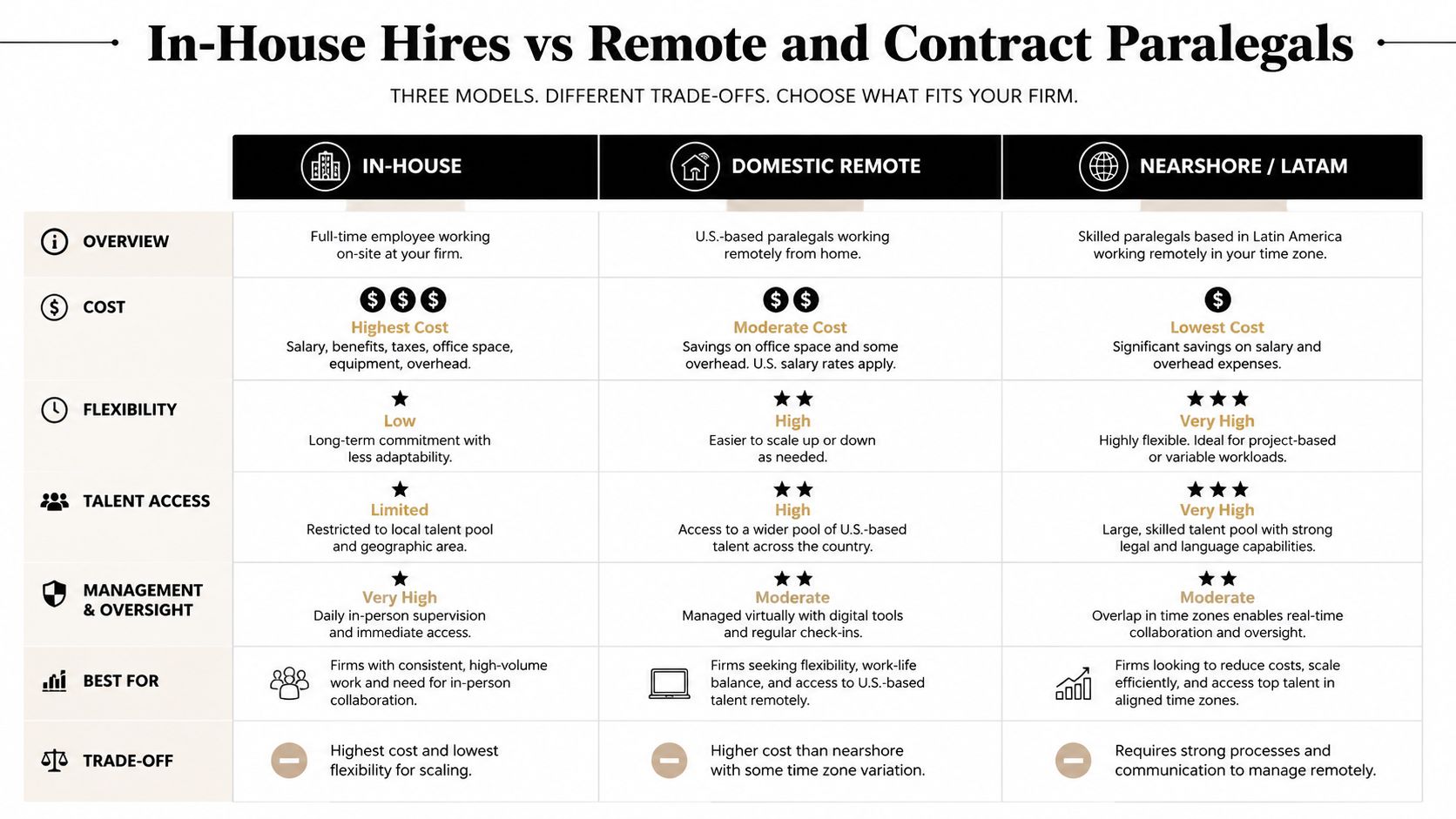
| Model | Strong fit | Main advantage | Main risk |
|---|---|---|---|
| In-house | Long-term, high-touch matters | Deep continuity and immediate collaboration | Full loaded employment cost and limited flexibility |
| Domestic remote | Ongoing support with location flexibility | Access to wider talent while preserving U.S. work norms | Requires disciplined communication and supervision |
| Nearshore or LATAM | Scalable support, repeatable workflows, specialty capacity | Potentially lower labor cost and broader availability | Requires careful compliance, timezone, quality, and confidentiality controls |
Independent legal-staffing commentary estimates that a fully loaded U.S. paralegal can cost about $85,000–$92,000 annually, while a comparable LATAM hire can be materially lower, as discussed in these paralegal cost benchmarks. The lower figure only matters if the firm also manages data access, supervision, workflow quality, and legal-process familiarity.
Internal hiring can support continuity and retention, particularly when the firm invests in development and clear progression. A useful overview of internal hiring advantages for retention helps frame that trade-off. Internal hiring isn't a bad choice. It's a bad choice when the firm uses it for every workload, including temporary spikes that disappear after the docket clears.
For firms evaluating flexible support, a remote legal assistant can handle defined administrative and case-support workflows when the firm provides clear instructions, secure systems, and an accountable supervisor. Generic freelance marketplaces often fall short because a large applicant pool isn't the same as legal vetting. You may spend your savings interviewing strangers.
Open marketplaces look inexpensive until someone has to use them. A partner or office manager posts a role, sorts through a pile of profiles, checks whether candidates understand legal work, schedules interviews across different calendars, verifies references, and discovers that “experienced” means something very different to every applicant.
That process consumes the exact resource law firms claim they're protecting: senior professional time.
A curated legal talent network changes the sequence. Instead of starting with a public applicant pool, the firm reviews candidates who have already passed sourcing, interviews, background checks, and skills validation. The firm still makes the hiring decision, but it doesn't have to perform every preliminary task from scratch.
A useful shortlist should show more than a name and a polished profile. It should give the firm evidence of legal experience, communication ability, relevant practice-area exposure, availability, and fit with the firm's timezone and workflow.
Video introductions and ready-to-review CVs can make the first review more practical, but they don't replace a structured interview. They move the firm past the least valuable part of the search, sorting applicants who never met the basic requirements.
AI can also help with matching and administrative coordination, but it shouldn't make an unchecked decision about legal capability. The firm needs human review, consistent criteria, and a record of why a candidate advanced.
A cheap channel is only cheap when the person operating it has time, judgment, and a reliable way to detect risk.
HireParalegals is one example of a specialized option. Its platform uses a curated network of remote legal professionals and provides candidate shortlists with CVs and video introductions, while also offering payroll management and compliance guidance for Latin American hires. That model can be useful when the alternative is asking a managing partner to spend afternoons fact-checking resumes and running interviews.
When you evaluate a platform, calculate the full internal workload it replaces. Include intake, sourcing, screening, scheduling, interview preparation, reference checks, and onboarding coordination. Then compare that total with the platform's fee or placement economics.
Don't accept vague claims about “quality.” Ask how candidates are screened, what skills are validated, how confidentiality is handled, who manages payroll, and what happens if the match fails. A curated platform earns its cost by reducing uncertainty and administrative work, not by putting a shiny logo on the same open-market process.
Most firms don't need another recruiting tool first. They need fewer handoffs, clearer decisions, and less calendar ping-pong. Hope you enjoy spending your afternoons fact-checking resumes and running interviews, because that's now your full-time job if the process has no structure.
The strongest changes are operational. They can run inside a spreadsheet, shared form, calendar tool, and existing applicant tracking system.
1. Use a structured intake form. Before posting a role, require the supervising attorney to define practice area, core tasks, required experience, working hours, software, confidentiality requirements, and the decision-maker. A vague request for a “strong paralegal” guarantees vague screening.
2. Build a scorecard before reviewing candidates. Separate must-have skills from preferences. Score candidates against the same criteria, such as case-management experience, document accuracy, client communication, filing familiarity, and timezone fit. This prevents the loudest interviewer from changing the standard halfway through the search.
3. Automate scheduling. Let qualified candidates select from approved interview windows. Use calendar automation for confirmations and reminders. The goal isn't to remove people from the process. It's to stop people from acting as human calendar software.
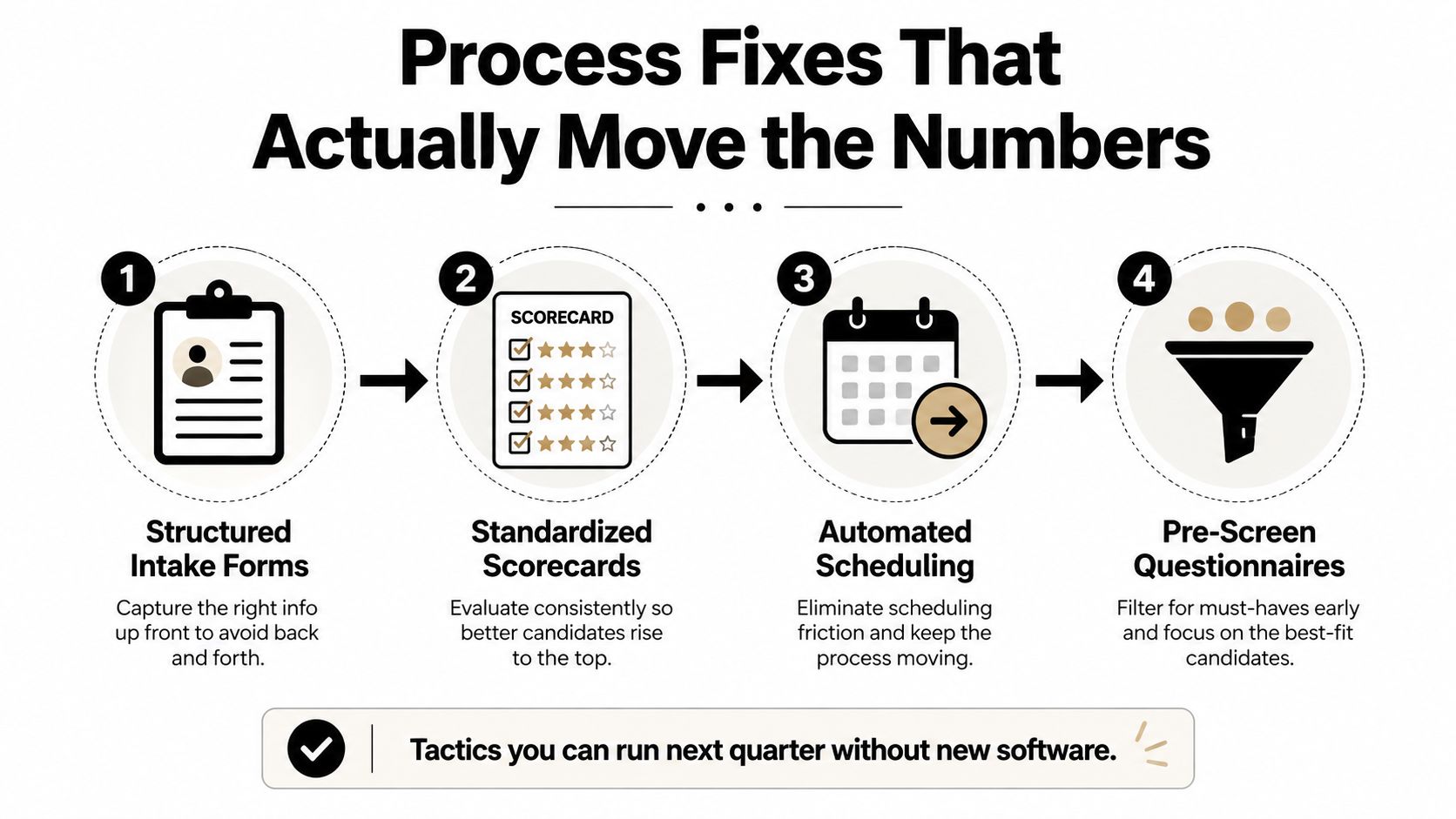
4. Add a pre-screen questionnaire. Ask only questions tied to the scorecard. Confirm availability, relevant matter experience, writing ability, software familiarity, and comfort with the firm's workflow. Don't create a twelve-page obstacle course and call it rigor.
A literature review reports roughly 55–60% reductions in time-to-hire and 20–30% cost savings when AI-assisted talent acquisition is implemented, with candidate engagement maintained or improved, according to this review of AI-assisted talent acquisition. Those figures describe implemented AI-assisted processes, not a magic button for every firm.
The failure mode is obvious. If the role is poorly defined or the scorecard is inconsistent, automation scales confusion. Use automation for intake, structured pre-screening, interview scheduling, and reminders. Keep human review for finalists, judgment-heavy legal work, and any decision involving sensitive information.
For the handoff after acceptance, a practical small business onboarding guide can help firms organize access, expectations, documentation, and early support. Legal onboarding should also include matter-specific confidentiality rules, secure-system training, and a named supervisor.
Firms that document recurring workflows should also create standard operating procedures for paralegal teams. A good SOP reduces training time and makes remote supervision less dependent on tribal knowledge.
Remote hiring becomes expensive when the firm treats access as onboarding. A new legal professional shouldn't receive broad matter access, vague instructions, and a cheerful “let me know if you have questions.” That isn't a management plan. It's an invitation to rework.
Confidentiality comes first. Give the person only the access required for assigned matters, use approved document systems, define communication channels, and explain how the firm handles downloads, local storage, personal devices, and client information. The specific controls should match the firm's professional obligations, technology, practice areas, and jurisdictional requirements.
A remote paralegal needs a named attorney or senior staff supervisor, a written task queue, clear escalation rules, and regular review of completed work. The supervisor should know which work can proceed independently and which tasks require attorney direction.
Timezone fit deserves equal attention. A modest labor-cost difference won't help if a court deadline arrives while nobody is available to answer a question. Agree on working hours, response expectations, urgent-contact procedures, and coverage for filing or client deadlines before work begins.
The same discipline applies to domestic remote staff. Location doesn't eliminate risk. It changes how the firm manages communication, equipment, access, and accountability.
A bad hire creates more than replacement cost. Attorneys repeat instructions, correct filings, repair client communication, review incomplete work, and rebuild trust. A remote arrangement can magnify those costs when the firm has no quality checkpoints.
Use a short performance framework:
The cost of remote talent is real only after these management requirements are included. Salary arbitrage without supervision is not a strategy. It's deferred turnover.
Treat the next month as a controlled operating experiment. Don't slash channels randomly and then wonder why the firm can't hire. Measure the system, remove friction, test a better talent source, and make compliance part of the cost calculation.
List every recent hire and calculate cost per hire using internal and external recruiting costs divided by total hires. Record time-to-fill by start date, attorney interview time, recruiter time, vacancy days, source, and whether the hire was internal, domestic remote, nearshore, or contract.
Put two numbers on the partner dashboard: cost per hire and time-to-fill. If vacancy cost matters heavily to your practice, add a separate vacancy-cost estimate rather than hiding it inside recruiting spend.
Create the intake form, scorecard, pre-screen questionnaire, and approved interview windows. Assign one decision-maker and set a deadline for feedback after each interview. If the firm needs a repeatable workflow, document it before buying software.
Run one role through a curated legal talent network and compare it with your usual process. Track shortlist quality, interview hours, time from request to candidate review, offer speed, and the internal workload required. Don't judge the channel by fee alone.
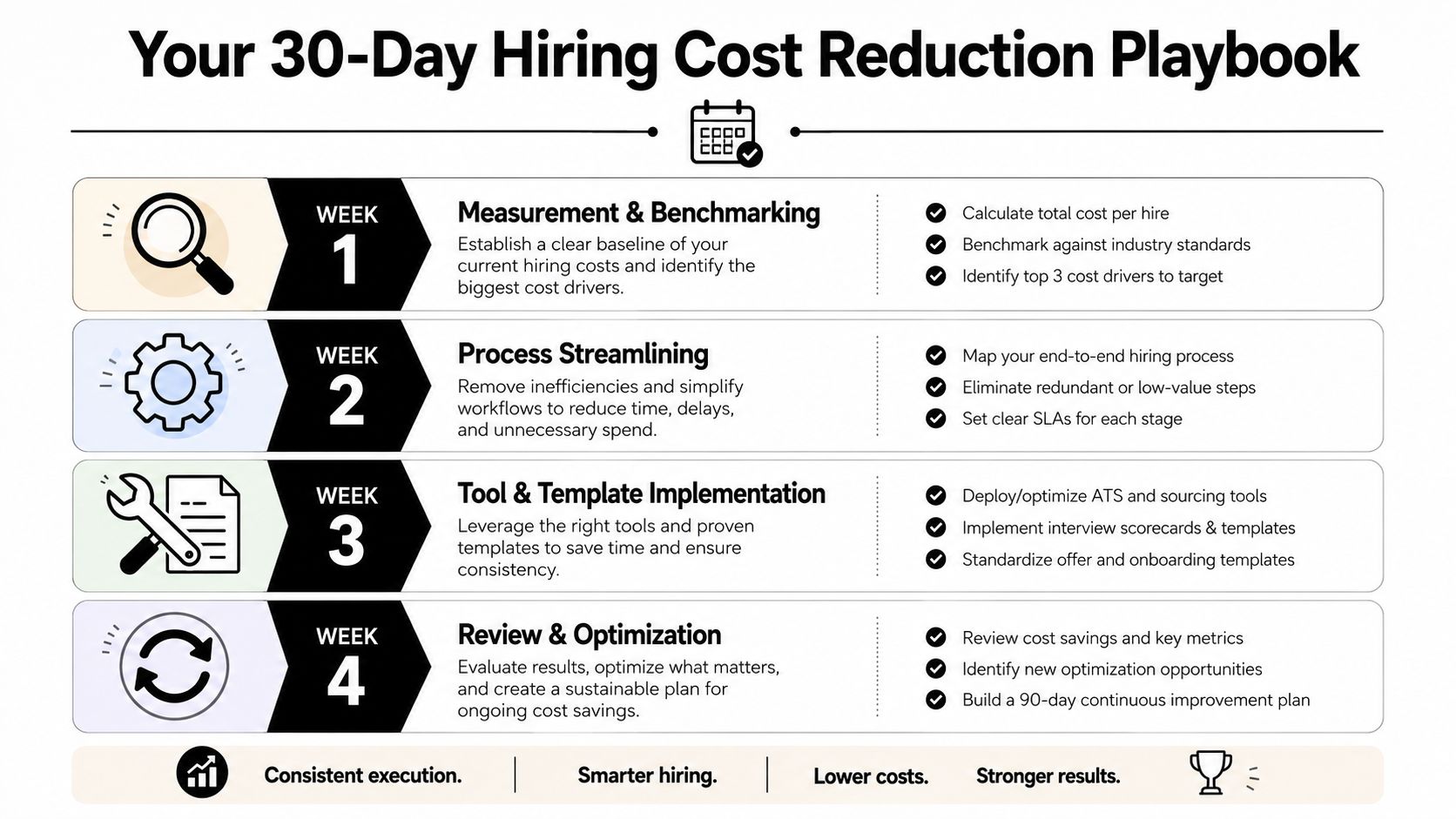
Finalize access rules, confidentiality instructions, supervisor ownership, timezone expectations, quality reviews, and escalation procedures. Review the first assignments and adjust the scorecard based on what the work requires.
The answer to how to reduce hiring costs isn't a cheaper job board. It's a system that fills the right seat quickly, measures the full cost, and prevents avoidable rework. Start Monday by pulling the hiring data your firm already has, then book a partner meeting to review the dashboard before another vacancy turns into an emergency.
If your firm has an open paralegal role or expects a workload spike, request a curated shortlist from HireParalegals, compare the full cost against your current process, and use the next 30 days to test the model with clear compliance and performance controls.