 14 minutes read
Most advice about AI legal document review starts with the wrong question: Can the software replace lawyers? That's vendor-brochure thinking. The useful question is whether the system can reduce repetitive review without dropping a cross-reference, exposing privileged material, or inventing an answer that someone later sends to a client.
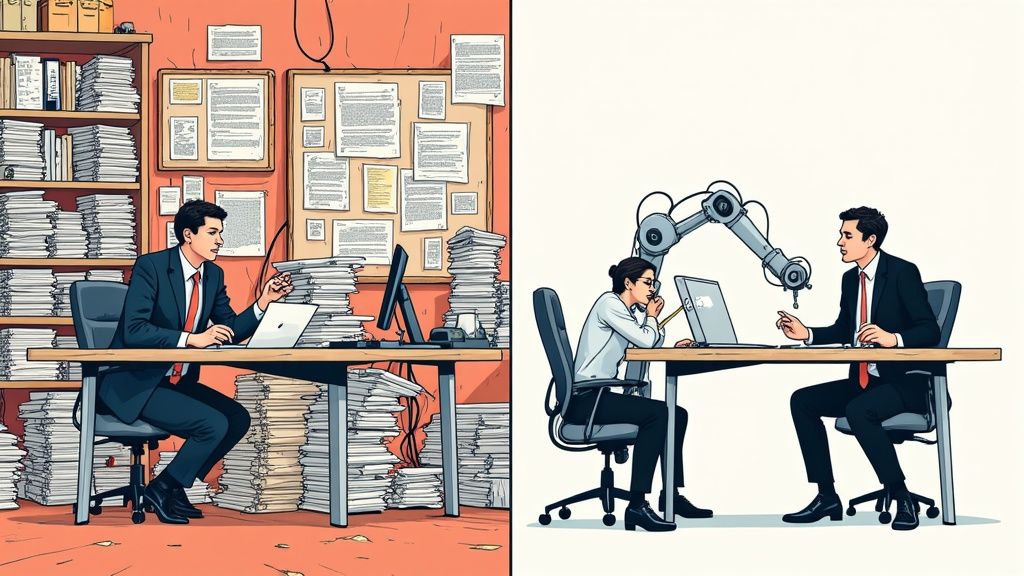
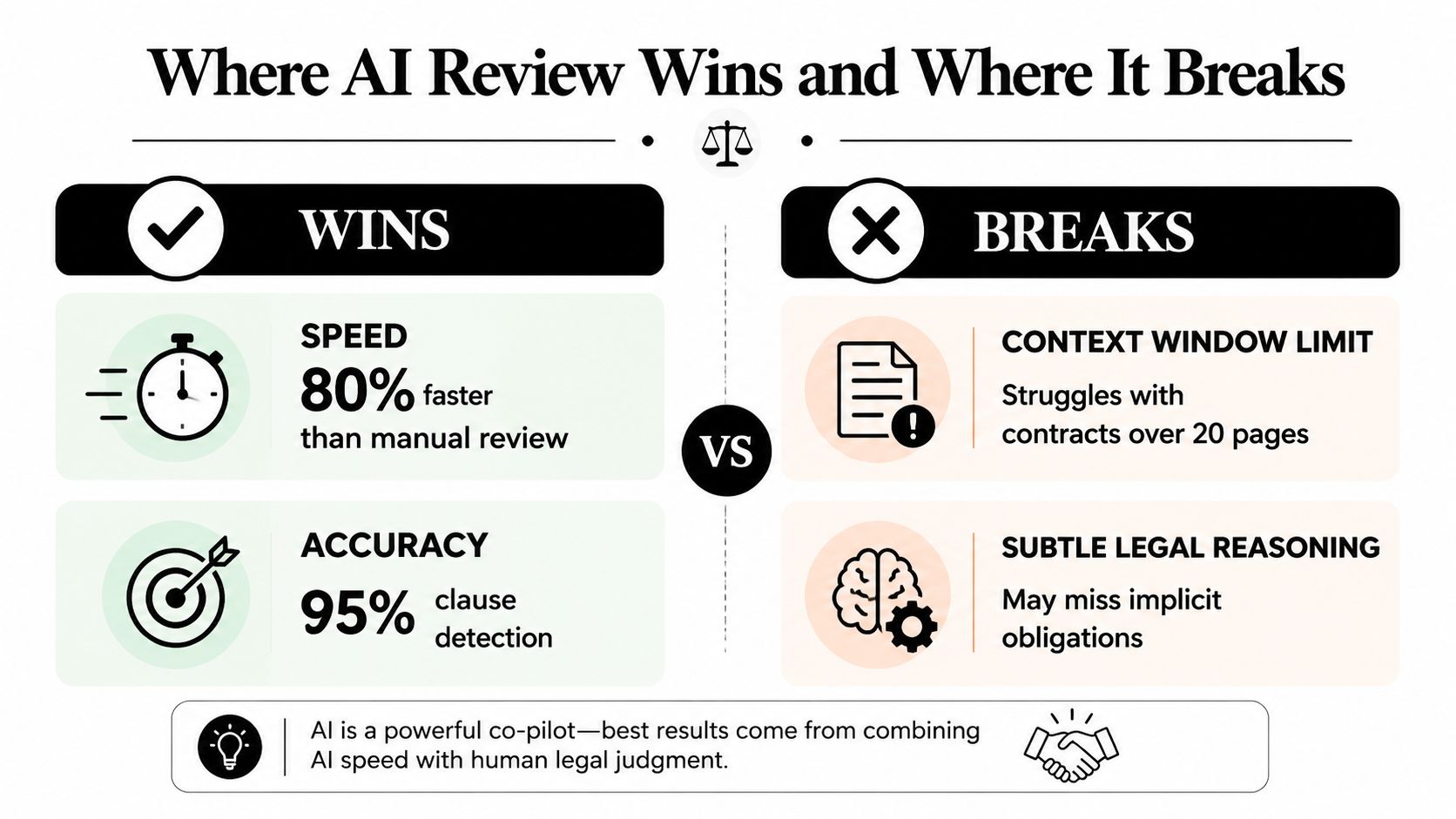
The answer is yes, but only inside a disciplined workflow. AI is excellent at first-pass triage, clause extraction, comparison, summarization, and exception detection. It's much less dependable at context, intent, privilege, jurisdiction-specific judgment, and risk allocation. Treat it like a fast junior reviewer who never gets tired, but also never gets to sign off.
A widely cited legal document review benchmark found that an AI system completed a nondisclosure agreement review in 26 seconds, while human lawyers in the same study averaged 92 minutes. The AI reached 94% accuracy, compared with an 85% average for the lawyers and 67% for the weakest human reviewer. The result, documented in the legal AI review benchmark, helped establish contract review as an early high-value legal AI use case.
That doesn't mean a model understands a transaction like a partner does. It means standardized first-pass work can move from manual reading to machine-assisted triage. The lawyer still decides whether a limitation of liability clause creates unacceptable exposure, whether an indemnity is commercially negotiable, and whether an exception matters in the specific deal.
The distinction sounds obvious. Firms still get it wrong.
A 2025 industry benchmark reported that document review was the leading AI use case, cited by 77% of legal organizations, and that 26% were already using generative AI in legal operations. The same benchmark reported that AI contract review can reduce review time by 80% to 85% on standard commercial contracts, with clause-identification accuracy around 95%, compared with roughly 80% for manual review. Those figures appear in the 2025 legal AI industry benchmark.

The operating principle: AI should narrow the field. Humans should decide what the field means.
AI review works best when the question has a defined answer. Find every change-of-control clause. Extract governing law. Compare termination language against a playbook. Flag deviations from approved fallback wording.
It becomes dangerous when the task asks for judgment. Is this risk material? Does this language create a fiduciary duty? Does the agreement's structure shift liability despite a friendly-looking cap? Those questions depend on context, negotiation history, related documents, and legal strategy.
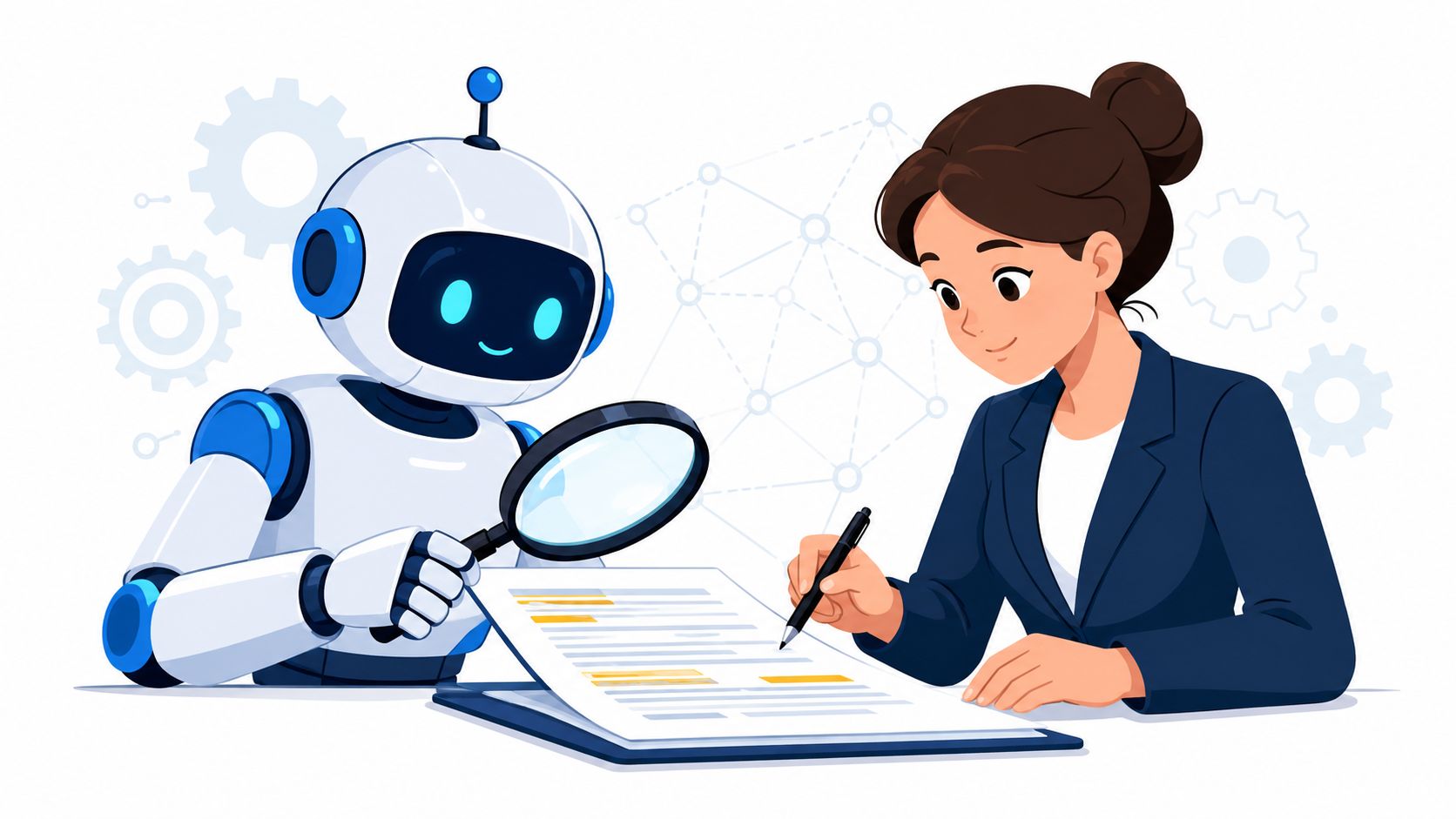
The practical model is simple. AI handles volume and consistency. Paralegals validate exceptions and surrounding language. Attorneys make the final call. Firms that skip the handoff don't have an automated legal department. They have an untracked liability generator wearing a nice interface.
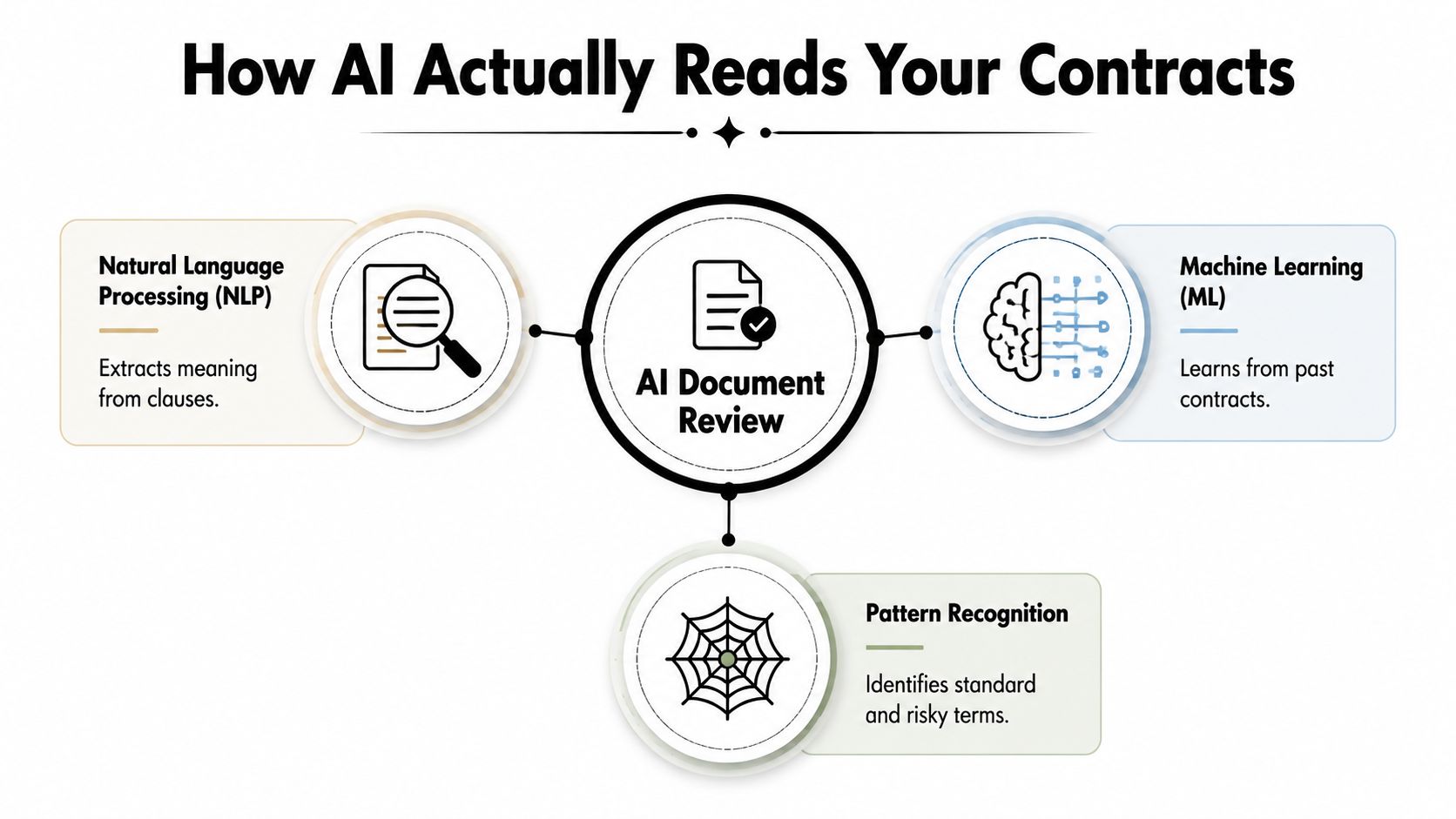
AI reviews contracts through a sequence of extraction, classification, retrieval, and generation steps. Vendors often compress those steps into the word “intelligence,” but the distinction matters when a review fails. A system can locate language accurately while missing the relationship between provisions, the limits of its context window, or information that should remain privileged.
Natural language processing, or NLP, breaks legal language into usable elements. It can identify parties, dates, defined terms, obligations, governing law, renewal mechanics, indemnities, confidentiality language, and other provisions. It can also connect a question to relevant passages when the wording differs from the search term.
For an NDA, that may mean locating the definition of confidential information, permitted disclosures, exclusions, and survival language. For a commercial lease, the system may extract rent mechanics, repair obligations, assignment rights, insurance requirements, options, and default provisions. The answer can depend on how several provisions interact, which makes document structure and retrieval quality matter as much as keyword matching.
Machine learning adds pattern recognition. A model can compare incoming language with prior examples, a clause library, or a firm playbook. If a team has labeled approved, rejected, and escalated language, the system can use those examples to identify likely deviations. That works well for standardized agreements. Novel documents and thin training sets create more uncertainty.
Context windows create a separate operational failure. A model may receive a clause without the definitions, schedules, exhibits, or referenced agreement that changes its meaning. Long contracts can also force systems to summarize or truncate material before answering. Require page-level citations and test retrieval across cross-references before trusting a result.
Asking a generative model to summarize an agreement produces readable prose. Asking a review system to populate a controlled table with source-backed answers produces an auditable work product. Prose can conceal omissions, while structured classification requires defined questions, supporting text, and an uncertainty or missing-information flag.
| Review task | Better machine role | Human checkpoint |
|---|---|---|
| Clause extraction | Locate and organize relevant provisions | Confirm the clause is complete |
| Playbook comparison | Flag deviations from approved language | Decide whether the deviation is acceptable |
| Risk ranking | Prioritize exceptions | Assess materiality and commercial context |
| Summary drafting | Create a first-pass overview | Verify every material statement |
A contract review automation workflow should use repeatable issue codes, source citations, and clear escalation rules. A single chat box that generates confident paragraphs gives reviewers too little control over evidence, corrections, and follow-up.
Do not accept “our model understands legal context” as a product explanation. Ask whether the system uses clause classification, retrieval from source documents, generative drafting, supervised learning, or a combination. Ask how it handles missing exhibits, defined terms, tables, scanned pages, conflicting provisions, and documents that exceed its context window.
Ask where prompts, extracted text, reviewer corrections, and privilege-sensitive material are stored, and whether customer data is used for training. Require controls that restrict access, preserve an audit trail, and route uncertain findings to a human reviewer.
The right system can show which text triggered an issue, preserve the reviewer's correction, and repeat the workflow after the demo ends. That is the standard to use.
The strongest evidence for AI review comes from actual workflows, not conference-stage magic tricks.
One law-firm case study reported first-pass review time falling from 4 to 6 associate hours to 50 to 80 minutes per document. Partner review fell from 60 to 90 minutes to 15 to 20 minutes, because the system generated a risk-ranked exception report instead of a full redline. The case study also reported that 94% of standard clause deviations were flagged automatically, with no non-standard clauses missed after deployment. Those results are described in the law-firm contract review case study.
A separate case study involving a 45-attorney firm processing more than 100 contracts per month reported review time dropping from 4 hours to 12 minutes per contract. It reported 99.2% clause-extraction accuracy on standard contract types against a manually reviewed validation set and estimated $1.2 million in annual recovered billable capacity. The details appear in the law-firm document assistant case study.
Those are meaningful results. They also describe the easiest environment for automation: standardized agreements, defined review criteria, and humans validating the output.
Legal documents rarely behave like isolated files. A purchase agreement may incorporate schedules, disclosure letters, exhibits, side letters, and referenced definitions. A lease may point to insurance documents or operating rules. A litigation review may involve email chains, attachments, chats, and duplicate files with meaningful differences.
If the system can't reliably keep those relationships in view, it may produce a technically fluent answer that misses the operative dependency. The problem isn't only how many pages the model accepts. It's whether the workflow preserves structure, links references, tracks versions, and tells the reviewer what wasn't available.
Independent commentary on AI's limitations in legal practice highlights prompt complexity, hallucinations, issue-code limits, and the cost of iterative refinement. The same verified data notes that 60% of respondents had some issues with AI-driven document review, while 14% had to retract more than 5% of produced documents. Those numbers should change your buying question from “Can it review documents?” to “What does it do when the record is incomplete or interconnected?”
AI can fabricate citations, invent authorities, state unsupported conclusions, or attach the wrong jurisdiction to an answer. BCG Search's discussion of legal AI risks and the referenced legal commentary both treat those failures as operational risks requiring thorough human oversight.
Use AI to surface and organize evidence. Never let a polished paragraph substitute for checking the underlying clause, authority, or factual record. The fastest review is worthless if a lawyer must later reconstruct where the machine went wrong.
A defensible workflow has visible handoffs. Nobody should be able to ask, after a missed exception, “Who checked that?”
Before uploading anything, define the document set, the issue codes, the playbook, the output format, and the escalation threshold. “Review for risk” is not a specification. “Identify assignment restrictions, compare them with the approved fallback, quote the relevant text, and escalate any deviation affecting consent rights” is.
Then confirm the source set. Missing attachments and poor scans can undermine otherwise capable tools. If the system didn't receive the exhibit, it can't reason from the exhibit. That sounds like a joke until someone relies on the missing page.
AI performs the first pass. It extracts clauses, identifies defined terms, flags deviations, ranks exceptions, and creates a source-linked report. It should also identify unanswered questions instead of filling gaps with confident guesses.
Paralegals validate the machine's work. They read the full provision, inspect surrounding sections, check defined terms, compare referenced documents, and correct false positives. They're not merely proofreading. They're restoring context the model may have flattened.
Attorneys decide. The supervising attorney assesses legal significance, approves client-facing conclusions, determines negotiation strategy, and resolves ambiguous or high-risk provisions. That division keeps expensive judgment focused where it belongs.
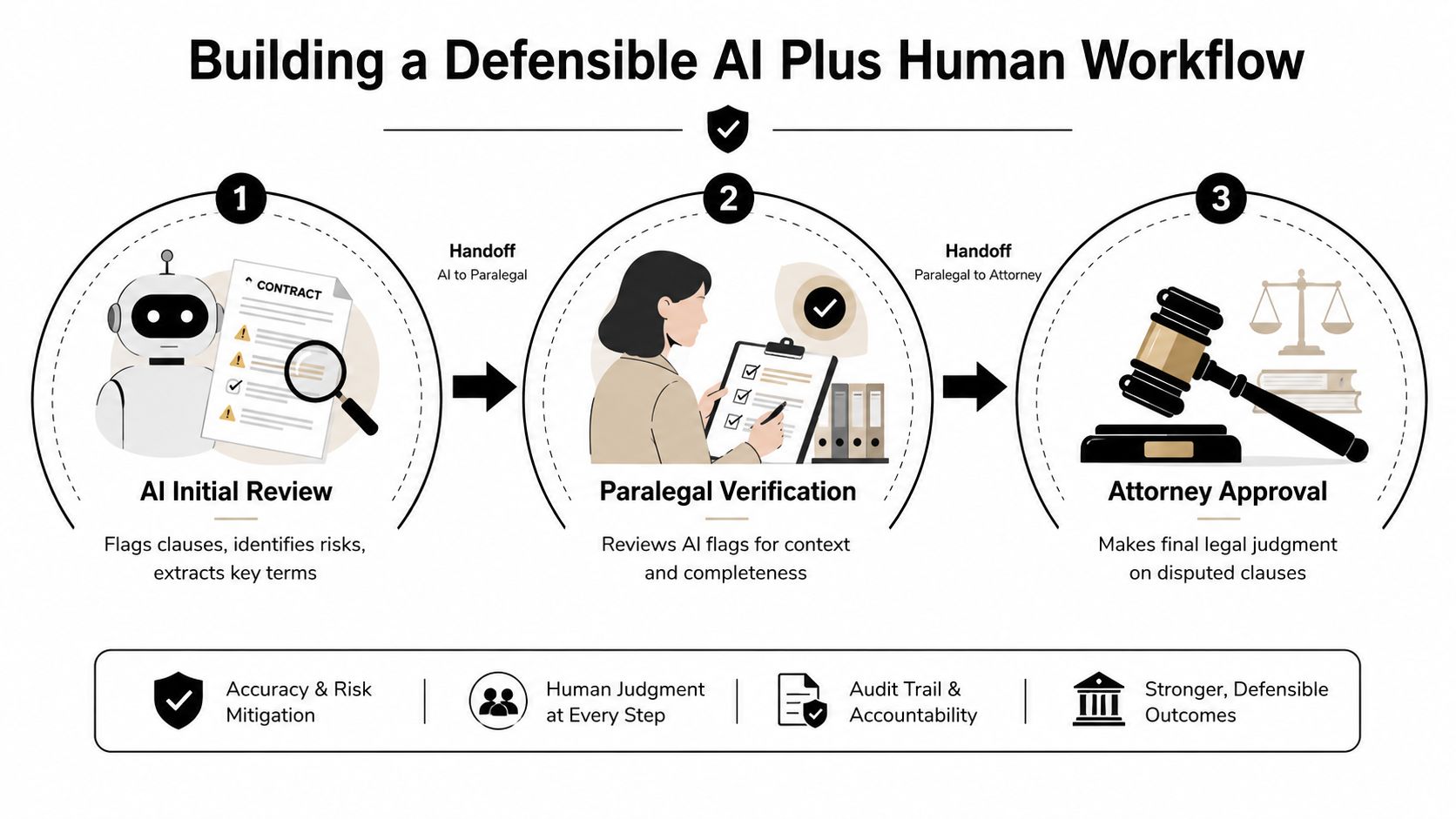
Every material finding should point back to the source text. Reviewers should record whether the clause was confirmed, corrected, escalated, or left unresolved. The system should preserve the original output and the human revision, rather than overwriting the machine's answer.
Thomson Reuters states that responsibility for AI use rests with the supervising attorney, and that no AI output should be submitted to a court, sent to a client, or otherwise relied on without independent verification in its foundational guide for legal professionals.
Practical rule: The machine can prepare the exception report. The lawyer still owns the conclusion.
For outputs containing citations or quotations, build a separate check. The American Arbitration Association and Law Association white paper states that attorneys must certify that AI-generated citations and quotes have been checked for relevancy and accuracy in its guidance on generative AI. That check belongs in the workflow, not in someone's memory at 11:47 p.m.
Technology isn't the bottleneck anymore. Governance is.
A firm can buy a secure platform and still run an indefensible process if users upload matters without approval, share outputs through uncontrolled channels, or fail to preserve the review history. The policy needs to answer who may use which tool, for which matters, with what data, and under whose supervision.
Using AI to review documents doesn't automatically change the privilege status of the underlying materials. It can, however, increase the risk of inadvertent production, third-party disclosure, and discoverable derivative materials. WilmerHale explains those risks in its alert on protecting legal professional privilege.
That means privilege review needs more than a checkbox. Control access by matter, restrict downloads, define approved processing environments, and identify where summaries and extracted data are stored. If an AI-generated report contains privileged reasoning, treat the report like a privileged work product, not like a harmless convenience file.
A useful audit trail management process should record the source set, reviewer identity, model or workflow version where available, prompts or review instructions, flagged issues, corrections, approvals, and final disposition.
A 2025 Thomson Reuters survey reported that only 41% of law firms had generative-AI policies, 40% provided training, and 20% measured ROI. It also reported that 71% of corporate legal clients didn't know whether outside counsel were using generative AI. Those findings are in the Thomson Reuters survey coverage.
Your governance checklist should cover:
The firms that win here won't be the ones with the loudest AI strategy. They'll be the ones that can explain, calmly and specifically, how a human checked the machine.
A slick demo proves almost nothing. Give every vendor your documents, your playbook, your ugly scans, and your awkward clauses. Then watch what breaks.
Ask the vendor to demonstrate:
The supplied vendor checklist calls for support for contracts over 100 pages, firm-specific clause recognition, integration with existing document management systems, and editable AI suggestions with an audit trail. Treat those as test criteria, not decorative feature labels.
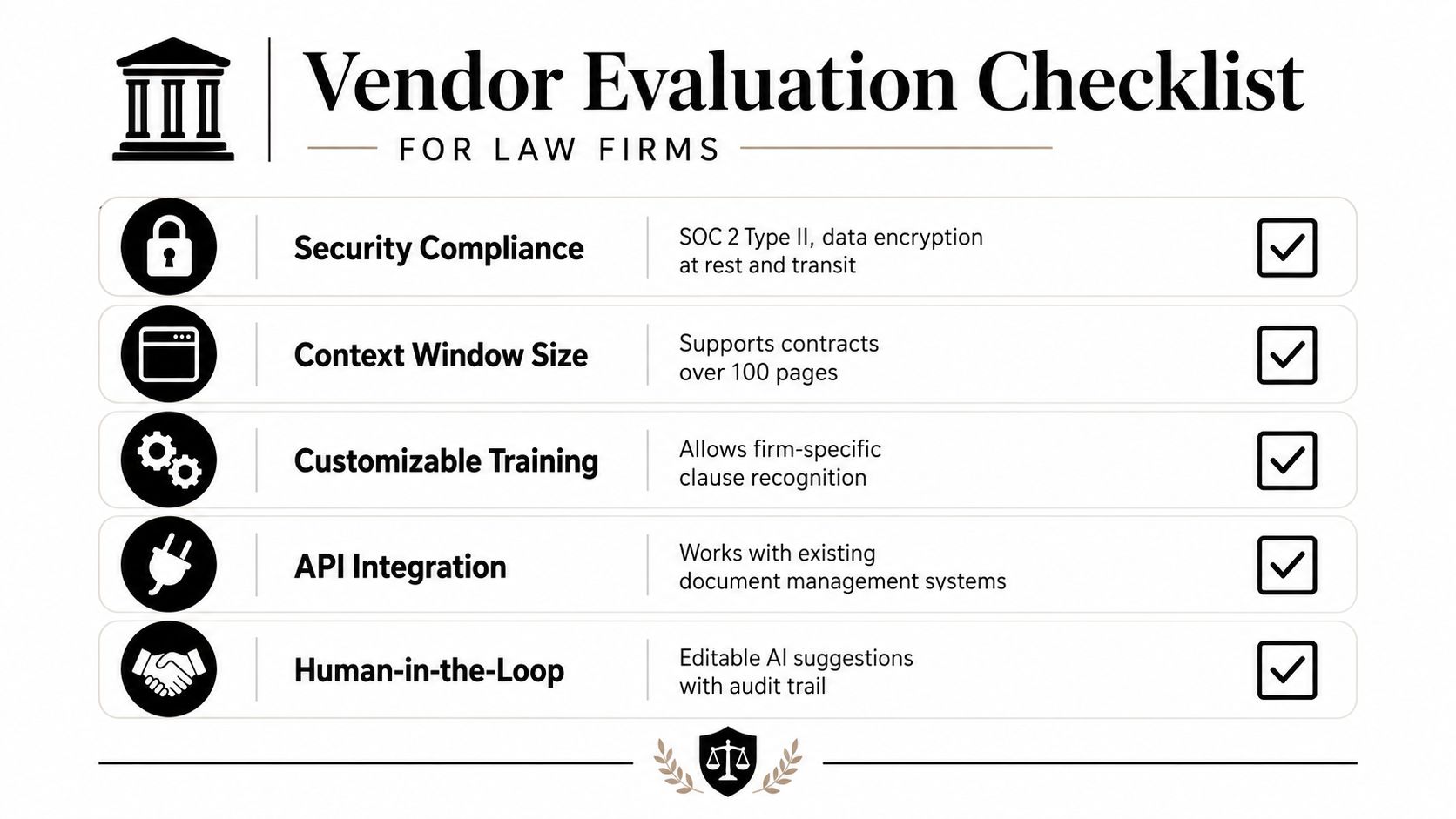
Ask where data is processed and stored, how it is encrypted, how access is controlled, and whether customer data is used to train shared models. Ask how the platform handles deletion, retention, audit logs, and administrator access.
Don't let a low license price distract you from review rework. Calculate the full cost of false positives, missed clauses, manual cleanup, training, integration, and attorney verification. The right system improves the whole workflow. A cheap system that creates a second review layer may just move the invoice.
Run a controlled pilot with representative agreements and predetermined acceptance criteria. Include the people who will use the tool, including paralegals and attorneys. If the vendor won't let you inspect source support and correction history, walk away.
AI creates capacity, but it does not remove the need for accountable reviewers. Better automation makes the exception queue more important. A person must inspect the flagged clause, read surrounding provisions, verify the source, check for missing context, and decide whether an attorney needs to act.
That workload rarely justifies a permanent hire. Transaction volume fluctuates, litigation deadlines arrive in clusters, and a small practice may need contract experience for one matter before requiring a different specialty. On-demand staffing keeps the verification layer flexible while preserving human responsibility for legal judgment.
Give standardized extraction and comparison tasks to the AI system. Route exceptions by document type, subject matter, jurisdiction, and severity. Paralegals can validate routine flags, check incomplete context, locate missing exhibits, and escalate questions that require legal judgment.
HireParalegals' legal support services describe access to remote legal professionals who can support document work and contract workflows. Any staffing model should use clear instructions, matter-specific access, source-linked corrections, timezone alignment, and attorney approval before client-facing use. Restrict access to the documents and systems each reviewer needs, especially where privileged material is involved.
Track where work stalls. Are paralegals correcting extraction, chasing missing exhibits, or clearing false positives? Are attorneys receiving concise, source-backed exceptions, or another batch of unsupported AI prose?
A workable process gives each participant a defined responsibility:
This division lacks the gloss of “fully autonomous review,” but it is the only version that will withstand a client question, a discovery dispute, or an uncomfortable internal audit. The workflow must show who reviewed each exception, what source supported the decision, and when an attorney approved the result.
Start with one repeatable document type, one approved playbook, and one review team. Run a controlled pilot, log every correction, and refuse to expand until source checks, privilege controls, and attorney sign-off work in practice. If human verification is the constraint, assess qualified on-demand paralegal support before purchasing a larger vendor promise.