 16 minutes read
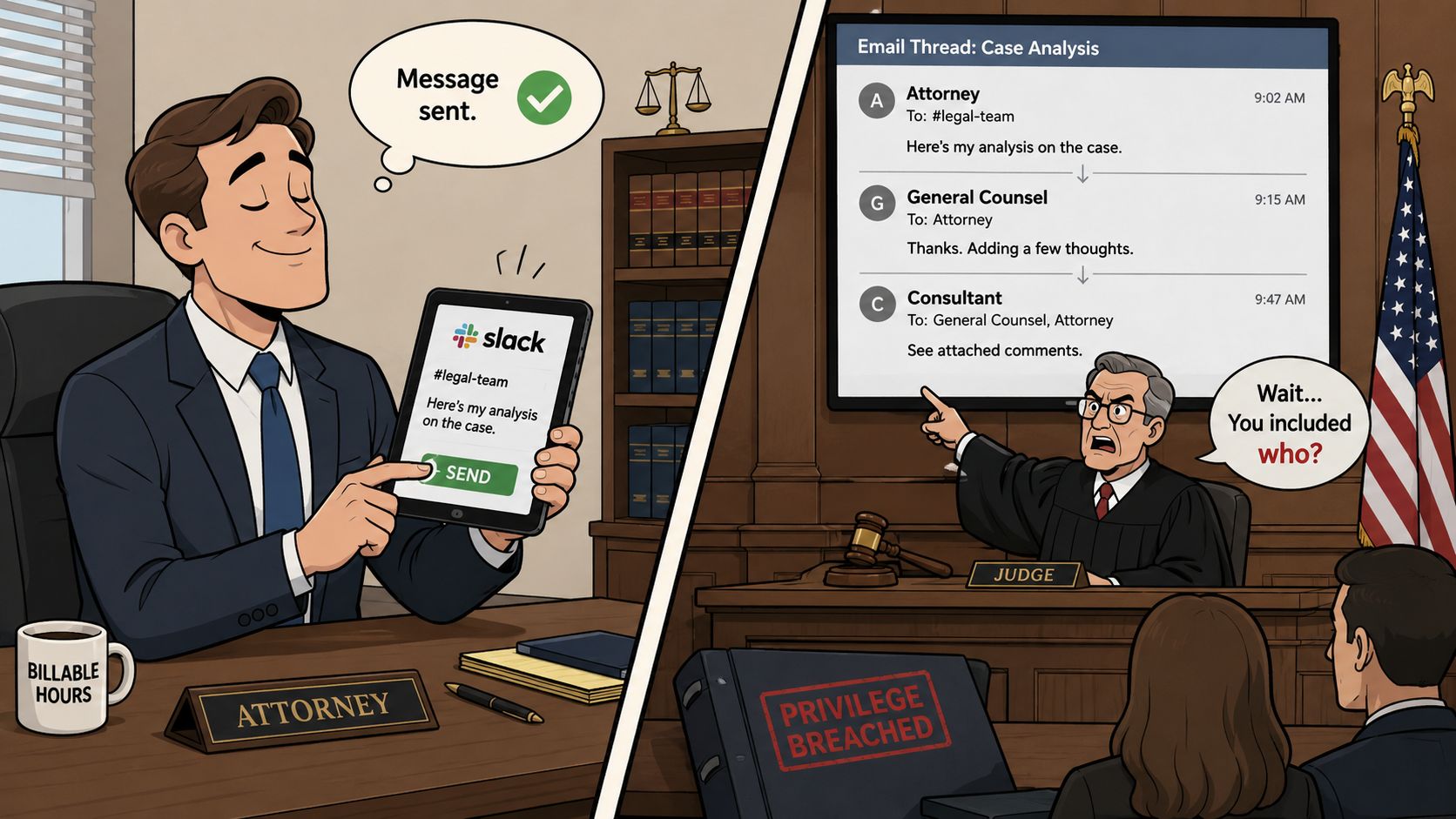
A partner sends a privileged strategy memo through a shared Slack channel. The channel includes the client's general counsel, a consultant, and several people nobody remembers adding. The consultant forwards it to a project workspace. The opposing party finds it in discovery. The court treats the disclosure as a waiver, and a defensible case settles for nuisance value.
That isn't a dramatic courtroom fantasy. It's what sloppy communication looks like in a hybrid practice. Teams, Signal, shared drives, email forwarding, automated summaries, remote staff, and public AI chatbots have created more ways to lose confidentiality than most firms have controls to manage. Attorney-client privilege is still a powerful doctrine, but it's not a force field.
The practical question isn't whether a document carries a “Privileged” label. It's whether the communication satisfies the legal test, avoids an exception, survives the relevant jurisdiction's rules, and remains confidential through every person and system that touches it.
Attorney-client privilege is one of the oldest recognized confidentiality doctrines in Anglo-American law. The Yale historical survey traces documented case law to 1654, apart from fragmentary Elizabethan references, and later scholarship identifies Upjohn Co. v. United States as the modern corporate-law milestone that expanded protection for employee communications during internal investigations. The Yale historical survey gives the doctrine impressive historical roots. It doesn't make today's shared workspace any safer.
A mid-sized firm can lose protection without anyone acting recklessly. An associate drafts an internal investigation memo. The partner posts it in a Teams channel so the client can respond quickly. A consultant helps interpret operational data, so someone adds that consultant to the thread. Later, an AI summarizer creates a clean digest and stores it in a separate workspace. By the time litigation begins, the firm has a privilege problem spanning people, platforms, and jurisdictions.

The uncomfortable truth: Most waiver failures are process failures wearing a legal costume.
The pressure is real. A 2005 National Association of Criminal Defense Lawyers survey found that 48% of outside counsel and more than 30% of in-house counsel reported erosion of privilege and work-product protections after Enron. Eighty-seven percent of lawyers said privilege or work product had recently been challenged. The survey's executive summary also identified challenges from federal prosecutors, federal regulators, and opposing civil litigants.
That history matters because modern workflows multiply the exposure points. A remote paralegal may work from a personal laptop. A client may invite an outside consultant to a legal call. A cross-border regulator may seek documents under a different privilege framework. A lawyer may paste a sensitive fact pattern into a public chatbot because the prompt looks harmless.
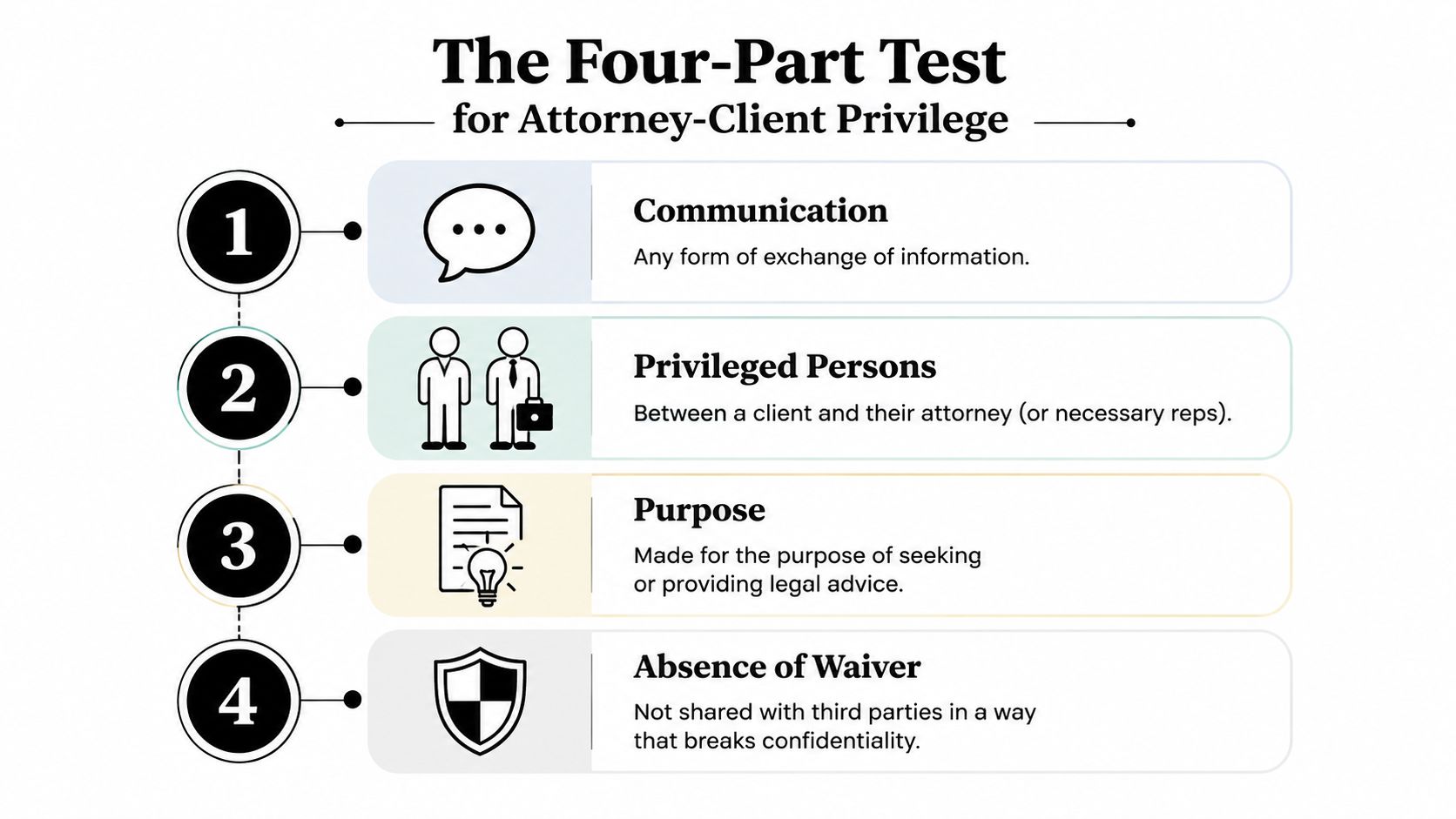
The rest of this guide comes down to four questions. Was there a communication? Were the participants privileged persons? Was the exchange confidential? Was its purpose legal advice? Then come the exceptions, cross-border conflicts, privilege logs, AI controls, and the Monday-morning operating system that keeps theory from collapsing in practice.
The classic attorney-client privilege test is concrete. The communication must exist, the participants must qualify, confidentiality must be preserved, and the purpose must involve legal advice. This privilege overview summarizes the four-part structure. Miss one element, and the protection becomes shaky fast.
Privilege protects an exchange, not every fact a lawyer learns. An email, call, memorandum, text, or chat can qualify. A fact doesn't become privileged because someone typed it into an email addressed to counsel.
Think of the difference between a sealed letter and a postcard. The sealed letter signals a confidential exchange. The postcard broadcasts its contents to anyone handling it. A message posted in a broad operational channel may be useful, but its audience can undermine the confidentiality element.
The exchange generally needs to involve the client, counsel, or a necessary representative acting to support the legal relationship. An interpreter or accountant may qualify when functioning as counsel's agent, but a convenient business contact doesn't become privileged merely because a lawyer is copied.
In-house counsel creates a recurring trap. The same lawyer may advise on legal exposure in one message and negotiate commercial terms in the next. Labeling both messages “Attorney Work Product” won't convert business advice into legal advice. The document's substance and purpose control.
Ask what the sender and recipient were trying to accomplish. A memo about contract economics may be ordinary business analysis. A memo routed through counsel to evaluate enforceability, regulatory exposure, or litigation strategy may support a privilege claim, provided the other elements remain intact.
Post-engagement summaries also deserve scrutiny. A lawyer's later recap of a meeting isn't automatically privileged if it merely records business events. The summary needs to reflect or facilitate legal advice, not just preserve a convenient corporate history.
A confidential huddle can become a press conference through one unnecessary recipient. Auditors, consultants, spouses, board observers, and other third parties require a specific role-based analysis. Ask whether their presence was necessary to obtain or provide legal advice, whether they were bound to confidentiality, and whether the distribution stayed controlled.
Upjohn draws another hard boundary. The American Bar Association's discussion of Upjohn explains that the privilege protects communications, not underlying facts. A company can protect what employees told counsel in confidence, but it can't hide the facts themselves by repeating them to a lawyer.
Privilege protects lawful legal consultation. It doesn't protect every communication involving a lawyer, and it certainly doesn't protect a plan to use legal advice as a tool for misconduct.
The crime-fraud exception removes protection when communications further ongoing or future unlawful conduct. Courts generally require a prima facie showing that the client was committing or intending a crime or fraud and that the lawyer's assistance was used to advance it. This review of attorney-client privilege and waiver explains the key temporal and causal boundary.
Advice about past wrongdoing can remain privileged. Advice that helps plan, conceal, or continue misconduct is different. If a client asks counsel to structure a contract to deceive a regulator, the firm should stop treating the request as a routine drafting assignment and escalate the issue immediately.
Forwarding privileged advice to a business partner, outside consultant, board observer, or other unnecessary recipient can destroy confidentiality. A common-interest or joint-defense arrangement may help in appropriate circumstances, but it isn't a magic phrase you add after the email has already gone out.
The same discipline applies to litigation support. Anyone reviewing documents needs a defined role, confidentiality obligations, and controlled access. Firms that treat a third party as “basically part of the team” are often relying on vibes where a court wants facts.
A translator or accountant embedded in the legal team may support privilege when the person's involvement is necessary to facilitate legal advice. An accountant invited because the client wants another business opinion is a different situation. The question is functional, not ceremonial.
Trustees face another limitation. Under the fiduciary exception, communications between a trustee and the trustee's lawyer may be discoverable by beneficiaries when the lawyer is advising on fiduciary administration. A trustee cannot assume that the trust's payment of legal fees makes every exchange unavailable to beneficiaries.
For a practical grounding in the discovery process surrounding these disputes, review this guide to discovery in litigation. Privilege decisions rarely happen in isolation. They arise inside collection, review, production, and meet-and-confer workflows.
Federal Rule of Evidence 502 limits subject-matter waiver for intentional disclosures to communications concerning the same subject matter when fairness requires considering them together. For inadvertent disclosures, protection depends on reasonable preventive steps and prompt corrective action. Federal Rule of Evidence 502 states the operative framework.
Use clawback language, seek an appropriate federal order when warranted, quarantine the recipient set, and document the response. Don't confuse a rescue mechanism with a permission slip for careless review. Exception analysis remains jurisdiction-sensitive, especially when a dispute crosses court systems or national borders.
A US privilege analysis doesn't travel cleanly in a corporate investigation. The same email may receive different treatment depending on where the court sits, who sent it, whether in-house counsel was acting legally, and whether a regulator seeks production outside ordinary discovery.
In the United States, attorney-client privilege focuses on confidential communications made to obtain or provide legal advice. Work product adds a separate protection for litigation preparation. ABA Model Rule 1.6 supplies a broad professional confidentiality regime, but ethical confidentiality and evidentiary privilege aren't interchangeable. A lawyer may owe confidentiality even when a court would compel production.
England and Wales divide Legal Professional Privilege into distinct categories, including legal advice privilege and litigation privilege. Communications with third parties can receive protection in litigation settings, but the analysis is not merely a US privilege test with British spelling. In-house counsel status, the purpose of the communication, and the litigation context can change the result.
Australia applies client legal privilege through a narrower, dual-purpose analysis in many disputes. Civil-law jurisdictions such as Germany, France, and Brazil often ground lawyer confidentiality in professional secrecy, sometimes with criminal-law consequences, but their systems don't mirror US discovery battles. A document may be protected from a lawyer's disclosure while still being handled through a very different production process.
| Pressure point | United States | England and Wales | Australia and civil-law systems |
|---|---|---|---|
| In-house counsel | Often protected for legal communications | Depends on the privilege category and legal purpose | Rules vary, with civil-law professional secrecy operating differently |
| Third parties | Necessary agents and common-interest parties require careful analysis | Litigation privilege may matter, but categories differ | Dual-purpose and professional-role tests can narrow protection |
| Regulators | Federal rules and agency demands shape production | Cross-border procedure can alter access | Local investigation powers and secrecy rules may control |
| Cross-border discovery | US courts may order production with choice-of-law disputes | UK and EU production no longer follows a frictionless assumption | Local law can restrict or reshape disclosure |
The global picture is moving, not static. A global attorney-client privilege guide notes developments involving in-house counsel, shareholder access in England, dual-purpose communications in Australia, and procedural questions in India about investigators summoning lawyers. Firms with international matters should involve local counsel before collecting or exporting documents, not after a foreign tribunal challenges the privilege position.
Operational compliance can create similar confusion. A firm dealing with Ontario employment or records obligations may find a resource on Ontario Bill 149 compliance useful for the surrounding process, but it shouldn't substitute for jurisdiction-specific privilege advice. Brexit also changed assumptions about UK and EU document movement. Treat every cross-border transfer as a legal decision, not a routine upload.
A privilege log is not a junk drawer for withheld documents. It's the explanation that lets opposing counsel and the court evaluate your claim without seeing the protected substance. Boilerplate entries such as “email regarding legal advice” invite a challenge because they identify neither the subject nor the legal purpose.
Start with the objection itself. A practical formulation is:
Privilege objection: The responding party withholds this communication under attorney-client privilege and, where applicable, the work-product doctrine. The communication was made in confidence between identified counsel, client representatives, and necessary agents for the purpose of requesting, providing, or facilitating legal advice. No waiver has occurred, and any inadvertent disclosure was addressed through reasonable prevention and prompt corrective action.
Adjust the language to the governing order and facts. Don't paste it into every response without checking whether the listed recipients and purpose are accurate.
Use a consistent set of columns:
A useful entry might read: “Email thread between litigation partner, associate, and client COO concerning factual chronology and counsel's request for information for legal assessment. Privilege and work product asserted. Attachment withheld separately as draft legal analysis.” That gives the court something to evaluate without smuggling the advice into the log.
The amended federal practice expects parties to address privilege-log timing and methods early in litigation. Raise the protocol at the Rule 26(f) conference, coordinate it with the litigation hold, and decide whether categories can be logged efficiently without hiding meaningful distinctions. Rule 502's federal text also matters when production mistakes and waiver arguments arise.
Run a second-person quality check before serving the log. A litigation support specialist can maintain the audit trail, but counsel must own the privilege judgment. Firms that need structured support can review audit-trail management practices and adapt them to their own review platform, hold notices, and approval chain.
Remote work didn't repeal privilege. It made confidentiality a systems problem.
A remote paralegal using a firm-managed laptop and a secure practice-management suite may fit comfortably within the legal team's workflow. The same person using a personal device, a household Wi-Fi network, and a consumer file-sharing account creates a different record. Add screen sharing during a video call, a family member within earshot, or an AI tool that retains prompts, and the firm may struggle to show that it took reasonable steps to preserve confidentiality.
Personal endpoints create uncontrolled copies. A downloaded exhibit can land in local folders, automatic backups, or personal email. Use firm-managed endpoints, encrypted storage, MFA, remote wipe capability, and role-based access. A confidentiality acknowledgment should cover remote staff, contract attorneys, and temporary reviewers, not just employees.
Ambient access is easy to ignore. Video calls should use headphones, private rooms, waiting rooms, controlled invitations, and screen-sharing limits. Don't discuss client strategy while a household member is sitting beside the laptop. A “mute” button isn't a confidentiality policy.
Public AI platforms deserve the strictest rule. A 2026 federal case held that documents a criminal defendant created using a public AI chatbot weren't protected by attorney-client privilege or work product. The case shows the danger clearly, especially where counsel didn't direct the AI use and the platform's privacy terms allowed collection or disclosure. The Harvard Law Review analysis of the AI privilege dispute describes the decision and the competing argument for a more fact-specific approach.
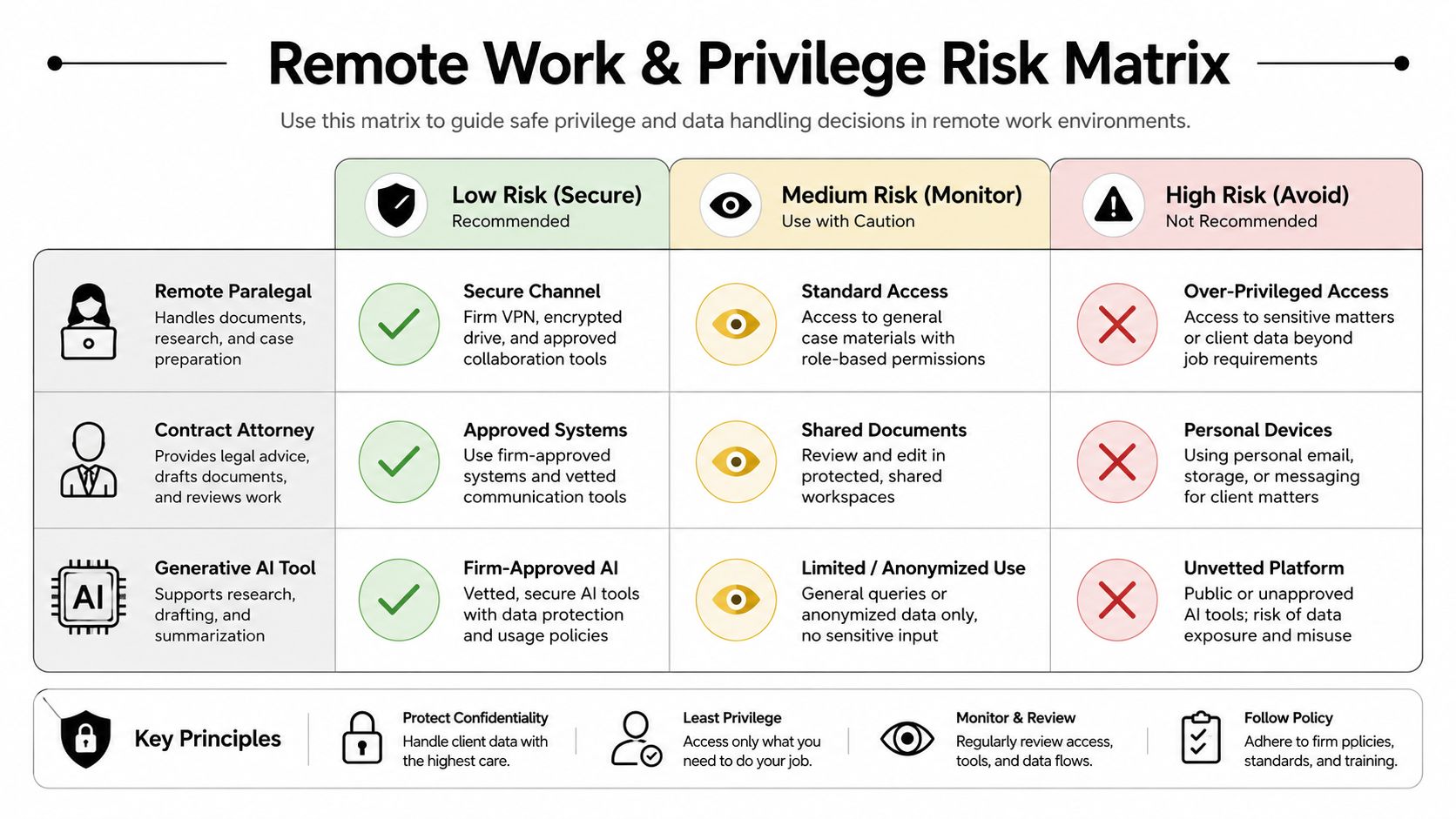
The principle is simple. If a third party can train on, disclose, or freely access the material, you need a serious confidentiality analysis before calling the workflow privileged. Firms using remote legal support can document safeguards through a formal data-security protocol. HireParalegals is one example of an on-demand platform connecting US law firms with remote legal professionals, but no staffing platform replaces the firm's own access controls and supervision.
Privilege protection improves when someone owns the process. It doesn't improve because the firm bought another software subscription and placed a lock icon on the dashboard.
The worst habits are familiar. Lawyers copy everyone “for visibility.” Clients mix legal advice with business chatter. Staff upload files to whichever tool is easiest. Nobody checks the guest list. Then the firm discovers that the privilege log is vague, the hold is incomplete, and the consultant's account still works.
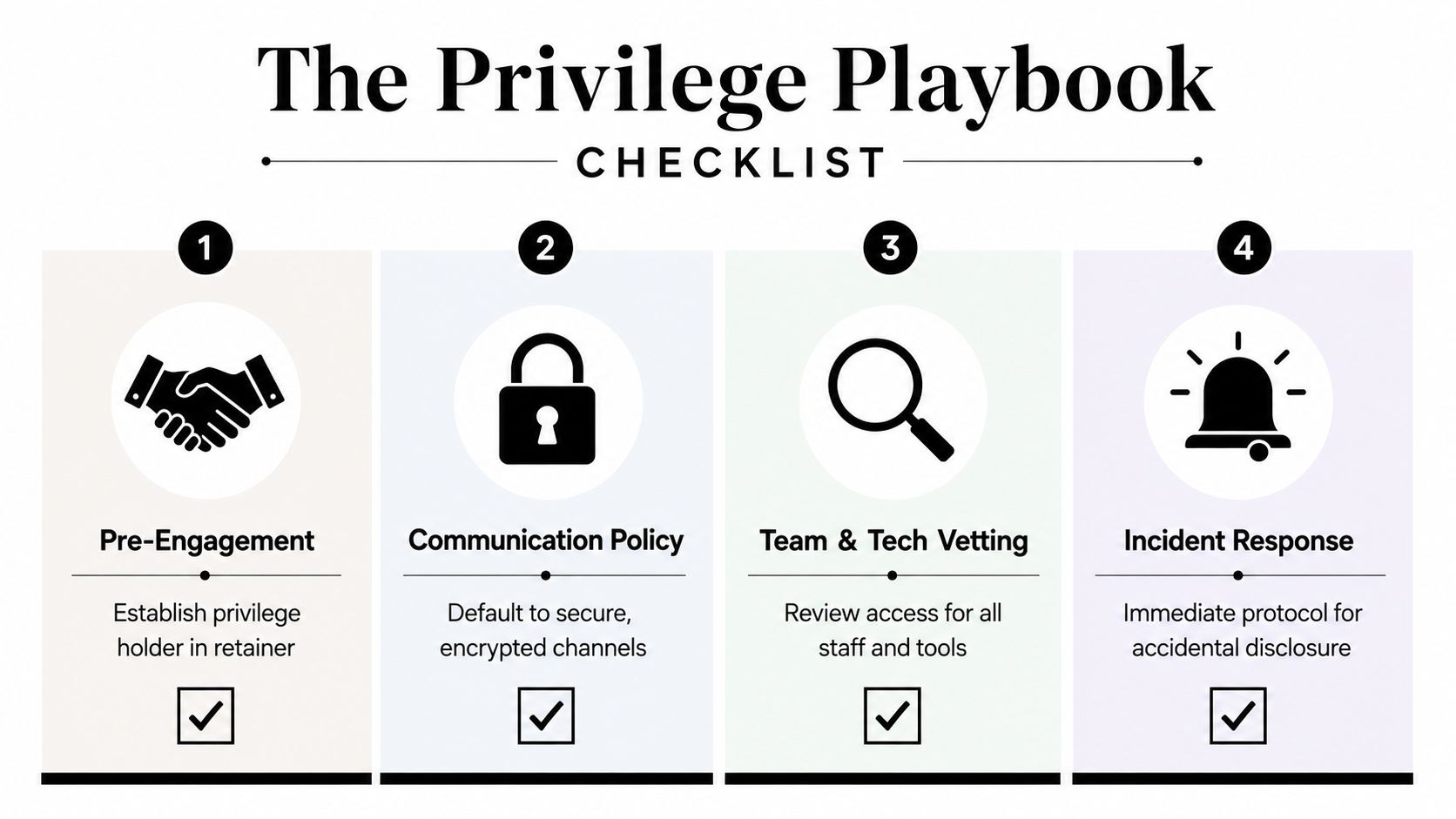
Treat attorney-client privilege like a maintained operating system. Establish the legal purpose, restrict the audience, vet every tool, and respond quickly when something slips. If your firm's remote support needs are growing, audit the people and platforms touching client information this week, then schedule the training huddle and external-email review before the next sensitive matter arrives.
Book a privilege-workflow review with your managing partner, general counsel, or outside e-discovery advisor this week. Bring your current communication policy, vendor list, privilege-log template, and remote-worker access report, then identify the first control you'll fix on Monday morning.