 15 minutes read
The work product doctrine protects materials prepared in anticipation of litigation from discovery, but a court can order production when the requesting party proves substantial need and undue hardship. Ordinary work product receives qualified protection, while an attorney's mental impressions, conclusions, opinions, and legal theories receive a stronger shield.
You're reviewing a discovery request that seems to ask for everything: interview notes, draft chronologies, internal emails, research prompts, witness assessments, and the working files your team built before the complaint was even filed. The request may be dressed up as relevance, but it feels like an attempt to acquire your litigation playbook without paying for the scouting report.
That's the moment the work product doctrine matters. It gives attorneys and their representatives room to investigate, test theories, evaluate witnesses, and prepare for trial without automatically handing those unfinished thoughts to the opposing side. It isn't a magic eraser, and it won't protect every document your firm touches. Used carefully, though, it changes the discovery conversation from “produce anything remotely relevant” to “show why this protected material is necessary.”
The request arrives late on a Friday. Your team has already spent days collecting custodial data, sorting email threads, and chasing a witness who apparently regards every deadline as a philosophical suggestion. Now opposing counsel wants the interview notes, the internal case assessment, the draft timeline, and communications about which witnesses appear credible.
Some of those materials contain facts. Others contain judgments. A few contain the candid observations that help a trial team decide which facts deserve attention and which ones belong nowhere near a courtroom. Producing everything would expose more than evidence. It could reveal how the team thinks.
That's why discovery practice requires more than keyword searches and a heroic paralegal working through lunch. A sound process starts with understanding the difference between material created to run the business and material created to prepare for litigation. The distinction can become especially important when the dispute involves broad document requests, multiple custodians, or investigations conducted before counsel has settled on a formal litigation strategy. For a practical grounding in the wider process, review this guide to what discovery in litigation involves.
The doctrine generally protects documents and tangible things prepared in anticipation of litigation or trial by or for a party or its representative. That can include attorneys, investigators, consultants, and other litigation-support personnel, depending on the circumstances and the applicable law.
But labels don't do the work. Calling a file “attorney work product” won't save an ordinary business record created in the usual course of operations. A litigation folder can contain protected analysis, discoverable facts, and administrative material sitting side by side. Someone has to separate them.

Practical rule: Don't ask whether a folder is protected. Ask what each document was created to do, who created it, and whether its contents reveal facts, strategy, or both.
The operational risk is often hidden in the handoff. A partner may ask a paralegal to prepare a witness summary. A client may forward that summary to an executive. An investigator may send interview materials to a commercial consultant. Each transfer creates a recordkeeping and protection question.
The work product doctrine doesn't let a firm avoid discovery. It gives the legal team a defensible basis to resist discovery of case-preparation materials, provided the team can explain the basis clearly and preserve the distinction between ordinary factual work product and opinion work product.
The federal foundation is Federal Rule of Civil Procedure 26(b)(3). It protects documents and tangible things prepared in anticipation of litigation or trial by or for another party or its representative, unless the requesting party satisfies the rule's demanding access standard. The current rule reflects the structure that emerged from the Supreme Court's decision in Hickman v. Taylor, 329 U.S. 495.
The history matters because it explains the policy. The doctrine originated with the Supreme Court's 1947 decision in Hickman v. Taylor, which recognized protection for an attorney's case-preparation materials from routine discovery. Congress and the rulemakers later codified that protection in the 1970 amendments to Rule 26(b)(3), converting a judicially developed principle into a standardized nationwide discovery rule. The gap between those milestones is a key part of the doctrine's development. See the United States Courts' work product materials for the historical framework.
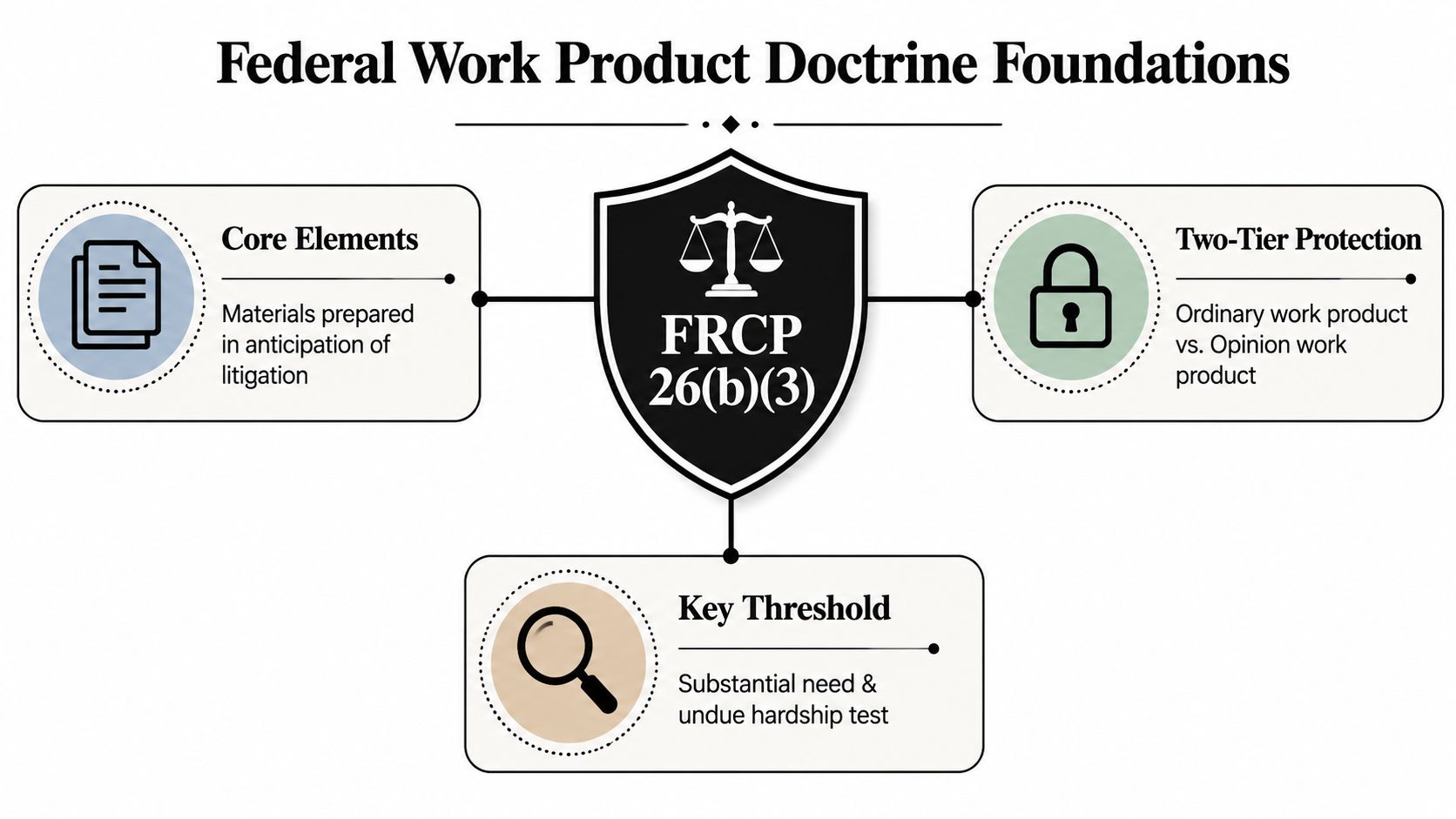
The rule doesn't treat every protected document the same way.
| Category | What it generally covers | What the requesting party must confront |
|---|---|---|
| Ordinary work product | Factual investigation, interview notes, compilations, and other litigation-preparation materials | Substantial need and inability to obtain substantially equivalent information without undue hardship |
| Opinion work product | Mental impressions, conclusions, opinions, and legal theories | A much stronger protection because disclosure exposes counsel's strategic thinking |
The practical distinction is straightforward. A witness's factual statement may be reconstructed through an interview or deposition. Counsel's note that the witness appeared evasive, vulnerable, or central to the defense reveals a different kind of material. It tells the opponent how the team is evaluating the case.
That privacy interest was central to Hickman. The Supreme Court recognized that lawyers need a private space to prepare litigation and that an opponent must provide adequate justification before accessing opposing counsel's work product. The rule therefore protects preparation without turning discovery into a contest where one side can demand the other side's entire mental playbook.
A disciplined team asks three questions early:
Those questions help the team build a defensible collection and review protocol. They also make later negotiations less theatrical. If you're improving intake, review, and production controls, resources focused on how to improve discovery outcomes can complement the legal analysis.
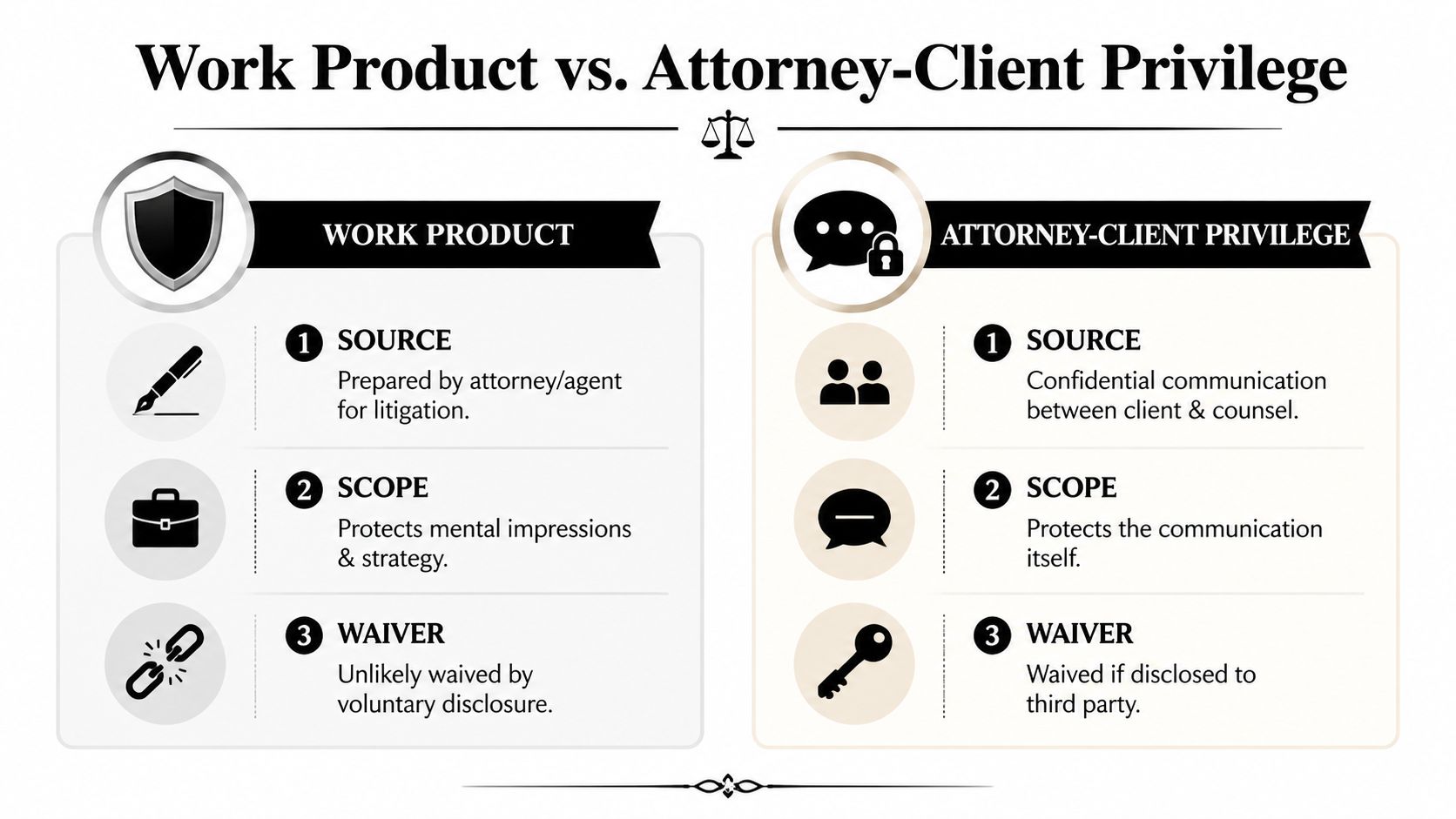
Lawyers often use “privileged” as shorthand for several protections. That shorthand is convenient until opposing counsel challenges it. Attorney-client privilege and the work product doctrine are not interchangeable, and a document can implicate one, both, or neither.
Attorney-client privilege protects confidential communications between a client and counsel made to seek or provide legal assistance. The focus is the communication and the confidential relationship. The privilege can apply outside active litigation because its purpose is to encourage candid legal consultation.
Work product protection focuses on litigation preparation. It can protect tangible materials prepared by or for a party or representative, including material that reflects counsel's analysis. The material doesn't have to be a direct conversation between client and lawyer.
| Question | Work product doctrine | Attorney-client privilege |
|---|---|---|
| What triggers protection? | Preparation for anticipated litigation or trial | Confidential communication for legal advice |
| What receives protection? | Materials, factual investigation, strategy, and mental impressions | The confidential communication itself |
| Who may create the material? | Counsel, a party, or a representative acting for the litigation effort | Client and counsel, with necessary participants handled carefully |
| Can an opponent overcome it? | Ordinary work product may be reached through substantial need and undue hardship | The privilege generally turns on confidentiality and waiver |
| What creates risk? | Weak proof that litigation motivated creation, or poor handling of mixed materials | Disclosure to a third party or use for a nonlegal purpose |
Consider a client email asking, “What should we do about this lawsuit?” The communication may raise privilege issues if it seeks legal advice confidentially. A lawyer's later memorandum ranking the client's defenses and identifying weaknesses is classic work product territory, particularly because it exposes mental impressions and legal theories.
The same file can contain both kinds of material. A factual attachment prepared by a business employee may not become privileged merely because counsel received it. A lawyer's annotations on that attachment may create work product concerns. Reviewers need to analyze the content, purpose, and context rather than apply one label to the entire email chain.
For a focused primer on the neighboring protection, see this explanation of attorney-client privilege. The operational lesson is simple: log and defend the protection that fits. A vague assertion invites a meet-and-confer fight, and nobody needs another one of those.
The work product doctrine protects preparation, but ordinary work product isn't absolutely protected. Under Rule 26(b)(3), the requesting party must establish both substantial need for the materials in preparing the case and an inability, without undue hardship, to obtain substantially equivalent information by other means. Missing either part should defeat the request.
That two-part standard shifts the dispute away from simple relevance. A document may be relevant and still remain protected. The requesting party must show why the material is necessary and why comparable information cannot realistically be obtained elsewhere.
Courts often focus on the available alternatives. Can the requesting side interview the witness? Obtain the public record? Review its own files? Conduct an investigation? If those routes can produce substantially equivalent information without extraordinary difficulty, the request for opposing counsel's file becomes much weaker.
The analysis is practical, not ceremonial. A party may argue that an interview note is uniquely valuable because the witness is unavailable or the memory is fading. Another party may respond that the witness is available for deposition and that the note merely records facts the witness can provide directly. The strength of the request depends on the actual gap between those options.
A useful review framework looks like this:
The requesting party doesn't get opposing counsel's preparation simply because the preparation would be useful.
A factual chronology may be vulnerable if the requesting party proves the required need and hardship. A chronology annotated with counsel's judgments about credibility, causation, or trial themes presents a much more serious protection issue.
The rule preserves a stronger shield for opinion work product, especially an attorney's mental impressions, conclusions, opinions, or legal theories. That's not a technical footnote. It's the difference between producing a factual lead and disclosing the map your team drew from that lead.
Paralegals should flag mixed documents rather than flattening them into “fact” or “opinion.” Redaction may preserve factual portions while protecting strategic analysis, but the defensibility of that approach depends on the document and the governing court's practice. When in doubt, escalate the close calls early. A late privilege fight is an expensive place to discover that nobody remembers why a document was created.
A protection that exists only in someone's memory isn't a litigation process. The firm needs a repeatable method that survives staff changes, rushed productions, and the inevitable “Can you just send me the whole folder?” request.
Start at collection. Preserve the surrounding metadata, creation context, authorship, recipients, and related correspondence. A document's purpose may not be obvious from its text alone. The email requesting a witness analysis, the matter number, and the timing of the assignment can matter as much as the analysis itself.
Use a workflow that separates legal judgment from administrative handling:
The privilege log should give the opposing side enough information to assess the claim without revealing the protected substance. “Email, privileged” is not a log entry. It's a shrug in spreadsheet form.
| Field | Example |
|---|---|
| Date | Applicable document date |
| Author | Litigation counsel or identified representative |
| Recipients | Individuals involved in the litigation effort |
| Document type | Internal memorandum |
| General subject | Witness interview assessment prepared for anticipated litigation |
| Protection asserted | Work product doctrine |
| Category | Ordinary fact work product, with opinion work product portions redacted |
| Time period | Applicable investigation period |
| Reason for withholding | Prepared for litigation preparation and contains factual investigation plus counsel's evaluative analysis |
The example avoids disclosing the very substance being protected. It also gives the opponent and court a usable description of the claim.
Log discipline matters: Describe the document's purpose and protection category, not the strategic conclusion inside it.
Finally, keep the review record. Document who made the classification decision, whether redactions were considered, and why a disputed item was withheld. That record won't guarantee success, but it gives the firm something better than a witness saying, “I think we've always done it that way.”
The old assumption was simple: if counsel's team created the material, the work product analysis was manageable. AI-assisted research and client-side AI use have made that assumption unreliable.
The difficult question isn't merely whether a prompt or output concerns litigation. It's who used the tool and whether the use occurred at counsel's direction. Recent coverage describes a split in 2026 federal decisions. One decision held that AI prompts and outputs used by a represented party's romantic partner weren't protected because they weren't created at counsel's direction. Another protected a pro se litigant's ChatGPT-related records. The divergence shows why firms shouldn't promise protection based solely on the fact that an AI tool assisted with legal work. The developing issue is discussed in coverage of when client AI use can affect work product protection.
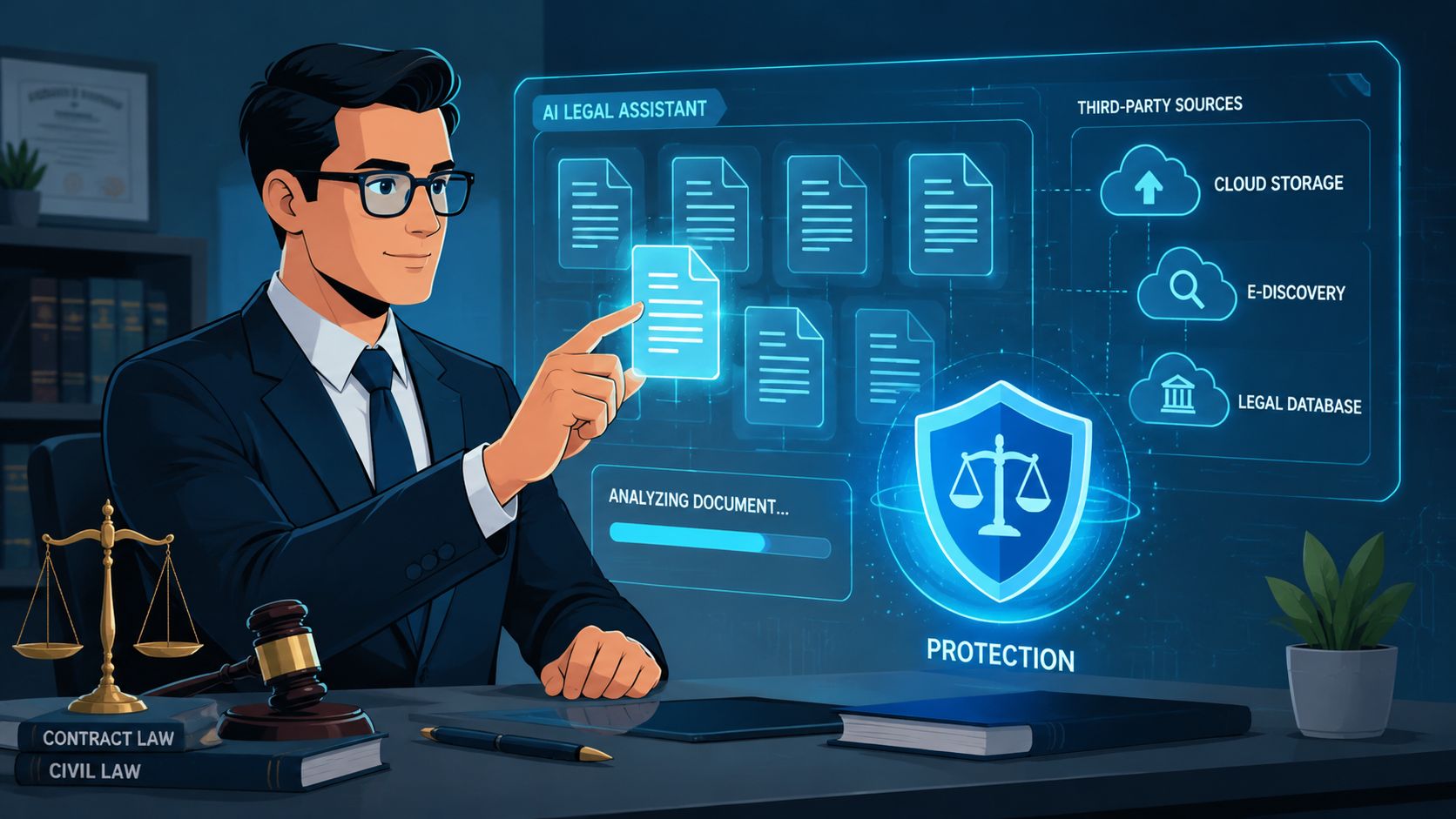
A prompt may reveal the user's theory, assumptions, or planned argument. An output may contain factual summaries, proposed language, or invented material that the team should never have relied on. The platform's retention and disclosure terms can also affect the confidentiality analysis.
That means the firm should identify:
For teams adopting document automation, guidance on AI legal document review can help frame workflow questions, but no tool can substitute for a protection analysis.
Third-party disclosure creates a separate trap. Courts may treat disclosure to a non-adverse third party as nonwaiving, but common-interest arguments can fail depending on the court's test. Investigative materials may also lose protection if the firm can't show that litigation was sufficiently anticipated. The practical boundary depends on the relationship between the holder and recipient, the purpose of the disclosure, and the timing of the investigation. The Miami Law scholarship on third-party and commercial-investigation issues is useful background for that nuance.
For privacy controls around emerging legal technology, firms can also consult Bridge Global on data privacy for lawyers. The recommendation is blunt: don't send sensitive case material into an AI platform or outside consultant relationship until someone has checked the instruction, confidentiality, retention, and waiver implications.
The work product doctrine works best as an operating discipline, not a panic button after opposing counsel serves a request. Legal teams should make the purpose of litigation preparation visible in assignment records, preserve context, separate fact work product from opinion work product, and keep a privilege log that explains the assertion without exposing the analysis.
A paralegal can put that discipline into practice immediately:
The doctrine began with Hickman v. Taylor and became part of Rule 26(b)(3), but the hard work still happens in the file room, the review platform, and the privilege log. Your team's best defense is a clear record showing what was created for litigation, how it was handled, and why the requested material deserves protection.
If your firm is struggling to keep up with collection, review, and logging demands, evaluate whether additional litigation support is justified. HireParalegals offers access to remote paralegals and legal support professionals for tasks such as legal research and document preparation, giving firms another staffing option when discovery volume outgrows the existing team.
Audit your active matters this week. Pick one live discovery project, review its collection notes and privilege log, identify any AI or third-party disclosure risks, and correct the process before opposing counsel finds the gap for you.