 17 minutes read
A practice manager opens a candidate folder late in the afternoon. Several paralegal resumes look promising, but one candidate has litigation experience, another has immigration casework, and a third has excellent client communication skills without using the exact phrase in the job description. The firm needs help quickly, yet a rushed decision could create training, quality, or confidentiality problems.
Matching in AI is the process of comparing candidate information with role requirements, then ranking or recommending people whose qualifications appear most relevant. For legal hiring, it should be treated as a decision-support system, not an automatic hiring decision. A useful match must account for practice area, seniority, actual skills, English fluency, working hours, jurisdictional familiarity, availability, and the limits of the candidate's permitted responsibilities.
AI recruiting has moved into mainstream enterprise use. One industry summary reports that 75% of large enterprises had adopted AI-driven recruiting tools by 2023, compared with 45% in 2020, while 67% of recruiters used AI for candidate sourcing in 2024 (industry summary of AI recruiting statistics). Those figures help explain why law firms are encountering ranked shortlists rather than simple resume searches.
The practical question isn't whether software can produce a score. It's whether your team can understand the score, test the candidate behind it, identify bias or missing information, and defend the final decision. This guide explains how matching works, where it fails, how preference-aware systems handle remote work, and how practice managers can build a more auditable process for paralegal hiring.
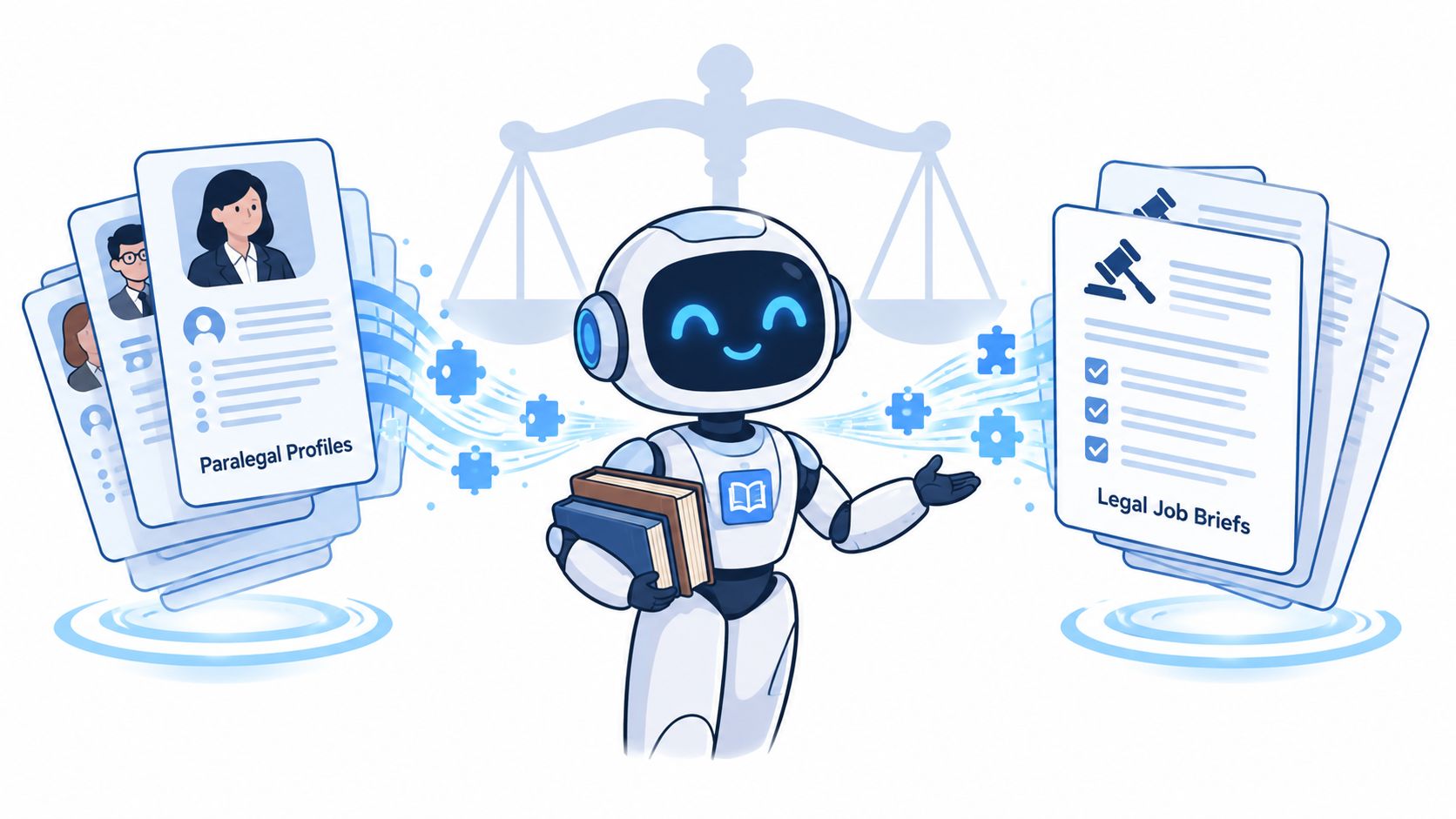
A traditional hiring process asks a recruiter to read resumes, compare experience, and decide who deserves an interview. Matching in AI performs part of that comparison automatically. It reads job descriptions and candidate profiles, extracts relevant information, estimates how closely the two align, and places candidates into a ranked list.
The ranking can help when a firm has more applications than a manager can review carefully. A system may recognize that “case management,” “client intake,” and “matter coordination” relate to one another, even when the resume and job description use different language. It may also separate required qualifications from preferred ones, provided the firm has configured those requirements clearly.
That assistance has limits. A high score doesn't prove that a candidate can perform the work, communicate appropriately with clients, protect confidential information, or operate effectively during the firm's working hours. It only indicates that the available data resembles the role profile according to the system's rules or learned patterns.

Practical rule: Treat an AI match as a reason to investigate a candidate, not as a reason to stop investigating.
The history of computerized matching also predates current generative AI. MIT Press describes an early commercial computerized dating experiment at Harvard in 1965, while the residency match process has operated for more than 70 years, creating a substantial institutional record for later analysis (MIT Press history of computerized matching and American College of Physicians discussion of AI and the residency match). Modern systems build on that broad idea, but they apply it to much richer text and structured data.
For a remote paralegal role, the match should answer several practical questions:
A responsible process answers those questions before extending an offer.
The easiest analogy is an organized librarian. A basic search tool looks for the exact words typed into a catalog. A more capable librarian understands that a book about “civil discovery” may also relate to requests for production, interrogatories, document review, and litigation support. AI matching attempts a similar interpretation with resumes and job descriptions.
The system receives information from a job description, application form, resume, interview notes, skills assessments, and sometimes candidate preferences. It may identify practice areas, prior responsibilities, software familiarity, language fluency, location, availability, and seniority indicators.
The quality of the result depends heavily on the quality of the input. “Need a strong paralegal” gives the system little useful direction. “Support a civil litigation team with discovery tracking, deposition preparation, case-file organization, and client communications during Eastern Time business hours” provides a more workable profile.
The software extracts features from the text. Some features are structured, such as years in a role, practice area, or stated availability. Other information is unstructured, such as a description of coordinating subpoenas or preparing exhibits.
Many systems represent language mathematically through embeddings. An embedding is a numerical representation intended to capture relationships in meaning. That allows the system to recognize related wording even when two documents don't share identical keywords.
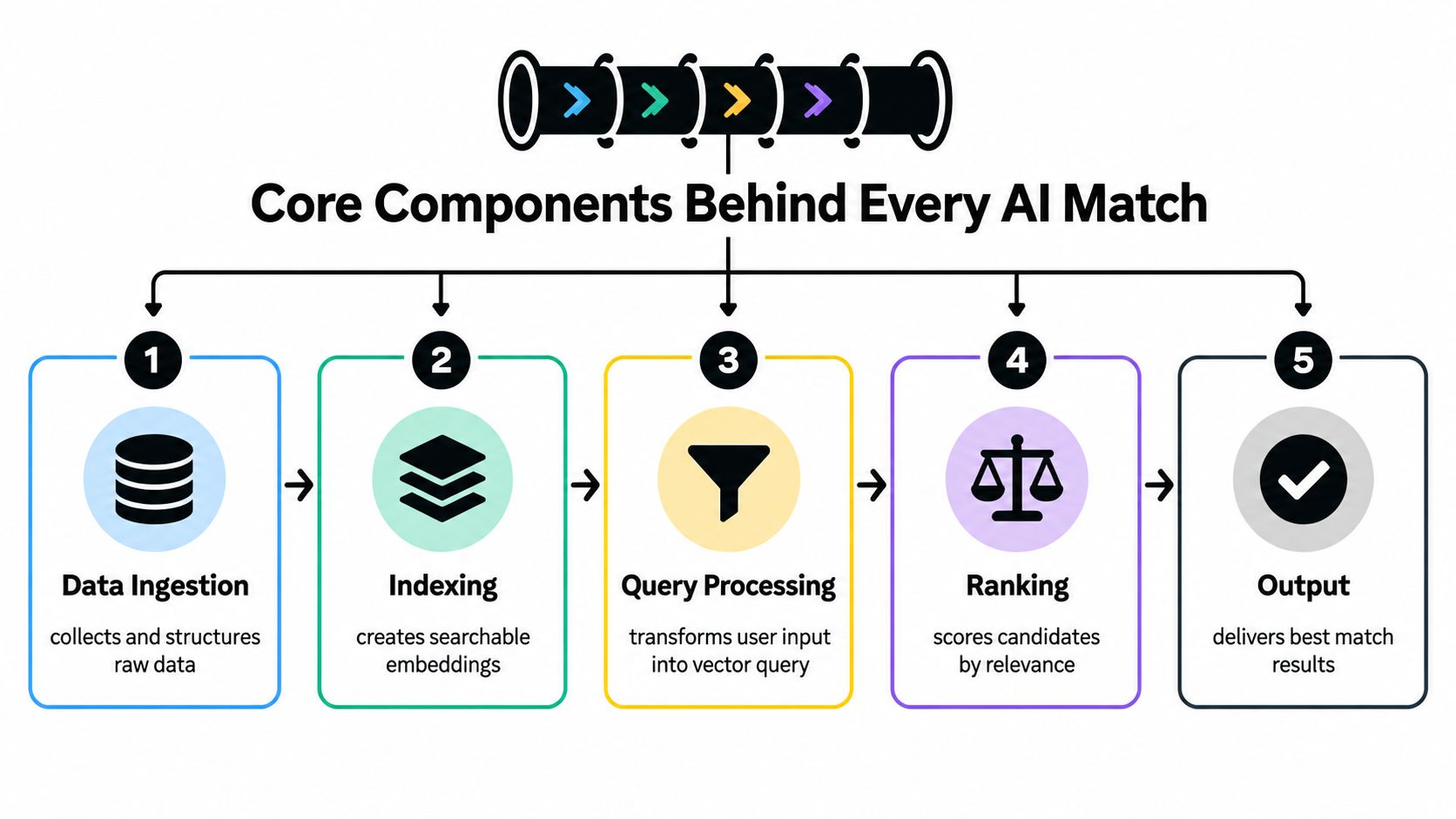
The system compares the role profile with each candidate profile. Some matching engines use similarity measures such as cosine similarity. Others use learning-to-rank models, rules, or combinations of several methods.
The output is generally a score, a ranking, or a recommendation. That result is probabilistic, not deterministic. A candidate ranked first isn't necessarily the strongest person in real life. The person may have a profile that most closely resembles the system's interpretation of the role.
This explains why wording differences can produce surprising results. A candidate who writes “managed intake and client communications” might match a role asking for “new-matter screening and client follow-up,” while another candidate with genuine experience may rank lower because the resume is sparse.
Managers who want to understand the broader automation ecosystem can also review resources such as an AI job application agent, while keeping a separate standard for legal hiring. Applying to jobs automatically is not the same as validating a candidate's ability to handle confidential casework.
For legal teams, the right next step is to inspect the evidence behind the ranking. A legal document review workflow can be relevant to a candidate's background, but it shouldn't replace a work sample that tests how the person identifies, organizes, and escalates issues.
An AI matching process usually contains several operational layers. Each layer can improve the shortlist, or introduce a different kind of error. Practice managers don't need to build the model, but they should know what to ask the vendor and what to inspect in the results.
Ingestion collects resumes, job descriptions, application answers, and related records. Normalization makes inconsistent information more comparable. For example, “litigation paralegal,” “civil procedure assistant,” and “case support specialist” may describe overlapping work, but the titles alone don't establish equivalent capability.
Legal practice areas make normalization especially important. Immigration support can involve forms, evidence organization, deadline tracking, and client intake. Civil litigation support can involve discovery, pleadings, deposition materials, and trial preparation. A system that treats every “paralegal” title as interchangeable can create false matches.
Your role profile should distinguish:
A skills taxonomy groups related terms. Entity resolution connects different expressions to the same underlying concept. “E-discovery,” “electronic discovery,” and “document review platform experience” may be related, but they aren't automatically identical.
The system should show whether a skill was explicitly stated, inferred from prior work, or supplied during an interview. That distinction matters because an inferred skill needs validation before it becomes a hiring assumption.
Not every requirement should carry equal weight. A firm may treat prior-authorization experience as essential for one role, while another practice may prioritize insurance verification, appointment scheduling, or patient communication.
Scoring can combine structured filters with semantic similarity. A candidate might have excellent substantive experience but fail a key schedule requirement. Conversely, a candidate may align strongly with the role's tasks but need training on the firm's case-management software.
The system converts scores into an ordered list. Ask whether it can explain the ranking in plain language. A useful explanation might identify relevant practice-area experience, matching responsibilities, language ability, and schedule alignment. “High compatibility” alone isn't enough for a defensible process.
A threshold determines when a candidate is recommended, held for review, or excluded. Thresholds should not be treated as universal. A highly specialized litigation role may need stricter evidence than a general administrative position.
Common failure points include incomplete profiles, outdated job descriptions, inflated skill labels, inconsistent title mapping, and missing timezone information. A ranking model can also reproduce patterns in past hiring decisions. If prior decisions favored a narrow profile, the system may learn to prefer that profile again, even when a broader candidate pool would be appropriate.
The central diagnostic question is simple: What evidence caused this candidate to rank here, and what evidence might be missing?
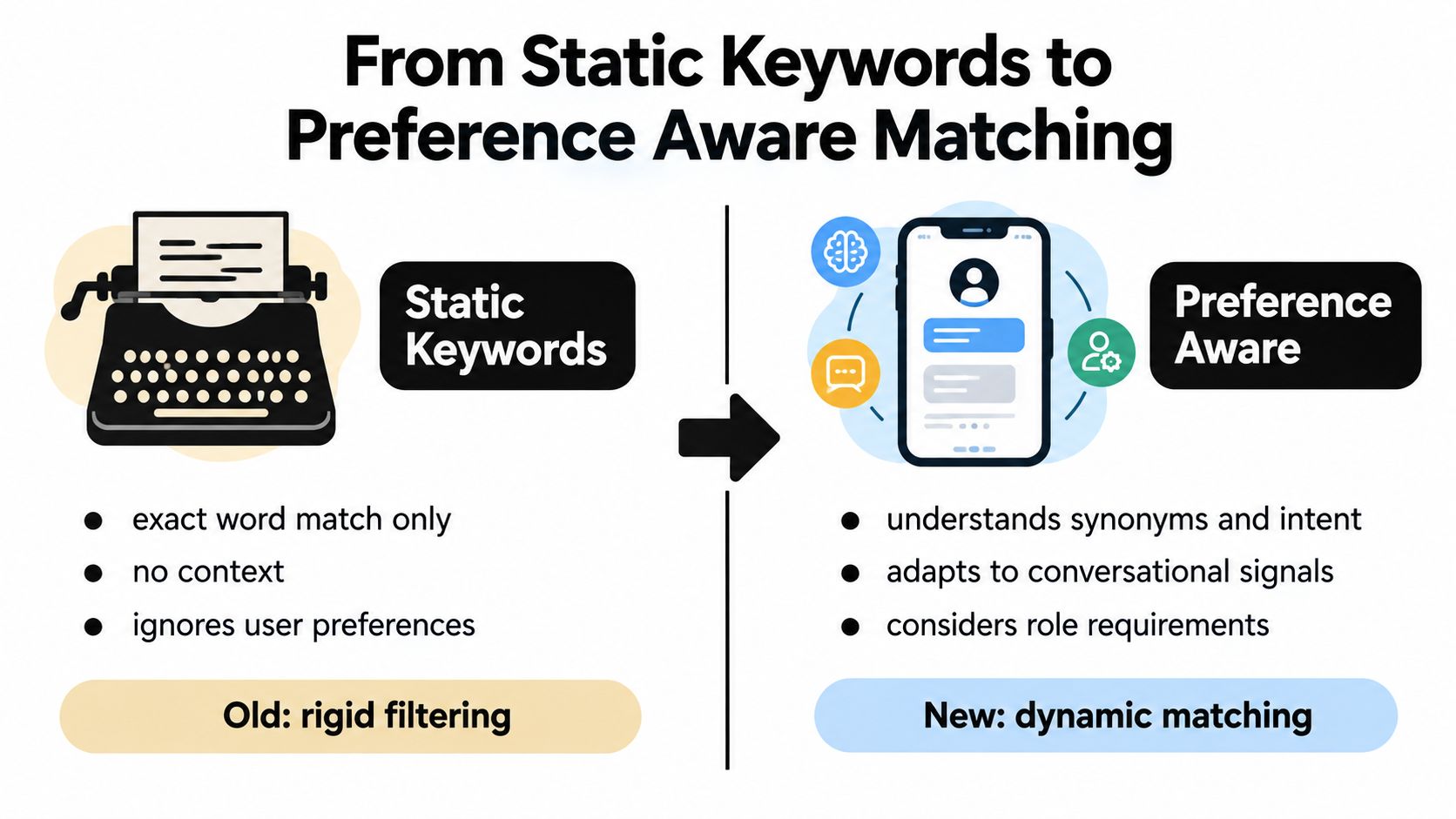
Static keyword filtering asks whether a resume contains the requested terms. That approach can be useful for a narrow requirement, but it struggles with synonyms, adjacent skills, incomplete wording, and changing role expectations. A candidate who has prepared hearing binders may be capable of trial-support work even if the resume never uses the exact phrase “trial paralegal.”
Preference-aware matching adds another dimension. It considers what the candidate wants and what the role requires. The system isn't only asking, “Can this person fit the firm?” It's also asking, “Does this role fit the candidate's schedule, work preferences, responsibilities, and expectations?”
A bilingual paralegal may have strong immigration experience but prefer work aligned with Eastern Time. A litigation support role may begin with discovery coordination and later expand into e-discovery administration. A candidate may accept the substantive work but not a schedule that requires frequent late-evening calls.
These aren't minor details. A candidate who can't reliably cover the required hours may be a poor operational match despite excellent technical skills. For remote staffing, the system should separately capture:
Preference data must also be handled carefully. A candidate's personal preferences can help identify a workable arrangement, but they shouldn't become a proxy for protected characteristics or an excuse for inconsistent selection.
Dynamic matching is most useful when the job has multiple dimensions and adjacent experience has real value. It can surface candidates whose wording differs from the job description, identify a workable schedule, and reveal a better fit between the candidate's goals and the firm's needs.
It can add noise when the firm collects too many loosely relevant signals. More data doesn't automatically produce a better decision. A concise, validated role profile with accurate skills normalization and timezone requirements may outperform a broad profile filled with subjective preferences.
Managers comparing tools that support meeting notes or conversational information may find a resource such as iScribe Live Transcribe vs Granola useful for understanding how transcription products differ. That comparison doesn't validate a legal candidate, but it illustrates why tool capabilities should be evaluated against a specific workflow rather than a general promise.
A skills-based hiring approach can help firms define adjacent experience more deliberately. The skills-based hiring framework is most useful when it supplements, rather than replaces, work samples and structured interviews.
A remote paralegal may support a litigation team from another time zone, organize an immigration evidence packet, or prepare a discovery tracker before an attorney reviews it. In each case, AI matching should produce more than a ranked list. It should give the firm a record of why the candidate matched the work, where the evidence is weak, and which conditions require human confirmation.
The practical benefit is defensible decision-making. A matching system can connect a candidate's documented experience with a defined workflow, such as deposition scheduling, pleading organization, client intake, or evidence indexing. It can also show whether the candidate's working hours overlap with the supervising attorney and whether the proposed supervision arrangement is realistic.
The risk lies in treating the recommendation as a conclusion. A model may infer litigation experience from broad administrative language, favor polished resumes over stronger work samples, or continue reproducing historical preferences that excluded qualified applicants. Timezone availability can also be misread. A candidate who appears suitable on skills may be unable to cover required hearing preparation or attorney check-ins.
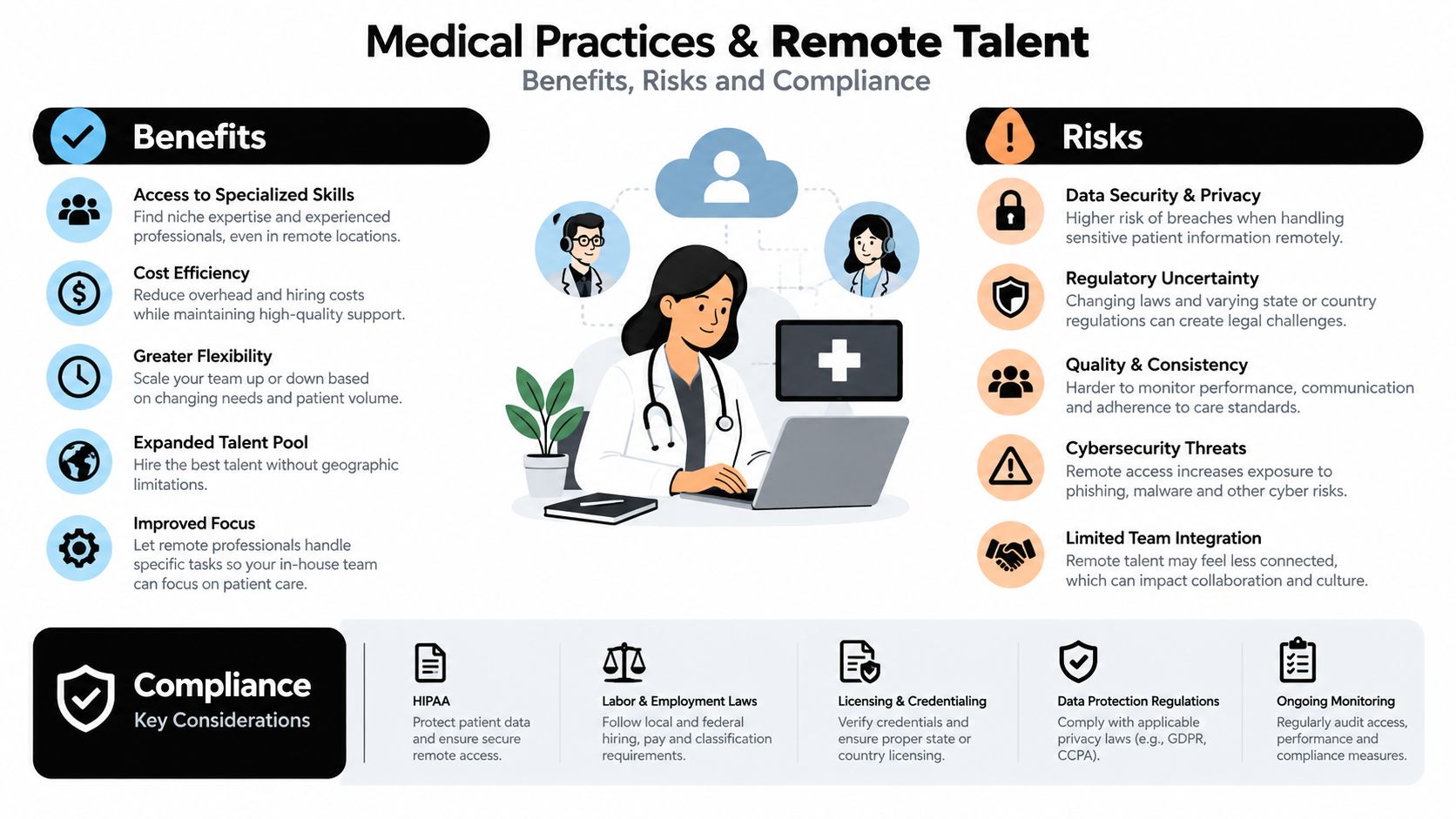
When a remote paralegal accesses confidential client information, the firm must enforce role-based access, approved systems, and documented confidentiality agreements. Access should reflect the person's assigned matters and tasks, not provide unrestricted entry to the firm's case files.
Under ABA Model Rule 5.3, nonlawyer assistance must be appropriately supervised. Ask how access to case files is controlled, how activity is logged, how devices are managed, and how escalation to the supervising attorney is documented. The firm should also define which tasks the paralegal may complete independently and which decisions must remain with a lawyer.
The same controls should apply during hiring validation. A work sample may test document organization or chronology building, but it should use approved, limited materials. References and interview answers can confirm skills without exposing unnecessary client information.
| Benefit or Risk Area | What It Means for Your Firm | Practical Safeguard |
|---|---|---|
| Litigation workflow fit | The candidate may have relevant discovery, calendaring, or filing experience | Link the match to specific work samples or verified task history |
| Immigration workflow fit | Experience with intake, forms, and evidence organization may vary in depth | Test the actual workflow and record the reviewer's findings |
| Timezone overlap | Limited overlap can delay attorney review and client communication | Confirm working hours, required overlap, and hearing-related availability |
| Supervision boundaries | Remote work can blur responsibility for legal decisions | Document assigned tasks, escalation routes, and attorney review points |
| Confidentiality and privilege | Case files may be accessed outside the firm's office | Use role-based permissions, approved systems, logging, and confidentiality agreements |
| Bias drift | Past hiring patterns may shape later recommendations | Review outcomes over time and investigate unexplained group differences |
| Score over-reliance | A ranking can overshadow contradictory evidence | Require the question, “What evidence caused this candidate to rank here?” |
The audit record should preserve the inputs, evidence, reviewer notes, and final decision. That record lets a manager explain why a candidate advanced, identify an unsupported inference, and revisit the configuration when hiring outcomes change.
A reliable process begins before a resume enters the system. Define the job in terms of work that can be observed and tested, then use AI to organize candidates against that definition.
Start with the matters the paralegal will support, the tasks assigned during the first stage, the attorney supervision available, and the schedule required. Separate must-have requirements from learnable preferences. For a remote immigration role, that might mean distinguishing experience with client intake and evidence organization from familiarity with a particular case-management platform.
Use a structured profile with fields for:
A role profile that says “excellent communicator” is difficult to audit. A profile that asks the candidate to draft a client update from supplied facts gives the reviewer something concrete to assess.
Use the same core questions and work-sample categories for every candidate being compared. Ask candidates to organize a mock case chronology, identify missing information in a fictional intake file, or explain how they would escalate an uncertain issue. The exercise should test support work, not invite the candidate to provide unsupervised legal advice.
A candidate evaluation process can help managers compare evidence consistently. Keep the AI score visible as one input, but require the reviewer to record why the candidate advanced and which areas still need confirmation.
Audit question: If the score disappeared from the screen, would the documented evidence still support an interview?
Don't choose a threshold just because a vendor uses it by default. Review a sample of recommended and rejected candidates, then ask whether the system is missing capable people because of wording, career breaks, unusual titles, or adjacent experience.
Fairness-sensitive matching research emphasizes that a “best fit” isn't automatically a “fair fit.” One line of recent research frames fairness as creating balanced groups and reducing variation within matches rather than relying only on pointwise scores (research on fairness-sensitive matching). For a law firm, that means examining whether remote candidates across jurisdictions, seniority bands, and language backgrounds are being systematically under-matched.
Your implementation checklist should include:
HireParalegals is one example of a service that combines AI matching with human recruiters to prepare remote legal-support shortlists. Its described process includes candidate sourcing, interviews, background checks, and skills validation, with a focus on remote professionals for US law firms. Even with that type of service, the hiring firm should conduct its own interview, confirm role boundaries, and review access and supervision requirements.
AI matching isn't appropriate when the role requirements are too vague, the available candidate data is unreliable, or the work involves sensitive judgment that cannot be evaluated through the system's inputs. In those situations, use the tool for organization only, or rely on a more deliberate human-led process.
Matching in AI can help law firms sort a large candidate pool and identify relevant experience that a strict keyword filter would miss. Its value comes from disciplined inputs, skills normalization, preference and timezone checks, and a clear explanation of why a candidate advanced.
The score still isn't the decision. Practice managers should define the role, verify skills through structured interviews and work samples, review recommendations for bias drift, and preserve privacy safeguards when remote staff access confidential or protected information. Start with one role, document the criteria, compare AI recommendations with human review, and refine the process based on evidence.
If your firm needs a remote paralegal shortlist, speak with HireParalegals about the role, practice area, schedule, and required skills. Review candidates yourself, interview before hiring, and confirm that the proposed workflow fits your supervision and confidentiality requirements.