
 15 minutes read
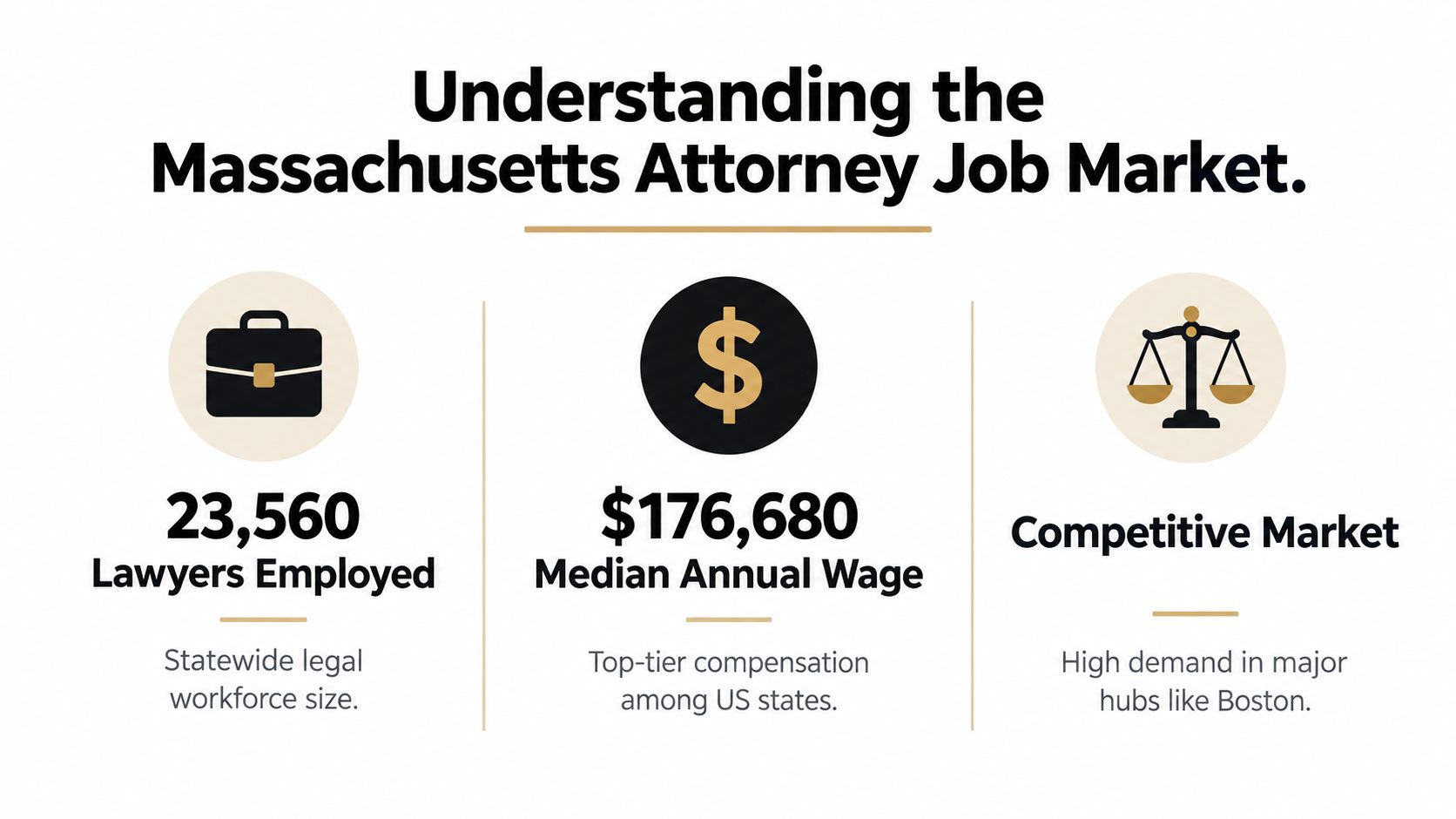
Massachusetts employed 23,560 lawyers and reported a median annual attorney wage of $176,680 in a 2025-derived statewide estimate, so the strongest path to attorney jobs in Massachusetts is targeted positioning, not sending the same application everywhere. Bar admission, practice-area fit, and regional or remote eligibility determine which opportunities are realistically available.
Those figures describe a substantial, well-paid legal market, but they don't describe one uniform market. Boston, Worcester, and Springfield attract different employers and practice profiles. A Massachusetts-barred litigator seeking a hybrid Boston role faces a different hiring process from an immigration attorney targeting Springfield or a health-care lawyer looking in Worcester. Remote listings add another layer, because some require Massachusetts admission while others accept candidates elsewhere who can work with Massachusetts clients or maintain local availability.
This guide breaks down the market by region, licensing status, compensation, job-search channel, and work model. It also explains how to present your credentials, avoid low-signal application habits, and decide whether a particular opening fits your experience before you invest time in the process.
The statewide estimate places Massachusetts at 23,560 employed lawyers, 6.5 lawyers per 1,000 workers, and a location quotient of 1.33, with a median annual wage of $176,680. The earlier Bureau of Labor Statistics release reported 20,380 employed lawyers, 5.71 lawyers per 1,000 jobs, a location quotient of 1.20, and a mean annual wage of $196,230. These figures show a dense attorney labor market with compensation well above ordinary professional benchmarks, but they don't mean every candidate can access every opening. The Bureau of Labor Statistics Massachusetts lawyer data provides the underlying employment and wage context.
The practical mistake is treating “Massachusetts” as a single search category. Employers in Boston often evaluate candidates for institutional clients, complex litigation, corporate work, and specialized regulatory matters. Worcester has a different mix of regional firms, health-care employers, family-law practices, and government-related work. Springfield serves a western Massachusetts client base with its own needs in public defense, immigration, and civil litigation.
A broad search produces plenty of apparent opportunities, but many won't be viable after you review the requirements. The listing may require Massachusetts admission, courtroom experience, familiarity with a particular county, a narrow specialty, or regular in-person attendance. A candidate who applies without checking those conditions is competing in the wrong pool.
The state also has a long-standing concentration of small practices. Historical Massachusetts lawyer employment data recorded approximately 38,143 active attorneys in 2005, with about 64% of private-practice attorneys working in firms with 1 to 5 lawyers, while roughly 15% worked in firms with more than 200 lawyers. The same report recorded women as 34.4% of the total active-attorney population at that time. The Massachusetts lawyer employment report illustrates why candidates should look beyond major national firms.

Practical rule: Choose a region, specialty, and work model before choosing a job board. The order matters because the same search phrase can combine incompatible roles.
A useful starting point is to classify yourself in three ways:
That classification turns a crowded market into a manageable target list.
Massachusetts admission is a meaningful hiring gate, not a formality completed after an offer. Candidates petition through the Supreme Judicial Court and qualify through examination, UBE score transfer, or motion. The state also requires MPRE documentation and registration with the Board of Bar Overseers after admission. Massachusetts bar admission guidance sets out the official process.
Examination is the ordinary route for new graduates and candidates who don't meet the requirements for transfer or motion. It requires preparation for the Massachusetts admission process and documentation review. Firms hiring early-career lawyers generally expect candidates to state clearly whether they have passed, are awaiting results, or plan to sit for the examination.
UBE score transfer can work for a lawyer who earned a qualifying Uniform Bar Examination score elsewhere. Massachusetts requires a score of at least 270 within the last 5 years. A transferred score doesn't eliminate the need to complete the state's petition, character, and documentation requirements, so candidates should avoid presenting transfer eligibility as equivalent to immediate admission.
Admission by motion is designed for experienced attorneys. The Massachusetts requirements include at least 5 of the past 7 years in active practice or teaching, along with the other admission conditions. That threshold excludes many lateral candidates who have substantial legal experience but haven't practiced continuously for the required period.
Recruiters and hiring partners typically want a precise answer to four questions:
A candidate who writes “bar admission pending” without explaining the pathway creates avoidable uncertainty. Put the jurisdiction, status, relevant dates, and expected next step near the top of the resume. Firms may also distinguish between work that requires a licensed attorney and administrative or paralegal support that doesn't involve legal judgment. Understanding that boundary is useful when evaluating the difference between legal support and unauthorized practice of law.
Licensing rules can change, and individual circumstances vary. Confirm your route with the Massachusetts Board of Bar Examiners or qualified bar-admission counsel rather than relying on a recruiter's summary.
Boston, Worcester, and Springfield should be treated as separate hiring markets. The right choice depends less on the city with the most postings and more on whether your specialty matches the work that local employers need.

Boston has the deepest concentration of large firms, corporate legal departments, and litigation practices. Business litigation, insurance defense, intellectual property, and in-house counsel roles can be attractive here, but the candidate pool is also broad. Employers may expect strong writing samples, recognizable matter experience, and comfort working with demanding institutional clients.
Proximity alone won't make a Boston application competitive. A lawyer with a narrow specialty and demonstrated client responsibility may be more compelling than a generalist with a longer but less relevant resume. Hybrid availability can widen the practical radius, but it won't substitute for Massachusetts admission when the position requires it.
Worcester offers a different balance. Health-care law, family law, and government-related positions fit the area's institutional and regional-client profile. Candidates who want meaningful responsibility in a smaller or mid-sized practice may find that their experience translates more directly here than it would at a large Boston firm.
The trade-off is specialization and network density. Some roles may rely heavily on local relationships, county familiarity, or the ability to appear regularly in nearby courts. A candidate relocating from Boston should explain why the central Massachusetts market is intentional, not a fallback.
Springfield serves western Massachusetts and attracts work in public defense, immigration, and civil litigation. Language ability, community familiarity, and experience serving clients with limited access to legal resources can matter substantially in these practices. Candidates should research the client population and court obligations rather than evaluating the role solely by title.
Regional compensation isn't uniform. Massachusetts listings show a spread from $90,000 to $100,000 in Woburn, $135,000 to $165,000 in Boston, and $125,776 to $197,200 for another Massachusetts posting, depending on role and specialty. The Massachusetts attorney listings on Justia Jobs demonstrate why geography should be considered alongside practice area, seniority, and employer type.
A useful decision test is simple: if you can name the local clients, courts, agencies, or industries your experience serves, you probably have a coherent regional strategy. If you can only name the city, your search is still too broad.
Massachusetts compensation varies by employer type, location, seniority, and the work the attorney is expected to perform. The statewide wage figures are useful for context, but they shouldn't be treated as an offer expectation for every role. A government position, a small-firm associate role, and a specialized private-practice opening may sit in very different compensation bands.
| Role type | Verified compensation context | What to evaluate |
|---|---|---|
| Assistant United States Attorney | $86,923 to $197,100 annually | Experience, federal role requirements, district location, and public-service trade-offs |
| Massachusetts Appeals Court staff attorney | $107,934.06 to $151,273.46 at the listed rates | Judicial writing, appellate experience, public-sector benefits, and effective-date changes |
| Boston private-practice example | $135,000 to $165,000 annually | Specialty, client responsibility, and firm structure |
| Woburn private-practice example | $90,000 to $100,000 annually | Location, experience level, workload, and advancement |
| Other Massachusetts posting | $125,776 to $197,200 annually | Practice area, seniority, and employer expectations |
The Assistant United States Attorney posting for Massachusetts lists the federal range and requires a J.D., active membership in any U.S. bar, at least 3 years of post-J.D. legal or other relevant experience, and residence in the district or within 25 miles of it. That role demonstrates why a high stated ceiling doesn't mean every applicant enters near the top.
The Massachusetts Appeals Court staff attorney listing lists a starting salary of $107,934.06 and a maximum of $151,273.46, with stated increases to $110,092.84 and $154,298.82 after the effective date specified in the notice. Candidates should read the notice carefully because public-sector compensation often includes formal ranges and scheduled adjustments rather than informal negotiation.
Ask about billable expectations, bonus criteria, health coverage, retirement benefits, parental leave, bar dues, continuing legal education, malpractice coverage, remote-work rules, and partnership or promotion criteria. A higher base can be less attractive if the workload, commute, or performance structure doesn't fit your circumstances.
Don't use the highest listing you find as a negotiating anchor without matching its requirements. Instead, compare your admission status, years of relevant practice, matter complexity, client contact, and geographic fit with the actual role. For a separate perspective on how legal work is priced, review this explanation of attorney hourly rates, while remembering that billing rates and employee compensation are different measures.
The most effective search usually combines broad listings with specialty channels. No single board captures every Massachusetts opening, and the highest-volume source isn't necessarily the best source for an experienced lateral candidate.
Justia's Massachusetts attorney listings can help candidates compare roles by location and practice area. Its Massachusetts page showed 298 attorney openings and 587 legal openings in mid-September 2026, so candidates should filter aggressively rather than assume every result is a direct fit. Those counts are time-sensitive and can change quickly.
ZipRecruiter's remote legal listings for Massachusetts are useful for identifying remote, hybrid, temporary, permanent, part-time, and contract roles. Indeed's Massachusetts lawyer and attorney listings can provide broad coverage, but candidates should verify the original employer, licensing requirements, and whether a listing remains active.
A practical channel order looks like this:
Massachusetts Bar Association activities, county bar groups, alumni networks, and practice-specific events can reveal openings before they become broadly advertised. Networking works better when you ask an informed question about a practice or employer, not when you send a generic request for a job.
Prepare a short explanation of your target: jurisdiction, specialty, preferred geography, and work model. A contact is more likely to remember “Massachusetts-barred insurance-defense associate seeking hybrid work in the Boston area” than “attorney looking for anything.”
For lawyers considering flexible engagements, freelance attorney jobs can be a useful category to investigate, provided the role clearly defines supervision, client responsibility, confidentiality, and payment terms. Always verify the employer and the terms independently before sharing sensitive documents.
Remote legal work exists in Massachusetts, but it isn't a single category. Current listings include full-time, part-time, temporary, permanent, and contract roles across business litigation, probate, insurance defense, contracts, immigration, legal counsel, and litigation support. Some roles explicitly require Massachusetts admission, while others focus on East Coast availability, New England residence, or the ability to work with a Massachusetts-based team.
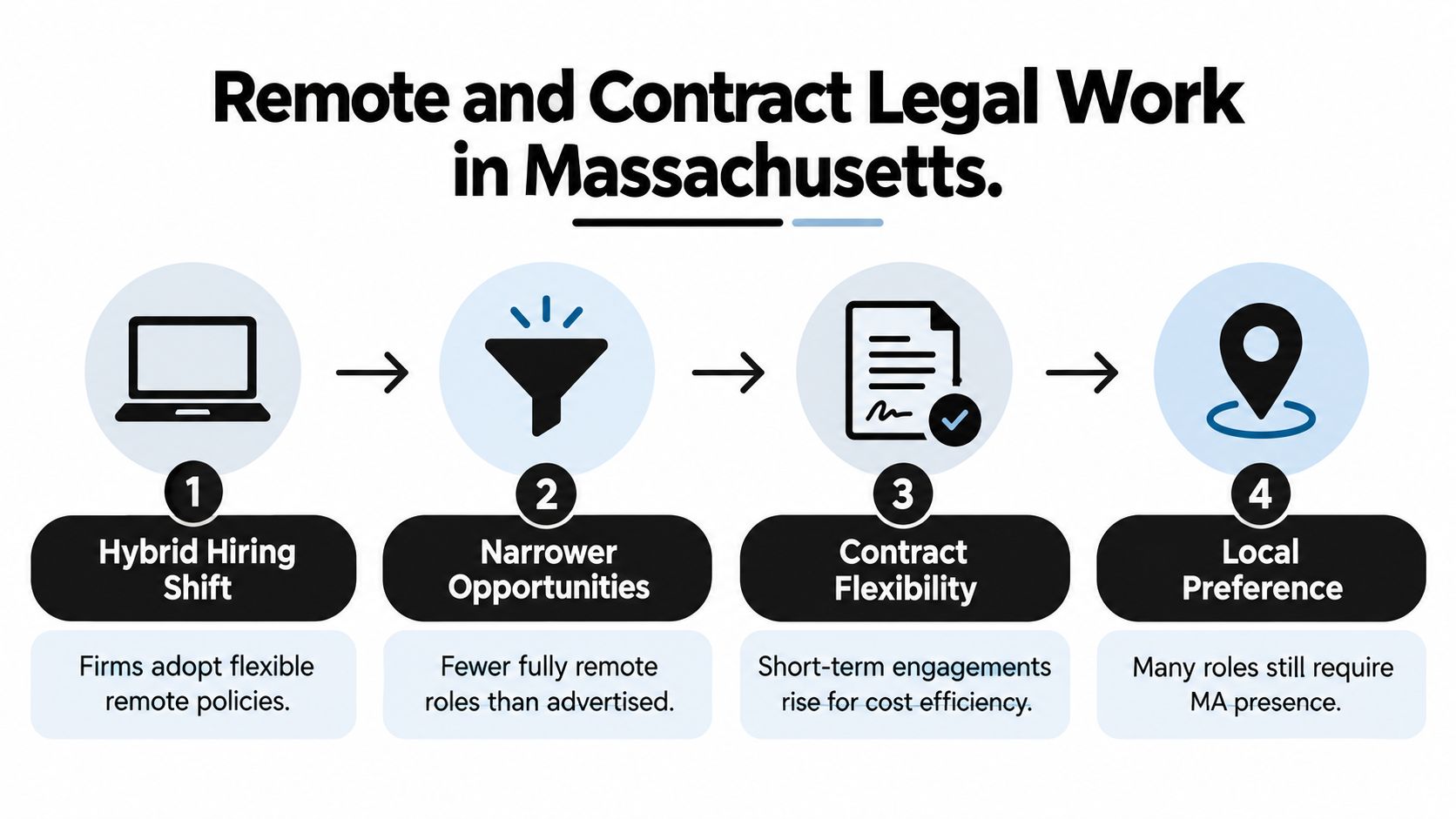
A remote label may still include client meetings, court appearances, occasional office attendance, or residence restrictions. Read the job description for terms such as “Massachusetts-barred,” “hybrid,” “travel required,” “local candidates,” and “Eastern Time.” A fully remote arrangement can widen access, but it can also attract applicants from a much larger geographic pool.
Remote work is often a better fit for document-intensive matters, drafting, research, contract review, and some litigation preparation. It can be less suitable when the role depends on frequent in-person client contact, local court appearances, intensive supervision, or rapid collaboration with a small team that works primarily in an office.
Contract roles can help an attorney manage workload fluctuations, test a practice area, or gain experience with a new employer. They may also offer less predictable continuity, fewer benefits, and limited access to mentorship or long-term advancement. Before accepting, clarify whether you're an employee or independent contractor, who controls deadlines, who owns work product, how conflicts are handled, and whether malpractice coverage applies.
Employers use remote and contract hiring for similar reasons. They can access candidates outside the Boston metro and add capacity without committing to a traditional permanent hire. That flexibility can benefit an experienced specialist, but firms may expect the contractor to begin with little training and deliver work independently.
For legal practices that need non-licensed support around scheduling, intake, records, billing, or administrative workflows, HireParalegals is one option that presents pre-vetted LATAM legal talent, including junior attorneys and legal support professionals, for interview before hire. Any arrangement must preserve the supervising attorney's responsibility for legal judgment, confidentiality, conflicts, and compliance with applicable professional rules.
Remote is an employment arrangement, not a substitute for licensure. Confirm the jurisdictional requirements before discussing duties or compensation.
Volume applications feel productive because they create visible activity. In a fragmented market, they often dilute the candidate's message. A focused application that connects your bar status, practice history, location, and client experience to the role gives the employer a reason to continue the conversation.

Write a one-line target before editing your resume. For example: “Massachusetts-barred civil litigator targeting hybrid insurance-defense work in Boston,” or “Immigration attorney seeking a Springfield-based role serving multilingual clients.” That sentence determines which matters, skills, and accomplishments deserve prominence.
Your resume should make these points easy to find:
Boston employers may test in-depth analysis, client management, and business judgment. Worcester employers may focus more on practical responsibility, regional relationships, and the ability to manage a broad caseload. Springfield employers may probe courtroom readiness, community-centered advocacy, language skills, and comfort with public-facing work.
Don't claim familiarity you don't have. If you're moving from another jurisdiction, explain how you will learn Massachusetts procedure, supervision expectations, and local practice. If admission is pending, describe the exact route and what work you can perform while awaiting authorization.
A remote candidate should present a concrete operating plan. Explain your working hours, secure workspace, communication habits, availability for occasional travel, and approach to confidential materials. Avoid framing remote work as a lifestyle preference only. Employers need evidence that the arrangement supports client service and team accountability.
This process takes more thought per application, but it prevents wasted interviews for roles that were never compatible.
The Massachusetts attorney market is large and well compensated, but it rewards fit over volume. Boston, Worcester, and Springfield present different practice opportunities, while remote and contract roles introduce separate questions about licensure, local presence, supervision, and continuity. The most useful first step is to identify the region and specialty where your experience is strongest.
Confirm your Massachusetts admission pathway, select a target submarket, filter listings by actual eligibility, and tailor each application around relevant matters and client needs. Use broad job boards for coverage, specialty channels and professional networks for signal, and treat compensation as a function of role scope rather than a headline number.
If you're pursuing attorney jobs in Massachusetts, start with a focused profile covering your bar status, practice area, preferred region, and work model. Then compare that profile with current openings and prepare a targeted application package. For firms that need flexible legal support alongside licensed counsel, review the role carefully and arrange an interview only after responsibilities, supervision, and jurisdictional limits are clear.