 18 minutes read
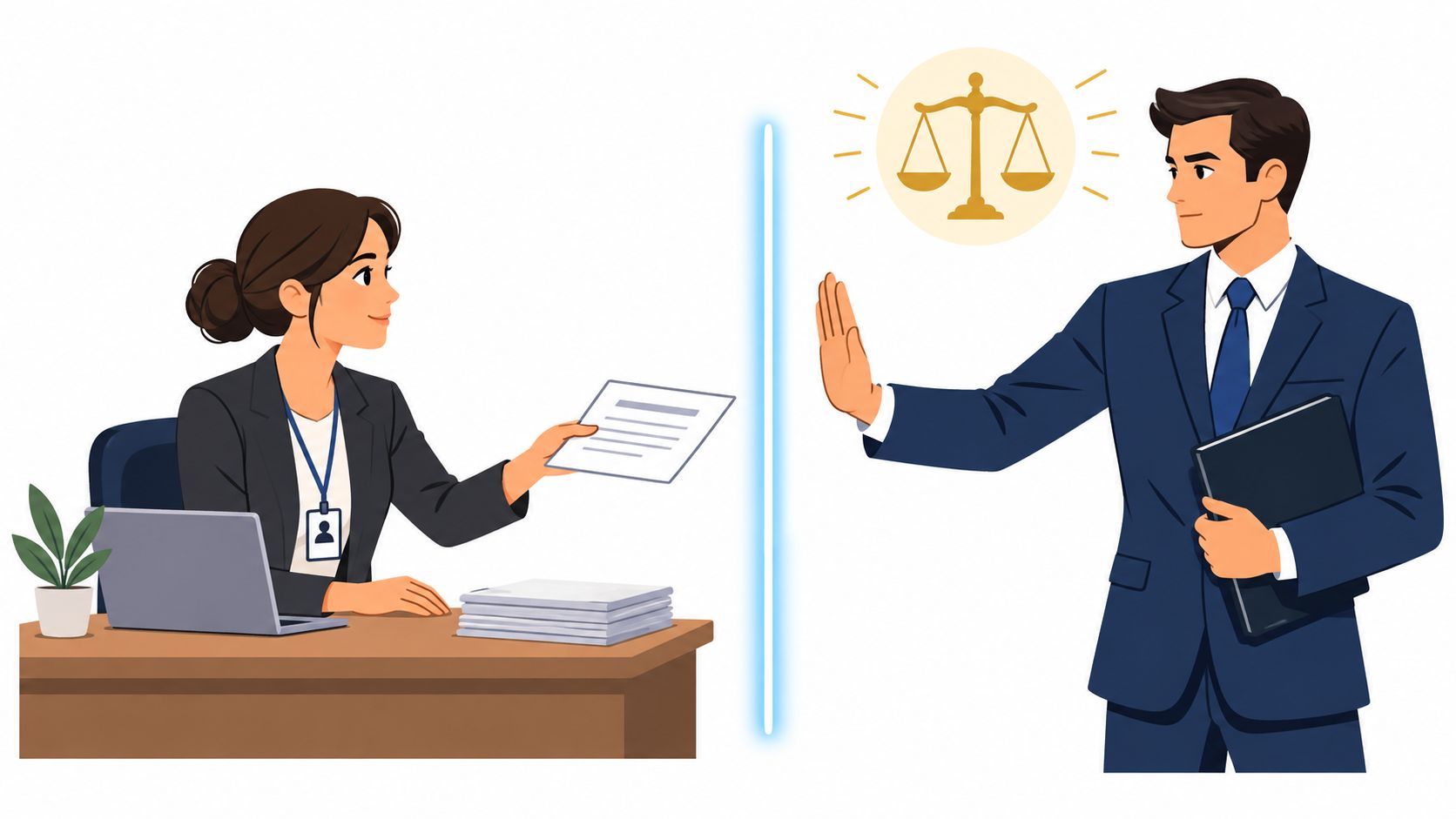
A paralegal cannot give legal advice, set fees, or establish an attorney-client relationship, but they can perform substantive legal work under attorney supervision. The question for a managing partner isn't whether a paralegal may work on a matter. It's whether the firm has preserved attorney control over the judgment communicated to the client.
A prospective client emails about a settlement. A remote paralegal drafts a reassuring reply, the partner skims it between hearings, and the message goes out. Nothing looks dramatic until you read the sentence that tells the client what to accept, sign, file, or do next. That sentence may have crossed the unauthorized-practice line.
The answer to can a paralegal give legal advice is no under the ordinary U.S. model. A paralegal may research, investigate, draft documents, organize a file, communicate factual information, and relay an attorney's direction. The paralegal may not independently apply law to a client's facts, recommend a legal course, interpret rights or responsibilities for the client, or make the final professional judgment.
This guide treats the rule as an operating issue, not a classroom definition. It separates legal advice from legal information, compares jurisdictional patterns, examines two firm scenarios, and provides supervision workflows, scripts, escalation triggers, and a checklist that works for remote and on-demand teams.
The bright line is straightforward. A paralegal can't give a client a legal opinion, establish the attorney-client relationship, set fees, or represent the client in court unless a specific law authorizes that activity. California expressly bars a paralegal from providing legal advice or representing a client in court, while North Carolina guidance says a lawyer can't delegate the giving of oral or written legal advice or a legal opinion to a paralegal. North Carolina's paralegal guidelines make the division especially clear.
That restriction doesn't make the paralegal's role narrow or clerical. Under lawyer supervision, a paralegal can conduct legal research, prepare drafts, gather facts, organize evidence, prepare discovery materials, coordinate communications, and identify issues for attorney review. The supervising attorney must direct the work, review the work product where legal judgment is involved, remain responsible for the client, and retain professional accountability. The NALA Model Standards for the Utilization of Legal Assistants frame the issue around supervision and responsibility, not merely the job title.

Practical rule: If the client could rely on the response to decide what legal action to take, route it to the attorney.
Remote staffing makes this harder because speed and distance can hide the moment judgment leaves the firm. A paralegal working from a home office may be the first person to see an intake message, a demand letter, or a worried question about a deadline. A shared inbox, chat channel, or automated drafting tool doesn't change who is authorized to give the answer.
Managing partners should apply four operating lenses:
The firm doesn't reduce UPL risk by telling paralegals to “be careful.” It reduces risk by making advisory communications difficult to send without attorney involvement.
The easiest way to train a team is to compare the client's question, the proposed response, and the decision the client might make afterward. Legal information describes the legal system. Legal advice selects or recommends a path for a particular person based on facts, rights, responsibilities, and likely consequences.
| Trigger | Legal Advice, Not Permitted for Paralegals | Legal Information, Permissible |
|---|---|---|
| A client asks which bankruptcy chapter to file | “You should file Chapter 7 because your income and assets make it the better option.” | “Chapter 7 and Chapter 13 use different eligibility, property, repayment, and procedural frameworks. The attorney needs to review your facts before recommending a path.” |
| A client asks whether to accept an offer | “You should accept because the insurer probably won't increase it.” | “The current offer is recorded in the file. The attorney will review the offer, available evidence, and your objectives before discussing options.” |
| A client asks about a filing deadline | “You still have time, so you can wait.” | “The file shows a deadline that requires attorney confirmation. I'll escalate this today and confirm when the attorney has reviewed it.” |
| A client asks what a contract clause means for them | “That clause lets you terminate without liability.” | “The clause addresses termination. The attorney must interpret how it applies to your agreement and circumstances.” |
| A client asks, “What would you do?” | Any personal recommendation or prediction about the client's legal choice | “I can't recommend a legal course. I'll make sure the attorney receives your question and relevant documents.” |
A response becomes advice when the paralegal moves from describing law to applying it. Citing a statute doesn't make the response safe. A carefully researched explanation can still be unauthorized practice if it tells the client how the law affects their specific facts or what action they should take.
The same principle applies to predictions. “The judge will probably dismiss this,” “the carrier won't negotiate,” and “you'll be fine if you wait” sound conversational, but each statement may influence the client's conduct. So can softer language such as “I think your best option is” or “if I were you.”
Texas bar guidance offers a practical filter. If answering requires legal knowledge or judgment, concerns the client's rights or responsibilities, or could lead the client to act, the paralegal shouldn't answer independently. The Texas Bar's guidance on paralegal boundaries turns a broad UPL rule into a usable intake test.
Before approving a client-facing message drafted by a paralegal, ask:
If any answer raises concern, rewrite the advisory portion or handle the communication directly. The paralegal can still prepare the timeline, identify the documents, summarize the client's question, and draft neutral logistics. The attorney must own the conclusion.
State variation matters, but it shouldn't distract a firm from the common operating standard. California, Texas, North Carolina, New York, and Florida use different combinations of statutes, court rules, ethics guidance, and enforcement practices. None should be treated as permission for an unsupervised paralegal to give a client individualized legal advice.
California states the prohibition most directly. California Business and Professions Code sections 6125 and 6126 form the statutory basis for unauthorized practice restrictions, and California ethics guidance warns that paralegal work can become UPL without appropriate attorney supervision. The San Diego County Bar ethics opinion is a useful reminder that the task alone isn't the complete test. Direction, review, and attorney responsibility matter.
| State | Scope Authority | Supervision Requirement | Notable Risk |
|---|---|---|---|
| California | Statutory UPL restrictions and professional guidance limit paralegals to supervised support work | Attorney supervision and responsibility must remain active | A client-facing task that looks administrative can become UPL when the paralegal interprets law or exercises judgment |
| Texas | Bar guidance uses legal judgment, client rights or responsibilities, and likely client action as practical indicators | The paralegal may relay attorney advice but can't expand on it independently | A helpful explanation can cross the line if it causes the client to act |
| North Carolina | Bar guidelines expressly prohibit delegation of legal advice or legal opinions | The lawyer retains responsibility for delegated work | Written or oral advice cannot be outsourced merely because the attorney assigned the task |
| New York | UPL and professional-conduct rules place legal judgment and representation with authorized lawyers | Firms must define duties and retain attorney control | Broad role labels and unsupervised client contact can obscure who is practicing law |
| Florida | UPL restrictions and bar regulation distinguish legal services from support functions | Supervision is necessary for delegated substantive work | Intake, document preparation, and communications can create risk when a nonlawyer appears to advise or represent |
The table is an operating comparison, not a substitute for jurisdiction-specific counsel. A firm's exposure may depend on where the client is located, where the work occurs, the subject matter, the court involved, and whether a limited-license framework applies.
Some jurisdictions have created regulated nonlawyer roles with narrow authority. Utah's licensed paralegal practitioner rule permits independent professional judgment only within defined areas of practice, not across the legal field. Ontario also regulates paralegals and permits advice within the scope of the applicable license and rules. The Utah licensed paralegal practitioner rule illustrates why a firm's policy must identify the jurisdiction and permitted service area rather than rely on the word “paralegal.”
For ordinary U.S. law-firm staffing, use the strictest applicable standard. The practical explanation of unauthorized practice gives firms a useful internal reference, but your supervising attorney should confirm how the rule applies to the matter. Treat certification, contractor status, experience, and location as relevant staffing facts, not as licenses to give advice.
Consider a plaintiff's firm handling a soft-tissue auto claim. The facts below are illustrative, but the workflow failure is common: the paralegal sees the client question first, feels pressure to be helpful, and answers before the attorney has exercised judgment.
9:08 a.m. The client forwards a carrier email offering $9,500 and asks, “Should I take this? I need the money for treatment.”
9:14 a.m. The remote paralegal replies:
“You should accept the $9,500 settlement. The policy limits make further negotiation pointless.”
The first sentence recommends a legal and financial course based on the client's facts. The second predicts the value of further negotiation and presents an insurance conclusion as settled. The paralegal has not merely transmitted an attorney's decision. They have made the decision visible to the client.
9:31 a.m. The supervising attorney sees the sent message. The firm now faces a UPL complaint and fee disgorgement in this illustrative scenario, along with the harder problem of explaining who advised the client and whether the client relied on that advice.
The corrective response isn't to delete the email. Preserve it, notify the supervising attorney, document the incident, assess the client's position, and determine whether remediation or regulatory reporting is warranted. Firms should also review their attorney-client privilege procedures so that internal escalation preserves appropriate confidentiality and records the response.
9:08 a.m. The same client sends the same question.
9:10 a.m. The paralegal tags the message ATTORNEY REVIEW, forwards the carrier's demand letter, and attaches a redlined timeline showing treatment dates, medical records received, and outstanding documentation.
9:13 a.m. The paralegal sends:
“Thanks for forwarding the carrier's offer. I've routed your question and the offer to the supervising attorney for review. I won't recommend whether you should accept or reject it, but the attorney will call you during the next available review window.”
9:30 a.m. The attorney reviews the file and speaks with the client. The paralegal records the communication, updates the task queue, and handles only the follow-up logistics assigned by the attorney.
The difference isn't that the second paralegal cares more or knows less. The difference is that the workflow separates fact development from legal judgment. The paralegal sees the message, prepares the file, and keeps the client informed without deciding the client's course.
Operational lesson: Every advisory question needs an owner, a queue, a release rule, and a neutral holding script. If one of those is missing, the firm is relying on individual instinct.
Can a remote paralegal work safely without constant attorney oversight? Yes, when the firm sets control points before granting client access. Supervision must identify the responsible attorney, define the paralegal's authority, and show exactly when work stops for review. Every file should make clear what the paralegal may complete independently, what requires approval, and what must be escalated.
Create a matter-specific delegation memo before assigning client-facing work. Name the supervising attorney, client, matter, permitted tasks, prohibited tasks, review requirements, approved communication channels, and escalation route. “Assist with litigation” is too vague. “Prepare a first draft of discovery responses for attorney review, organize exhibits, and communicate scheduling logistics” gives the paralegal an operating boundary.
The memo must also state that the paralegal cannot set fees, establish the attorney-client relationship, give a legal opinion, recommend legal action, interpret a document for the client, or appear in court unless applicable law expressly permits the activity. The attorney should review the memo with the paralegal and confirm understanding. Uploading the document to a shared folder is not supervision.
Route client communications through firm-managed systems, not personal email or untracked messaging. Give the paralegal drafting access where appropriate, while reserving release of advisory or substantive legal communications for the supervising attorney.
Use labels such as FACTUAL RESPONSE, ATTORNEY REVIEW, and URGENT LEGAL QUESTION. A paralegal may send a scheduling confirmation without approval if firm policy allows it. A message about liability, settlement, eligibility, a filing decision, rights, duties, or legal meaning belongs in the review queue.
Set the release rule in the case-management system. If the system cannot show who drafted, reviewed, and sent a message, the firm has a supervision gap.
A daily matter huddle should take only the time needed to identify blocked work. Use a consistent script:
“For each matter, state the pending client question, the next deadline, the document or fact still missing, and whether attorney judgment is required. No one sends an answer containing a recommendation, interpretation, prediction, or legal conclusion until the supervising attorney releases it.”
The huddle should surface unanswered questions before the client sends repeated follow-ups. It also lets the attorney redirect assignments. The paralegal can obtain medical records, prepare a chronology, or draft a factual status update while the attorney handles legal advice.
Keep a written action list. Assign each question to a named owner, record the deadline, and mark whether attorney review is pending. Remote teams need visible ownership because proximity cannot supply it.
Build escalation around both wording and substance. Any client question containing “should,” “recommend,” or “advice” goes to attorney review. The same rule applies when a client asks whether to sign, file, accept, reject, disclose, plead, settle, respond, or wait.
Use this Teams or Slack template:
Attorney review requested
Matter: [client and matter name]
Question: [copy the client's exact question]
Relevant facts: [neutral summary]
Documents attached: [list]
Deadline or urgency: [date or consequence, if known]
Paralegal action taken: [logged, forwarded, requested records]
No client recommendation sent.
Give callers a neutral handoff script:
“I can collect the facts and make sure your question reaches the attorney. I can't give legal advice or recommend what you should do. I'll document your question, confirm the relevant documents, and explain when the attorney or the attorney's designated team member will follow up.”
Match the script to the firm's actual response process. Do not promise a callback window the firm cannot meet. If no attorney is available, record the question, communicate the next confirmed step, and escalate any deadline or possible prejudice immediately.
Run a monthly file audit using a random sample of relevant matters and a documented review log. Examine emails, portal messages, intake notes, release history, escalation tags, and attorney approvals. Look for recurring weaknesses: prediction language, missing approvals, personal-channel communications, or attorneys approving drafts without reading the advisory sentence.
Use this printable checklist:
Firms hiring remote support should evaluate supervision capacity, not just drafting skill; our supervision best practices guide covers the control points in detail. HireParalegals connects U.S. law firms with pre-vetted remote legal professionals and supports interview-based selection, but the supervising lawyer still owns legal judgment and communication controls.
They aren't. A paralegal who contracts directly with a client, invoices through a separate business, or works on demand doesn't gain authority to provide legal advice. The billing arrangement doesn't change the nature of the act. If the person applies law to the client's facts without authorization and supervision, the firm should treat the communication as a UPL risk.
Accurate citations don't cure individualized advice. A paralegal may research a statute, case, or regulation and prepare an analysis for the attorney. The problem begins when the paralegal sends the client a conclusion about what that authority means for the client's rights, obligations, or next move.
It doesn't. An AI tool can help organize facts or produce a draft, but the attorney remains responsible for the final legal judgment. Review must be real, documented, and focused on the advice itself, not merely a quick approval of formatting. A polished draft can still contain an unsupported recommendation or an inaccurate application of law.
The American Bar Association's guidance on paralegal responsibilities identifies core prohibitions including legal advice, court representation, fee setting, establishing the attorney-client relationship, taking depositions, and signing pleadings. Use those boundaries when designing access and training.
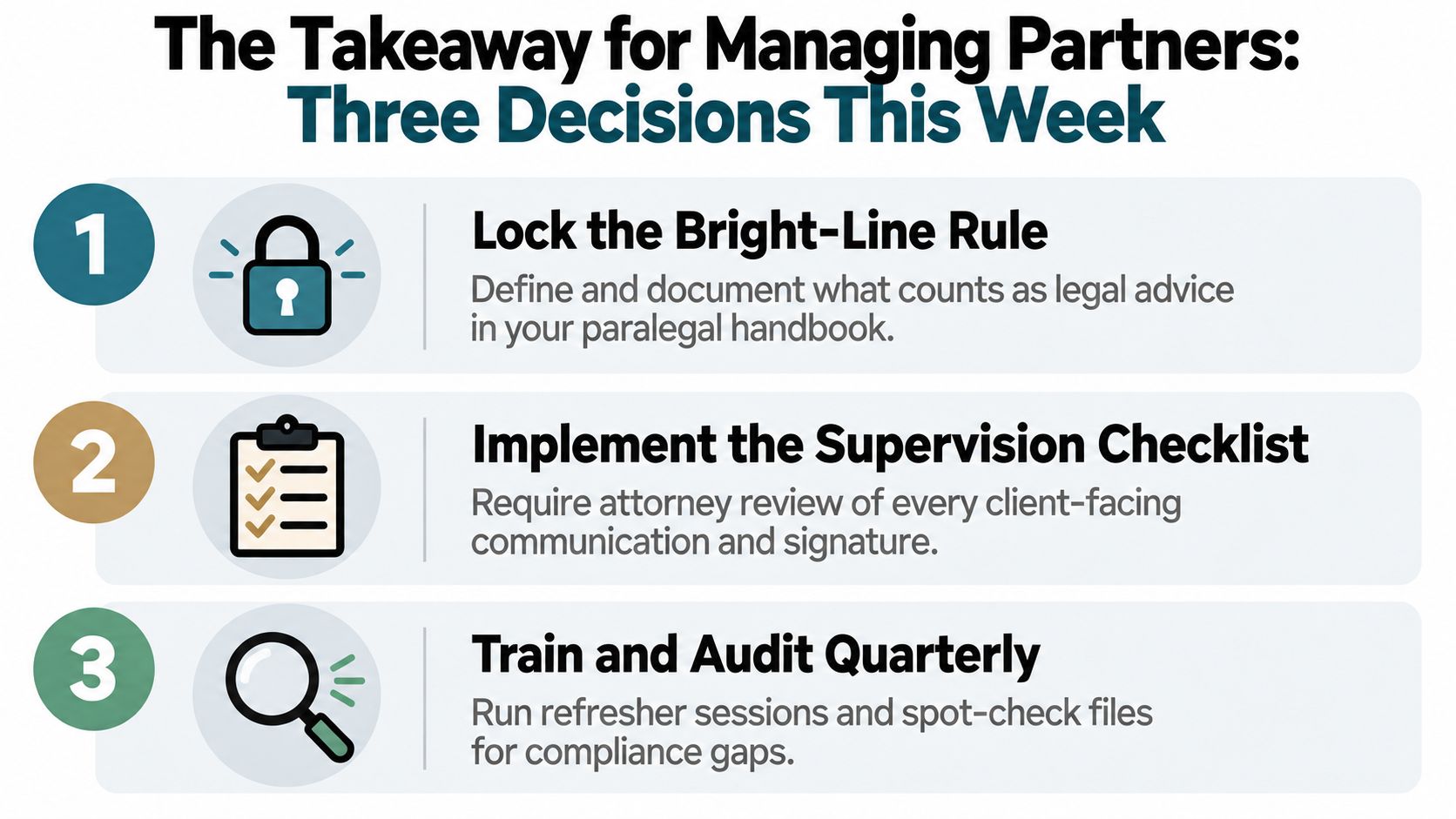
Make three decisions this week. First, lock the bright-line rule into the paralegal handbook: paralegals may perform substantive legal work under attorney supervision, but they can't independently give legal advice, interpret law for a client, set fees, establish the attorney-client relationship, or represent a client unless a specific law permits it.
Second, require the supervision checklist for every remote and on-demand engagement. Name the attorney, define the scope, separate drafting from release, use escalation tags, document approvals, and audit communications. The supervising lawyer's responsibility doesn't disappear because the paralegal works remotely, uses a contract, or drafts with an AI tool.
Third, script the intake handoff. A client shouldn't receive advice from a paralegal, but they also shouldn't be left with no path forward. The paralegal should acknowledge the question, collect the relevant facts, explain the boundary, and route the issue to the attorney.
Track one risk metric monthly: the count of paralegal-initiated written legal advice that reached a client or was applied to a matter without attorney review. When an incident occurs, preserve the record, notify the supervising attorney, remediate the file, provide written counseling or retraining, and consider Bar notification where warranted after qualified counsel reviews the facts.
Use a 90-day rollout. In week one, refresh the policy and delegation memo. In week four, train the team and deploy the scripts, labels, and release controls. In week twelve, complete the first compliance review and fix the workflow gaps it reveals.
If your firm uses remote or on-demand paralegals, review one week of client communications and mark every sentence that recommends, interprets, predicts, or reassures about a legal outcome. Then put the supervision checklist and attorney-review queue in place before the next message goes out.