
 16 minutes read
The hiring manager needs someone who can keep a complex immigration docket moving, but the applicants look interchangeable. One resume says “managed legal files.” Another says “communicated with clients.” Neither explains whether the candidate can prepare an I-130 packet, track an RFE, organize an asylum declaration, or work inside EOIR deadlines without constant correction.
That's the central problem with immigration law paralegal jobs. Immigration paralegal isn't one uniform position. Corporate filings, family and humanitarian matters, and removal defense require different forms of judgment, client communication, software fluency, and deadline control. Firms that treat them as interchangeable usually screen poorly and hire slowly.
This guide breaks down the work, the sub-markets, compensation, remote hiring, job channels, candidate evaluation, and practical vetting. The aim is straightforward: help candidates target the right role and help firms identify people who can protect case quality from intake through filing.
An immigration paralegal turns an attorney's case strategy into an organized, reviewable filing. The work starts before a form is drafted. It begins with intake, fact collection, document requests, deadline mapping, and a clear understanding of which agency or court will receive the submission.
A typical workflow includes:
The operational burden is substantial because every case has a different factual record and procedural path. A strong paralegal maintains packet integrity, which means the forms, supporting evidence, translations, signatures, filing fees, and attorney instructions remain consistent across the submission.
Paralegals work under attorney supervision. They can organize evidence, prepare drafts, communicate procedural requests, and coordinate case logistics. They can't give legal advice, independently decide legal strategy, set legal fees, or represent clients in court unless a specific rule permits a properly accredited representative to perform a defined function.
That distinction protects both the client and the firm. A paralegal can explain that a document is missing or that an attorney needs clarification. They shouldn't tell a client which immigration benefit to pursue or predict the outcome of a case.

Practical rule: Hire for controlled execution, not just familiarity with immigration vocabulary. The person must know what to prepare, what to escalate, and what not to answer independently.
The role changes sharply by practice area. A corporate immigration paralegal may manage employer questionnaires and recurring petition workflows. A humanitarian paralegal may spend more time on sensitive narratives and evidence development. A removal-defense paralegal must coordinate court-facing work, detained-client logistics, and compressed deadlines.
The phrase “immigration paralegal” hides several distinct job families. A candidate who excels at high-volume employer petitions may struggle with trauma-informed asylum intake. Someone experienced in removal defense may not be comfortable managing an employer's PERM documentation process.
| Sub-Market | Typical Caseload | Core Filings | Common Employers | Key Pressure Points |
|---|---|---|---|---|
| Corporate and business immigration | Employer-sponsored and employment-related matters | H-1B, L-1, PERM, I-140, adjustment and consular-processing materials | Large immigration firms, boutique business practices, corporate legal departments | Employer deadlines, document consistency, high volume, compliance records |
| Humanitarian and family-based immigration | Family petitions, asylum, waivers, naturalization, and humanitarian cases | I-130, I-485, I-589, waiver materials, naturalization applications | Small firms, nonprofits, legal-aid organizations, community practices | Sensitive client narratives, incomplete records, language access, evidence development |
| Removal defense | Court and detention-related matters | EOIR filings, bond motions, cancellation materials, defensive applications | Removal-defense firms, nonprofits, public-interest practices | Court deadlines, detained clients, changing facts, attorney escalation |
Business immigration rewards process discipline. The paralegal may manage employer questionnaires, education and employment records, organizational charts, prevailing-wage documentation, and petition support letters. The work can be repetitive, but it isn't simple. A small inconsistency between a form and an employer document can create avoidable review problems.
Family and humanitarian work requires a different operating style. The paralegal often has to help clients reconstruct events, locate hard-to-obtain civil records, coordinate translations, and communicate with people under serious stress. Empathy matters, but so does evidence discipline. A sympathetic intake conversation doesn't replace a complete timeline or a properly indexed exhibit set.
Removal defense is the least forgiving environment for a generalist hire. The paralegal may need to coordinate with detained clients, family members, interpreters, courts, and counsel while maintaining accurate procedural records. The role demands calm communication and immediate escalation when facts change.
Labor-market data supports the need for specialization without suggesting unlimited job growth. The U.S. Bureau of Labor Statistics projects little or no employment change for paralegals and legal assistants from 2024 to 2034, while still projecting roughly 39,300 annual openings driven largely by replacement hiring. The same source lists about 404,900 jobs in 2025 and a projection of about 403,800 in 2035. The immigration paralegal labor-market overview also cites a $61,010 median annual wage in May 2024 for paralegals and legal assistants. For candidates, that means specialization is more useful than assuming the market will reward a generic legal-support background.
Firms rarely reject a candidate because the resume lacks decorative credentials. They reject candidates because the resume doesn't prove the person can perform immigration work accurately under supervision.
A baseline candidate should show legal education or relevant experience, strong written English, organized file management, professional client communication, and comfort with case-management systems. An associate degree or paralegal certificate may help, but requirements vary by employer. Candidates changing careers can use a practical guide to transferable skills for career changers to translate project coordination, compliance, customer service, or records-management experience into relevant evidence.
The first screen should answer four questions:
A generic resume line says, “Managed client files and assisted attorneys.” A useful line identifies the work: “Prepared attorney-review packets for family-based petitions, maintained evidence checklists, and tracked agency notices.” The second version gives a hiring manager something to test.
Candidates should name the forms, proceedings, and case types they have handled. Relevant examples can include H-1B, L-1, O-1, PERM, I-130, I-140, I-485, I-589, consular processing, asylum, waivers, or EOIR filings, but only when the candidate can discuss the work accurately.
Language ability can materially improve client communication, particularly Spanish, Mandarin, or Portuguese. It doesn't replace immigration knowledge, and bilingual ability should be tested in the actual communication context rather than assumed from a resume.
For candidates who need formal training, compare programs carefully and review the practical scope of an immigration paralegal certification. A certificate can establish foundational knowledge, but employers still need evidence of filing accuracy, software use, and professional judgment.
Immigration paralegal compensation sits in a broad specialist band. Market data reported in 2026 places average annual pay at about $60,988, with most reported salaries between $46,500 and $73,500. A separate dataset estimates average pay at $63,326, or about $30 per hour, while another source reports an average of $67,056. These figures come from reported immigration paralegal salary data, and the spread should be treated as a market signal, not a guaranteed offer.
Another compensation source reports an average of $70,163 per year, while a separate dataset reports a mean of $55,020 and a top-10% level of $82,500. The difference reflects market, employer, seniority, specialization, and matter complexity. A candidate managing complex business filings in a major legal market shouldn't benchmark against an entry-level support role at a small nonprofit.
| Sub-Market | Tier 1 Markets | Mid Markets | Remote or Regional |
|---|---|---|---|
| Corporate and business immigration | Often supports higher compensation because of employer-facing work, technical filings, and volume | Depends on firm size, case mix, and seniority | Broadest remote potential, but experience and timezone requirements remain common |
| Humanitarian and family-based immigration | Varies widely by employer and funding model | Common across small firms and nonprofit practices | Available for intake, document preparation, and support, with client-access demands |
| Removal defense | Often shaped by court complexity and attorney supervision | Strongly dependent on nonprofit, legal-aid, or private-practice model | Less uniform because court coordination, detention work, and local procedure can require geographic familiarity |
Don't treat remote work as a substitute for specialization. Current listings show more than 4,000 U.S. immigration paralegal postings and multiple fully remote or hybrid roles, but the listings also show restrictions involving U.S. location, time zone, region, or practice area. The immigration paralegal job listings illustrate that remote access is uneven rather than universal.
Contract work can offer flexibility, but an hourly rate shouldn't be converted into an annual salary unless the workload is steady and the engagement includes enough billable hours. Firms should also define supervision, confidentiality, data access, work product ownership, and availability before treating a contractor as a substitute for an employee. Candidates comparing options can use remote jobs curated by JobGlance as one discovery channel, while verifying every listing directly with the employer.
For a focused benchmark, review the immigration paralegal salary guide, then compare the role's case mix and required experience rather than relying on a single average.
Indeed and LinkedIn are useful, but they shouldn't be your entire search. Immigration practices often recruit through professional communities, local bar networks, referrals, direct firm pages, and legal-specific boards. The strongest applicants may never appear in a broad search if the firm only posts to its own site or an immigration association channel.
Professional associations are valuable for specialized roles. The AILA community, regional immigration bar groups, and local paralegal chapters can surface openings tied to firms that already understand the practice area.
Direct firm pages deserve a separate search. Check large immigration practices, mid-sized boutiques, nonprofit employers, and established business immigration firms such as Berry Appleman, Fragomen, and BAL. A direct application can be more useful than an anonymous aggregator submission because it shows the candidate researched the practice.
Legal-specific boards can provide better filtering than general platforms. Candidates can supplement them with a practical paralegal job websites guide and then verify the employer's original posting.
General platforms still matter, but use targeted phrases such as “business immigration paralegal,” “asylum paralegal,” “removal defense paralegal,” “PERM paralegal,” “EOIR paralegal,” and “immigration case manager.” Avoid applying blindly to every result. Recruiter reposts, aggregator duplication, and stale listings can make a search look more active than it is.
Check saved searches frequently for corporate, humanitarian, and removal-defense terms. Review association and local-network sources on a weekly basis. Revisit direct firm career pages periodically because specialized practices may post roles there before distributing them elsewhere.
When a listing is older, verify whether it remains active. A candidate can send a short, specific inquiry naming the relevant case type and software experience. A firm can reduce noise by stating the required forms, work arrangement, supervision model, and expected caseload in the posting.
For broader remote-search ideas, this overview of remote work platforms can supplement legal-specific channels. It shouldn't replace direct verification of the employer, role, and employment terms.
Immigration hiring is a specialty screen. A resume that presents the candidate as a general legal assistant leaves the hiring manager to guess whether the person can perform the actual work. Most managers won't guess in the candidate's favor when the docket is deadline-heavy.
Lead with the case categories you know. A strong resume might identify business immigration petitions, family-based applications, asylum support, consular processing, or removal proceedings. It should also describe the candidate's role, such as evidence collection, form preparation, RFE coordination, client intake, attorney review, or filing-calendar management.
“Detail-oriented” has little value without proof. Replace it with a concrete description of how accuracy was maintained. For example, explain that you reconciled client questionnaires against supporting records, prepared exhibit indexes, or escalated inconsistent dates before attorney review.
Useful resume content includes:
Interview questions should test applied judgment. Expect scenarios involving a missing signature, inconsistent biographical information, an RFE, a compressed consular-processing timeline, or a client who asks for legal advice. The right answer usually involves identifying the issue, documenting it, following the firm's escalation procedure, and involving the attorney when the question crosses into legal strategy.
Candidates lose credibility when they claim familiarity with a filing but can't explain what they prepared, what evidence was needed, or what the attorney reviewed. Immigration work isn't interchangeable with general litigation support. Specificity is the strongest signal of real experience.
Firms often hire the wrong immigration paralegal because they evaluate resumes before defining the work. Start with the practice's actual docket. A role supporting PERM and employer petitions needs a different screen from a role supporting asylum declarations or detained-client matters.
Specialized recruiters can reduce search time when the firm needs an experienced candidate quickly. The tradeoff is cost and the need to validate whether the recruiter understands the firm's forms, software, and supervision structure.
Immigration-focused programs and associations are useful for developing a longer pipeline. Reach out to paralegal programs, AILA networks, local chapters, and community organizations that understand language and practice-area needs.
Targeted direct search gives the firm more control. Boolean searches can combine terms such as “immigration paralegal,” “I-130,” “I-140,” “PERM,” “asylum,” “EOIR,” “LawLogix,” and “INSZoom.” Referrals from trusted legal professionals can also reveal candidates who aren't actively applying.
A service such as HireParalegals can be considered alongside those channels for remote legal-support hiring. Its model connects firms with candidates for immigration and other legal specialties, including paralegals and legal assistants. Treat it as a sourcing option, not a replacement for the firm's own substantive assessment.
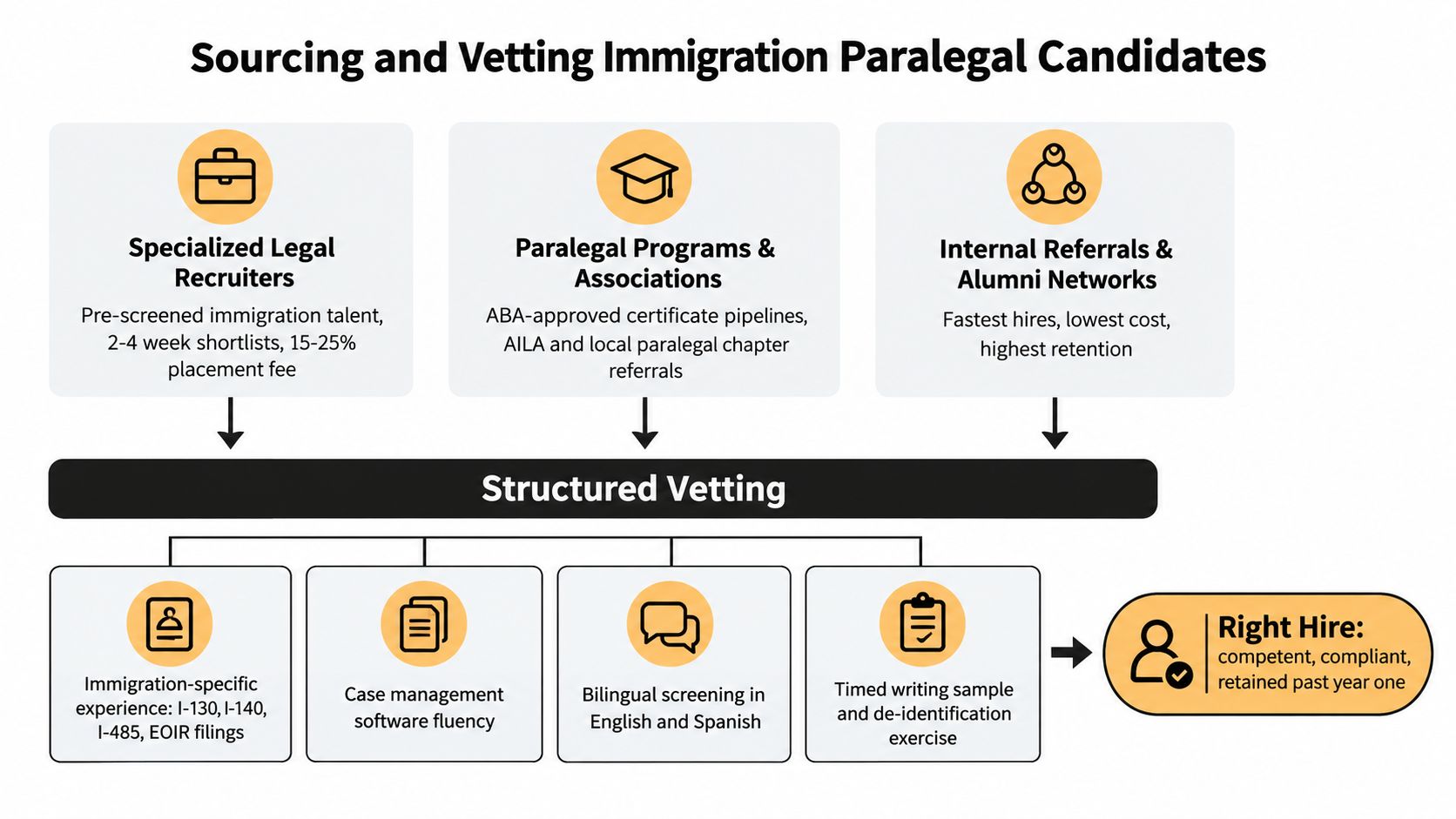
A strong process uses job-relevant exercises rather than conversational confidence alone.
The exercise must be proportionate, secure, and based on de-identified material. Don't send real client data to an applicant or ask for uncompensated work that resembles a live filing.
During the first month, pair the new hire with a senior paralegal and restrict independent ownership of high-risk submissions. At the 30-day checkpoint, review intake accuracy, task follow-through, and escalation habits. At 60 days, assess work-product quality and whether the paralegal can manage a defined matter type with ordinary supervision. At 90 days, decide which filings or workflows the person can own and which still require closer review.
The goal isn't to eliminate attorney oversight. It's to make oversight efficient by showing exactly where the paralegal performs reliably and where training remains necessary.
Job seekers should spend ten minutes mapping their experience to one sub-market. If you prefer structured employer documentation, recurring petition workflows, and business communication, target corporate immigration roles. If you have strong interviewing, language, and narrative-development skills, look at family and humanitarian work. If you can remain organized around court procedure, urgent changes, and difficult client circumstances, removal defense may be the better fit.
Then take one concrete action this week:
Hiring managers should publish the role they actually need. Name the sub-market, forms, software, language expectations, supervision model, remote restrictions, and the difference between intake support and substantive case preparation. A vague “immigration paralegal” listing attracts generalist resumes and makes screening slower.
For an uncertain hire, a clearly documented contract-to-hire arrangement can let both sides evaluate work quality, communication, and workload fit before making a permanent commitment. Define confidentiality, access, supervision, payment, and conversion terms in writing.
Hiring rule: Specialization beats years of generic paralegal experience when the specialization matches the docket.
Immigration law paralegal jobs cover distinct operating environments. Corporate immigration, humanitarian and family-based work, and removal defense each demand different filing knowledge, client communication, software habits, and deadline control. Candidates should market the work they have performed, while firms should test the forms, workflows, and writing required by their own caseload.
Start by choosing the right sub-market, then verify competence through a realistic exercise and structured references. Whether you're applying for a role or hiring for one, specific immigration experience is more useful than a broad legal-support label.
If you're hiring, define your case mix and required filings before opening the role, then use a structured screen to compare candidates consistently. If you're applying, revise your resume around the exact immigration matters you've handled and target employers whose docket matches your experience.