
 15 minutes read
You've probably seen the same job ad twenty times by now. “Immigration paralegal.” Friendly enough title, vague enough description, and somehow it's supposed to mean everything from family petitions to deportation defense to corporate visa work. That's the problem. The label is doing too much work, and if you're hiring or applying without sorting the job family first, you're basically shopping blind.
The honest version is simpler. Immigration law paralegal jobs split into three very different tracks, the work is deadline-heavy, and the people who thrive in it usually have sharper process discipline than most legal roles demand. The attorney owns the legal advice. The paralegal owns the paperwork machine, the follow-up, the intake hygiene, and the quiet act of preventing the whole case from catching fire.
Monday morning at an immigration practice is rarely gentle. Phones ring, a USCIS notice lands in the inbox, an RFE is due, and someone in the office is trying to figure out whether a PERM clock just started running. That's not “general legal support.” That's a workflow with a pulse.
The first bucket is affirmative immigration. This is the family-based and status-updating work, things like I-130s, naturalization, U/T visas, VAWA, and SIJS. The tone is client-facing and document-heavy, and the pace is steady until it suddenly isn't. Community practices and nonprofit shops live here because the clients need calm, organized support more than they need legal theatrics.
The second bucket is removal defense. Asylum, deportation-related support, and humanitarian pathways fall into this area. It's high-emotion work, and the paralegal has to be steady when the client isn't. The caseload can get messy fast, which is why process discipline matters more than charm.
The third bucket is business immigration. Think PERM, H-1B, L-1, and compliance. This is the most forms-and-deadlines-heavy version of the role, and it's the one where employers get cranky about error rates because one sloppy filing slows down the whole pipeline.
For candidates who want a practical place to compare legal-compliance openings, LatoJobs compliance job listings are worth a look because the category mix makes it easier to spot which employers want immigration-adjacent workflow talent, not just a warm body with a résumé.
| Job Family | Typical Cases | Pace & Pressure | Common Employers |
|---|---|---|---|
| Affirmative immigration | Family-based petitions, naturalization, U/T visas, VAWA, SIJS | Deadline-driven, client-sensitive, intake-heavy | Legal aid, immigration boutiques, nonprofit providers |
| Removal defense | Asylum, deportation defense, humanitarian pathways | Emotionally intense, hearing-driven, documentation-heavy | Nonprofits, advocacy groups, specialized firms |
| Business immigration | PERM, H-1B, L-1, compliance | Form-based, process strict, high accuracy expectations | Corporate legal teams, business immigration firms |

Practical rule: if a candidate can't tell you which bucket they want, they probably don't know what kind of pressure they're signing up for.
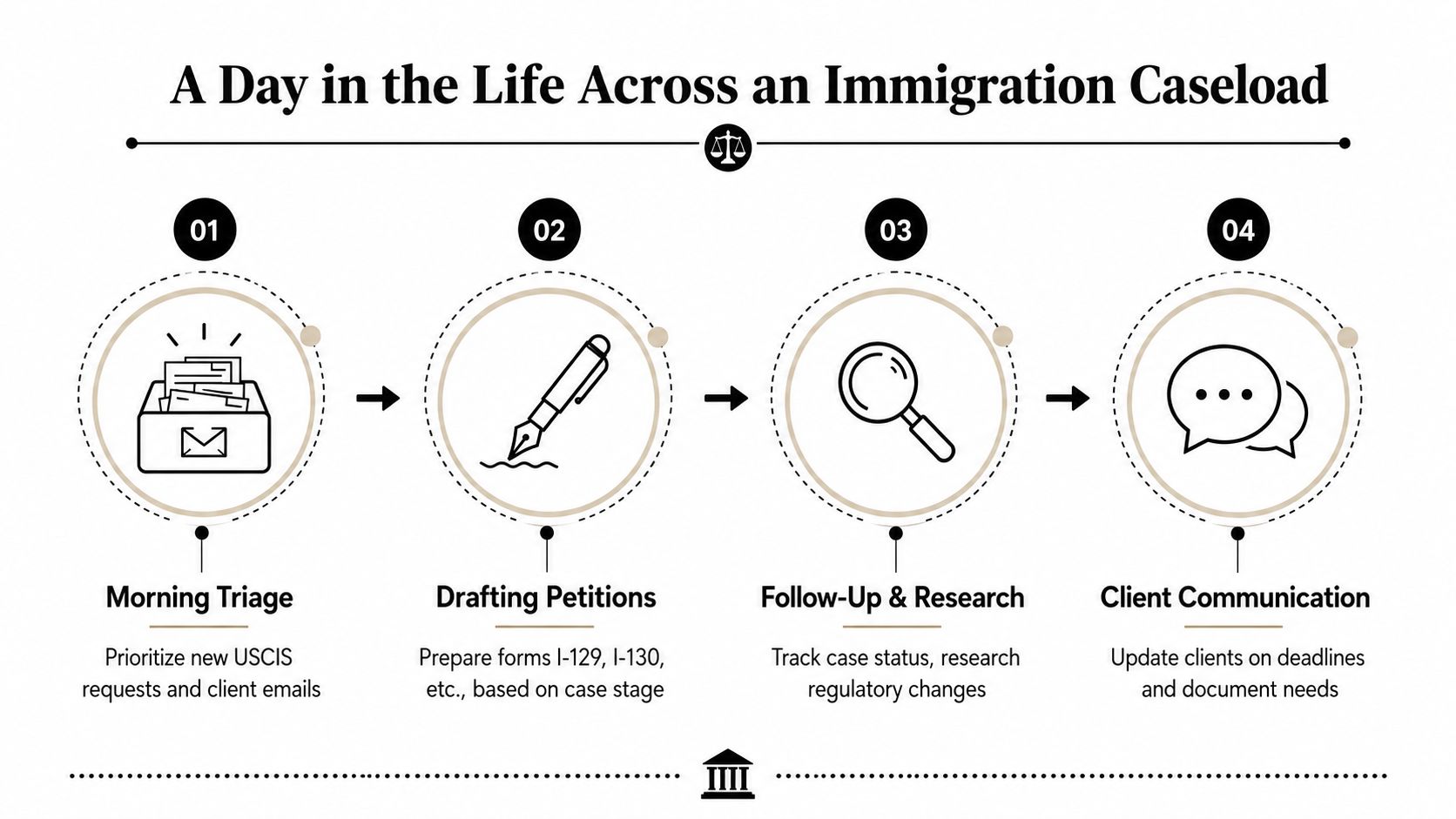
A real immigration desk doesn't run on “miscellaneous admin help.” It runs on triage, forms, deadlines, and follow-up. The best paralegals I've seen don't just stay busy, they keep cases moving without letting the seams show.
The day usually starts with inbox triage. USCIS messages, client emails, missing documents, and calendar alerts all hit at once, and someone has to decide what's urgent, what's waiting, and what will blow up if ignored. In a high-volume affirmative shop, that means checking which cases are waiting on signatures or identity documents. In a nonprofit removal-defense office, it might mean sorting trauma-sensitive client messages before a hearing. In business immigration, it's usually about status updates, form revisions, and who's holding the next filing up.
Then comes drafting. Petition packets, supporting exhibits, cover letters, and form data all need to line up. A good paralegal knows that the paperwork is the product. Sloppy intake creates sloppy filings, and sloppy filings create avoidable pain.
The afternoon is usually where the work hides. RFE responses get assembled, missing evidence is chased down, and case status checks happen in whatever system the firm uses. The tools vary, but the pattern doesn't. Case management software, USCIS portals, EOIR-related coordination, e-filing workflows, and docket control are the core machinery.

You'll also spend a lot of time explaining deadlines to clients who don't live inside your calendar. That's normal. The job is partly logistics and partly translation. The attorney prepares for hearings or interviews, the paralegal makes sure the packet, timeline, and evidence trail are ready.
The best immigration paralegals don't “manage tasks.” They manage failure points.
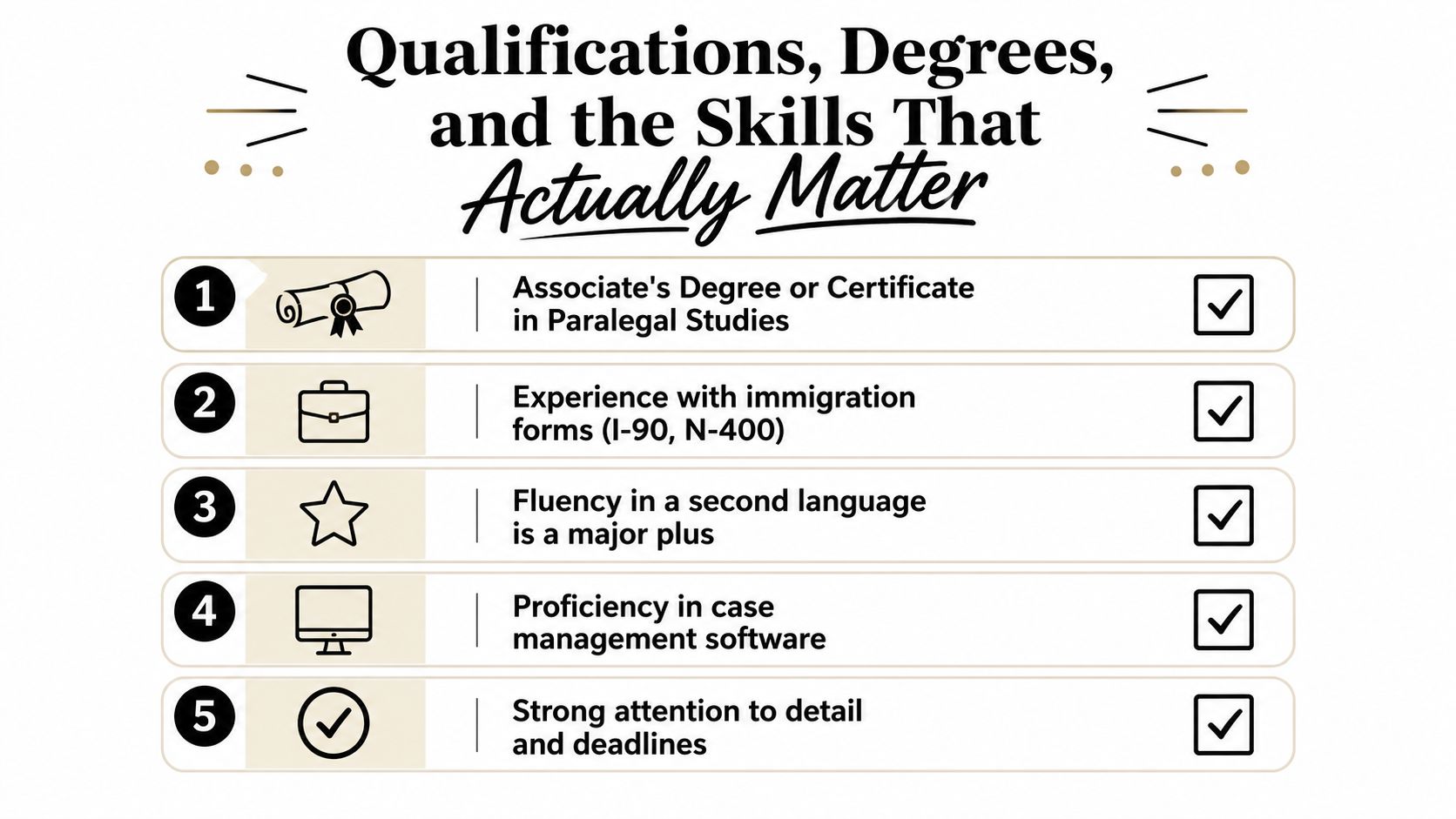
A lot of candidates obsess over the degree line and miss the actual screen. Immigration firms hire for accuracy, speed, and judgment first, then they look at schooling. A certificate or associate degree in paralegal studies is a common baseline, but it does not carry the room by itself. In this field, the person who can keep a filing clean, a client calm, and a deadline visible is the one who gets called back.
The skill stack is practical. You need document discipline, deadline control, client communication, and enough legal-tech comfort to move between case systems without constant help. Research, organization, and attention to detail also show up again and again in strong candidates, because immigration offices do not have time for someone who loses track of exhibits or leaves a form half-checked.
The job families matter here. Affirmative roles reward people who can handle intake cleanly, communicate with care, and keep family-based and humanitarian matters moving without confusion. Removal-defense roles demand sharper writing, trauma-aware communication, and careful hearing prep, because the work turns on evidence and timing. Business immigration is a different animal, and firms care most about process literacy, form accuracy, and the ability to keep status updates and filings in order without drama.
A second language is a strong plus, especially in community-facing roles. USCIS and EOIR familiarity is table stakes for serious applicants. Case-management tools are table stakes too, because nobody wants to train a new hire on basic document flow while filings are stacking up.
Good firms also look for proof that you can handle real scenarios, not just talk about them. If you want a useful model for that kind of interviewing, review nursing manager interview questions and pay attention to how they force people to explain decisions, not buzzwords. Immigration hiring works the same way. Managers want to hear how you handled missing evidence, a confused client, or a filing that needed cleanup under pressure.
For candidates who want to build a stronger profile around formal training, the internal guide on immigration paralegal certification is the cleanest place to start.
| Job Family | What Matters Most | What Helps Most |
|---|---|---|
| Affirmative immigration | Intake discipline, client communication, form accuracy | Bilingual fluency, community experience |
| Removal defense | Trauma-aware communication, hearing prep, evidence organization | Writing samples, nonprofit exposure |
| Business immigration | PERM and federal process literacy, speed, accuracy | Corporate workflow experience, case tools |
The phrase “entry-level” gets tossed around like it means “light training, easy onboarding, no stress.” That's cute. It's also usually wrong.
One recent posting required three years of affirmative-immigration experience across family-based relief, U/T visas, SIJS, VAWA, naturalization, and removal defense (Justia job posting). Another asked for five to seven years of immigration experience and preferred humanitarian-pathway work like asylum, U/T visas, and TPS, which is a very different ask from a generic assistant role. Employers are not just checking whether you've “worked in law.” They're checking whether you can take a case from intake to filing without stepping on a rake.
They want low error rates, good throughput, and a calm person under pressure. They also want someone who can handle client trauma without turning the office into a support group. That sounds blunt because it is. Immigration work is human work, but firms still need someone who can keep the machine moving.
The cleanest way into the field is usually not a straight leap into a polished firm posting. It's a nonprofit clerk role, a legal aid volunteer path, contract support, or remote overflow work where you can build actual reps. If you can prove you've handled intake, evidence chasing, and form prep without needing constant rescue, you're already ahead of most “entry-level” applicants.
Blunt truth: the label on the posting matters less than the filing volume behind it.
The first mistake candidates make is treating immigration law paralegal jobs as one pay band. They are not. An affirmative-immigration desk, a removal-defense seat, and a business-immigration desk pay differently because the work, the risk, and the client pressure are different.
The baseline market is the baseline, not the ceiling. The BLS puts the median annual wage for paralegals and legal assistants at $61,010 as of May 2024, with employment projected to show little or no change from 2024 to 2034 and about 39,300 annual openings expected each year for replacement and turnover (BLS outlook). That matters because immigration hiring does not rise on broad labor growth alone. It rises when a firm needs a specialist who can keep cases moving without creating avoidable mistakes.
A recent career guide says experienced paralegals in major immigration hubs can earn roughly $80,000 to $126,000, which is a very different conversation from the national median (ParalegalEDU immigration law guide). The same source lists city-level medians for all paralegals at about $73,470 in New York City, $63,110 in Los Angeles, $64,750 in Houston, and $63,050 in Miami. That spread is what you expect in a field where location, case volume, and client mix drive value.
The highest-paying pockets usually sit in business immigration and heavier litigation-adjacent work. Business immigration firms pay for pace, precision, and document control. Removal-defense practices pay for stamina, responsiveness, and the ability to keep records straight under pressure. Affirmative-heavy shops often pay a bit less than the most demanding litigation and corporate desks, but strong performers still move up fast because they save attorneys from constant cleanup.
| Market | Typical Pay | Notes |
|---|---|---|
| United States | $61,010 median annual wage for paralegals and legal assistants | BLS baseline, not immigration-specific |
| Major immigration hubs | $80,000 to $126,000 for experienced paralegals | Specialized practices can pay well above baseline |
| New York City | $73,470 median for all paralegals | Higher-cost market, strong demand |
| Los Angeles | $63,110 median for all paralegals | Large immigration footprint |
| Houston | $64,750 median for all paralegals | Strong business and community immigration activity |
| Miami | $63,050 median for all paralegals | Metro with steady immigration demand |
Remote work changes the economics fast, but only for the right kind of role. A Florida posting showed monthly pay of about $2,500 to $3,500 for in-person work, while another remote listing advertised $50 to $100 per hour (Indeed Florida listings). That gap is the market saying something simple. Firms pay more when they need someone who can work independently, keep deadlines straight, and handle immigration paperwork without constant supervision.
Remote fit depends on the job family. Business immigration is the easiest to remote-fill because the workflow is repeatable and document-heavy. Affirmative work can also work remotely when intake, form prep, and evidence follow a tight process. Removal-defense is harder to staff remotely because hearings, urgency, and attorney coordination make sloppy communication expensive.
For a cleaner salary-focused breakdown, the internal guide on immigration paralegal salary trends and pay expectations shows how employers should think about comp bands without pretending every market behaves the same way.
The practical read is simple. Candidates should negotiate based on the caseload they can manage, not just the title on the posting. Firms should budget for capability, not wishful thinking. If you need someone who can keep immigration workflow moving with minimal supervision, you are buying operational stability, not a generic assistant.
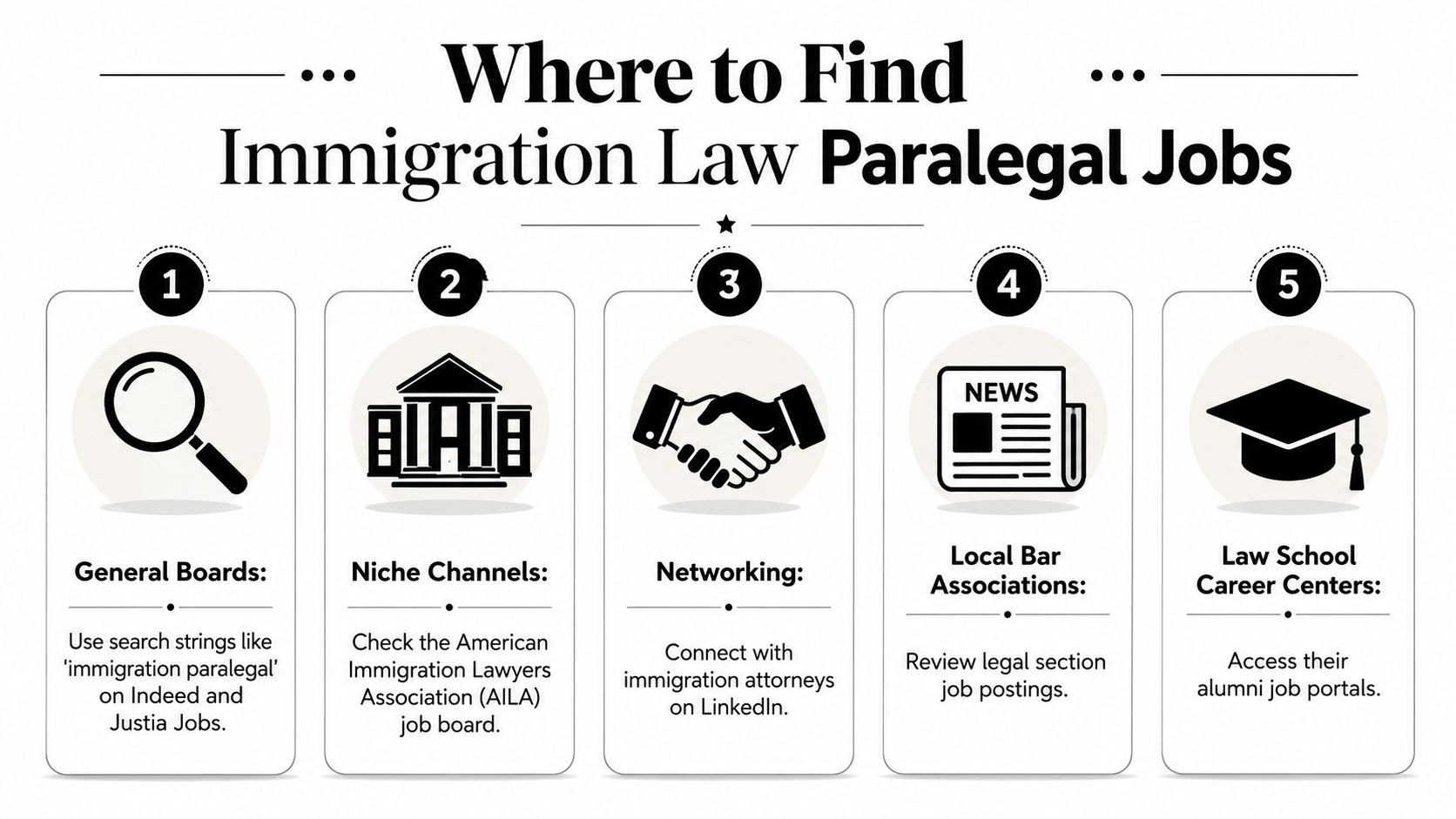
Stop spraying résumés into every listing with the word “immigration” in it. That's how you waste a week and learn nothing. A better search strategy starts with picking the job family, then matching the channel.
General boards like Indeed and Justia Jobs are useful if you search with intent. Use strings like “immigration paralegal,” then add filters for experience level, remote work, or practice area. If you're targeting affirmative or nonprofit work, look harder at mission-driven channels and direct employer career pages. If you want business immigration, remote-friendly legal staffing and corporate postings show up more often than people think.
For a focused remote search, immigration paralegal remote jobs is the kind of page that saves time because it points you toward the listings most likely to reward independent work.
Don't send the same résumé to every employer. For removal-defense work, attach a writing sample if they ask for one, because that's often the quickest way to prove you can draft cleanly under pressure. For business immigration, highlight any PERM or document-heavy workflow experience. For community practices, bilingual intake and client-facing experience can matter more than polished office jargon.
A few places are still worth the effort if you want quality over volume. FFWD.org and nonprofit career pages surface mission-driven roles that don't always appear on the big boards. Local bar association listings can be useful too, especially in metro areas with active immigration dockets.
The cheapest mistake is applying less, not more. The smarter move is applying narrower.
Traditional hiring breaks on immigration work because résumés don't show case complexity well. Someone can look “qualified” on paper and still fail the first week because they've never touched an RFE packet, never managed deadline-heavy filings, or never worked inside a process-driven office. That's not a candidate problem only. It's a sourcing problem.
Write the posting around actual workflows. Say whether you need PERM support, asylum packet prep, family-based affirmative work, or corporate visa processing. If the job is really about high-volume forms and follow-up, say that. If it's trauma-heavy client work, say that too. The wrong title attracts the wrong applicant pool.
Then screen for process literacy. Ask about the systems they've used, how they prioritize deadlines, and how they handle missing documents. A short scenario exercise beats a long résumé every time. Give them a mock filing issue and see whether they can organize the response without making the whole thing more chaotic.
For firms that want outside support rather than a long internal search, VolunteerBadge is useful as a way to think about candidate credibility through verified participation and visible contribution, especially when community or nonprofit exposure matters.
Curated talent pools are attractive because they cut through the noise. HireParalegals says it reduces hiring time to 24 hours and cuts payroll costs by up to 80% through a pre-vetted network of more than 10,000 paralegals with an average of 4+ years of experience and a four-step vetting process (HireParalegals). That's not magic. It's just less bad screening.
If you're a solo, a mid-sized firm, or an in-house team that needs immigration support without turning hiring into a second job, the answer is usually not “post harder.” It's define the workflow, screen for the workflow, and use a talent pool that already filtered for the basics.
Candidates, stop treating immigration law paralegal jobs like one uniform lane. Pick your job family first, build one portfolio piece that proves you can do the work, then apply through two smart channels instead of twenty random ones. If you want affirmative work, show client-handling discipline. If you want removal defense, show writing and resilience. If you want business immigration, show process control.
Firms, fix your funnel. Write the job around the case family, screen for workflow competence, and stop asking a generic résumé to reveal specialized experience it can't possibly show. If the role is urgent, use a vetted pool instead of pretending a broad posting will magically surface the right person.
Nobody gets into this work because it's easy. They get into it because the cases matter and the details matter, which is exactly why the right match makes life better on both sides of the hire. If you're hiring, make the process less theatrical and more useful. If you're applying, be ruthlessly specific, because immigration work rewards people who know exactly what game they're playing.