
 15 minutes read
You know the moment. Revenue is up, the calendar is full, and everyone keeps saying the firm is “busy,” which sounds flattering right up until realization slips, intake turns sloppy, and your best lawyers spend half the week doing administrative rescue missions. That's not growth, that's a slow-motion mugging.
Most firms call it a demand problem because demand feels easier to fix. More ads. More content. More rainmaking. Maybe another practice area if the mood is reckless and the coffee is strong. But the cleaner truth is usually uglier, and more useful. The firm is often capacity-constrained, pricing-constrained, or both.
The classic trap starts when the top line climbs and the machine underneath starts squealing. A managing partner sees more matters coming in, but the team is answering leads slowly, the work gets handled by whoever is least on fire, and partners are pricing like they're afraid of a difficult email. The result is predictable. The firm looks busier, but the economics get worse.
That's why the old “just add headcount” reflex is so dangerous. PwC's 2024 Law Firms' Survey found that among the Top 25 global firms, 94% recorded fee income growth, and 44% of those firms achieved double-digit growth. In the Top 10, growth came mainly from a combination of a higher average rate per hour and more chargeable hours, with the split described as roughly 65% rate increase and 35% volume increase in the survey's summary of growth drivers. That's the part owners miss while they're busy hiring too early. The firms that scaled were improving the engine, not just bolting on another seat. PwC's 2024 Law Firms' Survey
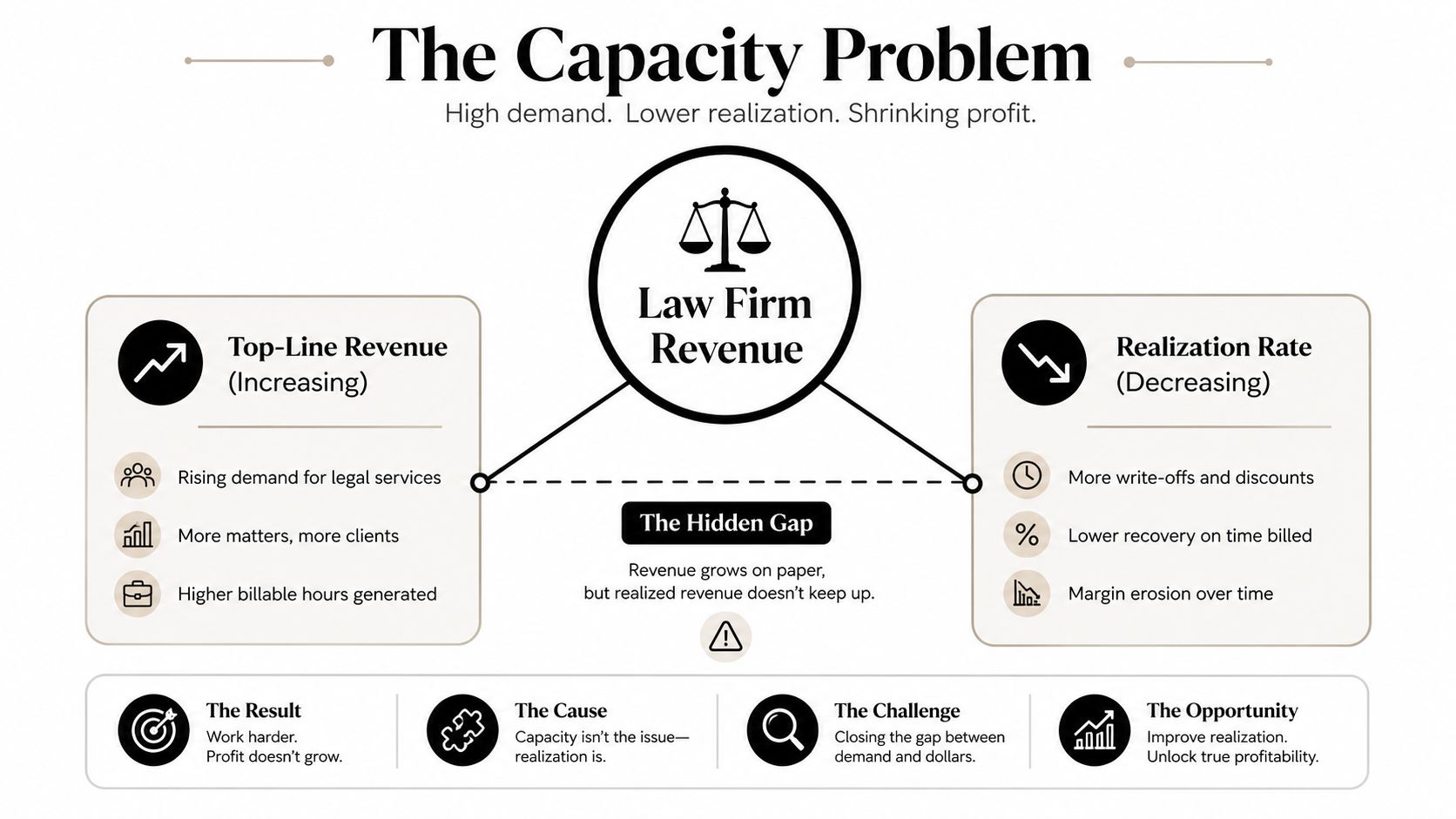
The rot usually comes from three places.

Practical rule: if more matters only creates more chaos, the problem is not marketing. It's operating leverage.
The fastest way to diagnose the constraint is to ask which metric is the weakest link. If leads are thin, you've got a demand problem. If leads exist but consults, responses, or signed matters are weak, you've got a conversion problem. If work is coming in but margins, realization, or attorney sanity are falling apart, it's a capacity and pricing problem wearing a marketing hat. That distinction decides everything else. Including who gets hired, what gets automated, and whether the next dollar should go to SEO or to the intake desk.
A decent growth goal isn't a slogan. It's a small set of numbers that have to move together without wrecking the firm's balance sheet or partner appetite for risk. If one metric gets better while the others slide, the partners will spend the next quarter arguing with each other instead of celebrating.
Start with revenue per lawyer, realization rate, collection rate, and net profit margin. Those are the numbers that tell the truth. The Macquarie 2024 legal benchmarking report found that firms with annual revenues greater than $20 million used technology more extensively in day-to-day operations and generated revenues that were almost 80% higher per full-time equivalent (FTE) team member than firms with revenues below $5 million. It also reported average net profit margins in FY2023 of 25% before partner salaries and equity dividends. Macquarie's 2024 legal benchmarking report
That matters because finance doesn't care about busy calendars. It cares whether every additional matter improves the economics. A firm can grow top line and still be worse off if collections lag or write-offs expand. A “grow 30% next year” target is a nice way to buy four different headaches and one awkward partner retreat.
A five-partner firm should translate ambition into a monthly dashboard, not a motivational poster. If the goal is more revenue, the partners need to know how many qualified consultations are required, how many proposals those create, what mix of matter types is being targeted, and how much operating cash exists before the next hiring decision gets made. If the dashboard doesn't answer those questions, it's not a plan. It's a guess with stationery.
CFO-style rule: if you can't tie growth to cash, margin, and pipeline coverage, the target is decorative.
Use the dashboard to set a direct chain from matter volume to capacity. For example, if the firm wants more revenue from higher-value work, the weekly review should show whether consults are landing, whether matters are being retained, and whether the firm has enough cash runway to absorb the work without forcing panic hiring. That's boring in the best way. Boring keeps payroll paid.
A lot of firms get cute and then get expensive. They throw budget at SEO, ads, or branding while intake is slow, status updates are random, and attorneys are reinventing the same process ten different ways. That's not a marketing strategy. That's mortgaging the office ping-pong table in slow motion.
Map the top five workflows by volume. Usually, that means intake, conflict checks, document collection, status updates, and matter handoff. Then choose the three that should be automated or delegated first, and assign a human checkpoint for quality and ethics. The point isn't to eliminate judgment. The point is to stop making a partner answer the same five questions like they're trapped in a very expensive loop.
A useful operational benchmark is client communication. One source recommends a 5 to 6 hour response-time target for client messages, paired with update cadences by case stage and a single source of truth for matter status. That's not glamorous, but it's the difference between a client feeling looked after and a client wondering whether the file has gone feral. For a practical SOP starting point, the process discipline in how to create standard operating procedures is worth a hard look.
The best firms don't add payroll when they feel stressed. They add capacity when the numbers show the firm can absorb it. Neutral guidance in the sources says firms should look for a sustained three-to-six-month surplus in operational capacity plus a predictable inbound pipeline before expanding payroll. That's the threshold worth respecting, because hiring too early just imports your mess into a bigger meeting.
| Operations Readiness Checklist Before You Spend on Marketing | ||
|---|---|---|
| Signal | Metric to Track | Ready Threshold |
| Intake speed | Time to first response | Client messages answered within the 5 to 6 hour target |
| Workflow clarity | Top workflows mapped and owned | Top five workflows documented |
| Automation coverage | Repetitive tasks delegated or automated | Three workflows automated or delegated first |
| Capacity | Unused team bandwidth | Sustained three-to-six-month surplus |
| Pipeline strength | Predictable inbound matters | Clear, recurring consultation flow |
If the checklist is red, more ad spend just accelerates the backlog. Clean the machine first. Then buy demand.
Referrals are lovely. They're also moody, inconsistent, and allergic to forecasting. A real acquisition engine doesn't chase luck. It builds a pipeline with names next to every stage and a weekly meeting that everyone mildly resents, which is usually a good sign that it's working.
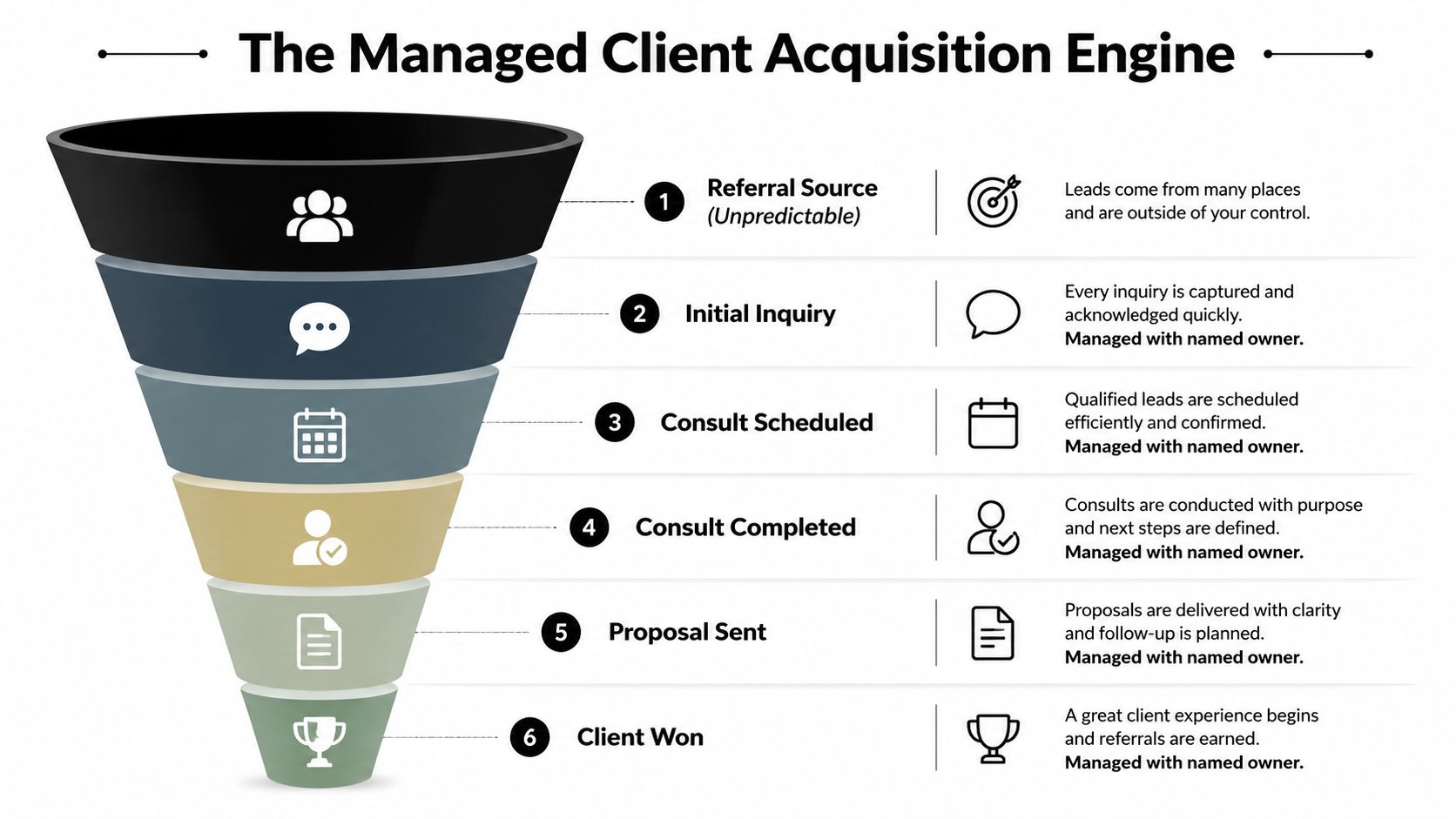
Start with an ideal client profile. If the firm can't define who it wants, it'll happily accept whoever pays first, which is how practices end up with a brand shaped by accidents. Then pick three to five pilot attorneys who will participate instead of nodding in the kickoff meeting and disappearing into deposition season.
From there, put CRM tracking in place and watch the funnel stage by stage. Intake speed matters because early responsiveness changes the odds before the first consult even happens. The firm should also tighten consult structure, because a better consult isn't just friendlier, it's more profitable. For a practical intake resource, optimizing law firm intake is a useful external reference when the bottleneck is lead handling rather than lead generation.
A strong pipeline is less about “more leads” and more about fewer leaks between inquiry and retention.
The sources point to a simple expansion path. Thought leadership, speaking, and a structured referral program can come after the firm knows what it stands for and how it converts. That order matters. Broad marketing before positioning is just expensive confusion with nicer fonts.
Also, don't ignore client experience metrics. A consult script that feels calm, a fast response time, and even a simple net promoter style feedback loop can improve win rates and referral generation. The point isn't to make every lawyer sound identical. It's to make the client journey repeatable.
For firms hiring around marketing execution, the internal role definition in this law firm marketing job guide is a handy benchmark for what should sit inside the role versus what should stay with partners.
Hourly billing has one thing going for it. It's familiar. That's also its problem. Familiar pricing makes people sentimental about a model that often rewards effort more than efficiency, which is a funny way to run a business if you enjoy being underpaid for getting better.
For litigation, hourly pricing still has a place because scope is messy and variables stack up quickly. For immigration and many family law matters, flat-fee packaging can improve cash flow if the scope is disciplined and the firm is ruthless about boundaries. For corporate work, value-based or fixed-scope pricing often makes more sense when the work is repeatable and the client cares more about certainty than micromanaging time entries.
The lever is often rate discipline. Raising rates is usually the highest-growth move a solo or mid-sized firm can make because it improves revenue without adding the noise of another lead source. That said, raising rates without better communication or clearer scope just tells the market you're more expensive now and somehow still confused.
Flat-fee packages work when the firm knows exactly what's included and what isn't. If the scope is fuzzy, the package becomes a tax on the team's patience. Value-based pricing works best when the firm can clearly connect the work to client outcomes and the client values certainty, speed, or risk reduction more than hourly detail.
Here's the practical move. Run a pricing worksheet on your top three matter types in one afternoon. Compare current realization, scope creep, and client sensitivity to price changes. Then decide whether the issue is the model, the packaging, or just the fact that the firm has been charging like it's apologizing for existing.
Simple rule: if the client buys certainty, sell certainty. If they buy flexibility, price the flexibility. If they buy litigation risk management, stop pretending time entries are the whole story.
If you need to communicate new pricing to existing clients, do it with scope clarity and confidence, not a defensive essay. Clients usually object less to price changes than to surprise and vagueness. Nobody likes a bill they don't understand, especially when the lawyer on the phone sounds like they're bargaining for their own job.
If the firm has earned the right to hire, the first hire shouldn't automatically be another attorney. That's a luxury move for firms that enjoy paying lawyer rates to do assistant work. A remote paralegal bench is often the smarter first step, because it converts partner time into matter capacity without forcing you to build a second office culture from scratch.

The math is straightforward even when the hiring process is not. HireParalegals matches US law firms with pre-vetted remote paralegals, legal assistants, and junior attorneys averaging 4+ years of experience through a four-step vetting process, with a curated network of over 10,000 candidates and a stated goal of reducing hiring time to 24 hours and cutting payroll costs by up to 80%. That's a very different posture from posting a role, refreshing inboxes, and hoping your next hire can spell “subrogation” without blinking. HireParalegals
The practical advantage is capacity. A trained remote paralegal can absorb repetitive work, improve after-hours coverage, and help a firm cover practice areas without hiring a full local bench for every variation. The local hire still wins in some settings, especially where in-person presence matters, client expectations are highly physical, or the work depends on office-specific supervision. But if the issue is throughput, not conference-room attendance, remote support is usually the cleaner first move.
The four-step process matters because legal support can't be “good enough” in the way a mediocre spreadsheet can. Sourcing, interviewing, background checking, and skills validation should all happen before a candidate ever touches client work. That's how you reduce the risk of handing off core processes to someone who looks polished but can't run the file.
Cross-border hiring also needs grown-up handling. Payroll, compliance, timezone alignment, and supervision rules all need to be clear before the firm turns capacity into permanent headcount. None of that is glamorous. It's still cheaper than discovering your new support structure was built on vibes and a shared inbox.
Tooling without metrics is just expensive procrastination. A lean firm stack usually means a practice management system, CRM, document automation, time tracking, and one workflow automation tool. Each tool should own a KPI. The CRM should move client acquisition cost and consult conversion. The practice system should support realization and collection. Time tracking should protect margin. Automation should reclaim hours.
The weekly partner dashboard should include revenue per lawyer, realization rate, collection rate, client acquisition cost, gross margin, and months of operating cash. Those six numbers keep the conversation honest. If the dashboard is fuzzy, the growth plan is probably vibes, not finance.
AI can help, but only with human checkpoints. Use it for drafting, summarizing, and routing where the risk is low and the workflow is obvious. Keep a person in the loop for anything that touches client advice, ethics, or judgment. Tech is a tool. It's not a substitute for responsibility, no matter how slick the demo looks on a Thursday.
For a deeper look at the staffing side of remote support, your guide to virtual paralegal employment is a useful reference when the firm is ready to turn capacity into a repeatable system.
Strategy without a calendar is a group chat. If the firm wants growth that sticks, the plan needs deadlines, owners, and review points that don't get politely ignored until the next retreat with bad coffee.
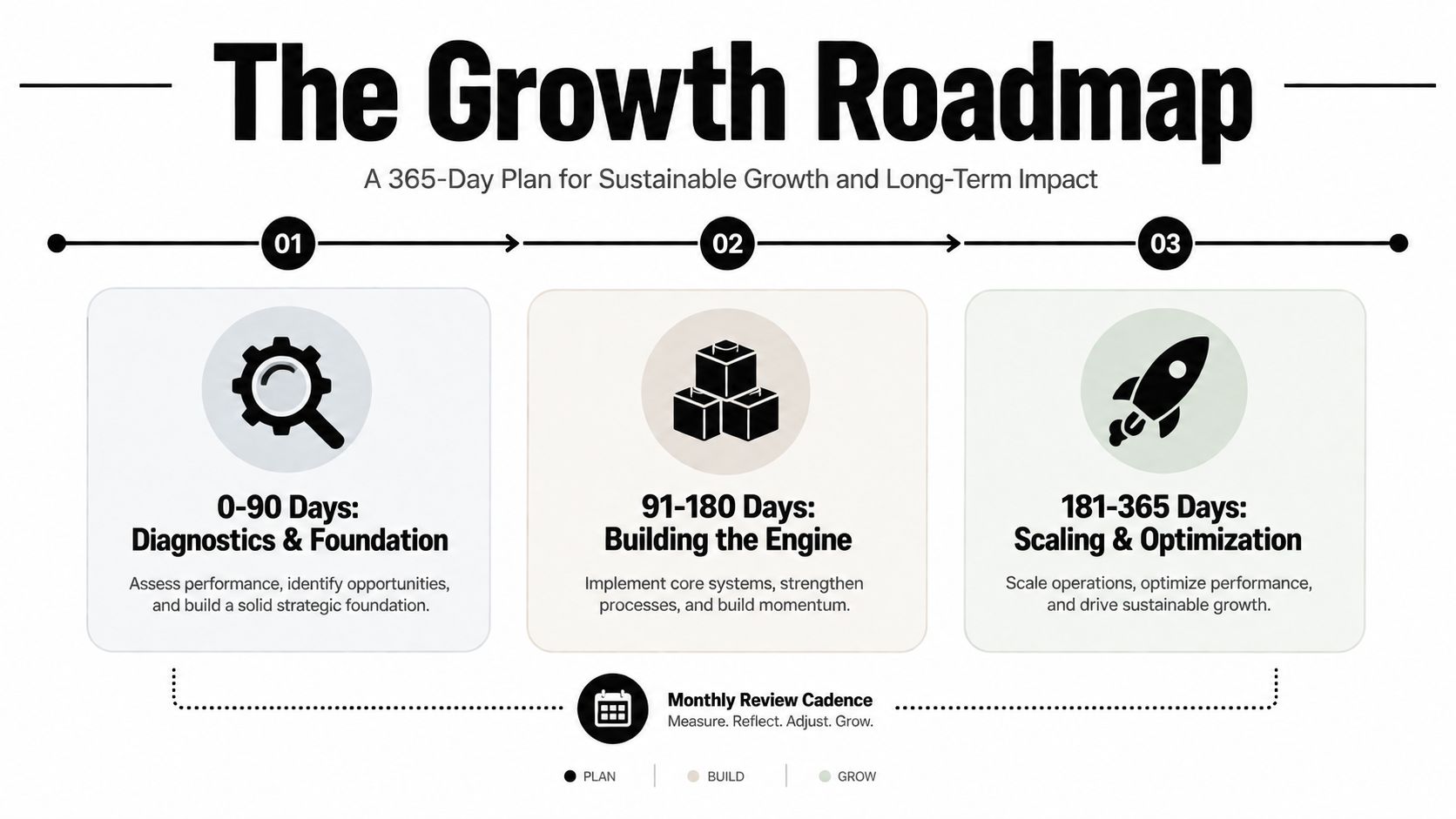
The first ninety days are for diagnostics and cleanup. No new hires yet. Map the workflows, instrument the KPIs, define the ideal client profile, and fix intake response time. Partners should review the dashboard monthly and the operational bottlenecks weekly. If the firm already has a plan template it likes, a customizable 30-60-90 day template can help structure the internal rollout without overcomplicating it.
A good 90-day target is not “grow faster.” It's “stop losing money to preventable friction.” That means cleaner intake, clearer ownership, tighter pricing discipline, and a firm-wide understanding of what counts as a qualified matter.
The next six months are when the engine gets built. Layer in client acquisition, launch thought leadership where it fits the niche, and reset pricing on the matter types that have been underperforming. If capacity is proven and the pipeline is predictable, this is the point where the first remote paralegal hire makes sense.
During this phase, monthly deliverables should include consult conversion review, pricing adjustments, and workflow adoption checks. The leadership team should still keep the meeting cadence tight. Too many firms confuse “progress” with more meetings. It's a terrible hobby.
The final stretch is about scaling the bench, not just the workload. Add support only where the numbers justify it, deepen the niche, and tighten the dashboard until the partners can run the firm from six numbers. That's the whole game. Not infinite growth. Controlled growth with fewer surprises and less drama.
Final rule: if the firm can't name the owner, the metric, and the review cadence, it doesn't have a growth plan yet.
Toot, toot. If the firm's numbers are still fuzzy, start with the dashboard, clean up intake, and stop hiring before the machine can breathe. Then turn the playbook into a real calendar, review it every month, and make the next decision from data instead of adrenaline.