 16 minutes read
The popular advice is to search only Rochester law-firm offices and accept the first mid-$40,000 offer that appears. That approach misses a large part of the opportunity. Legal assistant jobs in Rochester, NY, are being reshaped by hybrid work, remote-enabled case administration, turnover, and specialized document workflows, so your location doesn't have to define your entire job market.
Local employers still value candidates who can draft correspondence, organize exhibits, handle records, communicate with clients and insurers, and maintain accurate case files. At the same time, hybrid and remote roles let Rochester candidates compete for employers outside Monroe County, provided they can demonstrate strong technology habits, dependable communication, and legal-document competence.
This roadmap explains what the local compensation data means, where openings surface, which skills produce callbacks, and how to evaluate remote platforms without confusing flexibility with guaranteed earnings. It also shows how to build an application around the work attorneys need completed, rather than around generic administrative duties.
Rochester's legal-support market isn't disappearing, but it also isn't a market where every applicant can rely on simple volume. The stronger interpretation is that employers are replacing, reorganizing, and digitizing support work. National employment data supports that distinction. U.S. employment for paralegals and legal assistants rose from 345,240 in 2022 to 392,880 in 2025, while the Bureau of Labor Statistics projects little or no net growth from 2024 through 2034, with approximately 39,300 annual openings largely connected to replacement needs. Those figures describe a turnover-driven occupation, not an expanding market where any résumé will attract attention. (BLS occupation outlook data)
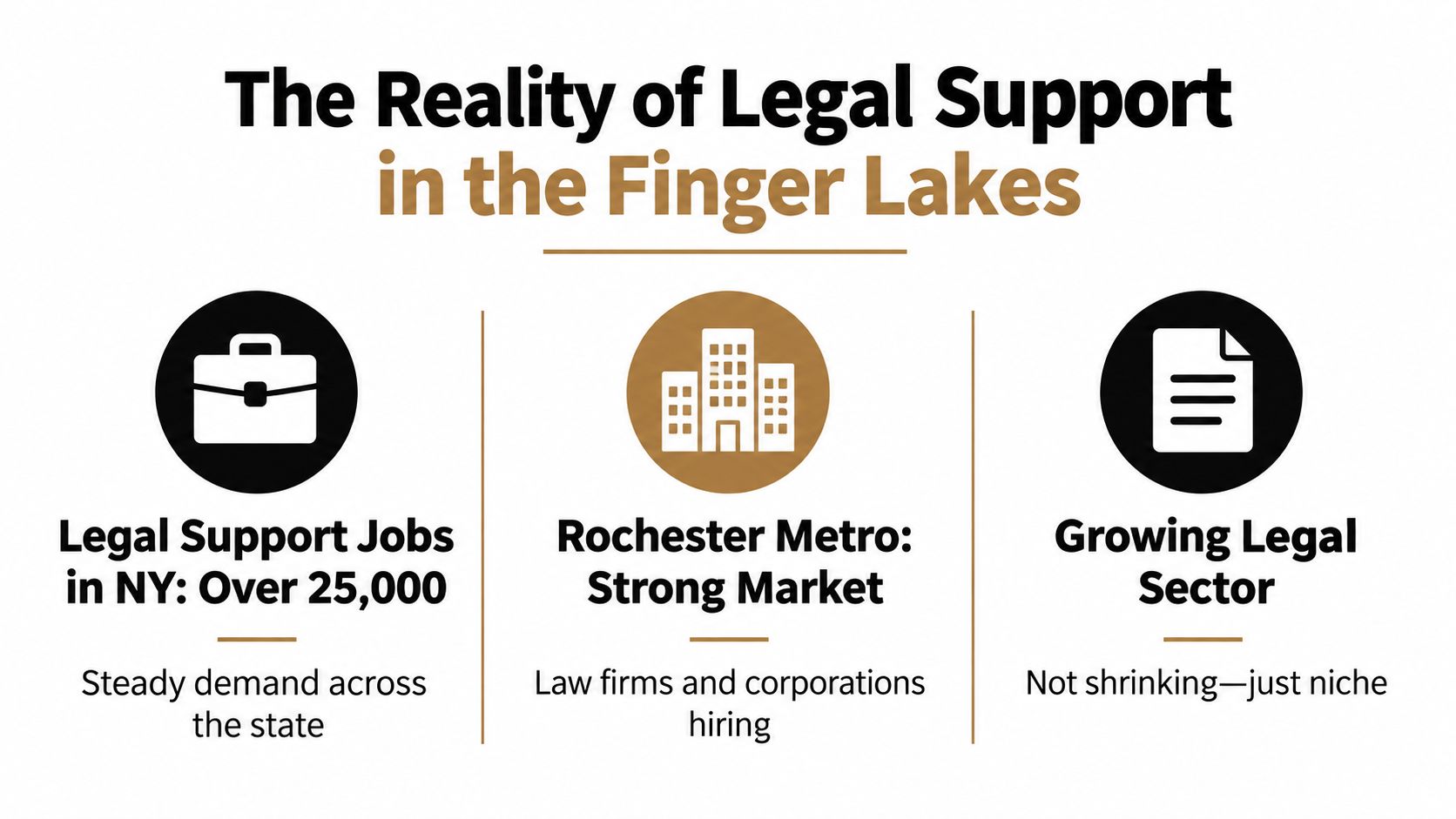
For Rochester, the federal baseline is useful because it separates occupational data from optimistic job-posting language. The U.S. Bureau of Labor Statistics estimated 1,170 employed paralegals and legal assistants in the Rochester metropolitan area in May 2023. The occupation had a 1.01 location quotient, meaning its local concentration was close to the national average. The same table reported a $28.79 median hourly wage, a $29.26 mean hourly wage, and a $60,860 annual mean wage. (Rochester legal-support labor data)
Job boards don't provide a complete picture. A broad Rochester search can mix legal assistants, paralegals, receptionists, intake coordinators, file clerks, and unrelated administrative roles. Some firms also recruit through their own websites, referrals, staffing companies, county portals, or professional networks instead of publishing a highly visible listing.
The compensation figures reinforce the need to read job titles carefully. A legal assistant may support litigation, personal injury pre-litigation, real estate transactions, family law, government work, or general office administration. Those roles can share a title while demanding very different levels of judgment, records handling, client contact, and deadline control.

Practical rule: Treat “legal assistant” as a starting label, not a complete description of the job. Read the workflow, reporting relationship, schedule, and document responsibilities before comparing offers.
The broader occupation's U.S. wage distribution provides another reference point. In May 2022, BLS reported a $28.46 median hourly wage and a $59,200 median annual wage for paralegals and legal assistants, with the 25th and 75th percentile hourly wages at $22.52 and $36.33. (BLS national wage table) Rochester candidates should use those figures as context, not as an automatic local offer expectation.
A separate Rochester metro table reports a $61.37 mean hourly wage and $127,650 mean annual wage for the broader legal occupation group in May 2025. That group includes legal occupations beyond legal assistants, so it shouldn't be presented as a direct salary promise for support staff. It does, however, show why occupational categories matter when you interpret local wage data. (Rochester legal occupation wages)
The strategic conclusion is straightforward. Don't search for “any legal job.” Identify the kind of support work you can perform reliably, then search locally and remotely for employers that need that workflow.
You can also compare local recruiting routes with specialized legal staffing options through New York legal staffing resources, particularly if your experience fits a focused practice area.
The most efficient search uses several channels at once. A single aggregator may show a useful snapshot, but it won't reliably surface county positions, small-firm openings, confidential replacements, or remote work posted for a statewide applicant pool.
Rochester's local search can look surprisingly narrow beside the broader New York market. One comparison in the available job data identified 41 local Rochester legal assistant postings, while LinkedIn showed 479 hybrid and 63 remote legal assistant jobs across New York. These counts can change as listings open and close, so use them as a market comparison rather than a permanent inventory. (Rochester and New York legal assistant listings)

Use job boards to discover titles, then move directly to the employer's careers page. Search law firms, legal-aid organizations, insurance companies, healthcare systems, universities, municipalities, and corporate legal departments. A firm may advertise for “litigation support coordinator” or “pre-litigation assistant” even when the underlying work resembles a legal assistant position.
Monroe County deserves special attention because public postings can make the schedule, compensation range, and hiring requirements easier to evaluate. One county legal assistant posting listed a hybrid schedule and an annual range of $45,550 to $60,217. (Monroe County legal assistant posting) Government roles may involve formal application steps and slower timelines, but they can offer clearer job descriptions and structured expectations.
A practical search map looks like this:
If you want a broader collection of legal employment sites, this guide to paralegal job websites can help you build a recurring search list. You can also find open roles through a separate job-search resource, then verify the employer, duties, and work arrangement before applying.
Hybrid work isn't an office job with occasional flexibility. A Rochester-area listing identified Microsoft Teams and Zoom requirements, while another role described a hybrid arrangement. That wording signals expectations around video communication, digital file access, meeting discipline, and availability during agreed working hours. (Rochester hybrid legal assistant posting)
Look for phrases such as remote document management, electronic filing, case management software, Teams, Zoom, client intake, and records retrieval. Then ask whether the role requires you to work from a secure private location, use employer-provided equipment, or attend in-person hearings and client meetings.
The distributed market creates geographic arbitrage, but only when your application proves you can operate without constant in-person supervision. Rochester is a strong base for employers in New York and nearby Eastern Time markets, yet remote hiring also increases competition. Your advantage must come from specialized workflow fluency, not merely from being available online.
Local compensation has to be interpreted by role, employer type, and responsibility. ZipRecruiter places Rochester legal assistant average pay at $47,594, with most workers in a range of $37,500 to $54,300 annually. Indeed's Rochester salary page provides a base reference of $22.08 per hour from 66 postings, while the Monroe County posting cited earlier lists $45,550 to $60,217 annually. (Rochester legal assistant compensation data)
Those figures don't contradict one another. They reflect different samples and job mixes. A private office hiring for general correspondence may price the role differently from a county employer, a litigation practice, or a firm that expects the assistant to manage medical records and settlement administration.
| Role signal | What it usually tells you | What to clarify |
|---|---|---|
| General legal administration | The employer may prioritize organization, correspondence, and scheduling | Whether you will handle filings, records, or client intake |
| Litigation or pre-litigation support | The role may involve exhibits, chronologies, discovery materials, and deadlines | Which tasks you own and which an attorney reviews |
| County or government position | The posting may provide a defined pay range and formal requirements | Schedule, civil-service process, benefits, and hybrid expectations |
| Hybrid or remote support | The employer expects reliable digital communication and file handling | Secure workspace, software access, equipment, and supervision |
Local legal assistant descriptions repeatedly emphasize work that generic administrative résumés often bury. Employers look for candidates who can draft correspondence and template-driven documents, assemble exhibits and enclosures, request and summarize medical, police, and investigation records, communicate with clients or insurance representatives, and manage pre-settlement or case-administration tasks. One Rochester posting preferred a college degree or a combination of education and office experience, along with at least one year of office experience. (Rochester pre-litigation legal assistant requirements)
A competitive candidate doesn't merely write “managed files.” They explain the control point:
The distinction between a generic administrative assistant and a legal assistant is often case compliance. Legal work depends on accurate names, dates, versions, attachments, deadlines, and confidentiality. A candidate who can describe how they prevent missing records or mismatching exhibits gives an attorney more confidence than a résumé filled with broad claims about multitasking.
Government work can provide a transparent compensation range and defined procedures, but the application process may be formal and the role may have fixed classification requirements. Private firms can offer faster decisions and exposure to a specialty, but duties and compensation may vary more widely from one employer to another.
Ask practical questions before accepting an offer:
The best offer isn't always the one with the highest stated range. It should match your desired specialty, supervision level, learning opportunity, schedule, and the evidence you can show in future applications.
Remote work can widen your employer pool, but it doesn't erase the need for specialization. A Rochester candidate who offers dependable litigation support, records organization, intake coordination, or document production can compete for work outside the immediate metro area. A candidate who offers only “general office help” faces a larger and less differentiated pool.
The most useful form of geographic arbitrage is workflow arbitrage. You make your location less central by showing that you can complete a defined legal process for an attorney in another market. That may involve maintaining a case-management queue, preparing exhibit packets, organizing discovery materials, handling client follow-up, or updating a matter database under established instructions.
Platforms such as HireParalegals connect law firms with remote legal assistants and other legal professionals through candidate matching and interview-to-hire support. The publisher describes a network of pre-vetted legal talent, including legal assistants and paralegals, with screening that includes sourcing, interviews, background checks, and skills validation. Treat those features as process details, not as a guarantee of placement, income, or workload.
You can also use a verified remote job search engine to broaden your search beyond Rochester. Review each listing for employment classification, pay structure, expected availability, software requirements, supervision, and whether the work is a long-term position or a project assignment.
A remote opportunity is worth serious consideration when:
You can review remote legal assistant opportunities as one additional source, while continuing to verify the employer and contract terms independently.
Remote legal support requires a secure workspace and disciplined communication. If your work touches medical records, client identity information, financial details, or case evidence, avoid public locations and uncontrolled personal devices. Employers should define access permissions, file-sharing practices, password requirements, incident reporting, and retention procedures.
Remote legal support isn't healthcare telehealth, but privacy principles still matter when legal files contain patient information. HHS says providers using telehealth should use private locations, and patients generally shouldn't receive telehealth services in public or semi-public settings without consent or exigent circumstances. (HHS telehealth privacy guidance) The same operational discipline is sensible when a legal assistant handles medical records or communicates with clients about health-related evidence.
Don't describe a remote platform as eliminating the local wage ceiling. Compensation depends on the employer, engagement, responsibilities, classification, and your demonstrated skills. The stronger claim is narrower and more useful: remote sourcing gives qualified Rochester candidates access to employers they wouldn't see in a city-only search.
A strong application makes an attorney imagine handing you a live file. Generic statements such as “organized office professional” don't show whether you can manage a chronology, catch a missing enclosure, or follow a template without changing legally significant language.
Start with the posting's actual workflow. If it mentions medical records, exhibits, insurance communication, and pre-settlement administration, make those terms visible in your résumé where they accurately describe your experience. If your background comes from healthcare administration, insurance, claims, or a government office, translate the transferable work into legal-support language without overstating your authority.
Compare these two approaches:
The stronger version identifies the work product, the control method, and the boundary of responsibility. That last point matters. A legal assistant supports attorneys and clients, but shouldn't imply that they provided legal advice, made legal judgments, or performed licensed work.
For a hybrid role, add evidence of independent communication. Mention experience coordinating through Microsoft Teams or Zoom only if you've used those tools. Explain how you manage task queues, follow up on unanswered requests, protect confidential files, and escalate an unclear instruction.
Expect practical questions about prioritization, document accuracy, difficult callers, missing records, and attorney review. Prepare a concise example showing how you received a request, organized the information, completed the task, checked the result, and communicated the next step.
A useful interview response might explain how you would handle a medical-record request: confirm the matter and authorization process under the employer's instructions, submit the request through the approved channel, log the date and status, follow up when appropriate, save the response in the designated matter location, and notify the responsible attorney or case manager of gaps. You aren't promising a legal conclusion. You're demonstrating controlled execution.
For additional preparation, review these paralegal interview questions, then adapt your answers to the specific practice area and technology named in the posting. Bring questions about training, review standards, caseload, scheduling, and remote access. Candidates who ask about workflow usually appear more prepared than candidates who ask only whether the position is flexible.
Rochester's legal community is small enough for reputation to matter. A polished résumé can open a conversation, but dependable follow-through is what makes attorneys, legal recruiters, and former supervisors remember you.
Start with organizations connected to the work you want. Follow local bar associations, legal-aid organizations, county employers, law-firm practice groups, and continuing-education providers. Attend events with a specific objective, such as learning which firms handle a practice area or meeting people who manage litigation support. Don't approach every contact with an immediate job request.
Use a simple networking routine:
Professional development should solve a visible gap. If your applications lack litigation vocabulary, study document organization, discovery terminology, and case chronology. If remote roles keep mentioning communication platforms and digital files, practice describing your experience with those tools accurately. If you want government work, learn the employer's application process rather than assuming a private-firm résumé will transfer unchanged.
Certifications and courses can help, but they won't replace evidence of accurate work. A hiring manager is more likely to value a clear explanation of how you maintain records and protect confidential information than a list of credentials unrelated to the position.
The market for legal assistant jobs in Rochester, NY isn't defined solely by local office openings or low-level clerical work. Local data shows an established support occupation shaped by replacement needs, specialized workflows, and technology. Compensation varies by employer and responsibility, so compare the actual duties rather than relying on the title.
Search county portals, firm websites, professional networks, and remote sources at the same time. Then revise your résumé around document assembly, records handling, exhibits, case chronology, client communication, and reliable digital work. A Rochester address can remain your base while your opportunity set extends to hybrid and remote employers across the Eastern Time market.
If you're ready to broaden your search, prepare a résumé that highlights your legal workflow strengths and apply to roles whose duties match your experience. For practices seeking remote legal support, evaluate candidates by documented skills, communication habits, confidentiality procedures, and the specific case tasks they can perform under supervision.