
 14 minutes read
Most advice about legal employment agencies starts with a fairy tale. A firm needs help, an agency says it can move fast, and everyone pretends the only trade-off is price. That's cute, until the shortlist is thin, the “screened” candidate has a conflict problem, and your team is stuck paying for urgency with margin, time, and possibly embarrassment.
The market is bigger and messier than the sales pitch. The U.S. legal workforce hit 1,245,200 jobs in July 2026, a record high and 8.1% higher than five years earlier, while the Bureau of Labor Statistics projects about 83,800 openings per year across legal occupations from 2024 to 2034 (Reuters on BLS legal employment data). So no, this isn't some tiny boutique corner where every agency is basically the same. It's a churn-heavy labor market with recurring vacancies, real compliance exposure, and plenty of room for vendors to look sharper in a deck than they are in practice.
The usual advice says faster, cheaper, easier. That's the comforting story because it's simple to sell and easy to repeat. But if you've hired through a few vendors, you already know the game: the first draft of the shortlist tells you more than the pitch ever did.
Most firms don't lose money on the headline fee. They lose it on the mess around the fee. Slow calibration, vague role scoping, weak conflict screening, and candidates who are “available” but not fit for the matter all chew through internal time. If your agency can't tell the difference between a warm body and a proper match, you're not buying recruiting. You're buying admin with extra steps.
The other problem is that legal hiring isn't generic hiring with nicer business cards. A firm can't treat credentials, jurisdiction, confidentiality, and supervision like optional seasoning. That's why the broad legal labor market matters, and why legal employment agencies stay structurally important. There's persistent churn, ongoing replacement hiring, and constant pressure to fill support roles without slowing the practice down.

Practical rule: if a vendor leads with speed and never talks about screening, assume they're optimizing for their own throughput, not your risk.
The better question isn't “Can you send people fast?” It's “Can you send the right people, with the right constraints, and explain how you checked?” That's where separation starts.
The EEOC defines an employment agency broadly as any person who regularly undertakes to procure employees for an employer or opportunities for employees to work for an employer, and that coverage can apply even if the agency isn't paid and has no minimum size threshold (EEOC guidance). That definition is broader than the average vendor brochure, which is exactly the point. If a business is regularly arranging labor, it's not playing outside the rules just because it calls itself a connector.
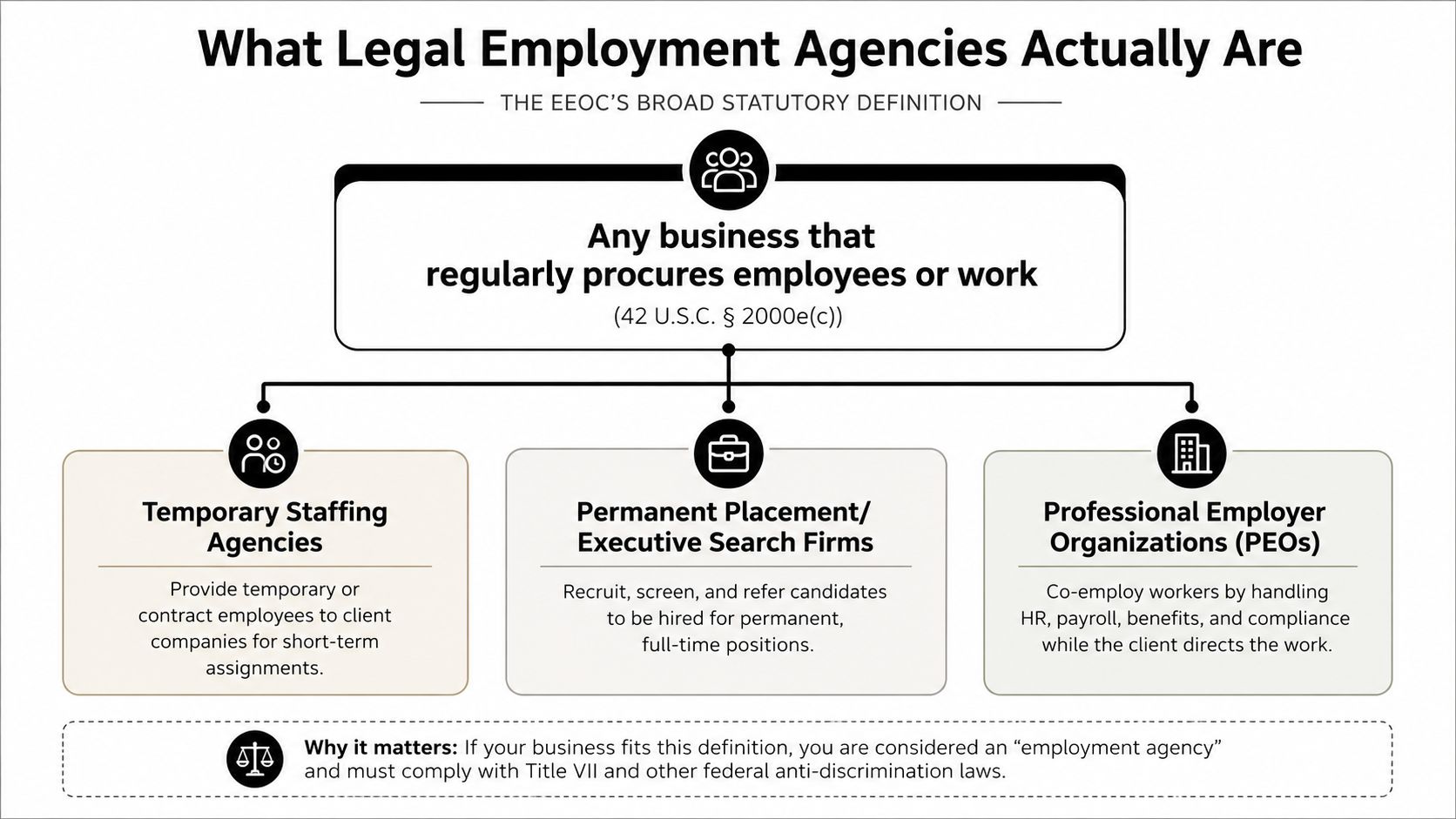
Temporary staffing agencies are for short bursts. If you need a paralegal for a three-week document review, this model makes sense because you're buying immediacy, not a long-term relationship. It's the right tool when the workload is obvious and temporary.
Contract staffing fits a longer project. Think six months of e-discovery support, where the firm needs continuity but doesn't want to add permanent headcount. The value is predictability without commitment to a full hire.
Retained search is for permanent, harder-to-fill roles. A senior compliance attorney or a niche practice leader is not a volume hire. You're paying for market research, outreach, and persistence, which is expensive but sometimes worth every cent.
Specialist paralegal staffing sits in the middle and, frankly, is where a lot of firms have been overpaying for old-school process. Curated remote talent pools work well when the need is recurring, the work is support-heavy, and timezone alignment matters more than office presence. If your practice keeps hiring the same kind of support role over and over, the traditional agency model starts to look like a very expensive habit.
The invoice tells the story. Traditional legal employment agencies are built around a search process. Curated on-demand platforms are built around screened supply that is already organized for faster deployment. Those are different businesses, even if both vendors sell the same promise of “talent.”
| Dimension | Traditional Agency | On-Demand Platform (e.g., HireParalegals) |
|---|---|---|
| Speed to shortlist | Often slower, especially for specialized support roles | Faster, with curated shortlists designed for immediate review |
| Vetting depth | Varies widely by recruiter and fee tier | Typically standardized around pre-vetted candidates |
| Remote fit | Can be uneven, because many agencies still think in office-based terms | Stronger fit for remote legal support and timezone alignment |
| Pricing transparency | Often opaque until the engagement is underway | Usually clearer upfront, especially for defined support roles |
| Best use case | Rare, senior, or highly specialized permanent searches | Repeatable support hiring, contract coverage, and scalable legal ops |
| Interview burden | Higher, because firms often do more filtering themselves | Lower, because the shortlist is more curated before it lands |
The advantage of the on-demand model is compression. You cut out a lot of back-and-forth, get a tighter shortlist, and spend less time interrogating candidates who never should have reached your calendar. That matters most in mid-volume paralegal hiring, where the traditional search process feels like running a depositions search through three separate systems.
A lot of firms still default to the old path because that is what they know. Fair enough. But if your team has to review every resume, chase every follow-up, and run screening anyway, the agency becomes just another gatekeeper. For a closer look at the model, see on-demand legal services.
The agency workflow looks tidy on paper. In practice, every bad intake call creates three bad candidates and one confused partner. If you want a clean hire, the first conversation has to cover the matter type, required credentials, supervision needs, start date, and the specific tasks the hire will own.
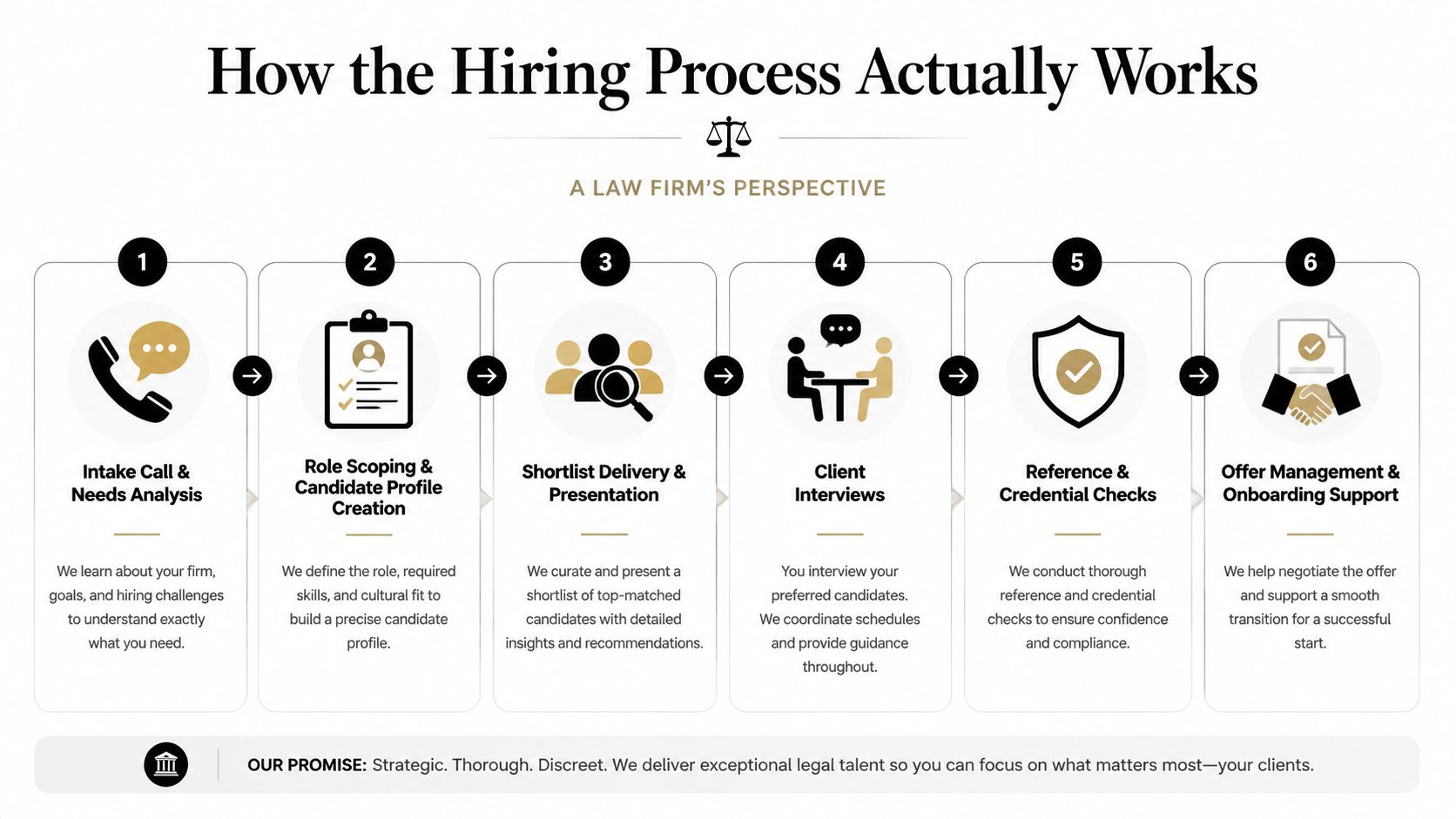
The loss usually happens between shortlist and interview. A vendor sends “qualified” candidates, but nobody clarifies which qualifications matter, so the firm spends a week rediscovering basic fit issues. Then there's the delay around references, credential checks, and offer management, where a vague recruiter suddenly becomes a very expensive email relay.
A decent agency should be able to explain what “screened” means without hand-waving. At minimum, that means role scoping, candidate presentation, and some actual verification before the first interview invite goes out. If the agency claims to do everything but can't tell you who checks what, you're the one doing the process management.
For a useful parallel on interview logistics in a different hiring context, patient care hiring with Talent Pronto shows how structured workflows can reduce candidate friction without making the process feel like a circus.
What good looks like: the firm owns final hiring judgment, but the agency should own the administrative drag that usually slows everything down.
The more rigorous vendors tend to work through a clear vetting sequence, sourcing, interviewing, background checking, and skills validation. That's the minimum standard to compare against. Anything less is just optimistic branding.
Paralegal pay is the easiest place to catch a vendor bluffing. The Bureau of Labor Statistics reported that paralegals and legal assistants earned a median hourly wage of $36.77 and a mean hourly wage of $38.37 in May 2023 (BLS wage data). That's the anchor. Everything else is markup, margin, or positioning.
If an agency adds a percentage markup on top of the wage, the cost climbs fast. On a six-month assignment, even a modest-looking spread turns into a meaningful monthly burn once you layer in recruiter margin, payroll handling, and administrative overhead. That's why firms need to ask for the full rate structure, not just the shiny headline.
Retained search is different. You're not buying hourly labor there, you're buying a search process and market access. That can be worth it for senior or hard-to-fill roles, but it's a bad fit for recurring support hiring because the economics are wrong from the start. Nobody should pay executive-search economics for a role that shows up every quarter like clockwork.
New York's rules are a useful sanity check because they make the fee structure less theatrical. The state requires agencies to be licensed, give the applicant a copy of the contract, and avoid charging just to register someone. It also caps fees by worker class, including 10% of first full month's wages for certain Class A workers, a one-week-wages rule for some Class A1 workers, and a sliding scale up to 60% of the first full month's wages for some Class B jobs (New York Attorney General employment agency guidance).
If a quote feels weirdly vague, it usually is. Ask what portion is recruiter fee, what portion is payroll handling, and what portion is just the vendor's appetite for margin.
That's the whole trick. Don't evaluate agency pricing by how polished the proposal looks. Evaluate it by whether the math survives a basic conversation.
Speed is the most overrated selling point in legal staffing. Silent exposure is the problem. A firm can recover from a slow shortlist. It's harder to recover from a contractor arrangement that should've been treated differently, or a candidate screened so lightly that a conflict or credential issue slips through.
First, misclassification. If someone is labeled a contractor but functions like an employee, the firm has a problem. That's not a semantic issue, it's a workflow issue, and the cost of getting it wrong lands on the firm's lap, not the recruiter's sales team.
Second, conflict and credential screening. For legal work, you can't just ask whether someone “has experience.” You need to know what they're allowed to do, where they're allowed to do it, and whether their background raises a supervision or ethical issue. That's where specialized scrutiny matters, especially for remote support and cross-border placements. If you want the doctrinal side of that problem, unauthorized practice of law is a useful reminder that jurisdiction and role boundaries aren't decorative.
Third, data security and confidentiality. Legal matters aren't generic files. They're client-sensitive, often messy, and sometimes time-critical. If an agency can't explain how it handles candidate data, matter information, and interview artifacts, it's asking you to trust vibes. That's not diligence, that's roulette.
The EEOC's current enforcement priorities also matter here. They explicitly highlight vulnerable workers such as immigrants and migrant workers, temporary workers, older workers, people with limited English proficiency, and people with arrest or conviction records, which should make any firm question how agency screening impacts access and placement fairness (Chartwell Law summary of the EEOC strategic enforcement plan). Agencies that recruit broadly can still screen in ways that exclude the very workers the law is trying to protect.
For a cautionary real-world reminder of how legal-title impersonation can spiral, woman posing as immigration attorney is worth a look. It's not the same thing as agency work, but it does underline the same point. Titles don't equal competence, and shortcuts around verification are how firms end up cleaning up someone else's mess.
Stop asking whether an agency “has great talent.” Of course they say that. Ask whether they can prove it, in writing, and whether their process survives contact with a real law firm workflow. The firms that stop bleeding time and money are the ones that make vendors answer uncomfortable questions before anyone signs a thing.
| Criterion | What to Ask | Pass/Fail |
|---|---|---|
| Licensing and legal status | Are you licensed where you operate, and how do you handle jurisdiction-specific requirements, including reciprocity where it matters? | Pass if they answer clearly, fail if they dodge |
| Vetting depth | What does screening include, exactly, and what gets checked before a candidate ever reaches my inbox? | Pass if they can name each step |
| Fee transparency | What's included in the fee, what is extra, and how do you price replacements or rush requests? | Pass if the pricing is itemized |
| Conflict screening | How do you check competitor conflicts and role restrictions, and at what stage do you do it? | Pass if they explain the process |
| Data security | How do you store candidate data, matter-tagged information, and interview artifacts during transitions? | Pass if they have a defined protocol |
| Replacement terms | What happens if the placement fails early, and how fast do you start over? | Pass if the answer is written, not improvised |
If you want a benchmark for structured verification, credential verification services are the kind of thing that should make a vendor conversation more concrete. The point is to force specifics. A vendor that can explain credential checks, conflict handling, and replacement terms is doing real work. A vendor that hides behind polished language is selling you hope with a markup.
Retained search is worth the premium when the role is senior, highly specialized, and hard to source. If you're hiring a partner-level rainmaker or a niche legal specialist, paying for deeper market research can be rational. Temporary staffing makes sense when the need is brief and specific, like coverage for a weekend deposition prep or a short document crunch.
For ongoing remote support, an on-demand platform is usually the smarter fit. That's especially true when your firm wants curated legal talent without paying for the overhead of a traditional search model. HireParalegals is one example in that category, with a curated network of pre-vetted legal professionals and remote support focused on law-firm workflows.
Walk away if the agency is vague about vetting, slippery on fees, or unwilling to show you a sample shortlist. That's not a negotiation problem. That's a signal problem. A vendor that can't explain how it checks credentials, conflicts, and fit probably isn't checking them carefully enough.
My blunt rule: if the agency sounds polished but can't make the process legible, keep your wallet in your pocket and move on.
The good firms make the process boring in the best possible way. The bad ones make you feel busy while they invoice you for confusion.
If your team is still comparing recruiters on charm instead of proof, stop doing that. Build a one-page scorecard, ask the hard questions, and test a vendor with a real role before you hand over a full search. If you want a faster way to evaluate remote legal support options, start by reviewing how your current vendor handles vetting, conflict screening, and shortlist quality, then compare it against a curated model that was built for US firms from day one.