 19 minutes read
Paralegal continuing education requirements don't form a single national rule. The counterintuitive part is that a paralegal can satisfy one credential's renewal standard and still have an unresolved obligation under a state registration, bar program, or employer policy. The compliance problem is usually not finding a course. It's proving that the right person completed the right subject, from an acceptable provider, during the correct cycle.
NALA's Certified Paralegal credential illustrates the issue. A CP must complete 50 hours of continuing legal education during each five-year recertification cycle, including legal ethics, while limits apply to non-substantive and technology credits (NALA's recertification rules). State models differ just as sharply. North Carolina uses an annual requirement, Wisconsin uses a reporting-period model, California uses a biennial certification framework, and Florida uses a three-year cycle (North Carolina's renewal requirements, California's paralegal MCLE statute, The Florida Bar's FRP program).
This guide treats paralegal CE as an auditable firm workflow, not a flat list of hours. You'll see how to map credentials, reconcile overlapping cycles, verify providers, preserve certificates, manage remote workers, and respond when a deadline or credential status is unclear.
Paralegal continuing education becomes a compliance issue when a firm tracks hours without tracking the obligations behind them. A usable program answers five questions: Which rule applies, what subjects qualify, who approved the activity, when does the cycle close, and where is the evidence?
Those answers may come from separate sources. A state can impose registration or reporting duties. A state bar can set education requirements for paralegals working under attorney supervision. A national association can administer a voluntary credential with its own ethics standards and renewal dates. The firm may also require training on confidentiality, litigation support, document management, or practice-specific risk.
A spreadsheet with an employee's name and total credits does not prove compliance when subject limits apply. Under NALA's CP recertification process, a Certified Paralegal must complete 50 CLE hours every five years, including at least 5 hours in legal ethics. The rules also limit 10 hours in non-substantive subjects and 3 hours in technology credits. A total-hours column cannot show whether the paralegal exceeded a cap or missed an ethics minimum.
The record becomes harder to defend when a paralegal changes location, supports clients in multiple states, or holds both a state registration and a national credential. A course may be useful and still fail a particular provider, subject, or reporting rule. Firms need a credential inventory that identifies each obligation, authority, cycle, subject requirement, provider standard, and renewal evidence.

Practical rule: Treat every credential and registration as a separate compliance obligation until the issuing authority confirms that credits may be shared.
Assign one program owner, such as a practice manager, HR lead, or compliance administrator. That owner maintains the inventory, calendar, certificates, provider records, and submission history. The supervising attorney confirms that the paralegal's work and training remain within the applicable professional framework.
The owner should be able to assemble an audit packet without reconstructing the record before a deadline. It should contain the governing rule, cycle dates, certificates, subject classifications, provider information, renewal submission, and any supervisor attestation.
Requirements can change, and internal checklists can become outdated. Confirm current obligations with the relevant authority or qualified counsel before relying on a prior cycle's records. That discipline turns CE from an after-the-fact training log into an auditable firm workflow.
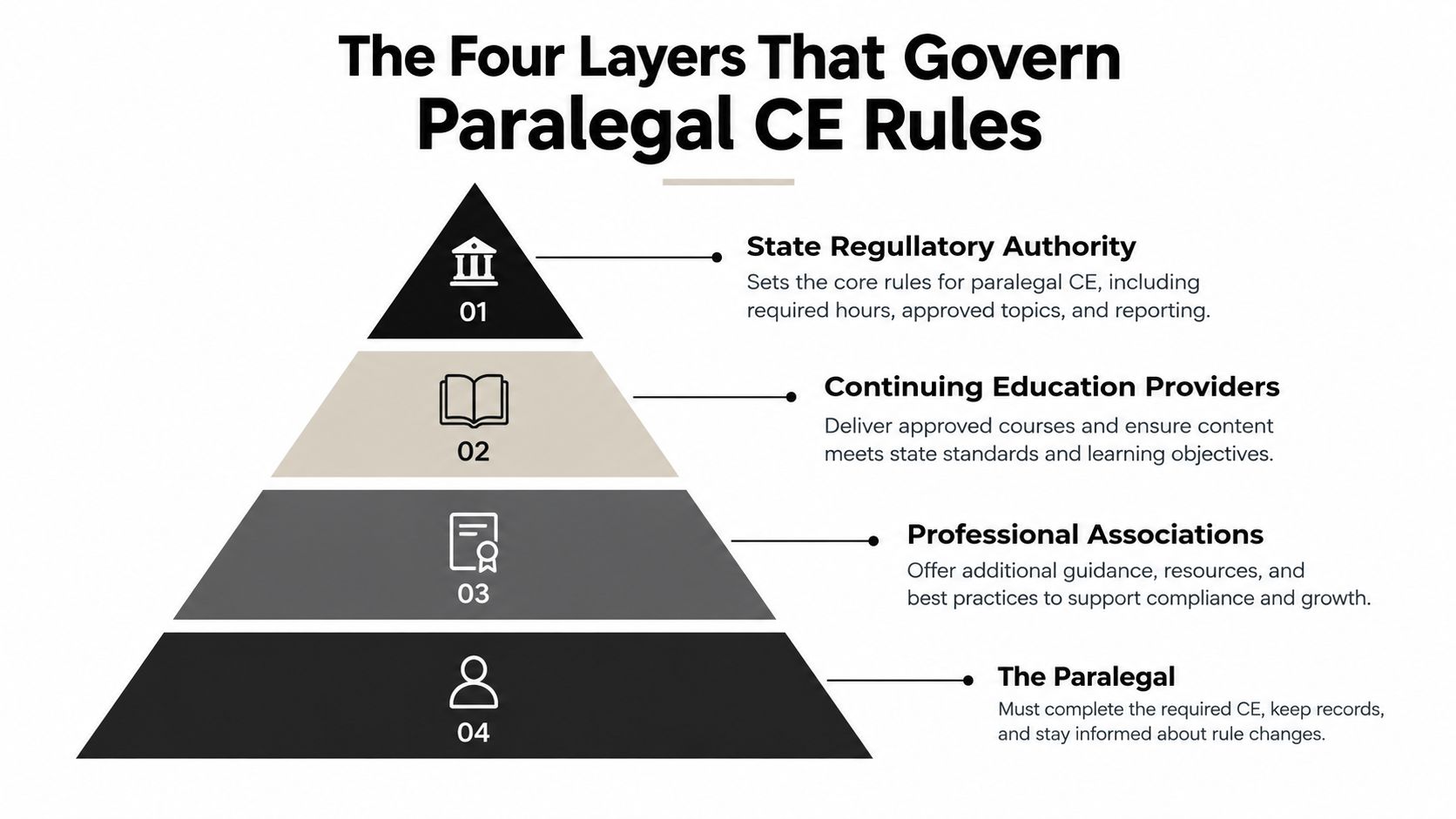
Paralegal CE obligations come from four separate layers. Firms should map each one before deciding whether a course satisfies a renewal requirement.
State registration or statutory rules. A state may regulate paralegal education, registration, or supervised work directly. California, for example, requires a paralegal to certify 8 hours of MCLE every two years, divided between legal ethics and general or specialized law, under the framework described in California Business and Professions Code Section 6450.
State bar requirements. A bar may administer a paralegal certification or education program, define acceptable providers, or require reporting through a particular portal. North Carolina requires 6 hours of continuing paralegal education each year, including 1 hour in ethics or professional responsibility, according to its North Carolina Bar renewal requirements.
Voluntary national credentials. NALA and NFPA apply their own credentialing standards. NALA's CP cycle remains separate from a state registration. NFPA credential holders must complete 8 CLE credits every two years, including at least 2 credits in ethics and/or DEI topics, according to the credentialing framework summarized in NALA's continuing legal education overview.
Employer policy. A firm may require training beyond an external minimum. Topics can include confidentiality, cybersecurity, legal technology, records handling, immigration, or litigation. Internal training can support competence without qualifying for a state or national credential.
The practical disputes usually concern ethics minimums, cycle boundaries, and provider approval. A technology course may improve a paralegal's work while counting only partially, or not at all, toward a credential. A state ethics course may also fall outside the national credential's reporting cycle.
Create a separate obligation record for each layer. Record its authority, cycle, subject rules, provider standard, deadline, and required evidence. Add a reconciliation note when one course may satisfy more than one obligation, and retain the basis for that decision.
Shared content does not guarantee shared credit. Separate records make overlapping credentials and multistate work auditable without treating the firm's training policy as a substitute for an external rule.
A useful comparison separates documented requirements from items that require confirmation. The table below preserves that distinction and identifies the rule that firms should verify before assigning credit.
| State or Body | CE Required? | Credit Hours | Cycle Length | Ethics Minimum | Approved Provider Rule |
|---|---|---|---|---|---|
| California paralegal MCLE framework | Yes, for the covered framework | 8 | 2 years | 4 | Courses must satisfy State Bar course-quality requirements |
| Florida Registered Paralegal | Yes | 30 | 3 years | 5 | Credit may come from The Florida Bar, NALA, or NFPA-approved programs |
| North Carolina certified paralegal | Yes | 6 | Annual | 1 | Confirm current North Carolina approval requirements |
| Wisconsin | Yes | 15 | Reporting period | 3 | Confirm current Wisconsin approval requirements |
| NALA Certified Paralegal | Yes | 50 | 5 years | 5 | Track NALA-recognized or otherwise acceptable activities under NALA rules |
| NFPA credential holders | Yes | 8 | 2 years | 2 in ethics and/or DEI | Confirm NFPA's current credit and provider rules |
| Texas | Confirm with the State Bar of Texas Paralegal Division | Not established in the verified data | Confirm the applicable cycle | Confirm subject requirements | Check whether the activity and provider meet the credential or local rule |
| New York | Confirm with the applicable New York authority | Not established in the verified data | Confirm the applicable cycle | Confirm subject requirements | Check the authority's current approval standard |
| Illinois | Confirm with the applicable Illinois authority | Not established in the verified data | Confirm the applicable cycle | Confirm subject requirements | Check the authority's current approval standard |
| Ohio | Confirm with the applicable Ohio authority | Not established in the verified data | Confirm the applicable cycle | Confirm subject requirements | Check the authority's current approval standard |
| Washington | Confirm with the applicable Washington authority | Not established in the verified data | Confirm the applicable cycle | Confirm subject requirements | Check the authority's current approval standard |
| NALS | Credential-specific rules require confirmation | Confirm directly | Confirm directly | Confirm directly | Check NALS requirements for the specific credential |
| AAPI | Credential-specific rules require confirmation | Confirm directly | Confirm directly | Confirm directly | Check AAPI requirements for the specific credential |
Florida illustrates why firms should track subject categories instead of relying on a single total. A Florida Registered Paralegal must complete 30 hours every three years, including 5 hours in ethics or professionalism and 3 hours in technology, under The Florida Bar's FRP program. The program recognizes sources such as The Florida Bar, NALA, and NFPA-approved programs, but a firm should still retain the activity description and confirm that the course fits the intended category.
NALA uses a different structure. A Certified Paralegal must complete 50 hours across a five-year cycle, with an average of 10 CLE hours per year, while still meeting the subject-mix requirements described in NALA's CP certification information. A firm that records only annual totals can miss an ethics or other category requirement.
The operational risk appears when one paralegal holds overlapping credentials. Florida's three-year cycle, NALA's five-year cycle, and the separate requirements associated with Wisconsin, North Carolina, and California should remain separate obligation records. One course may support more than one record, but the firm should document why it qualifies under each rule.
State status also matters. A table entry requiring confirmation is not evidence that no mandate exists. Assign an owner to verify the rule with the relevant authority, record the date and result, and update the obligation record when the authority changes its guidance.
For background on how certification requirements can affect hiring and credential decisions, firms can consult this guide to paralegal certification requirements. Use it for orientation, then rely on the issuing authority for the current requirement.
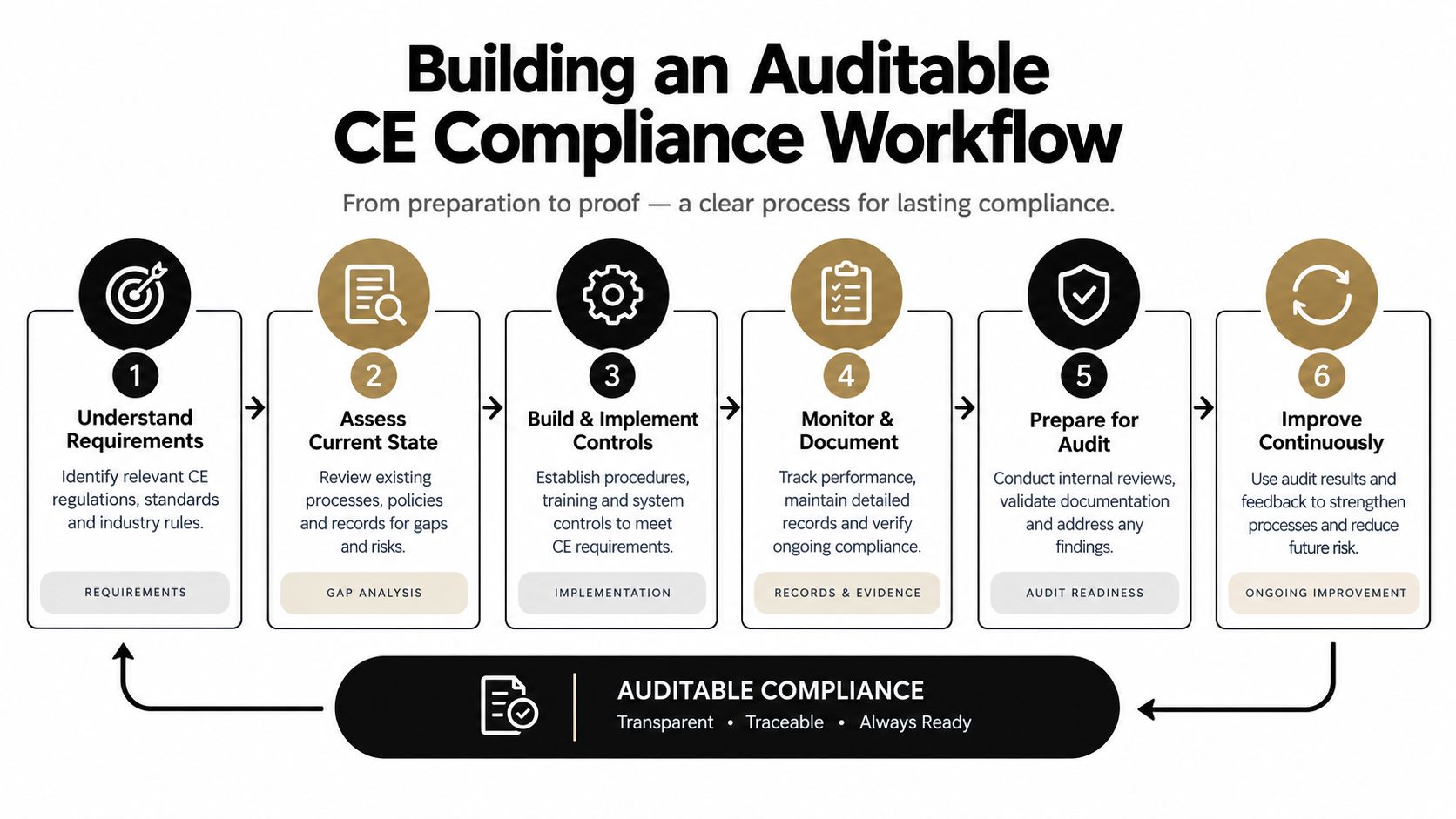
A workable process begins with the employee, not the course catalog. Build one row for every active registration and credential, then record the governing authority, cycle start, cycle end, required subjects, credit limits, provider rule, renewal method, and evidence location.
Inventory the obligations. Record every credential, state registration, and employer requirement. Don't combine a Florida registration and a NALA CP into one line.
Classify the credit rules. Identify ethics minimums, technology limits, non-substantive caps, self-study restrictions, and provider requirements. If the rule is unclear, mark it as pending confirmation rather than guessing.
Pre-screen the activity. Before enrollment, confirm the sponsor, accreditation or approval status, activity code, subject category, attendance method, and certificate format. Save the course description with the approval evidence.
Capture completion data. The certificate should show the participant, activity, provider, completion date, credit amount, and subject designation. Add the cycle and jurisdiction in the firm's internal record.
Review gaps on a recurring schedule. A quarterly review is more useful than a year-end scramble. Use reminders at 90, 60, and 30 days before a cycle end, but confirm that the issuing body permits completion through the deadline.
Assemble the audit file. Store certificates, attendance logs, provider information, invoices, renewal submissions, and supervisor attestations together. A versioned folder or learning management system is preferable to an employee's personal inbox.
Firms that already manage document review can adapt fast content approval workflow templates to course approval. The useful principle is separation of duties: one person selects the activity, another verifies the rule, and the employee submits completion evidence.
For firms with multiple offices or remote employees, an audit trail management workflow can help standardize naming, access, review dates, and retention. The tool matters less than the control. Every record should answer who approved the course, what obligation it addressed, and where the supporting evidence is stored.
A paralegal working across state lines may be subject to more than the rules of the firm's headquarters state. Review the worker's physical location, the firm and client locations, the matter's governing state, the credential issuer, the work performed, and the supervising attorney's duties.
Remote arrangements create separate compliance questions because those locations may not match. Document the analysis before assigning credential-sensitive work. Reassess it after a relocation, a change in practice group, or a new state registration.
| Scenario | NALA CP or related NALA credential | NFPA credential | State registration |
|---|---|---|---|
| Paralegal moves to another state | The existing NALA cycle generally remains a separate obligation. Confirm current NALA rules | Review the existing NFPA cycle with NFPA | New state obligations may apply. Do not assume automatic transfer |
| Paralegal works remotely for an out-of-state firm | Analyze the credential and work location separately | Confirm whether the activity and reporting location affect compliance | Determine which state's registration or reporting rules apply |
| Paralegal holds a national credential and state registration | Track both cycles independently unless written authority permits shared credit | Track NFPA requirements independently | Keep state records separate |
| Course is approved in one jurisdiction | Approval does not establish acceptance elsewhere | Verify NFPA acceptance independently | Verify the receiving state's provider and subject requirements |
| Credential or registration has lapsed | Treat the status as inactive until the issuer confirms reactivation | Follow the issuing body's reinstatement process | Contact the relevant state authority before assigning sensitive work |
The comparison between national and state credentials shows why one calendar is risky. NALA's CP requires 50 hours in five years, while Florida's Registered Paralegal framework requires 30 hours in three years, with separate ethics and technology requirements (NALA's recertification process, Florida's FRP rules). A single course may support both programs, but the firm should not apply the credit to both records until each authority's rules have been checked.
Keep the decision in a short jurisdiction memo for unusual arrangements. Record the paralegal's location, the firm and client locations, the active credential or registration, the planned work, and the authority that confirmed the treatment. Store the memo with the credential records so a reviewer can reconstruct the decision without relying on informal emails.
Credential verification belongs in onboarding, alongside employment authorization, references, system access, and confidentiality controls. Ask the candidate for the credential number and issuing body, then verify status through the issuer rather than relying on a résumé or scanned certificate.
Create a credential map before the new hire receives matter access. It should list:
The supervising attorney should review whether the person's assignments match the role and applicable supervision requirements. CE completion doesn't authorize a paralegal to provide legal advice, make independent legal decisions, or perform work reserved to licensed professionals.
For a remote paralegal, document the worker's physical location and the states connected to the firm's matters. Reassess the analysis when the person relocates or begins supporting a new practice group. A remote staffing platform such as HireParalegals may be one sourcing option for firms seeking remote legal support, but the hiring firm still owns credential verification, supervision, and recordkeeping.
Use a recurring manager review rather than waiting for renewal season. The compliance documentation process should make it easy to see missing certificates, unresolved provider questions, and approaching cycle ends without opening every employee file.
The immediate outcome of missed education may be administrative. Depending on the governing program, a credential or registration can become inactive, a renewal can be delayed or denied, remedial education can be required, or additional documentation may be requested. The exact response depends on the authority and the nature of the lapse.
The professional consequences can be broader. A firm may need to explain why a paralegal represented a credential as current, why a supervisor failed to monitor the status, or why records cannot establish compliance. If the underlying work raises supervision or unauthorized-practice concerns, the issue can move beyond a renewal file.
| Violation Type | Paralegal Consequence | Attorney or Firm Consequence | Severity |
|---|---|---|---|
| Missing certificate | Difficulty proving credit | Rework and audit exposure | Administrative |
| Incorrect subject classification | Credit may not satisfy the rule | Renewal gap and corrective review | Moderate |
| Missed cycle deadline | Inactive, delayed, or denied renewal depending on the authority | Matter reassignment and compliance escalation | Moderate to serious |
| Misrepresented credential status | Loss of professional credibility and possible credential action | Supervisory and reputational exposure | Serious |
| Work performed during an unresolved lapse | Possible restriction or remedial process | Review of files, supervision, and client communication | Case-dependent |
| Repeated failures | Escalation by the issuing authority | Possible referral or disciplinary scrutiny | Serious |
A firm shouldn't assume that a missing record proves the course wasn't completed, but it also shouldn't treat an undocumented claim as settled compliance. The first response should be to preserve records, contact the issuing authority, pause unsupported representations, and obtain qualified advice where client work or attorney discipline could be implicated.
For a general discussion of the operational impact of missing continuing education requirements, PIA Southern Alliance offers useful background. Its discussion shouldn't replace the governing credential or state rule.
A calendar should track actions, not just deadlines. The minimum viable system is a central register, a named owner, a recurring review, and a document location that survives employee turnover.
Avoid a calendar that places every renewal task in the same month. Set an internal completion target before the external deadline and keep redundant copies of certificates. Providers can change platforms or access rules, and an employee's account shouldn't be the only place where proof exists.
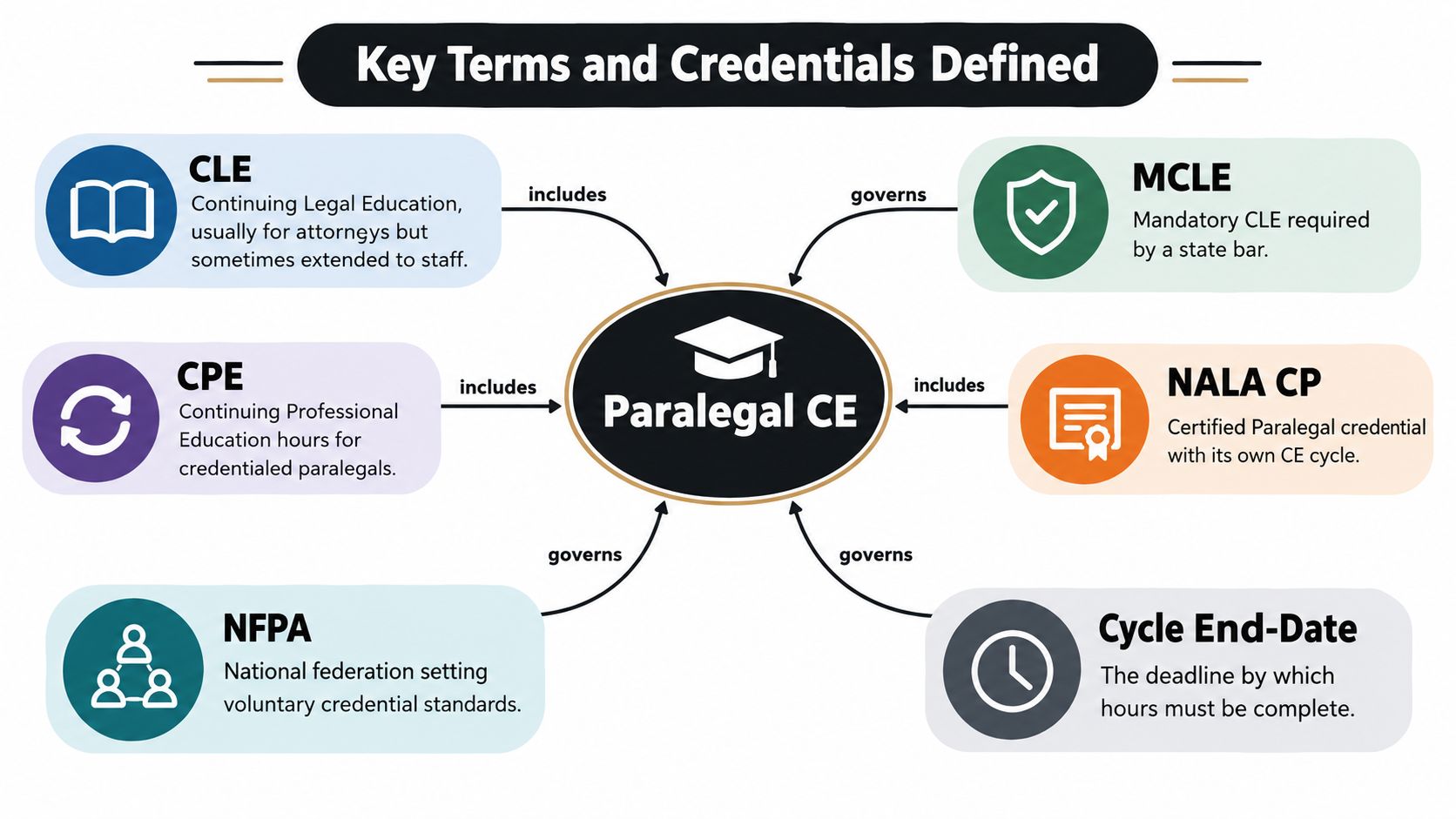
CLE usually means continuing legal education. MCLE refers to mandatory continuing legal education imposed by a state or other authority. CPE can mean continuing professional education tied to a credential. The acronym does not determine whether a course qualifies. The governing organization, subject category, provider status, and reporting rules do.
CP, or Certified Paralegal, is NALA's credential. Its renewal requirements should be checked against current NALA certification information rather than copied into a firm policy from memory. RP, CRP, and other national designations also require verification with the organization that issued them. NFPA's credential terms and current requirements should be confirmed directly with NFPA.
State programs use different labels and legal structures. Florida's FRP, or Florida Registered Paralegal, follows its own education framework. California's covered paralegal framework uses MCLE requirements and places certification responsibilities within a statutory structure. A title that sounds similar may therefore carry different duties, renewal dates, and proof requirements.
The working distinctions are:
For clean administration, tag credits by credential and category in the LMS. For example, separate NALA-CP-ETH from NALA-CP-TECH so ethics minimums and technology caps are calculated per cycle, while state credits remain mapped to the applicable jurisdiction.
Usually, you should treat the answer as no until confirmed. A course approved by one state, NALA, or NFPA may not satisfy another authority's ethics, technology, subject, or provider rule. Keep the course certificate, approval information, and written confirmation when the rules are ambiguous.
First, stop describing the credential as active. Check the issuer's reinstatement or reactivation process, determine whether remedial education or a new application is required, and document the date of every communication. Until the authority confirms status, assign work under the firm's ordinary supervision and role controls rather than relying on the lapsed designation.
Potentially, depending on the governing rule and the facts. A supervisor may need to explain the firm's verification, delegation, and monitoring process, particularly if the paralegal performed work outside the authorized scope or the firm represented that an inactive credential was current. The firm should obtain qualified professional advice if a lapse intersects with client harm, an ethics complaint, or a regulatory inquiry.
It can. Physical location, firm location, client location, matter location, and the type of work may all affect the analysis. A remote employee who moves should trigger a new jurisdiction review, not merely an address update in payroll records.
Possibly, but the firm shouldn't assume that an overseas provider or online course qualifies. Confirm whether the relevant authority recognizes the provider, format, subject, and documentation. A course can be valuable internal training even when it doesn't count toward an external credential.
Sometimes, but only after checking both sets of rules. NALA's subject caps and Florida's specific ethics and technology requirements illustrate why a shared course must be classified separately for each record.
Paralegal continuing education requirements are a layered compliance program, not a uniform national standard. State registration, state bar rules, national credentials, and firm policy can each impose different cycles, subject requirements, provider rules, and evidence expectations.
The most common operational failures are missed cycle boundaries, incomplete certificates, unverified providers, and unexamined overlaps between credentials. A firm can reduce those risks with a central credential matrix, a named owner, calendar alerts, supervisor review, and an audit packet for every active obligation.
Pick one paralegal this week. Verify every active credential and registration, record the next cycle end date, reconcile completed hours by subject, and store the supporting documents in a shared compliance location. Build the workflow before the next deadline arrives, then apply it consistently across the rest of the team.
Ask your firm's compliance owner to complete a credential audit for one paralegal this week. If the records reveal a gap or a multi-jurisdiction question, confirm the applicable rule with the issuing authority or qualified counsel before assigning work or submitting renewal materials.