 13 minutes read
Philadelphia has 9,320 paralegal and legal assistant jobs and a mean annual wage of $71,110. That's a real market, not a resume graveyard, and if you're hiring or job hunting here, you need to treat it that way.
The surprising part is that Philadelphia isn't just big. It's concentrated, competitive, and annoyingly good at rewarding people who already know how the legal machine runs. The metro's employment concentration of 3.29 jobs per thousand and 1.41 location quotient tell the story, and the pay sits about $4,650 above the national average in the 2023 BLS data (BLS Philadelphia metro occupational data). That combination changes the hiring game. Firms aren't fishing in a shallow pond, they're competing in a dense legal-services hub where experienced support staff have options.
Philadelphia is one of those markets where the numbers tell you to stop winging it. The metro has 9,320 paralegal and legal assistant jobs, and the $71,110 mean annual wage puts the area above the national average by about $4,650 per year in the 2023 BLS data (BLS Philadelphia metro occupational data). If you're a firm, that's not trivia. It's a warning label.
The 1.41 location quotient matters just as much as the wage. It says Philadelphia has a stronger-than-average concentration of paralegal work, which means more firms, more competition, and less patience for sloppy hiring. You're not the only buyer at the table, and the table is crowded.

Corporate legal departments, government offices, and mid-size practices all pull from the same local talent pool. That's why generic postings underperform. If your listing reads like it was copied from somewhere in 2014, the strongest candidates will scroll right past it and keep moving.

Practical rule: in Philadelphia, paying “market” means more than matching a vague national benchmark. It means understanding that local candidates compare offers against dense, specialized employers, not just other firms down the block.
The takeaway is simple. Philadelphia paralegal hiring rewards specificity. A firm that knows what it needs, what it pays, and what kind of work it offers will do better than one that posts a generic ad and hopes for the best. Toot, toot, that's not novel advice, but it's still where most hiring goes sideways.
The fastest way to get mediocre applicants is to use the same three job boards as everybody else and act shocked when the pile is thin. Better candidates in Philadelphia usually come from places that filter for legal seriousness before they ever apply. That means local legal associations, school networks, targeted LinkedIn outreach, and specialized placement channels.
Local paralegal and bar association boards tend to produce applicants who already understand the work. Penn Law career services and other university pipelines are useful when you want candidates with fresh training and local ties. LinkedIn works when you search with intent, not when you spray and pray. The difference is obvious in the first ten resumes.
For firms that need speed, legal staffing agencies can be useful, but only if they understand the practice area. A litigation-heavy shop in Center City and a corporate team in King of Prussia are not hiring for the same temperament, even if both use the word “paralegal” on the posting.
If you want a broader directory of where firms tend to post, the roundup at paralegal job websites is useful as a starting point. Just don't confuse “more channels” with “better channels.” More noise isn't strategy.
Firm-side truth: the best applicants often aren't actively scrolling job boards. They're already employed, already competent, and only open to a move if the role looks specific enough to be worth the hassle.
So yes, mix the channels. But lead with the ones that produce people who've already spent time around legal work. The rest is just expensive hoping.
Philadelphia hiring managers don't need another polished wall of adjectives. They want proof that you've worked in the legal mess, the kind with court deadlines, document churn, and clients who think “urgent” is a personality trait. Specific practice-area experience beats general enthusiasm almost every time.
A strong resume here says what you handled, not what you “supported.” If you've worked litigation, say so. If you've dealt with real filing systems, discovery, calendar management, intake, or docket-heavy work, put that near the top. Recruiters and partners skim fast, and they're looking for signs that you won't need six weeks of hand-holding.
Philadelphia-specific experience helps because it signals context, not just geography. Mentioning familiarity with the Commonwealth Court or Philadelphia Courts tells a reviewer you know local process isn't abstract. The same goes for software stacks. If you've used the tools a firm relies on, say it plainly instead of burying the detail in a paragraph no one will read.
A lot of strong candidates sabotage themselves by letting LinkedIn look like a ghost town. That's a mistake. Recruiters search for local legal support by title, location, and practice area, and a sparse profile can make a solid candidate disappear.
Here's the clean version:
If you want a sharper checklist of role expectations, the page on requirements for paralegal jobs is worth a look. The point isn't to decorate the profile. It's to make it obvious you can handle the work without a long orientation package.
Don't make the reviewer guess. If they have to decode your resume, they'll move on to somebody easier.
Remote-work competence belongs here too, but keep it concrete. Mention how you handle deadlines, communication, and document flow in hybrid setups. “Self-starter” doesn't impress anyone. Reliable output does.
Cold applications are fine if you enjoy watching half-baked resumes drift into your inbox like confetti. Local networking works better because it reaches people through trusted circles, and in Philadelphia, legal circles are still very real. That's where the paralegal market gets practical.
The Philadelphia Bar Association paralegal events are useful because attendees are already oriented toward legal work, not random career browsing. The Pennsylvania Bar Association paralegal resources also matter, especially if you want a wider statewide reach without pretending geography doesn't exist. Local paralegal chapter meetings are often where the quieter, highly competent candidates show up, the ones who aren't blasting for attention online.
Alumni networks can punch above their weight, especially from programs like Saint Joseph University and Temple University. Those circles work because they're relational, not transactional. If you only show up when you need a hire, people notice. Human beings are weirdly good at that.
A decent introduction beats a flashy pitch. Try a message that sounds like a real person wrote it.
Virtual and hybrid networking are part of the current environment now, and local legal tech meetups are worth watching because paralegals increasingly end up there too. That's not glamorous, but it's effective. Talent hides in places where work gets discussed.
The best networking move is still simple. Be known before you need help. That's the unsexy answer, and it works.
A lot of interviews in law firms are basically vibes with coffee. Someone seems sharp, someone seems polished, and everybody hopes the paper trail will sort itself out later. It usually doesn't. You want a structure that shows whether the candidate can survive real caseload pressure.
Start with scenario questions tied to actual tasks. If the role is litigation-heavy, ask how the candidate would manage document review when deadlines collide with scheduling. If the role touches corporate work, ask how they'd organize diligence materials and flag gaps without waiting to be rescued. Client intake, compliance research, and discovery support are all fair game.
The point is to watch how they think under operational pressure. A good candidate doesn't just know the task, they know the sequence, the communication chain, and the failure points. That's what separates someone who's useful from someone who looks useful in a clean interview room.
Direct advice: don't overvalue charm. A candidate who answers cleanly and asks smart questions is usually safer than the one who dazzles for twelve minutes and then falls apart under actual workload.
If you're open to hybrid or remote arrangements, test for practical readiness. Ask about communication habits, file organization, response times, and the candidate's setup. A remote paralegal who can't stay organized isn't a remote paralegal, they're just a future headache with Wi-Fi.
Panel interviews also help when the role spans multiple practice areas. Different lawyers spot different weaknesses. One person notices precision, another notices pace, and the panel gets a better read than a single interviewer trying to be a hero. Nobody needs that kind of heroics.
Salary is where firms reveal whether they understand the market or are just hoping candidates won't notice the gap. Philadelphia paralegals compare pay against local options, and they do it fast. If your offer sits below what the market supports, silence follows.
Local compensation data points to a clear pattern. The Philadelphia-Camden-Wilmington metro mean annual wage is $71,110 in May 2023, while the national mean for the occupation was $66,460 (BLS Philadelphia metro occupational data). The occupation is also projected to show little or no change from 2024 to 2034, with about 39,300 openings each year on average over the decade (BLS occupational outlook). That combination means firms cannot treat compensation as an afterthought. They have to pay attention to the full package.
| Experience Level | Typical Salary Range | High-Demand Practice Areas |
|---|---|---|
| Entry-level | Lower end of local market | Litigation support, intake, calendar management |
| Mid-level | Mid-range local pay | Civil litigation, corporate support, discovery management |
| Experienced | Upper local market | Specialized litigation, complex corporate work, government-related work |
Local salary trackers show the same direction. Indeed reports an average of $65,443 per year from 129 salaries in Philadelphia, while ZipRecruiter reports an average of $60,273 per year and says most salaries fall roughly between $48,400 and $69,100 (Indeed Philadelphia salary data) (ZipRecruiter Philadelphia salary data). ZipRecruiter also shows top earners around $80,726 annually, and other local trackers reach into the mid-$90,000s or higher.
That spread matters. Experience and specialization matter a lot. A candidate who can handle complex litigation, corporate support, or other specialized work is not competing in the same pay band as someone doing basic support tasks. Firms that want immediate contribution have to price for it.
Some hiring problems force a simple choice. Keep waiting on the usual cycle of posting, screening, interviewing, and hoping the right person sticks, or bring in vetted remote support and keep the work moving. If the caseload is climbing and your local search is stalling, remote help is the practical answer.
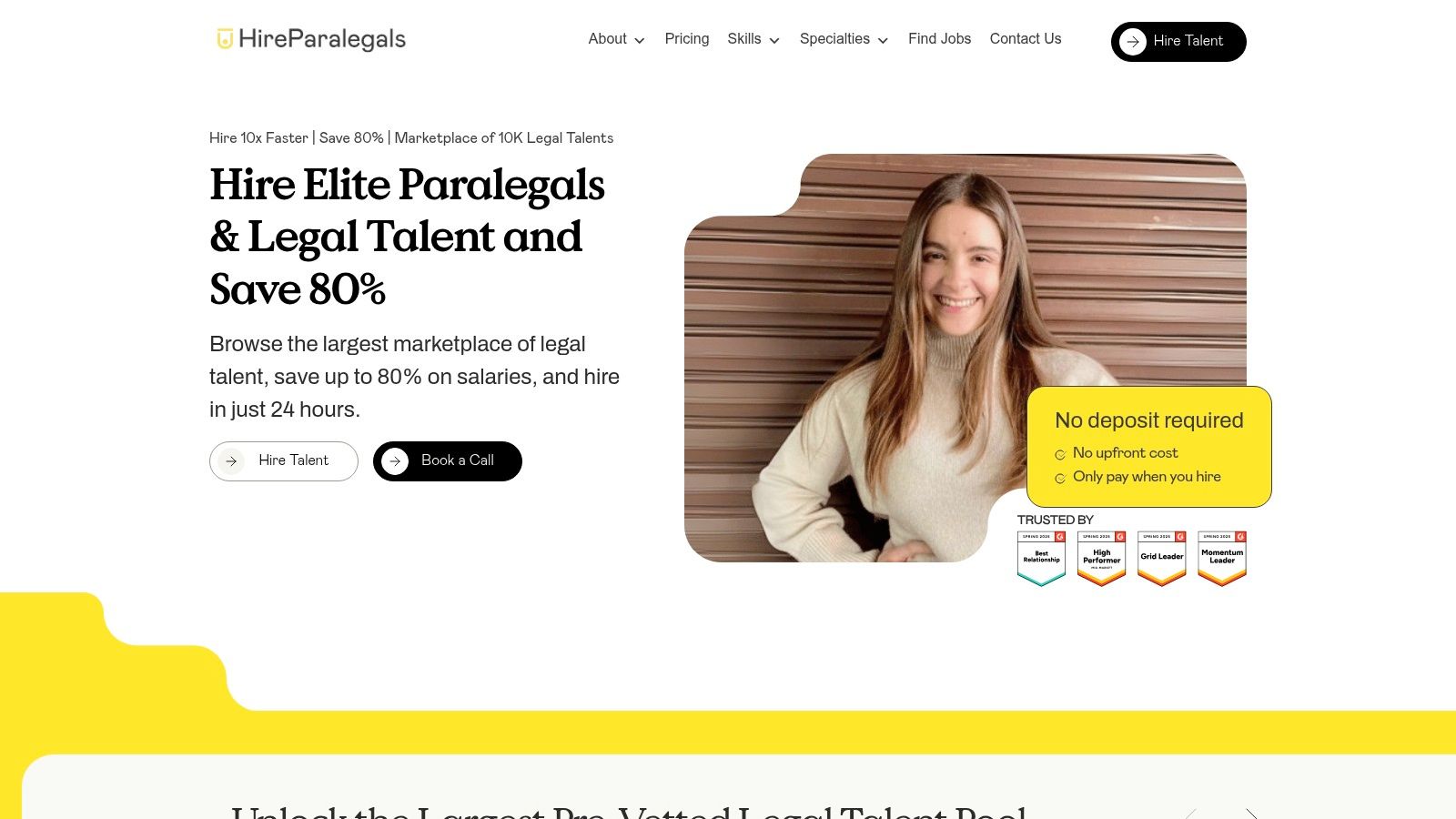
A vetted remote paralegal model fits firms that need qualified help quickly, want flexibility, or cannot afford a long local search. It also fits work that is document-heavy, deadline-driven, and not tied to daily file handling in the office. That covers a lot of what Philadelphia firms are paying for.
Virtual paralegal employment makes the most sense when the work is execution-heavy and the firm needs help without adding more friction to the hiring process. HireParalegals is one example of that model. It is a specialized on-demand talent platform for US law firms, with a curated network of over 10,000 pre-vetted paralegals, legal assistants, junior attorneys and other legal professionals, and it says its process includes sourcing, interviewing, background checking, and skills validation. The platform also says firms can hire in 24 hours, and that payroll management and compliance guidance are available for Latin American hires. That is a real option for firms that need coverage now.
Traditional hiring gives you in-person presence and a fuller read on office fit. Remote hiring gives you speed, flexibility, and less strain on your internal team. If your pipeline is thin, your deadline is real, and your partners are already feeling the overload, waiting another month for a perfect local candidate is a bad trade.
Use a simple rule.
If the work is backing up and your interviews keep producing polite no's, stop treating that as a mystery. It is a signal to change the channel.
The cleanest approach is often hybrid. Keep the local search open, especially for roles that benefit from Philadelphia-specific familiarity, but do not let pride slow down the work. A remote paralegal can give you breathing room while you keep looking for the right permanent fit.
The firms that handle this well do not cling to one hiring ideology. They hire for the problem in front of them. That is the whole game.