
 17 minutes read
A U.S. law firm hires a paralegal in Mexico to support discovery, draft routine documents, and communicate with clients during overlapping business hours. The legal work may be straightforward, but the employment administration isn't. You must determine who employs the worker, how local deductions and contributions are handled, what currency the worker receives, which records the firm must retain, and whether the arrangement creates obligations in more than one jurisdiction.
That's why payroll management services for international legal teams should be treated as a risk-control function, not merely a way to send monthly payments. A capable provider can coordinate contracts, payroll calculations, statutory obligations, currency conversion, reporting, and worker records. A domestic payroll platform or spreadsheet usually can't handle those responsibilities reliably across Latin American jurisdictions.
This guide explains how international payroll works, when outsourcing makes sense, where classification and labor compliance create exposure, and how a firm can evaluate the operational trade-offs. The recommendations apply to solo attorneys, small practices, growing firms, and corporate legal departments hiring remote paralegals, legal assistants, and other non-licensed support professionals.
A U.S. firm can hire a Latin American paralegal for document organization, intake, scheduling, supervised legal research, or client updates that do not require legal judgment. Overlapping time zones and capable support staff make the arrangement attractive. The operational risk appears when the firm must decide how to document the relationship, calculate pay, handle local obligations, and maintain defensible records.
Domestic hiring procedures rarely transfer cleanly across borders. A U.S. payroll system may calculate U.S. wages and deductions, but it will not automatically determine whether a worker in Mexico, Colombia, or Argentina belongs in an employee, contractor, or another locally recognized category. It may also fail to manage social contributions, required leave payments, termination obligations, or currency settlement under local rules.
Define the relationship before choosing a payment method. Record the worker's duties, reporting line, schedule, supervision, access to firm systems, work location, compensation terms, and expected duration. These details matter because a paralegal who works set hours, follows firm procedures, uses firm tools, and receives detailed instructions may operate like an employee even when the contract says “contractor.”
For U.S. classification, the IRS looks at the working relationship rather than the contract label alone, as explained in the IRS worker classification guidance. The detailed classification analysis belongs in the compliance section. Local law may apply a separate test, so a U.S. classification does not settle the worker's status in Latin America.
The firm must then select an operating model. It can hire through a local entity, engage a properly structured contractor, use an employer-of-record arrangement, or appoint a provider that combines recruitment support with payroll administration. Each option assigns responsibility differently. A lower initial cost can become a larger liability if the firm later corrects filings, changes the relationship, or responds to a labor dispute.

Practical rule: Decide who owns classification, local registrations, statutory payments, payroll records, and worker support before the candidate starts.
Spreadsheets can record hours and payment dates, but they do not interpret changing labor rules or create a reliable audit trail on their own. Manual processes also increase the chance of using the wrong currency, missing a recurring deduction, overlooking a change in work location, or approving payment before the underlying records are complete.
The broader payroll market reflects this operational pressure. One 2026 estimate values the global payroll services market at USD 35.32 billion, compared with USD 32.6 billion in 2025, and projects USD 52.75 billion by 2031 at an 8.35% CAGR, according to Mordor Intelligence's global payroll services market analysis. A separate estimate places payroll and compensation management at USD 30.39 billion in 2026, rising to USD 39.72 billion by 2031 at a 5.5% CAGR. The estimates use different market definitions, but both indicate continued investment in technology-supported payroll administration.
For a law firm, the point is practical. Payroll is no longer just paycheck distribution. It connects hiring structure, compliance ownership, worker experience, financial controls, and the firm's ability to add Latin American staff without accumulating administrative debt. Select a service provider based on its handling of local requirements, clear allocation of responsibility, and recordkeeping process, not on payment speed alone.
International payroll management starts with verified worker information and ends with records that show what was calculated, approved, paid, and reported. A professional service may provide the technology, local payroll expertise, employer-of-record structure, or a combination of those functions. The contract must state which responsibilities belong to the provider and which remain with the law firm.
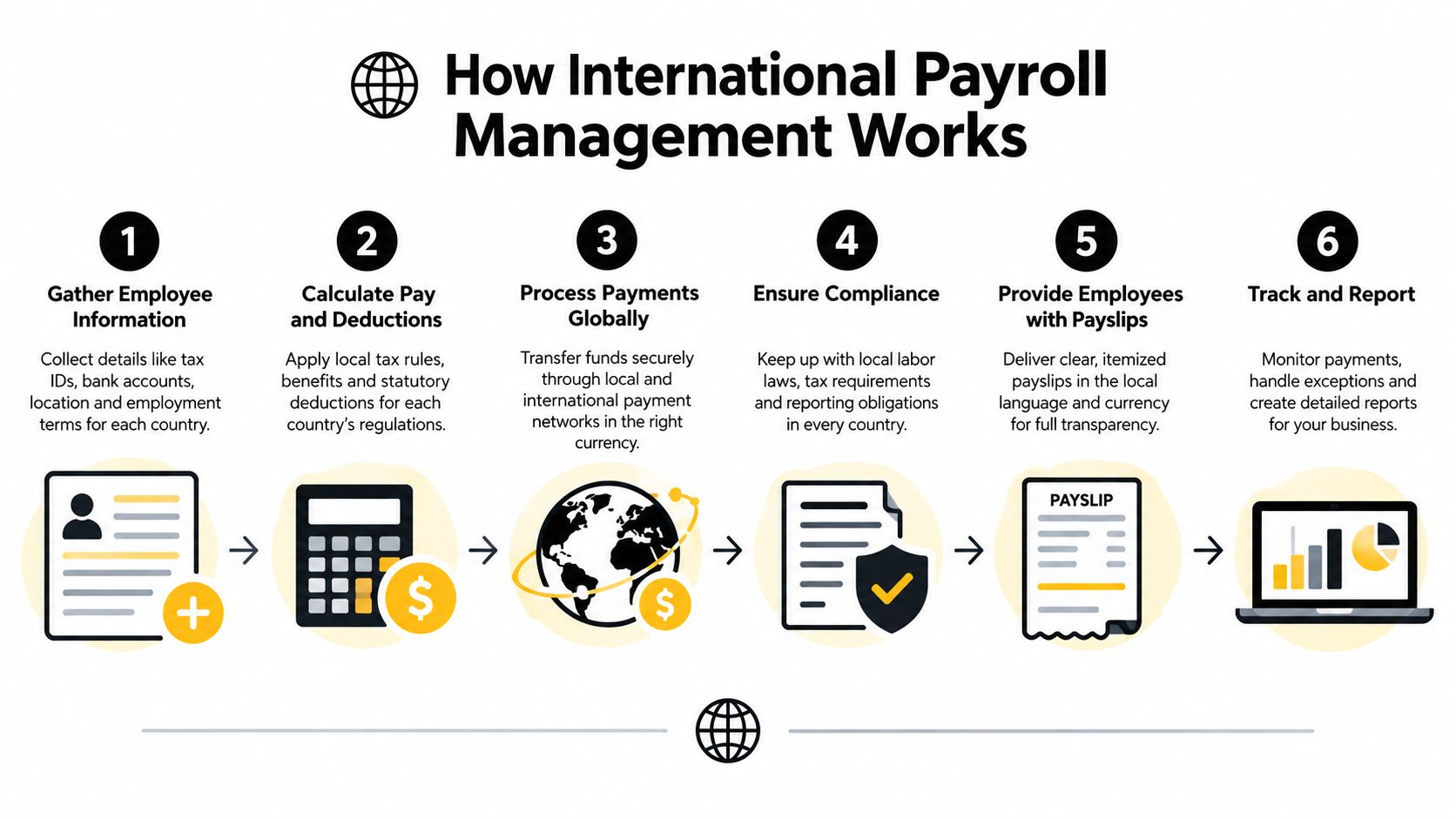
The first stage is data collection. The provider needs the worker's legal identity, work location, engagement terms, pay rate, payment currency, schedule, leave information, approved adjustments, and banking details. A firm should also identify whether the worker will handle confidential client material, use firm-owned equipment, or receive access to systems containing privileged information.
The second stage is classification and setup. The provider determines how the arrangement should be documented under the selected model and identifies the applicable local payroll requirements. If the firm changes the worker's location, duties, supervision, or hours, the arrangement may need to be reviewed again. Classification isn't a one-time checkbox.
The third stage is gross-to-net calculation. This can include compensation, approved additions, statutory deductions, employer contributions, leave-related amounts, and other items required by the applicable jurisdiction. Currency conversion needs a documented method and cutoff date. Otherwise, the firm and worker may disagree about whether a payment difference came from compensation, exchange rates, bank charges, or a processing error.
A fourth stage covers approval and payment. Use clear approval rights, separation of duties, and a cutoff calendar. The attorney or manager should approve time, leave, bonuses, and one-off changes, while the payroll administrator processes the run. The person approving a payment shouldn't be the only person able to alter the underlying data.
A serious service should provide more than a payment confirmation. Ask for an accessible record of payroll calculations, payment status, deductions, invoices, worker documents, support requests, and changes to the engagement. The service should also identify who handles local filings and statutory remittances, rather than using broad language such as “compliance support.”
Cloud delivery is now central to the payroll category. One market source estimates that cloud-based payroll represented roughly 80.4% of revenue in 2025, while also describing the growth of co-managed and on-demand models, as reported by Digital Minds BPO's payroll outsourcing coverage. Cloud access can improve visibility, but it doesn't eliminate the need for local expertise. A dashboard won't resolve an ambiguous classification issue or determine whether a local statutory obligation applies to a particular worker.
Firms exploring a smaller, cloud-first operating model can review guidance on cloud payroll for SMBs, but they should confirm whether the product supports the countries, currencies, worker types, approvals, and reporting obligations they need. For a practical firm-side checklist, the international payroll best practices guide can help organize questions before vendor conversations.
| Responsibility | Law firm | Payroll provider |
|---|---|---|
| Define duties and reporting structure | Owns | Reviews for setup implications |
| Approve hours, leave, and adjustments | Owns | Processes approved data |
| Determine service scope | Owns | Explains supported model |
| Local payroll calculations | Supplies accurate inputs | Calculates under agreed rules |
| Statutory filings and remittances | Confirms allocation | Performs where contracted |
| Confidentiality and system access | Owns internal controls | Protects data within its service |
| Payroll records and reports | Reviews and retains access | Produces and maintains records |
| Worker questions about payment | Escalates operational issues | Handles agreed payroll support |
This division matters because outsourcing doesn't transfer every risk. The firm remains responsible for giving accurate information, controlling access to privileged material, supervising legal work appropriately, and reviewing the provider's performance.
Handling international payroll internally can look attractive when a firm has only one remote worker. The internal administrator already knows the firm's approval process, and a bank transfer seems simple. That view ignores the recurring work behind each payment, including document maintenance, local rule monitoring, exception handling, reconciliation, worker questions, and evidence that the firm met its obligations.
A managed provider adds a fee and reduces direct control over the process. It can also provide local knowledge, standardized workflows, and a defined owner for payroll execution. The right choice depends on the firm's countries, worker classifications, internal expertise, tolerance for administrative risk, and need for scalability.
| Factor | In-House Administration | Professional Outsourced Services |
|---|---|---|
| Setup | The firm builds its own process and documentation | The provider supplies an established workflow |
| Local knowledge | Depends on internal staff or outside advisers | Usually assigned through the provider's country coverage |
| Classification | Firm must research and monitor the relationship | Provider may support classification under the contracted model |
| Payments | Firm manages currency, timing, and reconciliation | Provider coordinates agreed payment processes |
| Rule changes | Internal staff must identify and interpret changes | Provider monitors covered payroll requirements |
| Data controls | Firm designs access, approvals, and retention | Firm reviews the provider's controls and contract terms |
| Visibility | Direct access to every step, if records are maintained | Centralized reporting, subject to provider transparency |
| Scalability | Additional countries increase internal workload | Expansion may be easier within the provider's supported network |
| Main risk | Knowledge gaps and manual errors | Misunderstood scope, weak vendor oversight, or incomplete coverage |
| Best fit | Firms with verified local expertise and stable needs | Firms prioritizing controlled execution and reduced administrative burden |
Payroll accuracy deserves attention because employees experience mistakes immediately. ADP reported a global mean payroll accuracy rate of 78%, up from 75% the prior year, in its 2024 payroll survey. That historical benchmark means payroll quality has remained a persistent operational challenge, even before a firm adds foreign currencies and multiple legal systems.
Independent benchmark-style material also reports payroll error rates ranging from 1% to 8% in some workplaces and cites discrepancy rates below 1% for automated, integrated workflows, as described by EasyClocking's payroll benchmarks. Those figures aren't a promise for any particular provider or firm. They do support a practical conclusion: integrated inputs, current rules, and fewer manual corrections can reduce rework, but only when the implementation and review process are sound.
Outsourcing isn't permission to stop reviewing payroll. A provider may process the information it receives, but it can't know that a paralegal moved from Mexico City to another location unless the firm reports the change. It may also not know that the worker's responsibilities expanded from document support to supervising other staff or handling sensitive client communications.
Before signing, require written answers to these questions:
A domestic payroll comparison can still be useful for basic software evaluation. For example, firms reviewing payroll features such as leave tracking and statutory processing may consult information about HMRC-compliant payroll with LeaveWizard. That type of resource should be treated as a product and jurisdiction comparison, not evidence that a domestic payroll tool handles Latin American employment obligations.
For a broader staffing decision, firms can also review the legal outsourcing service model and separate legal-work delegation from payroll administration. The person doing the work, the firm supervising it, and the provider processing compensation may each have different responsibilities.
A law firm hires a remote legal assistant in Colombia. The assistant invoices monthly, follows the firm's schedule and supervising attorney, uses the firm's case-management system, and performs ongoing work central to the practice. Calling this person an independent contractor does not resolve the classification issue.
As noted earlier, the IRS examines control and the financial relationship. For a Latin American hire, apply that U.S. framework, then test the arrangement against local employment protections, tax rules, and enforcement practices. An employee classification can create withholding, Social Security, Medicare, employer contribution, and unemployment tax responsibilities. A foreign work location does not remove the need for a documented analysis.

A paralegal's title does not determine status. Working from home or outside the United States does not determine it either. The firm should document who directs the work, how payment is structured, whether the worker operates an independent business, who supplies tools, how much discretion the worker has, and whether the engagement is ongoing.
Those facts matter because misclassification can create more than a payroll correction. It may affect social contributions, leave, holiday pay, severance, termination procedures, tax reporting, and worker protections. It can also weaken the firm's position if the worker challenges the arrangement. Payroll management services can organize the records and payment process, but qualified counsel should review unusual or high-risk engagements before the firm commits to a structure.
Each country sets its own payroll requirements. Depending on the jurisdiction and worker model, the firm may need to address social security, health-related contributions, paid leave, holiday pay, severance, local tax treatment, mandatory records, and termination rules. Require the provider to identify which obligations apply and show where each item appears in the payroll report.
Location deserves its own control. U.S. multi-state payroll can create obligations based on where services are performed rather than where a worker lives. Remote work can also trigger registration or withholding duties, as described in Thomson Reuters' coverage of multi-state payroll risks. Latin American hiring requires the same discipline, plus foreign rules, local filings, currency considerations, and country-specific enforcement.
Maintain a location register for every remote worker. Record the country, city or region where services are performed, expected travel, employing entity or contracting party, start date, and approved changes. Payroll, HR, and the supervising attorney should work from one controlled record, not conflicting spreadsheets.
A payroll provider may receive names, addresses, identification details, bank information, compensation data, and records about leave or benefits. The firm must review the vendor's security controls, user access, incident response, retention rules, subcontractors, cross-border transfers, and confidentiality terms. Access should match the employee's role, and the contract should define what happens after the engagement ends.
Protected health information requires a separate review. HHS treats a person or organization that creates, receives, maintains, or transmits protected health information for a covered entity as a business associate. A written business associate agreement is required before the covered entity permits that business associate to handle electronic protected health information, according to the HHS business associate guidance. HIPAA compliance and general security practices are different matters. Do not describe a payroll vendor as “HIPAA certified.” First determine whether the provider handles protected health information, then obtain appropriate compliance advice.
Wage comparisons can also mislead. Resources may discuss concepts such as a wage floor for seasonal employers, but the applicable obligation depends on the jurisdiction, worker category, and employment circumstances. Do not carry a U.S. wage assumption into a foreign engagement without local review.
Use a written checklist that assigns an owner to each control:
A firm-side payroll compliance resource for legal practices can help administrators organize these controls. Use it as an operational reference, not as a substitute for advice from counsel or a qualified compliance professional.
The financial case for Latin American legal support isn't limited to a lower compensation expectation. A firm also needs to account for recruiting time, payroll administration, currency costs, compliance review, software, management attention, and the cost of correcting mistakes. A lower hourly or monthly rate can disappear if the firm spends substantial time repairing an improvised payroll process.
Professional payroll management services make the cost easier to evaluate because the firm can separate legal-support compensation from payroll administration. The provider's invoice should show what the firm is paying for, which obligations are included, what creates an additional charge, and how exchange-rate adjustments are handled. Request a sample invoice and a sample payroll report before committing.
A supervising attorney shouldn't spend billable time reconciling a foreign payment, researching a local filing deadline, or troubleshooting a spreadsheet formula. The practice manager should be able to review exceptions, approve changes, and confirm completion without reconstructing the entire payroll run.
That structure creates a cleaner division of labor:
The payoff is operational focus rather than a guaranteed financial result. A firm can add support without building a separate internal payroll function for every country, provided the provider's coverage matches the engagement and the firm maintains appropriate oversight.
A solo attorney may manage one remote paralegal through a tightly documented process. A larger litigation practice may need several workers supporting intake, discovery, billing coordination, and document production. As the team grows, inconsistent start dates, payment terms, approval methods, and data access create avoidable confusion.
Use one documented workflow for every hire:
HireParalegals is one option for firms that want a recruitment and international support model in the same workflow. Its stated offering includes pre-vetted Latin American legal talent, payroll management and compliance guidance for Latin American hires, and a Contractor of Record option covering contracts, payroll, and intellectual-property protection. A firm should still verify the exact scope, country coverage, security terms, and allocation of legal responsibility before using any provider.
The strongest operating model isn't necessarily the one with the lowest visible fee. It's the one that gives the firm dependable records, clear accountability, manageable approvals, and enough flexibility to change staffing without rebuilding payroll from scratch.
International hiring can give a U.S. law firm access to capable remote paralegals, legal assistants, and administrative support across compatible time zones. It also introduces classification, local labor, tax, currency, privacy, and recordkeeping questions that domestic payroll tools don't automatically resolve.
Use payroll management services as a risk-management decision. Before a worker starts, document the relationship, confirm where the work will be performed, assign responsibility for local obligations, limit access to firm and client data, and require transparent payroll records. Outsourcing can reduce internal administrative strain, but it doesn't remove the firm's duty to supervise the arrangement and review the provider's scope.
If your firm is preparing to hire in Latin America, ask HireParalegals for a country-specific explanation of its talent, Contractor of Record, payroll, and compliance support. Compare that proposal with your current process, have counsel review any uncertain classification or labor issue, and approve the engagement only when every responsibility has a named owner.
Speak with HireParalegals about your next Latin American legal-support hire, and request a clear outline of the contract model, payroll workflow, compliance responsibilities, and information-security controls before you proceed.