
 15 minutes read
Everyone wants to talk about remote attorney jobs California like it is a giant buffet of flexible legal work. It is not. The market is real, active, and selective, which means the attorneys who do well treat it like a California hiring problem with local compliance rules, not a keyword search with delusions of grandeur.
The usual advice is lazy: “Just search remote attorney jobs and apply widely.” That is a fast way to spend your afternoon sorting through stale postings from firms that expect you in the office by Tuesday. Focus on which practice areas support remote work, which postings are remote in name only, and what California ethics rules make the difference between a clean offer and a compliance headache.
California's labor market gives remote legal hiring a real backbone. The California Legislative Analyst's Office reported that in 2024, 13% of California employees worked mainly from home, about triple the pre-pandemic rate, and that by early 2026 the state's remote-work share was still around 15%. It also found 12% of jobs posted by Bay Area employers and 8% of jobs posted by other California employers offered remote work in 2024, plus 160,000 heavily remote jobs, equal to 7% growth versus 2019 in the state overall. Legal work fits that pattern because much of it can be done from a home office or a hybrid setup, which is why remote attorney hiring has stayed in the market instead of disappearing after the pandemic. For the ethics side, attorneys also need to pay attention to unauthorized practice of law rules before they take a role that crosses state lines or blurs supervision.
California's remote attorney market is not booming in a clean, predictable way, and it is not dead either. It is selective, uneven, and heavily concentrated in roles that do not depend on daily court appearances or constant in-person client contact.
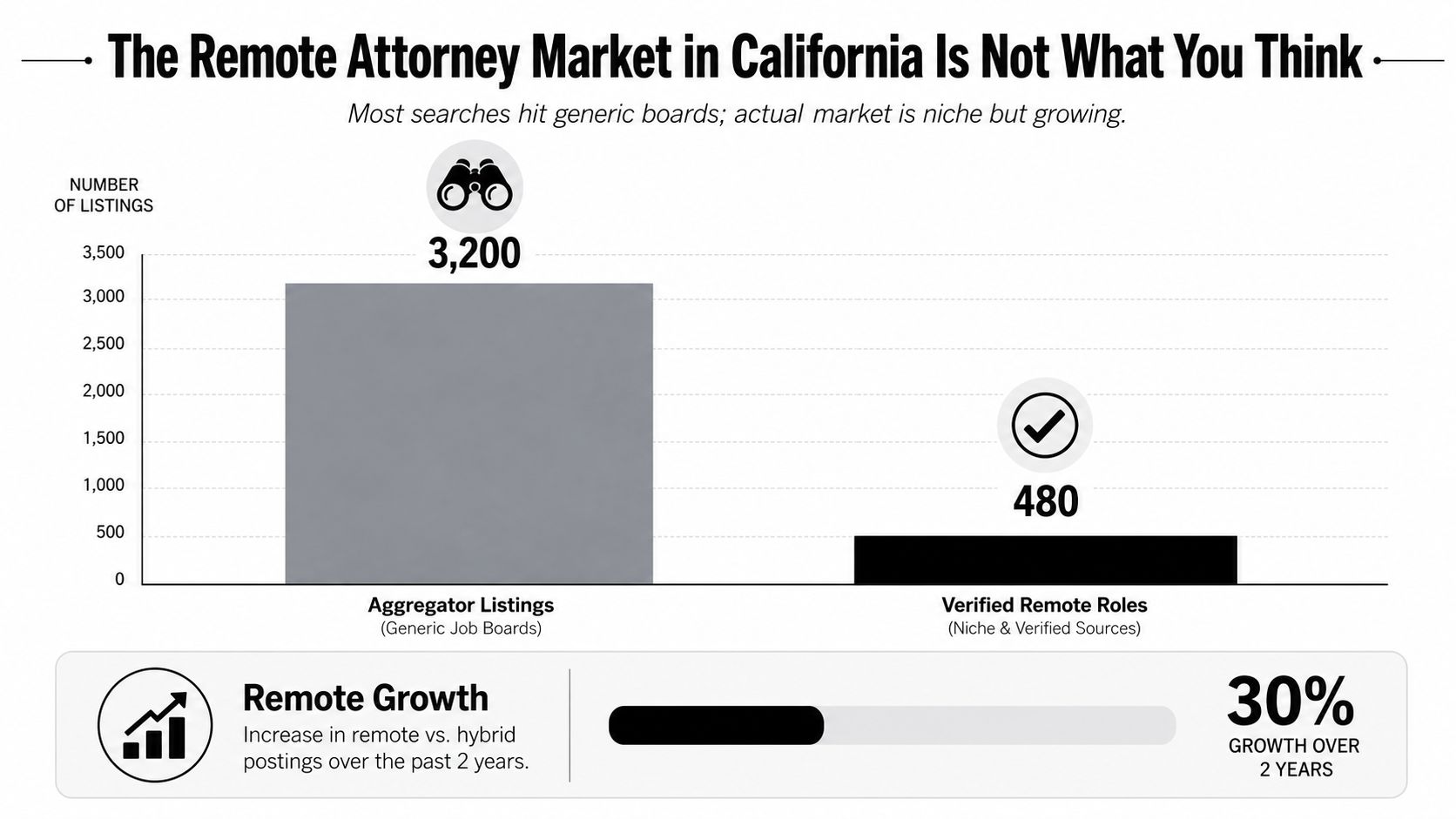
A lot of the listings you see are recycled inventory. Job boards keep surfacing reposts, stale ads, and hybrid roles dressed up as remote openings. The filter is not “remote or not,” it is remote with a genuine California operating model. Firms that hire well remotely want lawyers who can work California hours, handle drafting and filings without constant supervision, and stay productive without office hand-holding. That is a very different profile from a role that only works from home when convenient.
California's broader remote-work patterns explain why legal hiring still has room for distributed roles. Analysts at the LAO report describe a state with enough home-based work, enough employer flexibility, and enough white-collar infrastructure to keep remote hiring in circulation. Legal work fits that pattern because a large share of the job is writing, research, review, and issue spotting, not physical presence.
The practical takeaway is blunt. For remote attorney jobs California firms intend to fill, stop treating every posting as equal. Some openings are real. Some are hybrid roles in a trench coat. Some are firms trying to buy senior talent at junior pay. That is not a recruiting strategy, it is wishful thinking with a job description.

My rule: if the posting does not spell out hours, supervision, and California licensure expectations, treat the “remote” label like marketing copy, because that is usually what it is.
For a broader view of legal jobs in California that often overlap with remote hiring, start there and compare the requirements line by line.
California remote legal work lives and dies by bar status and ethics compliance. That sounds obvious, but a shocking number of firms still write job ads like licensure is a decorative accessory. It isn't. If you're doing legal work tied to California matters, the State Bar rules and unauthorized practice concerns are the part that matters, not the flattering line about “flexibility.”
The California Lawyers Association explains that Rule 5.5 bars a lawyer not admitted in California from establishing or maintaining a resident office or other systematic or continuous presence in California for the practice of law, and it also warns against holding out as admitted in California when that's not true (California Lawyers Association ethics guidance). That's the clean line firms need to respect. If you're licensed in California, remote work is often straightforward. If you're not, the rules get complicated fast.
A California lawyer working for an out-of-state firm still needs to protect the California side of the equation. That means being clear about where the work is performed, what jurisdiction the matter belongs to, and whether the role could drift into multi-state practice issues. If the employer expects you to support California matters, your bar admission, supervision structure, and marketing materials all need to match reality.
The risk isn't just some abstract ethics violation buried in a memo. It shows up in ordinary hiring patterns, especially when firms assume a remote lawyer can be dropped into any matter pool without jurisdictional review. That's where people get sloppy. Remote work doesn't erase conflicts, confidentiality duties, or licensure boundaries. It just makes the firm's systems matter more.
If you want a plain-English breakdown of the compliance side, use what counts as unauthorized practice of law as a reference point and then sanity-check the job description against it. The basic test is blunt. If the firm can't explain who supervises the work, where the attorney is admitted, and how client confidentiality is protected, the setup needs more scrutiny.
Practical rule: a real remote legal role should be able to answer three questions without hesitation, where you're licensed, what matters you'll touch, and how the firm prevents anyone from stepping over a jurisdictional line.
Some practice areas fit remote attorney jobs California very well. Others keep calling themselves remote while still dragging you into court, depositions, client meetings, or last-minute evidentiary fire drills. That is the divide that matters. The postings that survive remote work tend to cluster around litigation counsel, senior counsel, family-law remote attorney, and entry-level associate roles, but the label alone tells you almost nothing.
The strongest remote fits are the practice areas built around drafting, research, review, negotiation, and document-heavy workflow. Corporate transactions, employment law, and some intellectual property work usually belong here. Those matters can often be handled from a laptop, especially when the firm already uses distributed case files and routine digital communication.
Employment law stands out because many roles center on policy review, counseling, document drafting, and dispute management. Corporate work also works well remotely when the lawyer is not spending the day in constant in-person board meetings or local closings. That is why remote-friendly postings show up there far more often than in practice areas that depend on physical presence.
If you want a clean salary reference before you start comparing offers, the associate lawyer salary breakdown gives you a better baseline than vague recruiter talk.
Family law, criminal defense, and real estate litigation are much harder to keep fully remote in practice. Family law often demands client handholding, local court appearances, and the kind of in-person sensitivity job boards like to gloss over. Criminal defense and real estate litigation can be even more location-bound because evidentiary work, hearings, and local procedures do not move online just because a recruiter wants a softer headline.
The right move is to target the areas where remote hiring is already normal, not where it is aspirational. If your background is litigation-heavy, be clear about where your remote value comes from, motion practice, discovery, research, and oral advocacy, not just responsiveness in Slack. That is expected, not a selling point.
If you are screening for roles that are built for home-based work, attorney jobs from home is a more relevant starting point than a generic board full of hybrid bait.
Generic job boards are where remote attorney listings go to die. You get reposts, expired ads, and roles that say “remote” but still expect you in downtown LA three times a week. If you are serious, search where legal hiring happens.
Start with legal staffing platforms and specialized boards that understand jurisdiction and experience level. Robert Half posts remote legal roles that are usually more specific than broad marketplace listings, and niche platforms like HireParalegals are built around remote legal support pipelines instead of one-size-fits-all recruiting. That matters because a law firm looking for a California-licensed remote attorney usually wants a narrow candidate pool, not every resume with “litigation” on it.
A useful recruiter-side habit is to treat your search like AI lead generation for recruiters on the hiring side, which means targeted sourcing, filtered outreach, and fewer wasted conversations. The best candidates do the same thing in reverse. They narrow by practice area, licensure, and seniority before applying, because shotgun applications just create noise.
LinkedIn can be useful if you use it properly. Do not just search the job tab. Track hiring partners, practice group leaders, and in-house counsel at distributed firms, then watch for patterns in what they post and who they already know. That is how you surface unposted work and get past the public pile.
Bar association career centers are still worth checking because they tend to carry more jurisdiction-aware listings. So are direct outreach campaigns to firms with visible distributed teams. Keep the pitch simple. You are California-licensed, you know the subject matter, and you can manage matters without office supervision. That is the pitch. Not a life story, not a manifesto, not a twenty-paragraph tribute to flexibility.
If you want a starting point that already filters for home-based legal work, attorney jobs from home is a more relevant place to begin than a generic board full of hybrid bait.
A remote search works better when you target firms that already behave like remote firms. If their culture still needs three conference rooms to approve a calendar invite, move on.
California remote attorney pay is all over the place, and that is exactly why sloppy benchmarking causes bad hires and bad applications. The number changes with practice area, seniority, and whether you are reading a salary aggregator or a real posting with real duties attached. If you anchor on the wrong figure, you either lowball strong candidates or chase openings that were never priced for your level.
One salary source reported that as of December 17, 2025, the average remote attorney in California earned $130,558 per year, or $65.02 per hour, with a range from $125,856 to $134,246 annually, and that California's average was 11% below the U.S. average of $145,925 for the role (salary source). The same data pool was also used by another tracker, which estimated that as of July 5, 2026, the average yearly pay for a remote lawyer in California was $99,309, with most workers earning between $78,000 and $101,700. Those gaps are not a mistake. They show how much the result depends on the mix of jobs and the source behind the numbers.
The useful read is simpler. This market still sits in six-figure remote attorney territory, but pay moves fast once the work gets specialized. One California remote attorney posting advertises $150,000 to $200,000, and another remote employment-law counsel role advertises $150,000 to $240,000 for eligible states including California. A broader salary aggregator also estimates remote contract attorney pay averaging $117,627 with a range of $88,300 to $137,200 (Robert Half listing context). That is the point that matters, specialized remote legal work pays differently from general remote lawyer listings.
If you are hiring, do not pretend the lowest marketplace number is competitive just because it is convenient. If you are applying, do not assume every remote opening pays like a junior research role. The right figure turns on whether the work is litigation-heavy, counseling-heavy, or transactional, and whether the employer expects California-hour availability with high autonomy.
| Role Type | Salary Range | Typical Experience Required |
|---|---|---|
| General remote attorney in California | $99,309 to $130,558 | Broadly experienced, role-dependent |
| Specialized remote attorney posting | $150,000 to $200,000 | Senior or practice-specific |
| Remote employment-law counsel | $150,000 to $240,000 | Senior counsel level |
| Remote contract attorney | $88,300 to $137,200 | Varies by contract scope |
For a broader compensation frame, compare this with the associate lawyer salary breakdown so you can see where remote California offers sit relative to traditional early-career compensation.
Remote attorney hiring is less forgiving than office hiring. Nobody can “feel out” your work style over coffee if the coffee never happens. So your application has to do the heavy lifting. It should scream independence, writing quality, and California fit before a recruiter even opens your cover letter.
Lead with California bar admission and practice area alignment. Put your strongest evidence of independent case management near the top, because that's what remote screens are looking for. If you've run motions, handled discovery, drafted research memos, or managed matter flow with little supervision, say so plainly.
Your LinkedIn profile should do the same thing. Use terms that match how remote attorney jobs California postings are screened, such as litigation depth, legal writing, research, oral advocacy, and case ownership. If you've handled a high-volume docket, say that in plain English. If you've worked cross-functionally with paralegals, staff attorneys, or client teams, make it visible.
Remote interviews often include writing exercises or case discussions because firms want proof, not vibes. That's fair. Bring a clean writing sample, be ready to explain your process, and answer the inevitable question about how you manage deadlines without in-office supervision. The best answer is not “I'm self-motivated.” Everyone says that. The better answer is how you prioritize, track matters, and keep communication tight.
Here's the hiring order that matters:
That ranking sounds blunt because it is blunt. Law firms hiring remotely don't want a generalist who “likes flexibility.” They want someone who can step in, keep the calendar from exploding, and draft like they've done this before. That's the job.
The first three months decide whether a remote attorney role becomes a long-term asset or a politely worded burnout story. The legal work matters, obviously, but so do the systems around it. Malpractice coverage, document control, communication cadence, and onboarding all need to work from day one.
If you're setting up a distributed practice, confirm that your malpractice coverage fits remote work and covers the jurisdictions and matter types you'll touch. Then get serious about your home office setup, encrypted email, and secure access to case files. No, the dining table doesn't count as a strategy.
If you're joining a public-sector or government-adjacent role, read the telework terms carefully. A CalCareers Personnel Attorney posting says it's eligible for full-time telework under Government Code 14200, but remote-centered employees may still need to report in person to headquarters or offsite events and use a shared workspace or “hotel” when in the office (CalCareers posting). It also requires a two-page maximum statement of qualifications and submission through the state application system. That's the kind of detail people miss when they assume “remote” means friction-free.
The challenge isn't logging in from home. It's staying organized when no one walks by your desk to ask whether you've reviewed the latest draft. Set a daily cadence for file review, client updates, and task triage. Use cloud-based case management, document naming rules, and a calendar system that's stricter than your old office's chaos ever was.
A useful extra lens is tooling. If you want a benchmark for how some teams structure distributed hiring and workflows, even a resource like for coding interviews is a reminder that remote teams succeed when they standardize process instead of improvising every interaction. That principle applies just as much in legal practice as it does in technical hiring.
The last thing to remember is that sustainable remote work is built on boring discipline. Check your systems, protect your records, and don't let “remote” become code for “nobody will notice if I wing it.” They will.
If you're hiring California-licensed remote attorneys, stop screening like every role is the same. Build your job post around practice area, bar requirements, supervision, and real work location expectations, then source through channels that already understand distributed legal hiring. If you're a candidate, tighten your search, clean up your profile, and stop applying to jobs that are secretly hybrid. Start with one firm that hires remotely, one practice area that matches your depth, and one application that proves you can work independently without theatrics.