 12 minutes read
The average annual pay for a Remote Lawyer in Florida is $75,197, top earners reach $97,895, and there are 1,000+ remote attorney jobs currently posted. So yes, the opportunity is real, and no, “remote” doesn't mean you can work from a beach chair in another state and call it a strategy.
Florida has a big enough legal market to support serious remote hiring, but it still has the usual Florida-sized pile of licensing rules, residency expectations, and compliance fine print. That's the part most fluffy career guides skip, because apparently pretending the bar exam disappears once you buy a laptop is still fashionable.
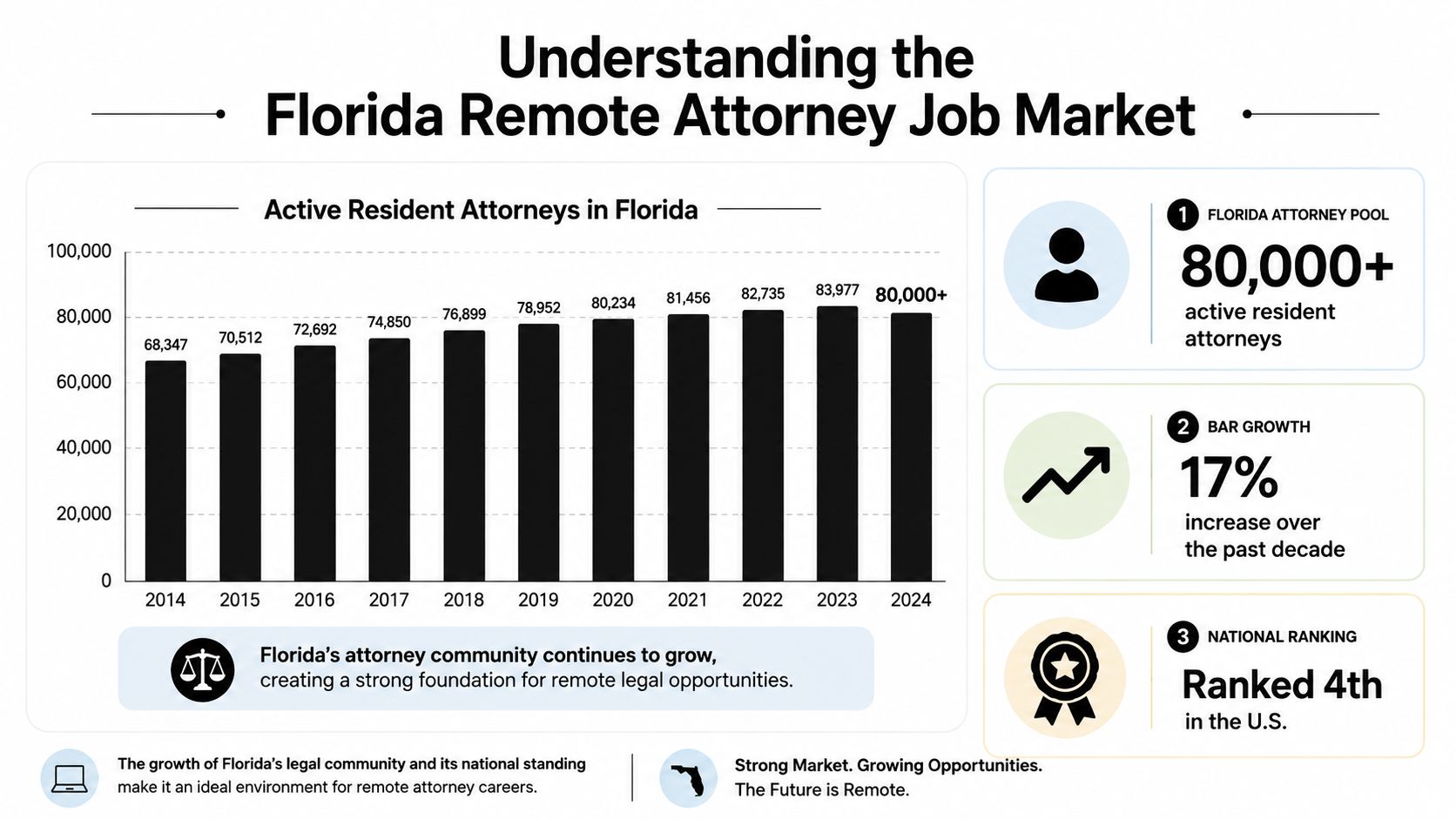
Florida isn't some tiny side market where remote legal work happens by accident. The state has just over 80,000 active, resident attorneys, that number has grown 17% over the past decade, and Florida ranks fourth among states for lawyer population behind New York, California, and Texas (Florida Bar report). That's a real labor pool, not a token niche.
The compensation also tells you this isn't a graveyard for underpaid admin work. Florida's remote attorney category sits at a meaningful salary level, which is exactly why firms keep posting these roles and candidates keep applying. If you're evaluating remote attorney jobs Florida, you're not looking at a vanity listing category, you're looking at a functioning market with enough depth to justify a focused search.
Remote in Florida usually means remote from Florida, and often licensed in Florida. That's not a small detail, it's the whole game. If you ignore the license gate, you'll burn time applying to jobs that were never available to you in the first place.

Practical rule: if a role says remote and then quietly says Florida Bar admission required, believe the second sentence.
If you're trying to map the market from the employer side, HireParalegals' work at home attorney resource is one useful reference point for how firms frame remote legal roles. The bigger takeaway is simpler, though. Florida has enough attorney supply, enough mobility, and enough demand to make remote hiring active, but it still rewards people who understand the walls before they start banging on them.
Florida's attorney market is broad, and that matters because remote hiring tends to favor employers that already have volume, turnover, or multi-office workflows. The Florida Bar says the state has more than 113,000 lawyers overall, with 15% residing out of state, which tells you the talent pool is already interstate in practice even when the jobs themselves are not location-free. That is one reason remote legal recruiting keeps moving. The market is active because firms already know they can draw from more than one geography.
Pay varies by market and practice area, and a lot of candidates misread that immediately. ZipRecruiter's Florida data shows Fort Lauderdale remote attorney pay averaging $93,998 and St. Petersburg averaging $92,980, both well above the statewide remote lawyer average (ZipRecruiter Florida salary data). Family-law remote attorney roles also show a distinct pay band, with an average of $77,540 and a typical range of $58,300 to $91,500 (ZipRecruiter remote legal roles in Florida). In plain English, this market is segmented, not flat.
If you chase “remote attorney” and ignore geography, practice area, and firm size, you will get a noisy inbox and very little progress. If you target metro-heavy postings, especially in higher-paying markets, you will usually find roles that expect more autonomy and less hand-holding. That is the trade.
Remote work also does not erase compliance risk. Some employers will screen for issues that have nothing to do with legal analysis and everything to do with whether you clear the firm's own background standards, which is why DUI and Florida job background checks matters for candidates who want to know what can surface before an offer is finalized. Remote legal hiring is still hiring, which means human judgment, credential checks, and the occasional awkward follow-up question.
If a posting starts drifting into jurisdictional questions or practice-authority boundaries, read it carefully and then read it again. That is where unauthorized practice of law basics stop being theory and start affecting whether the job is open to you. Wise candidates treat that as a screening issue, not a philosophical one.
Florida remote attorney postings are blunt about the one thing that matters most, Florida Bar admission in good standing. Some listings are even more direct than a cranky senior partner on a deadline. One Florida remote attorney posting says, “You must be admitted to the Florida Bar – no exceptions.” Another requires an active Florida Bar license in good standing plus 2+ years of attorney experience (Indeed Florida remote attorney jobs). That's the gate.
A few roles add another credential, and that's where people get tripped up. One Tampa-area posting required active Florida and Puerto Rico licenses, Spanish and English fluency, and independent remote work capability, while another Florida remote family-law role stressed Florida Bar admission and fast-paced intake and drafting work (Indeed Tampa remote attorney jobs). That's not decorative. It means the employer's workflow depends on specific jurisdictional and communication skills, not just a warm body with a JD.
If you're not already admitted in Florida, don't pretend a general remote job search will magically solve that. It won't.
The smarter move is to separate what's possible now from what's possible after you clear licensing. Some attorneys may find adjacent paths through multistate firms, travel-based roles, or later relocation, but none of that erases the present-day requirement in most Florida remote postings. And if a role asks for Florida licensure, it means exactly that.
For a plain-English discussion of the boundary lines around cross-border practice, what counts as unauthorized practice of law is worth reading before you improvise your way into trouble.
Remote legal work also raises practical issues like malpractice coverage, jurisdictional scope, and where you're allowed to perform the work. That's not glamorous, but it's the part that keeps a remote setup from turning into a disciplinary mess. If the job is with a firm outside Florida, the question isn't just whether they like you. It's whether their supervision, insurance, and workflow match the way you'll practice.
The cleanest rule is simple. If the posting says Florida-based, Florida-licensed, or Florida-resident, treat that as a hard requirement unless the employer says otherwise in writing. Hope is not a compliance strategy. It's just a bad filing system.
The main boards matter, but they're not the whole story. Indeed, Glassdoor, and LinkedIn all surface Florida remote attorney roles, and each behaves a little differently. Indeed tends to be where the hard requirements show up plainly, Glassdoor often reflects broader market visibility, and LinkedIn is where volume can get messy fast, which is why you need a filter instead of optimism.
Start with the obvious terms, then tighten the net.
One remote Florida firm listing required a one-week training period in the Broward County office before the role became remote, which is a polite reminder that “remote” often includes a little in-person overhead first (Glassdoor Florida remote work from home law jobs). That matters because some candidates are fine with onboarding travel, and others are not. Don't find out after the interview.
If you're trying to work online from rural areas while keeping your search tight, work online from rural areas from SwiftNet Wifi is a useful practical read on stabilizing the non-legal side of remote work. The internet connection isn't the glamorous part, but it's usually the first thing that ruins a remote legal setup.
The highest-yield strategy is usually direct firm outreach plus targeted board searches. Third-party boards help you identify openings, but firms and recruiters are where you'll find the roles that are calibrated for remote legal work. If you want a structured legal jobs page as a starting point, HireParalegals also maintains an attorney jobs from home page that can help you compare remote legal openings without wading through junk.
The bottom line is boring but true. Search where the postings are, but verify where the work really happens. Otherwise you'll spend half your week chasing listings that are “remote” in the same way a treadmill is “outdoors.”
Remote legal hiring is picky for a reason. Firms want lawyers who can produce without being hovered over like a nervous intern with a stapler. So your resume has to scream autonomy, precision, and tech readiness.
Employers repeatedly flag legal research, writing, document drafting, client communication, and time management as core requirements (ZipRecruiter remote attorney postings in Fort Lauderdale). That part is familiar. The remote-specific part is the technology stack. Postings call out comfort with legal practice management software, secure document sharing platforms, and e-filing systems, which is recruiter language for, “Please don't make our staff troubleshoot your laptop for two hours.”
Useful rewrite: don't say you're “comfortable in fast-paced environments.” Say you managed a caseload independently, met filing deadlines, and kept client communication moving without daily supervision.
If you've handled intake, drafting, file updates, or remote collaboration, show it in the first half of the resume, not buried in a paragraph that nobody will read. Spell out the systems you've used when they matter, and describe outcomes in workflow terms. Employers don't need poetry. They need evidence you can run a caseload without turning every question into a meeting.
Your headline should be functional, not clever. A good headline tells recruiters your practice area, your Florida licensure status, and that you work well in remote settings. The About section should briefly cover your jurisdictional coverage, your case management style, and your communication habits. That's the information remote legal recruiters scan for.
For firms evaluating call-heavy intake or client communication workflows, Voicedial.ai on legal call handling is a useful reminder that voice systems and intake discipline now matter more than most lawyers want to admit. Remote law firms still live and die on responsiveness, and someone has to answer the phone without sounding like they woke up in a deposition.
If you're one of the few candidates who can legitimately say you've handled complex matters with minimal supervision, put that near the top. If not, don't fake seniority. That trick dies fast in interviews, and it's embarrassing for everyone involved.
Remote interviews separate the lawyers who can run their own work from the ones who need constant supervision disguised as “collaboration.” Hiring teams cannot watch your day-to-day habits, so they listen for process, judgment, and communication. If your answers stay vague, they will pick the candidate who sounds like they have practiced outside a conference room.
Expect questions about deadlines, client communication, and how you handle document workflows without in-person oversight. You should also be ready for jurisdictional questions, especially if the role has Florida-specific scope or the firm works across state lines. That is not paranoia, it is risk control.
A strong candidate asks sharper questions back.
That last one matters more than people think. If the answer is fuzzy, the job may be too.
Use Florida salary data as your baseline. ZipRecruiter Florida salary data shows that remote lawyer pay in the state varies widely, with average compensation and top-end figures far apart. That is not a license to demand a number just because it exists. It means you should know where you fit before the employer tries to anchor you low and dress it up as “market.”
Negotiation rule: ask for the things that affect your actual work, not just the headline salary.
Press for clarity on malpractice insurance, equipment support, workflow expectations, and any travel requirements tied to onboarding or court appearances. If the firm wants you remote but still expects periodic office time, get that in writing. Nobody likes a surprise commute, especially one hidden inside a “flexible” job.
Before you sign, verify the role's jurisdictional scope, supervision model, and tech requirements. If the answer sounds like “we'll figure it out later,” that usually means you will be the one figuring it out later, and probably on your own time.
If you are actively targeting remote attorney jobs Florida, stop spraying applications into the void and get selective. Check Florida Bar eligibility first, target postings that match your practice area and location, and make your resume prove you can work independently in a real remote workflow. If you want a more structured way to compare remote legal opportunities, start with a focused job board search and build from there, because the firms hiring now reward precision, not hope.