 16 minutes read
Let’s be real. Your firm is drowning in admin work, your attorneys are losing billable hours to scheduling chaos, and you know you need help. But the official requirements to be a legal assistant feel like they were written by a committee. What you actually need is an organizational ninja, someone who can wrestle the operational beast into submission so your legal eagles can just… practice law.
In the legal world, people throw around "legal assistant" and "paralegal" like they’re the same thing. This is a rookie mistake. It’s like confusing your pilot with the air traffic controller—both are critical, but you don’t want them swapping seats mid-flight. Getting this right is step one before you even think about writing a job post.
A legal assistant is the operational engine of your firm. They’re the masters of administrative flow, wrangling everything from client calls and chaotic calendars to file organization and basic correspondence. They keep the lights on and the machine running.
Crucially, they don't do substantive legal work that you can bill to a client. That’s paralegal territory. If you want the full, unvarnished breakdown, our guide on the difference between a paralegal and a legal assistant lays it all out.
Think of your firm's structure as a pyramid built for one thing: efficiency. At the top, you have your attorneys, focused on strategy, casework, and high-value client work. Right below them are paralegals, handling the complex, billable support tasks. And holding the whole thing up? The legal assistant, who manages the administrative load so everyone else can function.
This visual shows how the pieces are supposed to fit.
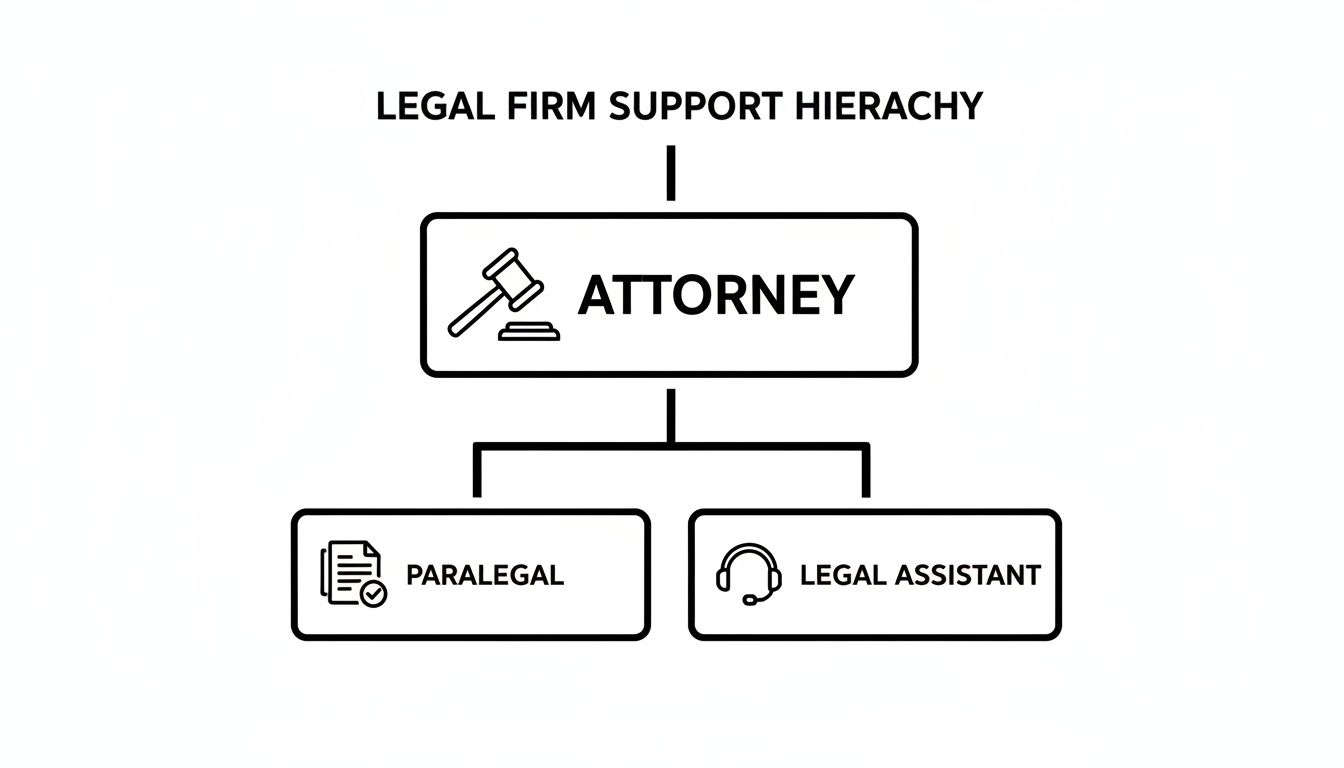
The takeaway is brutally simple: an attorney's time is your most valuable asset. It should be shielded by two distinct layers of support, each with a specific job.
Just to hammer it home, here’s a quick and dirty comparison.
| Aspect | Legal Assistant | Paralegal |
|---|---|---|
| Primary Role | Administrative & organizational wizard | Substantive legal support |
| Typical Tasks | Answering phones, scheduling, filing, data entry | Legal research, drafting documents, case management |
| Billing Status | Non-billable (pure overhead) | Billable to clients (revenue generator) |
| Client Interaction | First contact, scheduling, general info | Case-specific updates, information gathering |
See? One manages the business of law, the other assists with the practice of law.

The biggest mistake I see firms make is hiring a paralegal for an assistant's job—or vice versa. You either end up paying a premium for someone to answer the phone, or you ask an admin to handle complex legal work they aren't trained for. Both are expensive, face-palm-worthy errors.
So, the first real requirement is clarity. A legal assistant is a force multiplier who creates time and space for everyone else. Get that wrong, and the rest of your hiring process is doomed from the start.
Let's get one thing straight: you do not need to hire a legal assistant with a four-year degree in Renaissance literature to manage your calendar. That’s an expensive assumption that filters out amazing candidates who are qualified in practice, not just on paper. Too many firms get hung up on demanding a B.A. and end up hiring someone who can write a killer essay but can’t e-file a document to save their life.
The truth? The path to becoming a great legal assistant is flexible. You're not looking for a legal scholar; you're looking for someone who can hit the ground running. A focused certificate program or a two-year associate's degree often produces a more competent, practical hire than a fresh grad with a fancy—but totally irrelevant—bachelor's.
You need skills, not just sheepskin.
So if a four-year degree isn’t the golden ticket, where do you find these plug-and-play professionals? Shift your focus from broad, theoretical knowledge to practical, hands-on training.
Here’s what actually signals competence:
The data backs this up. The U.S. Bureau of Labor Statistics pegs the typical entry-level education as an associate's degree or certificate. O*NET data shows the reality on the ground: 44% of working legal assistants hold a bachelor's, but 30% have an associate's, and 12% have other focused training. The talent pool is diverse. You can see the full breakdown of legal support education trends for yourself.
Stop screening resumes based on the university's brand and start looking for proof of practical application. An Ivy League degree doesn't guarantee they know how to handle a frantic client call with grace.
Think of it like hiring a chef. You wouldn't hire someone based on their history degree; you'd hire them because they can cook. Same logic. The most important requirements to be a legal assistant are proven skills, not the line item under "Education" that costs you a premium.
Let’s talk about that alphabet soup of acronyms you see on resumes. Frankly, many certifications are just expensive wallpaper. You don't have time to become an expert on what they all mean. You just need to know which ones prove a candidate can actually do the job without constant hand-holding.
Think of certifications as a competence signal. Some are a lighthouse, cutting through the fog to show you a pro. Others are a flickering candle in a hurricane—utterly useless. Your job is to spot the difference.
The trick is to separate the credentials that require tough exams and continuing education from the ones that are basically participation trophies.
When you see these, you can be reasonably confident the candidate has a solid baseline of knowledge. These aren’t just pieces of paper; they represent a serious professional commitment.
Here are the ones that should make you lean in:
Optional certs like NALA’s CP (which demands 50 CLE hours every five years) or the NFPA's exams give a candidate an edge. But don't ever discount raw experience. In most states, a high school diploma and a few years of supervised work is more than enough to qualify.
A certification doesn't replace grit, common sense, or the ability to anticipate a partner's needs. But it does show a level of professional dedication you don’t find in casual applicants. It’s a filter for seriousness.
The big exception here is California. The Golden State has its own strict rules about who can even use the title "paralegal," which heavily influences what firms look for. If you're hiring there, pay close attention to state-mandated requirements. For a deeper look, our guide on paralegal certification requirements is a solid resource.
Ultimately, treat certifications as one helpful data point, not the whole story. It tells you they have the book smarts. The interview tells you if they have the street smarts.
Alright, let’s get down to brass tacks. Forget the fluffy phrases on job descriptions. "Detail-oriented" and "team player" are table stakes—that’s like asking a surgeon to know how to hold a scalpel. We need to talk about the real, in-the-trenches skills that determine if a legal assistant will sink or swim.
You're not hiring an admin. You're hiring a force multiplier who frees up your attorneys to do high-value work. That requires a specific blend of skills, and you need to know what to look for.
Let's break them down into two buckets: the hard skills you can test for, and the soft skills you have to hunt for.
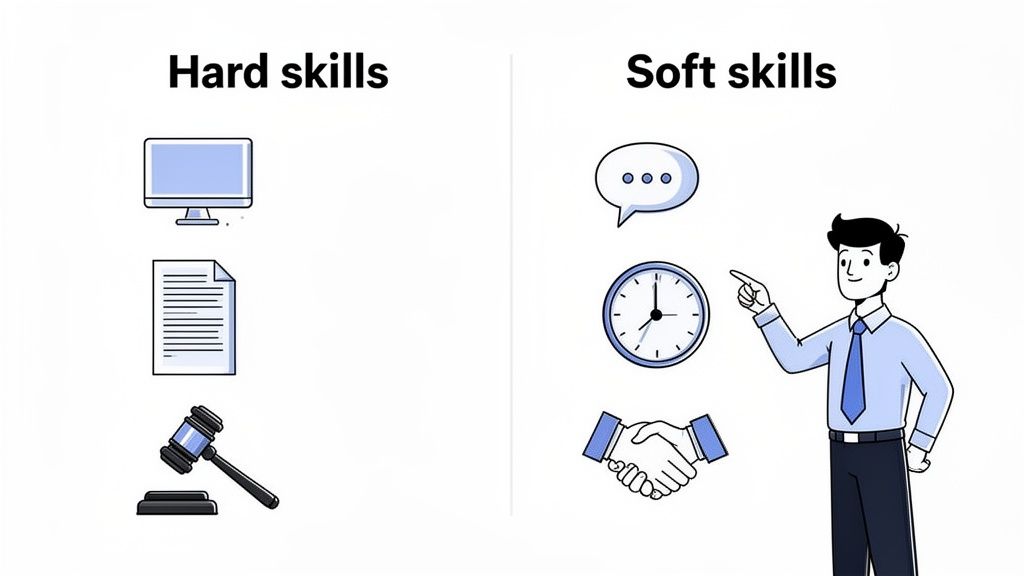
This is the pass/fail stuff. If a candidate bombs these, the interview is over.
These skills are testable. Give them a small, practical task during the interview. It'll tell you more than their resume ever will.
This is where the magic happens. Hard skills get them in the door; soft skills make them indispensable.
I’d rather hire someone with 80% of the hard skills and 100% of the right attitude than the other way around. I can teach someone how to use our software. I can’t teach them how to have a sense of urgency.
Look for these traits during your conversation:
These are the core requirements to be a legal assistant who will actually move the needle for your firm. Ignore them at your own peril.
Use this cheat sheet to standardize your interviews and spot red flags before they’re sitting in your office.
| Skill Category | Must-Have Skills | Red Flags to Watch For |
|---|---|---|
| Technology | Proficiency with standard legal software (e.g., Clio, MyCase, Westlaw). | Vague answers about tech experience; blames old bosses for lack of training. |
| Document Mgmt | Ability to accurately draft and format routine legal documents. | Can't describe a standard pleading; their own resume has typos. |
| Communication | Clear, proactive, and professional correspondence (written and verbal). | Poorly written emails; interrupts constantly; doesn't ask clarifying questions. |
| Problem-Solving | Anticipates needs; suggests solutions instead of just stating problems. | Blames others for past failures; has a passive, "not my job" attitude. |
| Discretion | Demonstrates understanding of client confidentiality and ethical boundaries. | Loves to gossip; shares overly specific details about past employers. |
| Composure | Stays calm and focused when discussing high-pressure situations. | Gets visibly flustered by hypothetical stressful scenarios; bad-mouths past pressures. |
This isn't exhaustive, but it's a solid framework. By digging into both hard and soft skills, you get a much clearer picture of who you're really hiring.
Let’s be blunt: "years of experience" is a garbage metric on most resumes. You can have a candidate with five years of experience who mostly fetched coffee and fought with the copy machine. Then you have someone with the same tenure who was the right hand to a partner on a landmark case. They are not the same.
That's why we've found that 4+ years of direct, hands-on experience is the real sweet spot. It's not a random number. It's the tipping point where a professional stops just executing tasks and starts operating with autonomy.
Think about it. The first couple of years are about learning the ropes. By year four, something clicks. They're no longer working off a to-do list; they're anticipating needs, spotting roadblocks, and making judgment calls that save your attorneys hours of headaches.
What does this "gold standard" experience look like in the wild? A legal assistant with 4+ years doesn’t just manage a calendar; they strategically map it out around case deadlines. They don’t just file a document; they understand the ripple effect of a missed deadline and have failsafes in place.
This depth of experience turns them from an admin into a true strategic partner. A seasoned pro can confidently:
Anyone can be trained to answer a phone. It takes years to know exactly what to say—and what not to say—when a high-stakes client is on the line, freaking out about a bill. That’s the seasoned judgment four years of experience buys you.
Hiring someone with less experience might look like a way to save on salary, but it’s a false economy. Every hour your senior staff spends training a junior hire is a non-billable hour. When you focus on the requirements to be a legal assistant who has already cleared that four-year hurdle, you're investing in someone who adds value from day one, not someone who drains resources for six months.
Hope you enjoy spending your afternoons fact-checking resumes and running interviews—because that’s your full-time job with the old hiring model. Posting a job and praying the right person finds it is slow, expensive, and a total crapshoot. You need someone who meets the real requirements to be a legal assistant, not just the first person with a decent-looking resume.
The modern playbook is different. It’s about tapping into curated, pre-vetted talent pools where the grunt work is already done. This is where a specialized service becomes your secret weapon, turning a months-long hiring headache into a solution that can show up in as little as 24 hours.
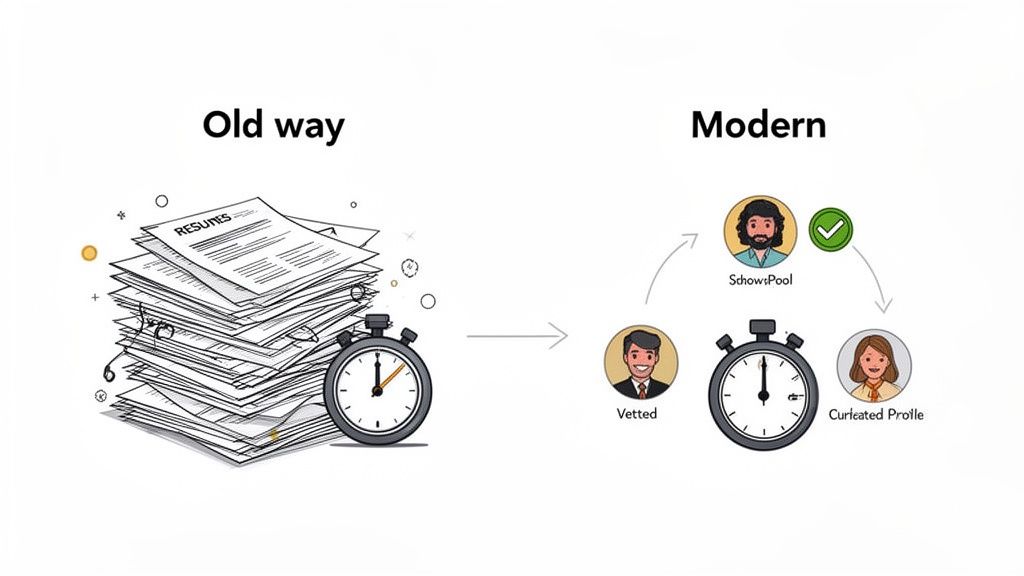
We built our entire system to solve one problem: your time is too valuable to waste on unqualified candidates. Our four-step vetting process is designed to eliminate 99% of the hiring risk before a profile ever hits your desk. Toot, toot!
Here’s the breakdown:
Think of it as a quality control filter for talent. By the time you see a candidate from us, they've already been tested, verified, and confirmed to be a top-tier pro. We handle the noise so you can focus on the signal.
This isn’t just about finding someone; it’s about finding the right someone, fast. To really ditch the old models, it’s worth exploring modern talent acquisition best practices. This mindset, combined with a ruthless focus on practical abilities (what is skills-based hiring), is a total game-changer.
Hiring is a big deal. You're investing time and money, and you need to see a return. Let's cut through the fluff and tackle the questions we always hear from firms trying to nail down the real requirements to be a legal assistant.
It's simple: billable vs. non-billable. A legal assistant handles the non-billable operational tasks that keep the firm running. Their salary is overhead. A paralegal performs substantive legal work you can bill to clients. They are a direct revenue generator, and their compensation reflects that.
You're either investing in operational efficiency (the assistant) or a direct revenue stream (the paralegal). And a quick insider tip: hiring a remote legal assistant through a service can slash your overhead. No benefits, payroll taxes, or office space costs. It's a ridiculously efficient financial move.
This is the big one, right? The answer boils down to one word: experience. Hire someone fresh out of school, and plan to invest three to six months of your team's time just getting them up to speed. It's a painful, expensive drag.
A seasoned professional with 4+ years of experience, especially one vetted for your practice area, starts adding value in week one. They already know the rhythm of a law firm. No hand-holding required.
This is why experience is the ultimate shortcut. It collapses that frustrating learning curve and delivers an almost immediate return on your investment.
Absolutely. This is where modern hiring models crush the old way. You're no longer locked into long-term, full-time commitments.
Need an extra pair of hands to get through a mountain of discovery documents? Need to cover for an employee on leave? Flexible talent platforms let you bring in a highly qualified legal assistant on demand.
This gives you insane control over your budget. You get expert help exactly when you need it, without the dead weight of another full-time salary. It’s a smarter, more agile way to build your team.