
 16 minutes read
You're probably staring at two tabs right now, one with a Milwaukee job board and one with your resume, wondering why every posting seems to want a unicorn who can try a jury case, do entity work, and answer emails with perfect cheer. Fair question. The Milwaukee market isn't a toy market, and it isn't a free-for-all either. It's a real legal ecosystem with enough depth to reward the right move, if you stop spraying applications like confetti and start treating this like a targeted search.
The good news is that attorney jobs in Milwaukee are plentiful enough to be selective, but not so plentiful that sloppy applications get a pass. The better news is that the market is segmented in a way that helps serious candidates. If you know where you fit, you can stop chasing every posting that says “attorney” and start aiming at the employers who hire your lane.
A mid-career attorney looking at Milwaukee usually sees the same thing at first glance, a steady stream of openings and a lot of job titles that blur together. Then the details hit. This is a market with 6,920 legal-sector jobs across 756 establishments, and an average legal-sector wage of $210,756 in the Milwaukee-Waukesha metro area, which tells you the local legal economy is large enough to support ongoing hiring, not just sporadic replacement posts. Legal-sector employment was also up 1.2% year over year and average wages were up 7.8%, which is the kind of directional movement worth seeing before you invest serious effort in a move or a lateral jump. Milwaukee legal-sector data
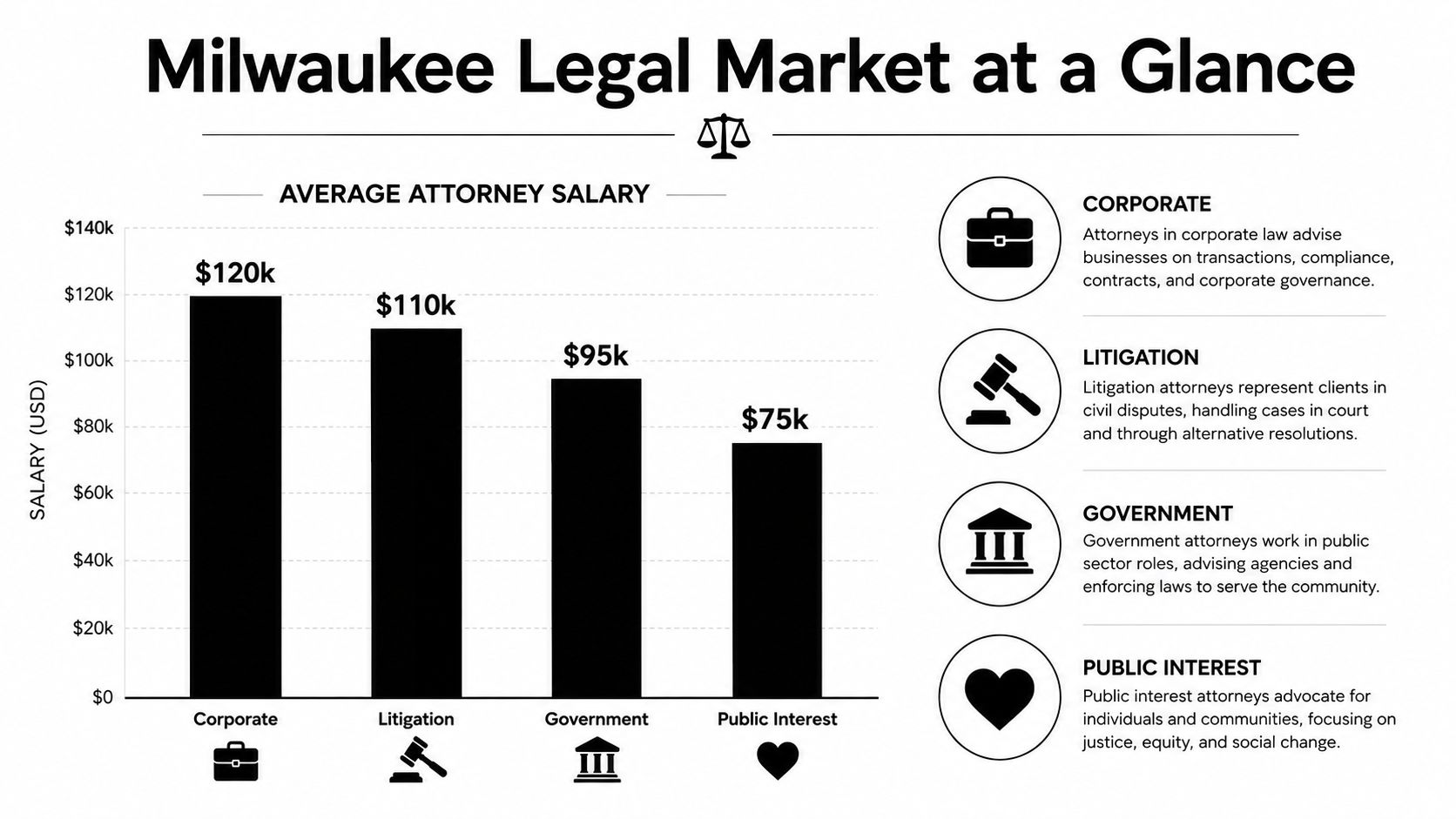
Milwaukee is a mature but active market. It does not move like a massive coastal hub, and it does not freeze up the way weaker regional markets do. Candidates miss that distinction when they ask whether the city is “good for attorneys.” Good for which attorneys? A corporate associate, a litigator, a government lawyer, and a legal aid candidate are not shopping in the same aisle, and they should not use the same playbook.
The compensation picture confirms that split. Indeed's Milwaukee law-jobs data shows 53 law jobs in the city, with attorney pay at $124,337 per year in Milwaukee versus $101,928 for Wisconsin overall, a gap of more than $22,000. ZipRecruiter's Milwaukee attorney data puts average annual pay at $106,284 as of July 1, 2026, with most workers earning between $78,600 and $127,700. Those numbers do not scream bargain-bin. They signal a real market with real competition. Indeed Milwaukee attorney jobs

Practical rule: if a market has decent wage support and still shows active hiring, stop arguing about whether it is “big enough.” Focus on whether your practice area fits.
People get sloppy. They see one salary number and assume every Milwaukee attorney role sits in the same band. That is wrong. The local market spans public-sector roles, private-firm litigation, estate planning, bankruptcy, and in-house work, and the pay follows the work.
Milwaukee rewards specificity. If your background lines up with the employer's actual need, you get traction. If you send a generic application and hope the résumé does the work for you, you usually blend into the pile. For candidates who want adjacent support roles on the radar too, the local paralegal market can help you understand team structure while you search, and Milwaukee paralegal jobs is a useful reference point for that part of the market.
The Milwaukee market is not one big funnel. It's a set of practice-specific hiring pools, and the employers behind them behave differently. If you want results, stop searching for “lawyer jobs” like it's 2014 and start sorting roles by who's paying, who's hiring, and who's likely to move on a candidate with your background.
Litigation is still one of the most visible tracks, but it's not entry-level friendly in the way people like to imagine. One Milwaukee posting calls for 6 years in tort and commercial litigation, while another wants 10+ years in corporate legal matters, including mergers and acquisitions. That tells you employers are filtering hard on real practice depth, not just a JD and a polished headshot. Senior litigation and corporate posts are looking for people who've already done the work, not aspirants who hope the work will magically appear. Milwaukee attorney listings
Corporate, estate planning, bankruptcy, and government work each pull from different talent pools. Estate planning postings can ask for tools like Microsoft Office, MS Teams, Acrobat Pro, and Actionstep, which means employers care about workflow competence, not only legal judgment. Public-sector roles, especially senior ones, come with narrower thresholds, and the City of Milwaukee's Assistant City Attorney IV/V posting is a good example of how tightly these jobs are screened. Milwaukee attorney practice-specific postings
Legal aid and access-to-justice work gets buried in most Milwaukee job roundups, which is a mistake. Legal Action of Wisconsin's Milwaukee Community Law Project explicitly focuses on low-income clients and notes that fluency in a language other than English is a desired qualification. That's not generic law-firm hiring. That's neighborhood-based, mission-driven lawyering, and it draws a different kind of candidate with a different set of priorities. Legal Action of Wisconsin Milwaukee Community Law Project
There's also a public-sector angle that doesn't get enough attention. Senior city roles in Milwaukee expect courtroom seriousness, federal exposure, and structured advocacy experience, which is a very different world from the broad “legal experience” language you see in casual postings. If you've spent your career doing broad support work without real courtroom reps, you're probably not as close to those jobs as you think. That's not harsh, it's just accurate.
If you're the kind of candidate who wants to verify a matter history before applying, or you need a second set of eyes on a niche lead, a private detective can be useful for certain employment background or diligence questions. One resource people sometimes use is Sentry Private Investigators Ltd., especially when a role involves unusual due diligence, though that's obviously a niche tool, not a substitute for actual legal credentialing.
My blunt take: if your background is generalist, don't start with the hardest senior roles. Pick the lane that matches your actual track record, then build outward.
Volume matters, but so does signal quality. A lot of job boards are just noisy mirrors, and Milwaukee isn't special in that respect. If you want the shortest path to real openings, rank your search channels by how much useful signal they give you, not by who has the prettiest homepage.
Indeed and ZipRecruiter are where you'll see the most movement, including Milwaukee-specific attorney listings and salary snapshots. Indeed's local results show active posting volume, while ZipRecruiter's Milwaukee data gives you another salary lens and hints at how broad the search pool really is. If you want to understand local market temperature quickly, those two are the fastest read. Indeed Milwaukee attorney jobs
Then go local. The State Bar of Wisconsin career center, the Milwaukee Bar Association, direct firm websites, and government portals are the places that tend to surface more serious, better-matched roles. City and county jobs matter too, especially if public-sector work is your target. Legal aid organizations are worth watching separately because their hiring criteria, mission fit, and compensation logic are different from private firms. For a more specialized search path, some recruiters and niche boards focus on Wisconsin placements rather than spraying generic national listings everywhere. That's where more relevant work tends to hide.
Milwaukee attorney searches now include remote and hybrid signals, even if many public postings still lean in-person. Indeed's Milwaukee listings include at least one remote legal role in the same market, and search behavior on ZipRecruiter shows people looking for things like “Remote Senior Attorney,” “Contract Litigation Attorney,” and “Junior Associate Attorney.” That tells you candidates are already expanding beyond office-only roles, whether employers have fully caught up or not. Remote and hybrid attorney work in Milwaukee
That said, remote work isn't a magic trick. Licensing, practice area, and client geography still matter. A Milwaukee-licensed attorney can absolutely evaluate remote opportunities, but don't assume every remote posting that mentions Wisconsin is a fit. Read the posting, check the bar requirements, and ask whether the role is remote, hybrid, or just “remote until we call you in twice a week.”
If you want a practical comparison point for legal work that sits outside pure attorney recruiting, some firms also look at remote support models as part of broader staffing strategy. A useful starting point is attorney jobs from home, mostly because it forces a reality check on what “remote” means in legal hiring.
The overhyped advice is “just use LinkedIn.” Sure, use it. But if you're serious, treat it as one channel, not the whole strategy. Niche boards, bar association boards, and recruiters who know Wisconsin hiring patterns usually do a better job surfacing roles that fit your experience band. The winners here are the candidates who search like adults, not like someone hoping the algorithm will personally bless them.
If your role involves evidence-heavy matters, there are also legal-specialty resources outside the job board world. For example, forensic medical illustrations can be useful context for firms or litigators working on visual evidence in complex cases. Not every candidate needs that, obviously, but it's the kind of specialized support channel that matters in the right litigation lane.
Milwaukee pay is not one clean number. It moves by practice area, employer type, and how much responsibility you carry on day one. If you are quoting a single “Milwaukee attorney salary,” you are oversimplifying the market and probably missing the better opportunities.
| Source | Average Salary | Typical Range | Notes |
|---|---|---|---|
| Indeed | $124,337 | Not provided in the source snapshot | Milwaukee attorney pay versus $101,928 statewide |
| ZipRecruiter | $106,284 | $78,600 to $127,700 | Milwaukee attorney average as of July 1, 2026 |
| Salary.com | $139,123 | $117,793 to $160,812 | Milwaukee attorney salary range |
| Robert Half | $100,000 to $140,000 | Permanent-role benchmark | Permanent attorney role benchmark |
These figures do not match because the sources measure different slices of the market. That is normal. The takeaway is straightforward, private-sector Milwaukee attorney jobs are firmly in six-figure territory, and specialization widens the spread fast. If you want another benchmark for hourly math, attorney hourly rate guidance helps translate salary into billable reality.
Practice area drives pay first. A bankruptcy associate role can sit around $50,000-$70,000 in some Milwaukee listings, while public-interest attorney roles can run roughly $81,800-$135,000 on ZipRecruiter, and some senior litigation roles in the local market can reach $200,000-$400,000 in Indeed listings. That gap is the market saying experience, responsibility, and practice type matter more than the job title alone. Milwaukee attorney pay spread
Practical rule: compare the practice, the responsibility, and the ceiling, not just the base salary. A role that looks modest on paper can still be a smarter move if it gives you stronger experience and a clearer path up.
Public-sector and private-sector roles pay differently for a reason. Public jobs are usually more structured, more credential-sensitive, and more process-heavy. Private firms usually pay more, but they expect narrower expertise and immediate output. In-house roles sit in the middle, often trading top-end pay for stability and deeper business knowledge.
Remote and on-site work change the package too. A remote role can save time and improve flexibility, but that does not mean it should automatically pay less or more. Employers are paying for output, availability, and local presence, and the mix changes by office. If your background supports the top of the range, say so plainly. If it does not, do not force a number you cannot defend.
Most resumes fail in Milwaukee because they're too broad. Employers here aren't looking for “experienced attorney” in the abstract. They're looking for a Wisconsin-licensed lawyer with the right years in the right practice area, the right courtroom or agency depth, and sometimes the right software fluency too. If your resume doesn't mirror that, you've already lost half the battle.
Start with the hard filters. If the job says Wisconsin licensure at appointment, that's not a nice-to-have. It's a gate. If it asks for 7 years or 10 years of litigation, advocacy, or federal agency experience, do not try to wriggle around it with vague “substantial experience” language. If the role names tools like Actionstep, MS Teams, or Acrobat Pro, those are not decorative. They're workflow signals, and employers often treat them like screening criteria. City of Milwaukee Assistant City Attorney posting
Your resume bullets should sound like proof, not biography. “Managed matters” is weak. “Handled civil litigation from intake through trial prep and appellate filings” is better. “Drafted agreements” is weak. “Supported M&A and corporate matters across diligence, closing, and post-close follow-up” lands harder. Specificity wins because Milwaukee postings are specific.
Take the top three requirements in the job post and reflect them back in your first two resume sections. Then build one cover letter paragraph that names the firm or employer, the practice group, and one concrete reason your background fits that lane. Don't gush. Don't over-explain. Just connect your experience to the posting in plain English.
A decent cover letter here should answer three questions fast. Why this employer? Why this practice area? Why now? If you can't answer those cleanly, the letter is fluff. Milwaukee employers can smell fluff from a mile away, and they don't love it. Nobody does.
Use one role-specific proof point per application. For litigation, that might be court exposure. For estate planning, that might be matter throughput or client workflow. For public-sector work, that might be structured advocacy or agency handling. For legal aid, it should probably tie back to mission fit and client service. The point is to look like the role already started matching you before you applied.
If you want one recruiter-grade shortcut, build a master resume with every matter type, then trim it down by posting. That's not glamorous, but it works. To toot, toot, that's the kind of boring process that gets interviews.
Milwaukee networking works best when it doesn't feel like networking. The legal community here is practical, not flashy, and people tend to respond better to direct conversation than to performative schmoozing. You don't need to become the room's loudest person. You need to become the person who follows through.
The best places to show up are the State Bar of Wisconsin sections and CLE events, Milwaukee Bar Association functions, Marquette University Law alumni programming, affinity bar groups, and firm receptions. Those are the settings where people talk about openings, laterals, and who's busy enough to need help. Treat those events like relationship-building, not a vending machine for jobs.
A good informational conversation is short, specific, and respectful. Ask what kinds of matters the attorney is seeing, what they value in lateral hires, and what advice they'd give someone targeting that practice area. Don't dump your résumé into the first minute of the conversation. That's not networking, that's ambush-adjacent.
The City of Milwaukee is a good reminder that some employers use supplemental questions, written or performance tests, and structured interviews as part of selection. That means your interview prep shouldn't stop at “tell me about yourself.” It should include crisp examples of litigation, advocacy, or matter-management results, depending on the role. If you can't give a clean example under pressure, you're not ready for the more selective public-sector interviews.
Don't try to sound impressive. Sound useful. Milwaukee interviewers tend to reward the candidate who can explain what they did, why it mattered, and how they'd handle the next matter.
Close the loop after every useful conversation. Send a thank-you note, mention one concrete point from the discussion, and ask whether there's anyone else you should speak with. That's how referrals happen without you forcing the issue. And yes, it's old-school. Old-school still works when the market is competitive.
This week, do four things. Update your resume for one practice area, not five. Apply through five channels, with at least one local source and one direct employer source. Schedule two networking touches, ideally one bar-related and one warm introduction. Benchmark your target salary against earlier market guidance and a second source, because one data point is how people fool themselves.
FAQ
If you're serious about attorney jobs in Milwaukee, stop waiting for the perfect posting to appear and start working the market like it's a real market. Pick your lane, tailor the application, and use local channels with discipline. If you want a faster route to relevant legal roles, start by reviewing live listings, then reach out to the employers who match your actual practice background this week.