
 13 minutes read
You've got a promising paralegal candidate in Bogotá, your partner in New York is free for exactly 18 minutes between hearings, and the interview invite is already on its third reschedule because somebody guessed the wrong timezone. Then the candidate goes quiet. Not because they're flaky, but because your scheduling process looks like it was assembled during a fire drill.
That's the part most law firms miss. Scheduling across time zones isn't a polite admin task, it's a recruiting system, and broken systems leak talent. When the candidate is already juggling multiple offers, every messy calendar exchange tells them something about how your firm handles pressure, detail, and follow-through.
The good news is that the chaos is fixable. The bad news is that “just send a Calendly link” is not a strategy, it's a shrug with branding.
A remote paralegal search usually starts with optimism and ends with calendar whiplash. One attorney wants mornings, another only appears after lunch, and the candidate is trying to stay responsive while living in a different country, in a different rhythm, with a different idea of what a normal workday looks like. Add in interview panels, internal approvals, and a candidate who's probably comparing your process with two other firms, and suddenly the scheduling hiccup becomes the thing that decides who gets hired.
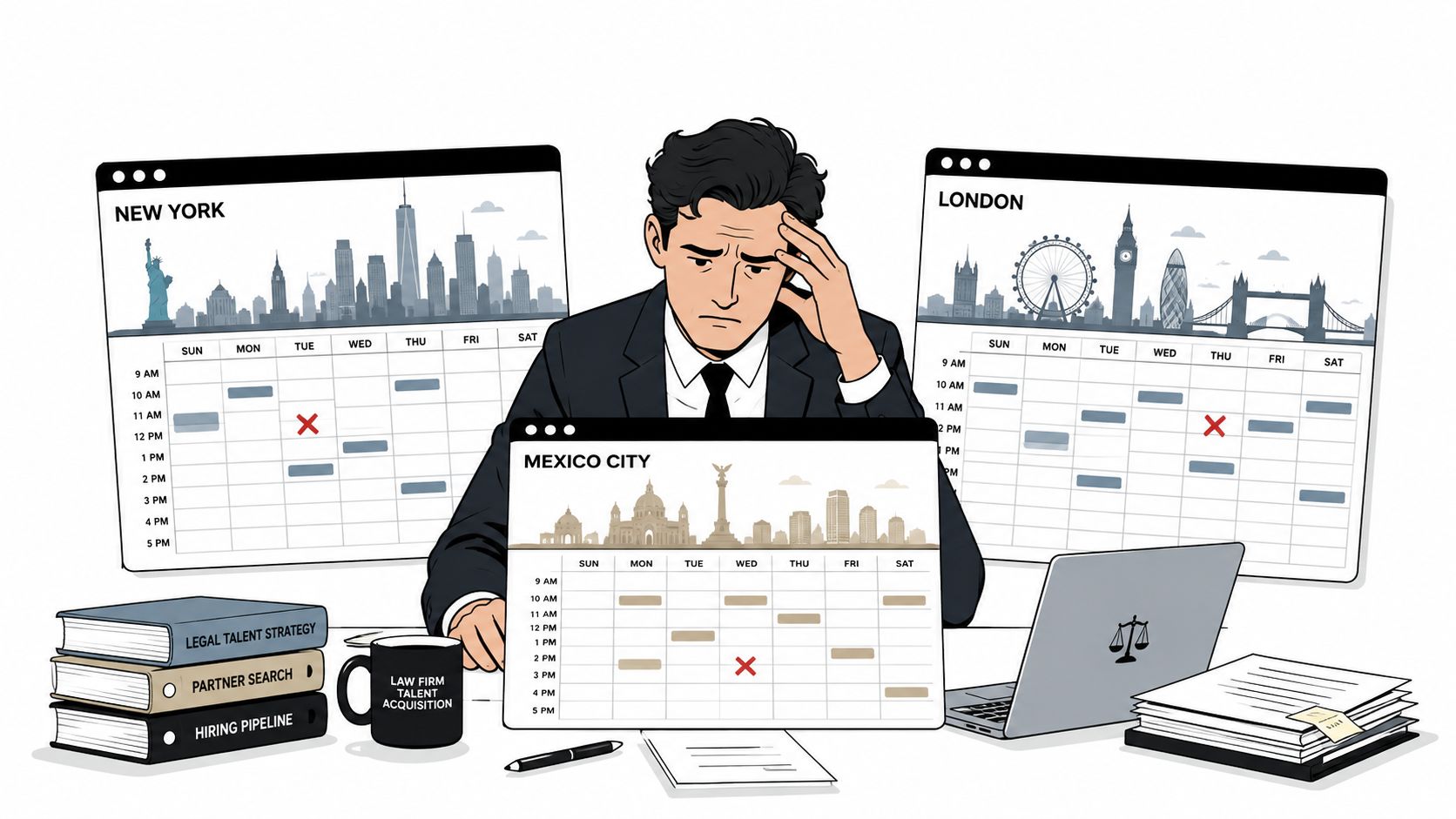
The problem is that legal hiring has no patience for drag. Partners bill, intake moves, cases stack up, and a promising paralegal candidate does not wait around forever while someone recalculates whether 3 p.m. ET is humane in Peru. In a global collaboration study, about 33% of meetings included employees in different time zones, and cross-time-zone meetings had 36% more attendees than single-time-zone meetings, which is a tidy way of saying this is routine work, not edge-case nonsense (study on synchronous collaboration).
A law firm isn't just trying to find a slot. It's trying to coordinate multiple decision-makers with different calendars, then do it without looking disorganized. That's harder when the candidate is in Latin America, the interviewer is on the U.S. East Coast, and the second-round panel is in Los Angeles pretending 4:30 p.m. is still a reasonable human hour.

Practical rule: if the scheduling exchange takes longer than the interview itself should have taken to book, your process is already failing.
There's also a revenue angle that firms underestimate. Research on distributed work shows that a one-hour increase in temporal distance can reduce synchronous communication by 11% (Rice University overview, Microsoft Research analysis). That's not abstract. It shows up as slower confirmations, more reschedules, and more chances for a strong candidate to disappear into a faster-moving pipeline.
For firms trying to tighten intake and hiring, support tools like AI-driven support for attorneys can help reduce the admin load around calendar coordination and follow-up. But the scheduling logic still has to be designed well, or the software just automates the mess.
Start with the overlap, but do not worship it. The mistake is treating “good enough for one meeting” as “good enough for the hiring process.” A better setup maps each person's local working hours, then finds the shared window where live conversations do not feel like a hostage negotiation.
The math matters because temporal distance has a real cost. A one-hour increase in temporal distance can cut synchronous communication by 11% in distributed teams, according to the Microsoft Research analysis. In practical terms, if your interviewer is in Chicago and your candidate is in Mexico City, or your panel stretches from California to Argentina, every extra hour shrinks the part of the day where people can talk without resentment.
The useful move is simple. List every participant's working hours, then compute the intersection, then protect that window like it is the last clean discovery folder on earth. For a hiring team spread across the U.S. and Latin America, the overlap is usually enough for a live screen, a competency interview, and a final partner meeting, but only if you stop wasting it on wandering, unfocused conversations.
Here is a practical way to think about it.
| Common US-to-LatAm Overlap Windows | |||
|---|---|---|---|
| US Time Zone | LatAm Region | Overlap Window (Local US) | Usable Interview Hours |
| Eastern | Colombia | Morning through mid-afternoon | Several hours if both teams keep standard daytime availability |
| Central | Mexico and nearby Central Time markets | Late morning through late afternoon | Several usable interview slots |
| Mountain | Colombia or Mexico depending on season | Mid-morning through early afternoon | Fewer, but still workable live options |
| Pacific | Latin America farther south | Late morning through early afternoon | Narrower window, so schedule discipline matters more |
A three-person panel can work if you assign one anchor window and one fallback window. The anchor handles live interviews. The fallback handles overflow when someone is in court, in transit, or doing the classic attorney move of vanishing without warning.
Cross-time-zone hiring gets easier when live time is reserved for actual decisions, not calendar theater.
Geography changes the math in a way that is easy to miss. The same research found that arranging teams north-south can preserve more overlap than spreading them east-west across longitudes, as noted in the Microsoft Research analysis. Two hiring setups can look similar on a map and still feel wildly different in real life.
Manual timezone arithmetic in Slack is where dignity goes to die. If your process depends on someone remembering whether Peru is currently one hour ahead of Mexico City, the process is already fragile. Shared booking pages, timezone-aware calendars, and UTC normalization are the tools that keep hiring from turning into a group project nobody asked for.
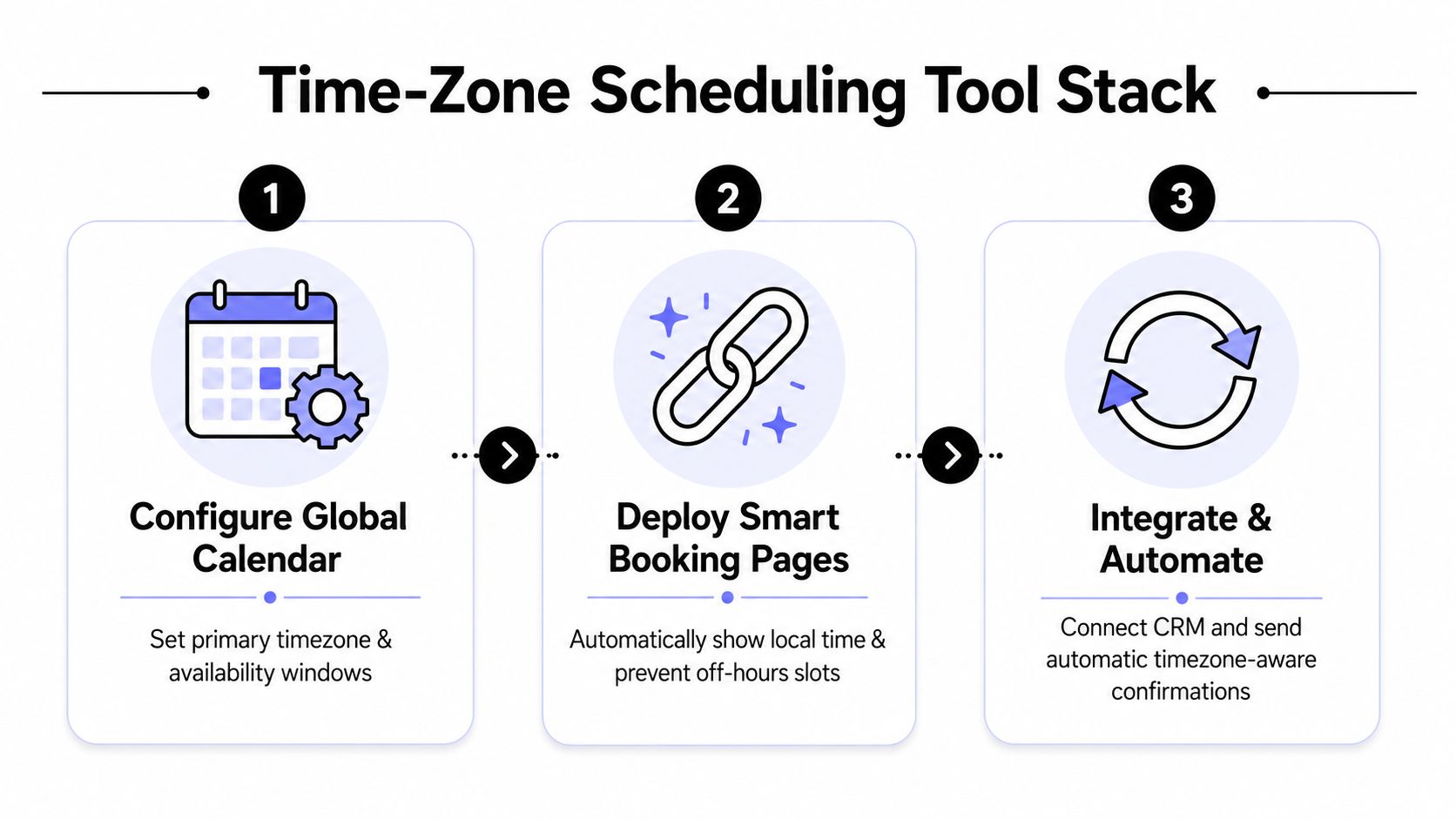
The technical pattern that works is boring in the best way. In Microsoft Dynamics 365 Field Service, booking operations are normalized to UTC inside the schedule assistant, the Gantt chart is shown in UTC, and bookings are converted back to each resource's local time when exiting the assistant (skdul.ai guide). That exact setup isn't the only way to run a calendar, but the logic is solid. Normalize the system, then translate for the human being on the other end.
Use a shared booking page so the software handles timezone conversion instead of making your team do math in email threads. Calendly, Cal.com, Microsoft Bookings, or another similar platform can show candidates only the slots that fit your firm's rules, which means fewer “Does 2 p.m. your time mean my time?” messages and fewer accidental off-hours invites. The point isn't the brand name, it's the removal of human error.
For candidate-facing scheduling, keep the setup strict:
The internal playbook on paralegal calendar management is worth using as a reference point if you want a cleaner setup for interview blocks, reminders, and team availability.
Practical rule: if you can't tell at a glance whether a slot is fair, your candidate definitely can't.
And don't assume the candidate's calendar is saving you. Check whether their system auto-detects timezone correctly, because bad device settings are a very efficient way to get someone on the wrong call at the wrong hour. If Outlook sync is part of your stack, troubleshooting Outlook Calendar sync is the sort of unglamorous fix that saves a lot of embarrassment.
A slot that looks clean in February can turn messy by March or November. The overlap you counted on does not always stay put, because major markets do not all change clocks on the same dates, and some places do not change them at all.
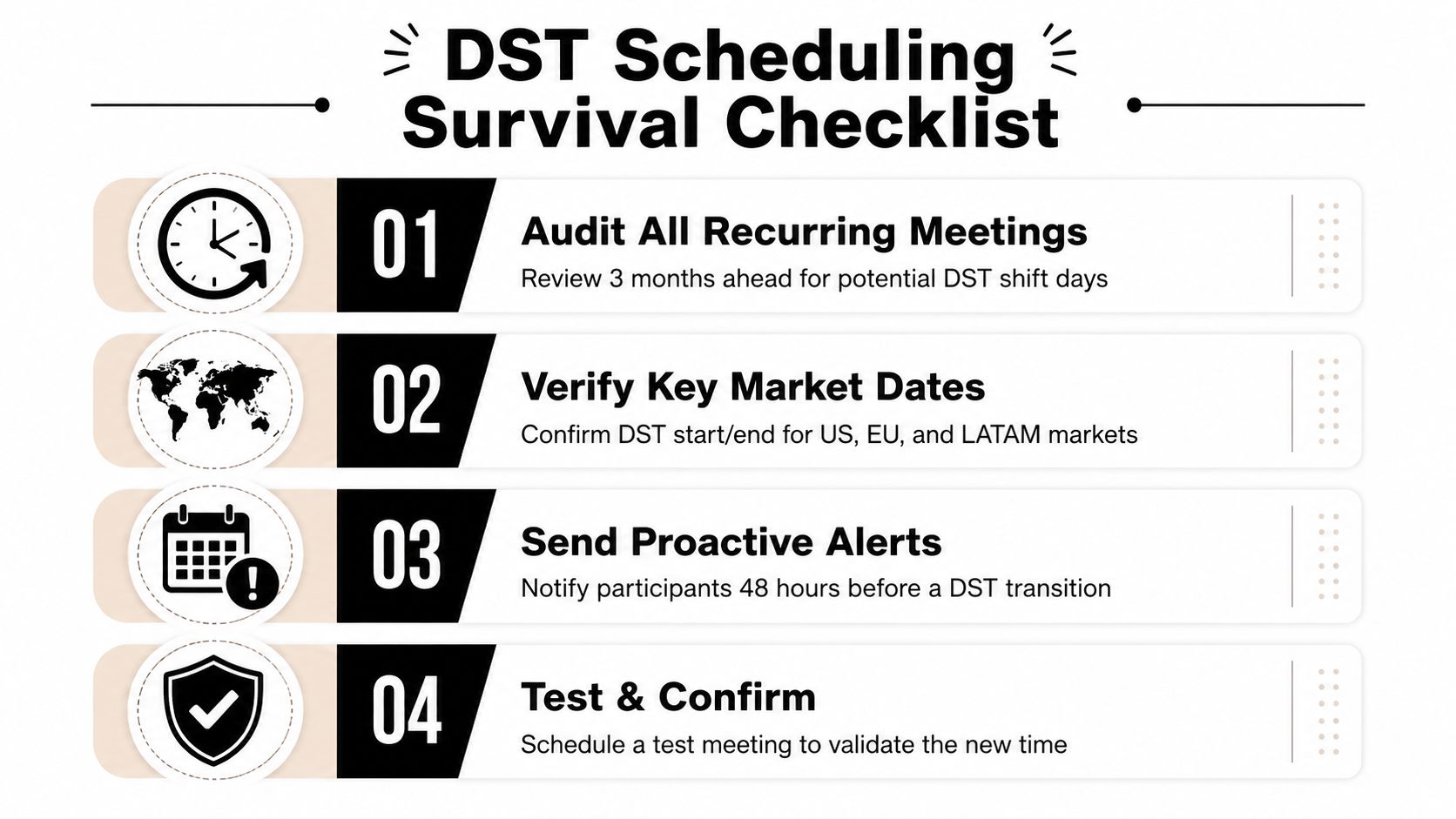
A recurring Chicago-to-Mexico City interview series can drift by an hour when one market shifts and the other does not. That kind of drift is not a corner case. It burns candidate trust, makes the firm look inattentive, and creates exactly the sort of calendar chaos that remote hiring does not need. The fix is timezone-aware scheduling that shows local times clearly, confirms invites in both calendars, and gives candidates proposed windows instead of freezing everything to a single clock reading (OnceHub overview of timezone scheduling issues).
Do the audit before the clocks move. Check every recurring interview, verify the relevant markets, and confirm the live slots again after the transition. Label times in UTC or local time explicitly, then recheck the schedule before DST hits so nobody gets shoved an hour off course.
A calendar invite can look correct in one inbox and wrong in another. One participant's system may update on time while another lags behind, and that gap is enough to send a candidate to the wrong meeting. If you are hiring across borders, recurring interviews should be treated as live scheduling objects, not fixed monuments.
The invitation has to carry more of the load:
Scheduling guidance from remote-team operations also points toward UTC normalization, calendar labels that stay explicit, and recurring events that get checked rather than trusted on autopilot (HubSpot resource on UTC normalization). That is the practical version of calendar management. Fewer assumptions, fewer missed interviews, fewer apologies that start with “our calendar did something weird again.”
Top paralegals know they have options. If your scheduling flow feels clunky, you're not just creating friction, you're signaling that the firm is going to be equally clunky after they join. That's why timezone-friendly scheduling is a competitive advantage, not a courtesy.
A 7 a.m. invite for someone in Bogotá isn't clever, it's careless. The candidate reads that as, “We didn't think about your reality before asking for your time.” A better approach is to offer a few options in the candidate's local timezone, label everything clearly, and follow up with async alternatives when live slots don't line up.
The firms that win strong remote talent make booking feel effortless. They don't make candidates translate calendars, infer timezones from a partner's assumption, or email back and forth just to find a reasonable conversation slot. They remove the guesswork, and that alone changes how the firm is perceived.
That matters more than most leaders admit. When scheduling is smooth, the candidate feels respected before the first interview even starts. When it's messy, they assume the rest of the process will be too, and they start looking for a better-run team.
A few habits pay off immediately:
The broader lesson lines up with the Overvue pre-hire assessment guide, which is useful context for firms trying to structure hiring more intentionally. Screening gets better when the candidate journey is designed to be respectful, not just efficient.
If you're already hiring remotely, the internal guidance on best practices for managing remote teams is worth folding into your process too, because the way someone is scheduled is usually a preview of the way they'll be managed.
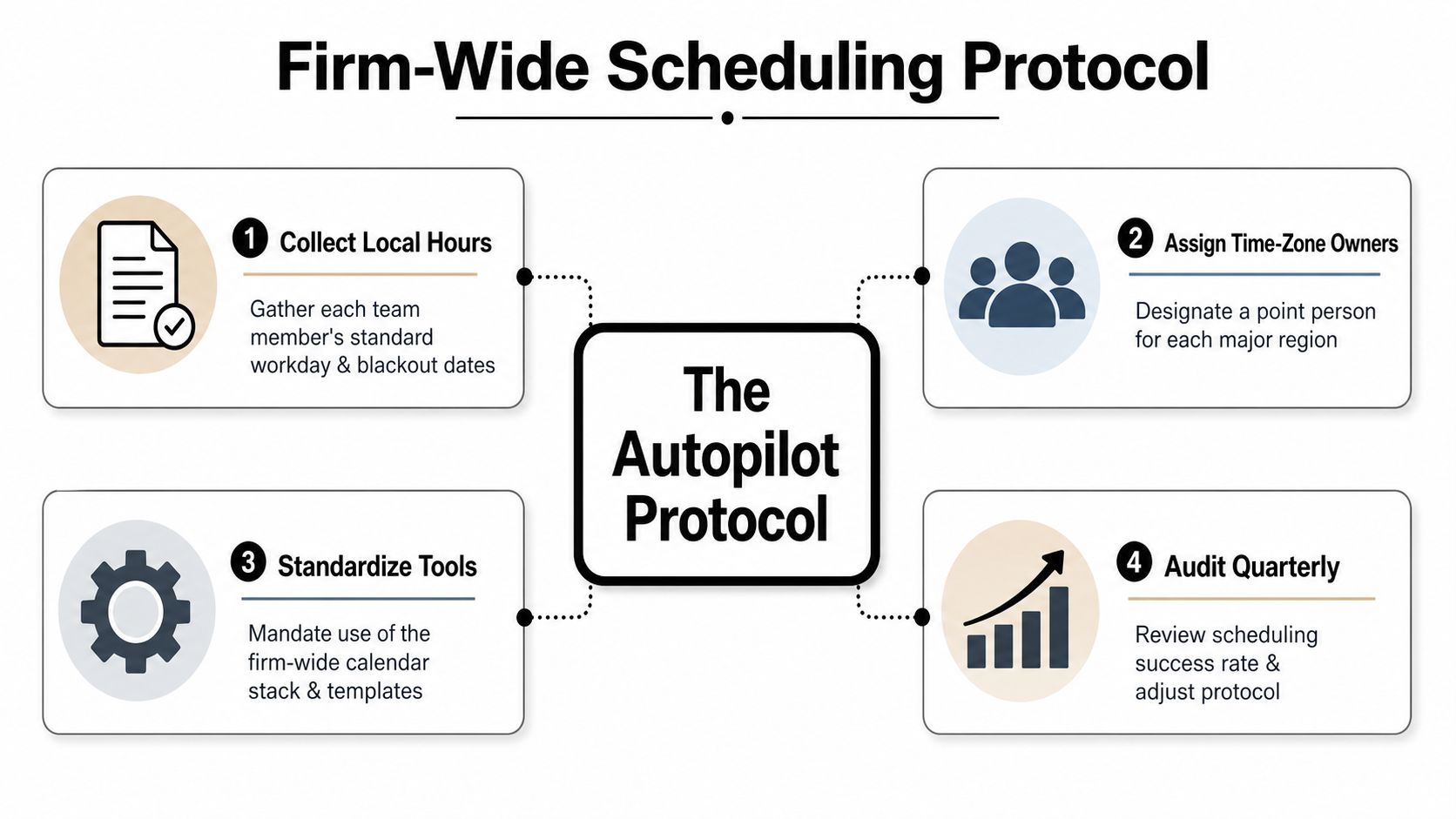
The best firms stop treating scheduling as a series of one-off favors and start treating it like an operating system. That means collecting each interviewer's local hours and blackout times in one shared roster, assigning a point person for each major region, and defining a few anchor windows that the team respects. If everyone can improvise, nobody is really in charge.
The next layer is fairness. Rotate inconvenient slots by region on a predictable cadence so the same geography doesn't always eat the early calls or late evenings. That's not a nice-to-have. It's how you keep resentment from settling into the hiring process before the person is even on payroll.
Define a pain threshold, then stick to it. Many teams use something like an acceptable local window during the workday and require explicit approval for anything outside it, which stops casual off-hours invites from becoming the norm. Keep meeting lengths short by stage, too. If a conversation can be tighter without losing substance, make it tighter.
For a law firm, the protocol can be ruthlessly simple:
If the numbers start drifting, fix the process, not the people. One scheduling guide recommends measuring attendance and late-join rate over four weeks instead of assuming the first impression is accurate (workmate.com). That's the right instinct. Calendar systems lie politely until you force them to tell the truth.
For onboarding the people you do hire, the internal guide on how to onboard remote employees pairs well with this protocol, because the same discipline that makes interviews clean also makes start dates less chaotic.
Bottom line: the schedule should survive without heroics.
Connect the booking tool to your applicant tracking system, send timezone-aware confirmations automatically, and keep the roster current. If you can see the whole process in one place, you can finally stop mortgaging your afternoons to calendar math and get back to hiring people who can help the firm.
If your firm keeps losing candidates to reschedules, fix the process this week. Pick one shared booking system, set a firm-wide pain threshold, assign regional timezone owners, and audit the next four weeks of interviews for late joins and avoidable churn. If you want a faster path, have your hiring team standardize the schedule first, then run every new paralegal interview through that same workflow.