 20 minutes read
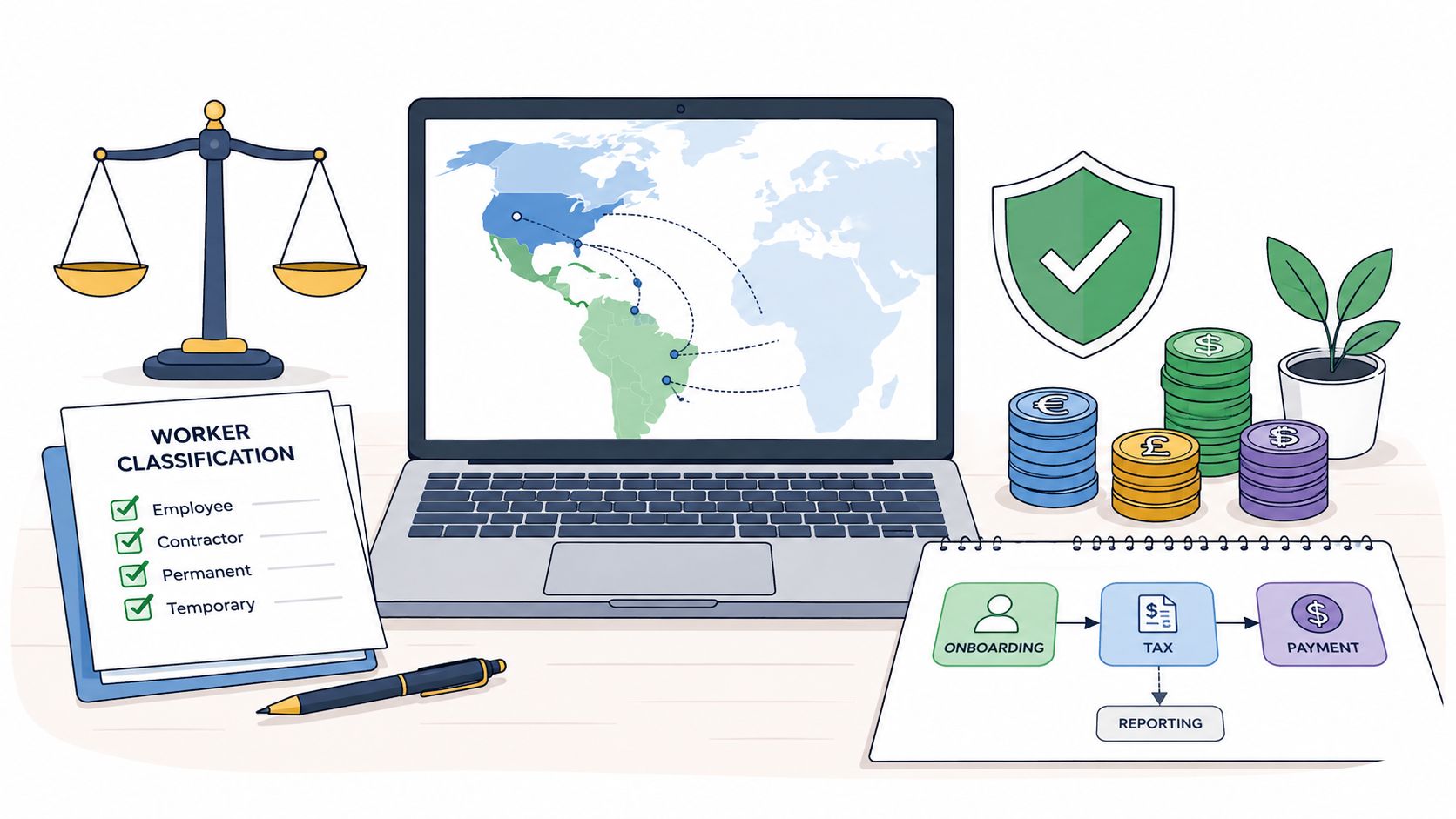
Finding a capable remote paralegal is often easier than paying one correctly across borders. The interview goes well, the candidate understands discovery, speaks fluent English, and can work with your case-management system. Then payroll enters the room carrying worker classification, local tax, social security, statutory benefits, withholding, reporting, currency, confidentiality, and termination rules. Suddenly, that “simple contractor” looks less simple.
The popular advice says to find talent first and sort out payroll later. That's backwards. For a US law firm, the payment model shapes onboarding, supervision, client confidentiality, continuity, and the cost of ending the relationship. A classification mistake doesn't stay in finance. It can disrupt a matter, expose client data, or leave a partner explaining a missed deadline.
These international payroll best practices turn the problem into a practical operating sequence. Latin American hires deserve country-specific review, not a recycled US contractor template. I'll also point to HireParalegals as a relevant source of payroll management and Latin American compliance guidance, alongside this overview of remote legal teams and attorney assistants. Let's get to the part that keeps your Friday evening intact.
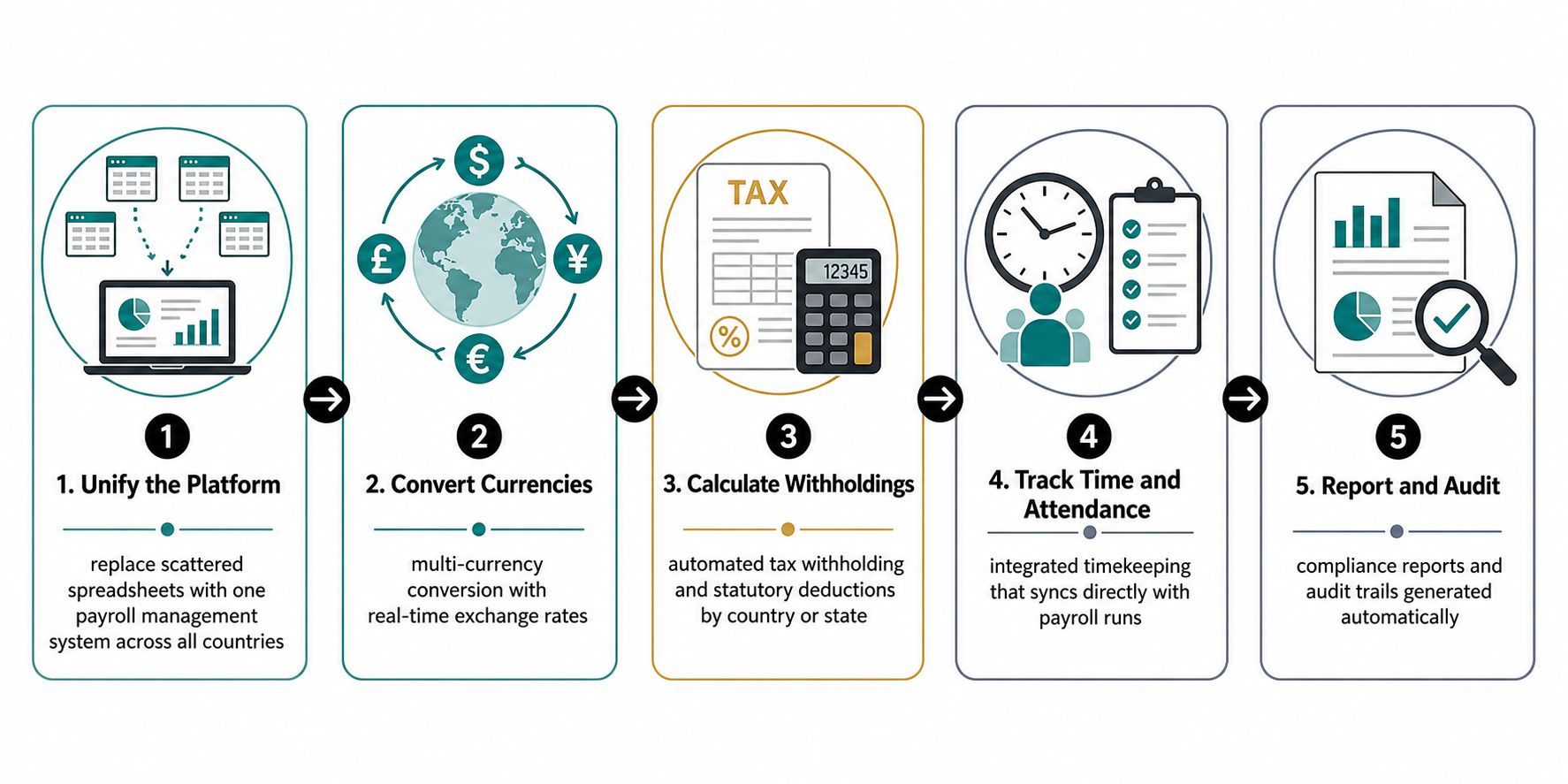
Spreadsheets belong in planning, not in the control system for paralegals paid across countries, currencies, tax regimes, and pay calendars. A centralized platform gives a US law firm one record for worker details, approvals, pay records, deductions, payment status, and reporting.
The need is practical. In a 2023 ADP survey of 1,486 payroll professionals, only 33% reported average payroll accuracy of 90% or above across all countries, down from 52% before 2020. ADP later reported an overall mean payroll accuracy of 78%, compared with 75% the prior year. Review the ADP guide to global payroll management and best practices.
Centralization improves visibility, but it does not replace judgment. Keep a human approval step for unusual hours, classification changes, bonuses, deductions, and final payments.
Select a platform that connects with your HRIS, finance tools, time tracking, and case-management workflow. ADP reports that just under one-third of companies integrate payroll data with other global business systems across every country they operate in, while another 33% have only partial global integration. Its ADP payroll technology guide supports choosing connected systems over isolated payroll software. For firms using Dynamics 365, this payroll integration guide for Dynamics 365 offers a useful implementation reference.
Before signing, require the provider to:
A provider can calculate pay correctly and still create risk if it cannot show who approved the run or where client-sensitive worker data traveled. Connect payroll to your broader contract management system, so payment records, contracts, and approvals support continuity when a matter cannot wait for a missing administrator.
The first question isn't, “What rate does this paralegal want?” It's, “What relationship are we creating?”
A firm that controls the person's schedule, assigns daily tasks, supplies tools, supervises legal work, and expects ongoing availability may be describing an employment relationship, regardless of what the contract calls it. The OECD describes “false” or “bogus” self-employment as misclassifying what should be an employment relationship as independent contracting, and reports that about half of the countries mentioning self-employment raised the issue in their reporting. The OECD-related global payroll discussion makes the operational point clear. Classification needs review before payment, not after an authority asks questions.
For a new country, get local advice on five matters:
A local entity gives the firm direct control but creates administrative and compliance overhead. A PEO or EOR can make sense when the firm has a small or uncertain footprint. A contractor model is appropriate only when the facts support independence.
Do not treat “international” as a magic compliance word. A platform might process payments while leaving classification, legal review, confidentiality controls, and local registration decisions with you. The payroll compliance guidance from HireParalegals is useful for framing the operational questions, but country-specific legal and tax advice still belongs with qualified professionals.
A US law firm can approve a salary in dollars while its remote paralegal receives a very different amount in local currency. Set both values before the first payment, or the exchange rate will make the decision for you.
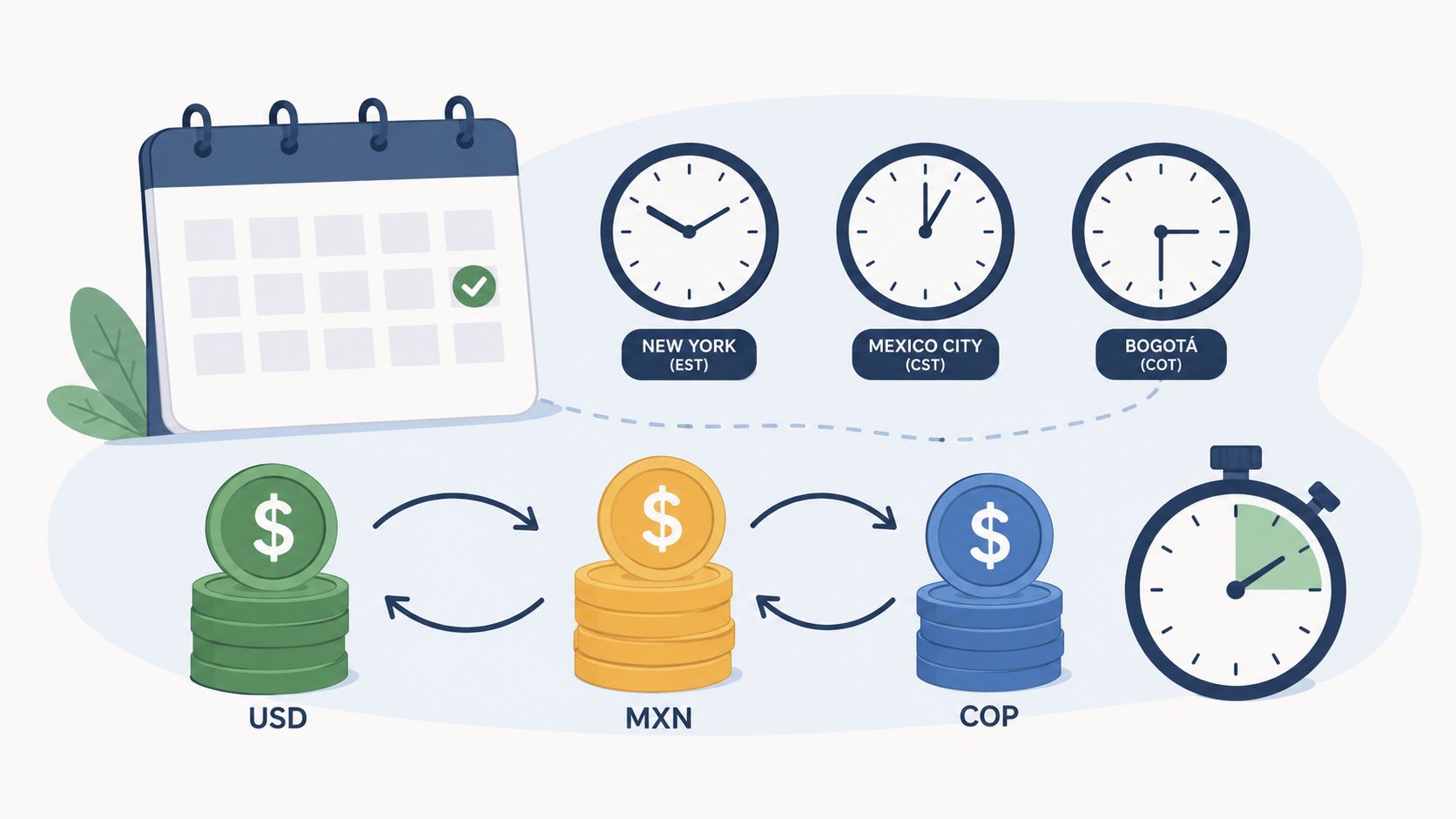
Put the currency choice in the offer and employment or contractor agreement. Decide whether compensation is paid in local currency or a hard currency such as USD or EUR, then document the FX policy, including use of a spot, mid-month, or fixed rate. Keep a multi-currency record for every payroll run with the local amount, conversion rate, and reporting-currency equivalent. The distributed workforce payroll guide explains this documentation discipline.
Payment timing is a client-service control. A paralegal in Bogotá should know whether “payday” means the US initiation date, the intermediary-bank date, or funds available in the local account. Confusion here damages trust and can interrupt work on active matters.
Create a written calendar with payroll cutoffs, approval dates, expected settlement dates, and the person responsible for investigating delays. Shared shared calendar tips for freelancers can help coordinate payroll deadlines across time zones, but the firm still owns the approval process. Test the payment route before the first full run, confirm beneficiary information securely, and record fees and FX spread instead of reviewing only the headline exchange rate.
For Latin American paralegals, ask:
The cheapest transfer is not automatically the best choice. A lower fee has little value if settlement is unpredictable or the provider cannot produce an audit trail. Reliable payment supports onboarding confidence, continuity, and focused client work.
A generic contractor agreement is not a global employment strategy. Local law can fill gaps in your document, and it rarely fills them in the firm's favor.
Your agreement should describe the relationship as it will operate in real life. Define the role, authority limits, expected hours, time-zone availability, pay structure, approved expenses, leave or vacation treatment, confidentiality, data access, intellectual property, notice, final pay, dispute resolution, and governing language. For a paralegal, add practical boundaries around client contact, legal research, document handling, and attorney supervision.
Termination provisions deserve special attention. A worker may have rights tied to notice, cause, severance, accrued leave, or statutory payments. A vague “either party may terminate at any time” clause won't necessarily override mandatory local rules.
Use English and local-language versions where appropriate, and state which version governs if the texts conflict. Have a local lawyer review the template for each country where the firm expects recurring hiring. That's cheaper than discovering during an exit that your template ignored mandatory obligations.
Confidentiality and IP language also need local-law review. For Latin American paralegals, don't rely on an aggressive non-compete as your main protection. Focus on enforceable confidentiality, limited access, return or deletion of records, assignment of work product where permitted, and clear post-engagement obligations.

Practical rule: If the contract doesn't explain who can access client files, what happens when access ends, and how the firm confirms deletion or return, the contract isn't finished.
Store the signed agreement, amendments, approvals, and onboarding records together. Your payroll file and your matter-risk file shouldn't contradict each other.
Time zones don't create missed deadlines. Vague ownership does.
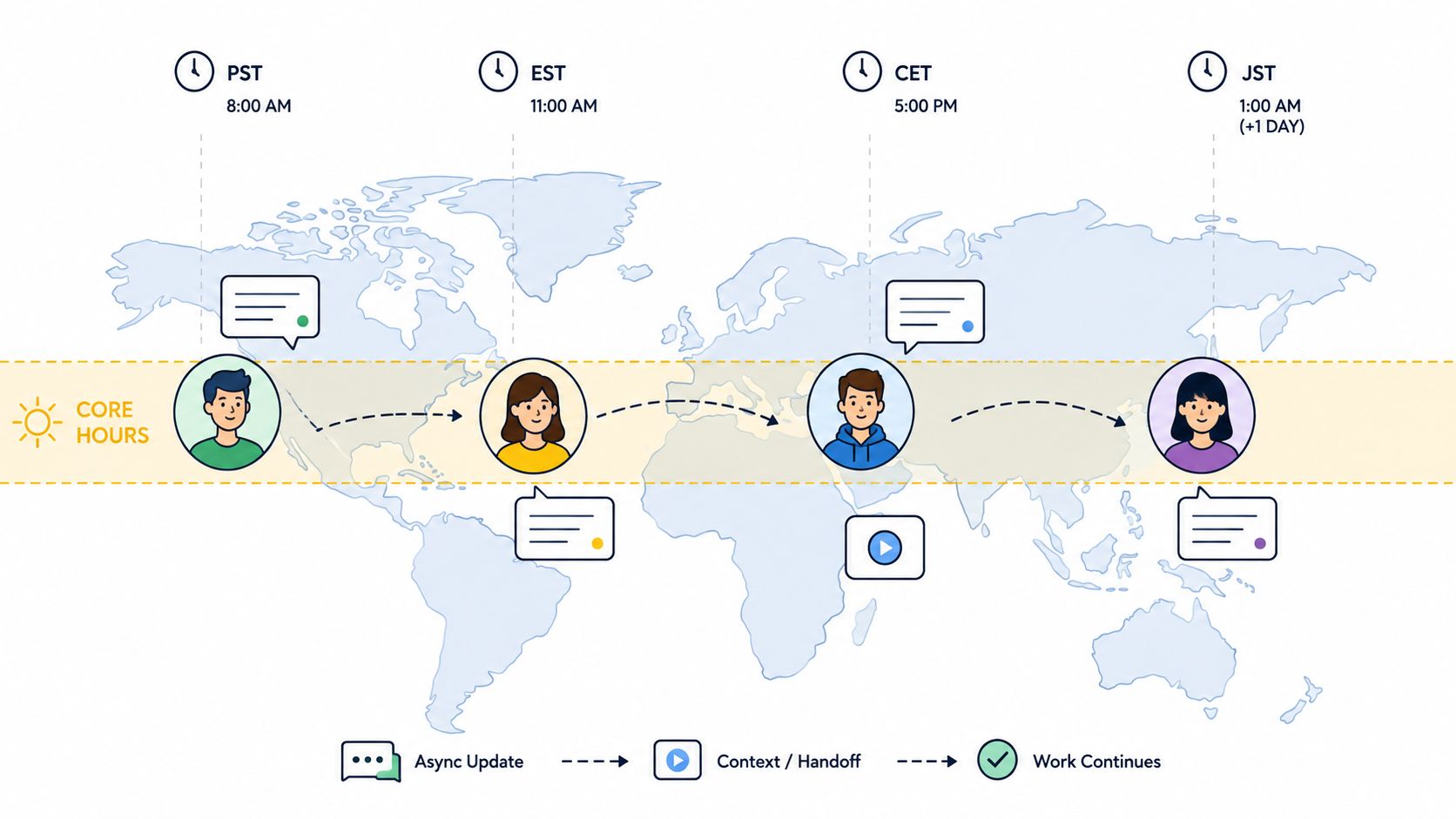
A New York firm working with paralegals in Mexico City or Bogotá needs written rules for urgent matters, ordinary requests, handoffs, and client-facing availability. Set core collaboration hours, then design the rest of the work for asynchronous execution. Don't make every task wait for a meeting just because the team isn't sitting in the same office.
Define:
Time records should show what the firm paid for and what the worker was expected to do. That doesn't mean tracking every keystroke. It means agreeing on work windows, approval rules, overtime or extra-hours treatment where relevant, and the records needed to support the chosen classification.
A shared task board such as Asana, Monday.com, or Notion should show owner, status, deadline, dependencies, and the location of the approved source document. For complex instructions, a short Loom recording can save a long chain of confused messages.
Use the scheduling guidance for teams across time zones to formalize the workflow. A calendar also helps, especially when US daylight-saving changes affect overlap with Latin America.
Currency hedging is not a badge of financial sophistication. It's a way to stop a stable staffing plan from becoming a monthly guessing game.
Start by separating predictable payroll from variable payroll. If the firm expects to pay the same team in the same currency for a defined period, a forward contract may provide useful budget certainty. If headcount or compensation changes frequently, spot conversion may be simpler and less restrictive.
The contract should explain who carries FX movement and when the firm can revisit compensation. Don't promise a local-currency amount, budget in USD, and hope everyone feels generous when the rate moves. That arrangement creates friction for the worker and noise for finance.
Before using a forward, document:
A provider such as Wise or OFX may offer currency tools, but compare terms carefully. Forward contracts can reduce volatility while creating obligations if your payroll shrinks. That trade-off is acceptable only when the underlying payment need is reasonably stable.
For a small practice, a clearly documented FX policy may be enough. For a firm with recurring cross-border payroll, formal hedging can make forecasts more reliable. Either way, make the decision at offer stage, not after the first payment lands short.
Compliance changes after onboarding. Tax rules get updated, benefits become mandatory, registrations shift, and the worker's role can drift away from the facts that supported the original classification.
Use a three-part control framework:
A practical global payroll compliance framework also recommends a quarterly self-audit and maintaining an evidence pack that can be assembled within 48 hours. Keep that evidence pack organized by worker and country, with contracts, approvals, reports, payment records, filings, and remediation notes.
For each paralegal, review whether the actual work still matches the documented model. Does the firm control the hours more tightly now? Has the worker become economically dependent on the firm? Are they performing duties that require a different local treatment? Did the firm add bonuses, expanded authority, or client-facing responsibilities without updating the agreement?
Also check legal confidentiality. Payroll files contain personal data, while paralegal workflows contain client information. GDPR-covered operations may transfer payroll data outside the EU or EEA only with an appropriate transfer mechanism, and a payroll-specific Record of Processing Activities should map payslips, tax IDs, bank files, time records, and statutory reports. The cross-country payroll data compliance guidance notes that breach-notification duties vary by jurisdiction and that GDPR can require notification within 72 hours in some cases.
Document what was checked, who checked it, what failed, and what changed. Auditors like evidence. Partners like fewer surprises.
Payroll compliance keeps the relationship safe. Performance design makes the relationship worthwhile.
Don't assign a newly hired junior paralegal the same work as a specialist who can manage complex discovery or prepare a research memo for attorney review. Define levels by actual capability, not by a flattering title. Then connect each level to permitted work, supervision, turnaround expectations, quality review, and access to client systems.
A useful structure is:
Track a small set of metrics consistently. Billable hours, task completion, turnaround time, error rate, partner feedback, and client-service impact tell you more than a vague claim that someone is “busy.” Review the numbers with the paralegal so the dashboard supports coaching rather than becoming a surprise weapon at evaluation time.
For ROI, use a transparent formula:
(Billable hours × billing rate) + partner time saved − paralegal cost
That formula isn't a promise of profit. It's a decision tool. If a senior paralegal reduces attorney review time but has fewer directly billable hours, the time saved still belongs in the analysis. If a junior worker produces volume but creates rework, the error cost belongs there too.
Be careful with legal confidentiality when building dashboards. Use matter IDs, role-based permissions, and minimum necessary detail. A performance report should prove operational value without becoming another uncontrolled copy of the client file.
One paralegal may own a process. One paralegal should not be the process.
Illness, family emergencies, resignation, connectivity problems, and abrupt changes happen. A firm that relies on one person for immigration discovery, contract review, billing support, or filing preparation has turned a staffing choice into a continuity risk.
Start with the five workflows that would hurt most if they stopped. For each one, create a short playbook containing:
Assign a primary and secondary owner for every critical process. The secondary shouldn't merely know that the document exists. They should perform the work while the primary observes, then lead a later run while the primary reviews.
Give every new paralegal access only to the systems and matters required for their role. Teach them where the playbooks live, how to update them, how to record a handoff, and how to escalate a client-sensitive issue. That turns redundancy into a routine rather than a panic exercise.
Review the documentation quarterly. Outdated instructions are dangerous because they look authoritative while sending people down the wrong path.
A backup worker also needs a compliant payment and confidentiality arrangement. Don't bring someone into a client matter as an emergency substitute before confirming classification, contract terms, access permissions, and payment mechanics. Speed is valuable. Uncontrolled speed is how firms end up mortgaging the office ping-pong table.
| Item | Implementation complexity | Resource requirements | Expected outcomes | Ideal use cases | Key advantages |
|---|---|---|---|---|---|
| Centralize Payroll Through a Single Platform (Don't Let Spreadsheets Run Your Life) | Medium–High: data migration and integrations | Payroll platform subscription; IT/setup time; per-employee fees | Fewer errors, faster runs, automated compliance | Firms with multi-country payrolls and distributed paralegals | Multi-currency, automated withholding, audit trails |
| Know Your Compliance Framework Before Hiring (Don't Learn This the Hard Way) | Medium: legal research and country-by-country analysis | Local employment lawyers or PEO/EOR; budget per country ($500–$2k) | Lower misclassification risk and legal exposure | First hires in new jurisdictions or complex employment law markets | Prevents fines/back-pay, clarifies mandatory benefits |
| Master Currency Exchange and Payment Timing (Spot the Arbitrage, Lock in the Savings) | Medium: ongoing monitoring and scheduling | FX services (Wise/OFX), treasury time, payment tooling | Lower transaction costs and improved cash forecasting | Frequent cross-border payrolls with multiple currencies | Batch payments, local rails, reduced FX margins |
| Establish Clear Contracts with Defined Scope, Hours, and Termination Terms | Medium: drafting + local legal review | Local legal review ($1.5k–$3k), bilingual templates | Fewer disputes, defensible terminations, clearer expectations | Any cross-border hires, especially client-facing or sensitive roles | Protects IP/confidentiality, clarifies employment status |
| Implement Timezone-Aware Scheduling and Async Communication Protocols | Low–Medium: process design and tool adoption | Collaboration tools (Slack, Loom, PM), manager time to set protocols | Faster turnaround, fewer meetings, continuous progress | Distributed teams across overlapping time zones | Async efficiency, better retention, 24/7 workflow |
| Use Currency Hedging and Forward Contracts for Payroll Predictability | Medium–High: financial agreements and monitoring | FX provider offering forwards, upfront capital, finance expertise | Fixed payroll costs and predictable budgeting | Stable, recurring payrolls in volatile currencies | Locks rates, protects margins, reduces forecasting variance |
| Track and Audit Payroll Compliance Quarterly (Build a Second Pair of Eyes Into the Process) | Medium: recurring reviews and reconciliation | Local accountants/PEO or compliance specialist ($200–$5k/quarter) | Early detection of errors and audit readiness | Firms with multi-jurisdiction payrolls or regulatory scrutiny | Avoids penalties, provides documented evidence |
| Segment Paralegals by Seniority and Set Performance Metrics to Justify ROI | Medium: role design and metrics tracking | HR/ops time, performance dashboards, reporting tools | Improved quality, measurable ROI, clearer delegation | Scaling remote teams needing accountability and cost justification | Matches tasks to skill, quantifies value, improves throughput |
| Build In Redundancy and Cross-Training to Prevent Single Points of Failure | Medium: documentation and structured training | Time for process docs, cross-training sessions, knowledge repo | Continuity during absences, faster onboarding, fewer disruptions | Critical workflows where deadlines and continuity matter | Resilience, institutional knowledge, reduced single-point risk |
The cleanest implementation sequence is boring, deliberate, and effective.
First, choose the worker model before recruiting. Decide whether the facts support a contractor arrangement, whether an EOR or PEO is more appropriate, or whether the firm needs a local entity. Then obtain country-specific classification and tax guidance before the offer goes out, especially for a Latin American hire.
Next, issue a compliant contract. Define scope, hours, time-zone expectations, compensation currency, payment timing, statutory benefits, vacation or leave treatment, confidentiality, IP, access controls, notice, final pay, and termination procedure. If the worker will handle client information, the contract must align with the firm's security and confidentiality policies.
Configure payroll and payment controls before onboarding finishes. Connect the payroll platform to the relevant HR, finance, timekeeping, and reporting systems. Set approval rights, payment calendars, FX rules, bank verification, exception alerts, and reconciliation steps. Then document the worker's onboarding, including classification reasoning, local registration, tax setup, required benefits, system access, training, and emergency coverage.
Verify every pay run. Before payment, check worker data, tax treatment, time records, approvals, and changes. During processing, review calculations and variances. After processing, reconcile the payroll register to the ledger, bank confirmation, tax and social security payments, and benefits funding.
Use this compact review list for each worker:
A local entity makes sense when the firm expects sustained scale in a country and can support local administration, registrations, filings, and employment obligations. It offers control, but it also creates a permanent operating responsibility.
A PEO or EOR is usually the practical route for a small or uncertain international footprint. Strada's 2026 Global Payroll Workforce Possibility Report found that only 22% of organizations operate a single global payroll platform, while the average enterprise runs nearly five payroll systems. The same report found that 68% of organizations operating in five or more countries couldn't immediately see payroll processing status across all locations, and that 2.6% of annual payroll spend was lost on average to errors, rework, compliance failures, and inefficiency. Those findings are summarized in global payroll industry reporting. Fragmentation is expensive, even when every individual vendor seems reasonable.
A contractor arrangement belongs only where the facts support genuine independence. The label won't rescue a relationship that functions like employment. Review classification before payment and whenever the role changes.
HireParalegals is one practical option for US firms that need vetted remote legal talent alongside payroll administration and guidance for Latin American hires. Its Contractor of Record option addresses contracts, payroll, and IP protection as part of the engagement. The firm should still obtain appropriate local legal and tax advice, because no platform can turn country-specific obligations into a universal checkbox.
The best international payroll practices are not about making payroll invisible. They're about making ownership, evidence, payment, confidentiality, and continuity visible enough that the firm can scale without gambling with client service. Start with your next cross-border hire. Decide the model, get local guidance, configure the controls, and build the backup before the first invoice or pay run lands.
Ready to make your next remote paralegal hire without leaving classification and payroll to chance? Talk with HireParalegals about vetted legal talent, payroll management, and Latin American compliance support, then have your local legal and tax advisers validate the structure for your firm.