 14 minutes read
If you're searching for construction lawyer jobs, a polished résumé alone won't distinguish you. Firms want attorneys who can read a project schedule, identify contractual risk, communicate with technical professionals, and move a dispute toward resolution without losing sight of the client's commercial objective. That combination makes construction law different from a general legal role and creates a wide range of career outcomes.
The market includes litigation firms, transactional construction practices, real estate departments, insurers, developers, contractors, and in-house legal teams. Compensation can be attractive, but it varies sharply by geography, seniority, firm structure, and the complexity of the work. The strongest candidates understand those differences before they apply.
This roadmap explains what firms assess, where hiring signals appear, how to prepare for interviews, how to interpret salary information, and how to choose between firm, in-house, and boutique paths. It also addresses the practical role of remote legal support, including how medical practices and other organizations can use specialized administrative talent without assigning unlicensed staff work that requires legal or clinical judgment.
Construction lawyer jobs sit between contract law, commercial litigation, real estate, insurance, infrastructure, and project operations. A junior generalist may spend much of the day researching a discrete legal question. A construction attorney may instead review a change-order dispute, interpret notice provisions, assess delay documentation, coordinate with an engineer, and advise a client before the disagreement becomes a formal claim.
That project context explains why these roles aren't usually treated as entry-level legal positions. One current salary estimate places average annual construction lawyer compensation at $107,482, with reported weekly pay of $2,067, monthly pay of $8,957, and an hourly rate of $52. The same estimate places the reported range between $82,991 and $127,819, with the middle 50% between $94,663 and $118,127. Those figures come from Salary.com's construction lawyer salary estimate, and they should be read as market indicators rather than guaranteed offer levels.
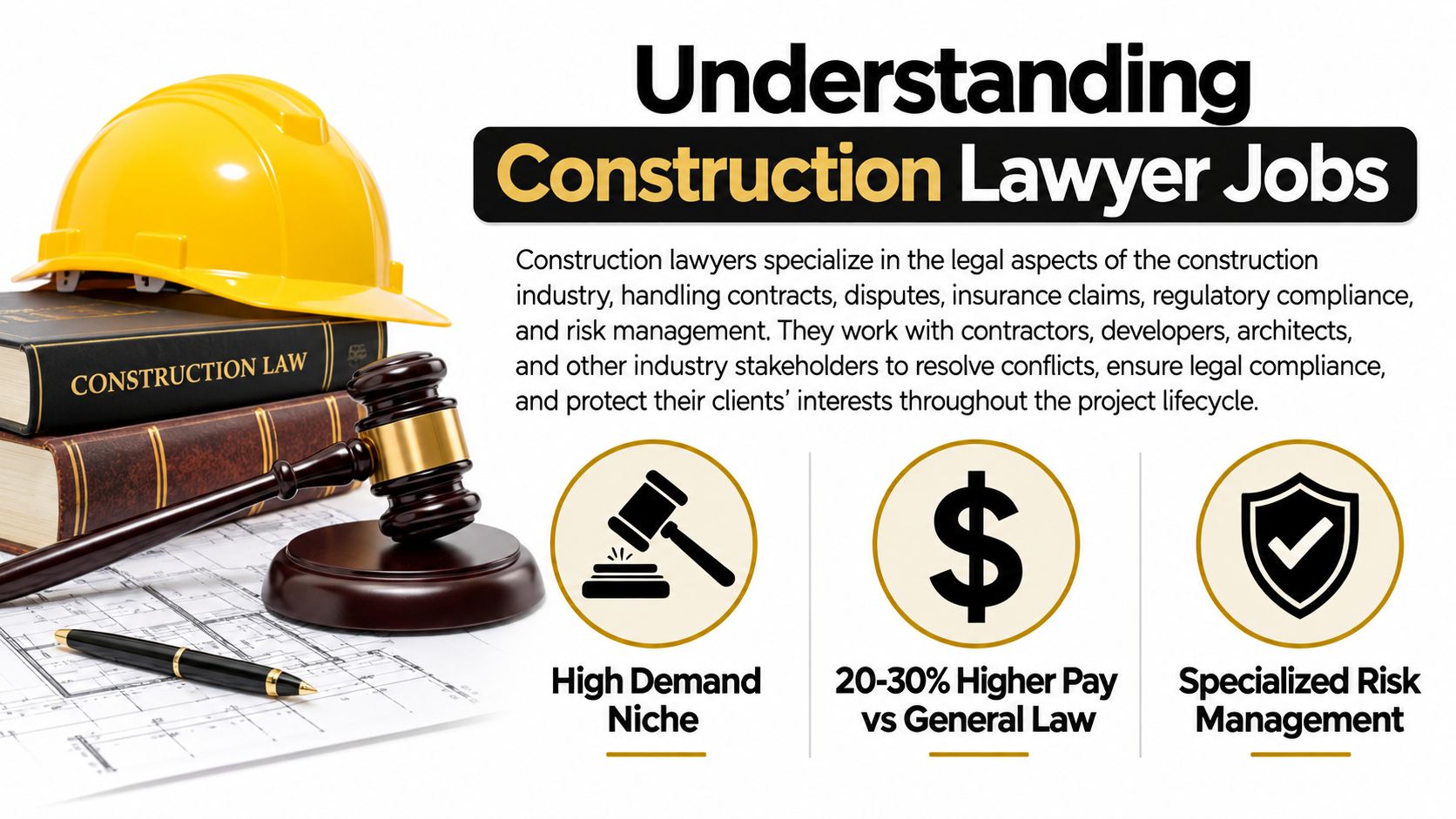
The daily work depends on the client and the stage of the project. A contractor-facing attorney may draft contract language, preserve claims, and negotiate payment issues. Counsel for a developer may focus on procurement, design responsibility, financing conditions, insurance, and warranty exposure. A dispute lawyer may build the factual record for mediation, adjudication, arbitration, or litigation.
The specialty also serves clients with different risk tolerances. Contractors often need practical advice that protects cash flow and preserves notice rights. Lenders and insurers may prioritize documentation, indemnity language, and allocation of risk. Medical practices may encounter construction counsel when opening, renovating, or leasing facilities, but their internal teams generally need administrative support rather than a remote worker making legal decisions.

Practical rule: Firms hire for project judgment, not just familiarity with legal terminology.
Construction law also follows project volume and commercial activity. The broader U.S. legal labor market is projected by the Bureau of Labor Statistics to include about 864,800 lawyer jobs, grow by 4% from 2024 to 2034, and generate roughly 31,500 openings per year, as summarized by Sartori Global's real estate and construction legal overview. Construction law therefore has a durable place in the profession, but individual hiring can still rise or slow with infrastructure spending, development activity, insurance claims, and dispute volume.
A JD and bar admission establish that you can practice law. They don't prove that you can manage a construction file. Hiring partners usually look for a second layer of evidence, practical fluency with contracts, project records, negotiation, dispute resolution, and communication with people who don't speak in legal abstractions.
Start with the formal floor:
A construction law résumé should make those capabilities visible. “Assisted with litigation” is weaker than a clear description of the work, such as preparing a chronology from project correspondence, analyzing notice compliance, or drafting a settlement position for attorney review. Never overstate your role, especially where a partner or supervising lawyer made the final decision.
A market listing for Tampa, for example, reports that construction lawyer roles commonly require a JD, bar admission, construction-law knowledge, contract and dispute-resolution skills, and strong negotiation and communication abilities. The same construction lawyer job-market source reports a typical annual range of roughly $74,700 to $97,300, with an average of $95,094. That regional data reinforces the need to evaluate the actual role rather than rely on the title.
Practical evidence can include redacted drafting samples, a writing sample analyzing a delay or payment issue, a description of mediation preparation, or a concise explanation of how you worked with technical consultants. Continuing education can help, but a certificate won't compensate for an inability to explain a change order or identify a defective notice.
Career guidance from Juris Education's construction lawyer pathway describes work across specialist firms, general-practice construction teams, in-house roles, and dispute-resolution settings. It also emphasizes drafting, advocacy, project management, and collaboration with contractors, architects, engineers, and clients. Those are useful signals because they mirror the work employers need completed, not merely the subjects candidates studied.
The best opportunities often reveal themselves before a formal posting appears. A firm that is adding attorneys to its real estate group, publishing analysis about infrastructure disputes, or recruiting support for a busy claims practice may already be experiencing demand. Candidates should track those signals instead of treating every job board listing as equally valuable.
Words such as “construction contracts,” “delay claims,” “payment disputes,” “surety,” “design professional liability,” and “change orders” indicate a practice with a defined workflow. A posting that lists only “commercial litigation” may still involve construction matters, but you'll need to ask how much of the docket is construction-related.
Industry directories can help you identify employers connected to contractors, builders, engineering firms, and infrastructure projects. Browsing LatoJobs engineering job categories can provide useful context about the construction and engineering organizations that may generate legal work, even when they don't advertise attorney positions in the same place.

Use a simple tracking sheet with the employer, role, practice description, location, contact, application date, response, and interview outcome. The purpose isn't administrative perfection. It's to learn whether your applications are reaching the right decision-makers and whether your materials communicate relevant experience.
Networking works better when the request is specific. Ask a construction partner about the types of disputes entering the practice, ask a claims professional which contract issues cause recurring problems, or ask an in-house lawyer how project teams involve legal counsel. Those conversations create better market intelligence than sending a generic message that says you're interested in “any opportunity.”
Remote legal support can also be part of a firm's staffing model. A construction practice may use a remote paralegal or legal assistant for document indexing, chronology preparation, deadline tracking, discovery organization, or first-pass file review under attorney supervision. A platform such as HireParalegals' construction law paralegal resource can be relevant when a firm needs specialized support without assigning legal judgment to an administrative professional.
For medical practices, the boundary is especially important. A remote medical virtual assistant may coordinate records, appointments, insurance communication, or administrative follow-up, but shouldn't provide legal advice or independently negotiate construction claims. If the assistant or another outside vendor can access protected health information, the practice needs a written business associate agreement that defines the services and requires compliance with applicable privacy and security obligations, as described in HHS sample business associate agreement provisions.
Construction law interviews test whether you can turn legal doctrine into a project-aware decision. Interviewers may give you a short scenario involving a late notice, disputed scope, defective work, unpaid invoices, or a design change. They want to hear how you identify facts, preserve options, communicate risk, and decide what needs attention first.
Bring three or four examples that show different parts of the work. One should involve drafting or reviewing a notice or contractual clause. Another should demonstrate parallel deadline management. A third should show negotiation, mediation preparation, or collaboration with a technical professional.
Use a clear structure:
A strong answer might explain how you separated entitlement from quantum, confirmed notice requirements, identified missing project records, and recommended a next conversation with the client. A weak answer recites general contract principles without showing how those principles affected the project.
Interviewers may ask whether a client should issue a notice immediately, accept a proposed change order, pursue mediation, or escalate a payment dispute. Don't rush to a confident conclusion when the facts are incomplete. State what you would verify, identify the contractual deadline, explain the risk of waiver, and distinguish legal advice from business preference.
Your writing sample should reflect the same discipline. A concise memorandum that organizes facts, governing provisions, uncertainty, and recommended next steps is often more persuasive than a long research paper. Candidates who need a refresher can review this practical guide on how to write a legal memorandum.
You can also use practice job interviews with AI to rehearse concise answers, but don't let rehearsal make you sound scripted. The final interview should show listening, measured analysis, and an ability to explain a difficult issue to a client who needs a decision rather than a lecture.
Interview standard: Explain what you would do first, what information you need, and how you would protect the client while that information is collected.
Construction law can pay well, but the phrase “construction lawyer salary” hides several different markets. A national estimate places average annual pay at $100,626, with most jobs clustering between $79,000 and $103,000 and top earners reaching $131,000, according to ZipRecruiter's construction lawyer salary data. Another 2025 estimate places average pay at $91,180, with reported lows near $59,000 and highs around $156,000, while a separate 2025 hourly estimate places average pay at $54 per hour, with most earnings between $46 and $62 per hour.
Those figures aren't contradictory so much as incomplete. Salary datasets combine different locations, experience levels, employer types, and job definitions. A major-market associate at a specialized firm may be evaluated against a very different compensation structure than a lawyer at a regional practice handling a mixed docket.
Geography is one factor. Legal demand and salaries tend to be stronger in major commercial centers, while regional markets may offer excellent work with lower nominal compensation. Seniority matters, but so does the type of responsibility. A lawyer who can independently manage contract negotiations, experts, claims, and client relationships has a different market position from someone who has only assisted with research.
Firm structure also changes the calculation. Ask whether the stated compensation includes a bonus, how the bonus is determined, whether billable expectations apply, and whether origination or collections affect advancement. For an in-house role, compare salary with the scope of responsibility, travel expectations, reporting structure, and the degree of project ownership.
Before accepting an offer, ask:
The practical conclusion is simple. A headline salary doesn't tell you whether the role offers genuine specialization, unsustainable billable pressure, or limited responsibility. Evaluate the work you'll perform and the advantage it can create for your next move.
A contract dispute can test all three environments differently. In a specialist firm, you may compare several projects and opposing strategies at once. In-house, you see how legal advice affects procurement, scheduling, and risk decisions. In a boutique, you may take ownership of a focused dispute from early assessment through advocacy. The strongest path depends on where you will make, explain, and refine judgment.
| Career path | Typical learning environment | Main trade-off | Suitable priority |
|---|---|---|---|
| Specialist law firm | Multiple clients, contracts, claims, and disputes | Greater workload intensity and competing deadlines | Building technical depth and a portable practice |
| In-house counsel | Continued exposure to one organization's projects and risk decisions | Less matter variety and potentially fewer formal training layers | Understanding operations and influencing decisions early |
| Boutique or dispute-focused practice | Concentrated work in a defined specialty | Project flow may be less predictable | Developing deep expertise in claims, arbitration, or a niche sector |
Early-career lawyers usually develop faster when supervision includes explanation, review, and access to varied files. A specialist firm can provide that foundation, provided partners let associates analyze contract language, connect claims to project records, and speak with clients rather than assigning only document tasks.
In-house work suits lawyers who want continuity and business context. You may follow a project from procurement through completion, see which risks receive attention, and help create contracting processes that teams can use repeatedly. The trade-off is narrower exposure. Your judgment may become highly useful within one organization or business model without developing the same range of matters found in private practice.
Boutiques fit lawyers who have identified the disputes, contracts, or project types they want to handle. Close client contact can accelerate advocacy skills, while concentrated matters can build a recognizable specialty. Before choosing one, examine how work is sourced and whether the practice has a reliable workflow for document-heavy cases.
Remote support can also affect the quality of the training environment. A lawyer in a boutique or small in-house team can use platforms such as HireParalegals to assign defined tasks, including document organization, scheduling, or correspondence routing, under appropriate supervision. That arrangement should preserve the lawyer's responsibility for legal analysis while reducing administrative drag.
Use three questions before choosing:
Choose the setting that gives you repeated practice making sound decisions with incomplete facts, technical evidence, and real client consequences. That is the environment most likely to build the judgment construction lawyer jobs demand.
Construction lawyer jobs reward more than a legal credential. Firms look for attorneys who can connect contract language to project facts, manage document-heavy matters, communicate with technical teams, and exercise judgment before a dispute becomes expensive. The strongest candidates present evidence of those abilities rather than relying on broad descriptions of legal interest.
Use this checklist as you evaluate your next move:
Candidates changing direction can also review free tools for a career switch while organizing research, applications, and interview preparation. Requirements and professional obligations vary by jurisdiction, so confirm licensing, confidentiality, employment, and compliance questions with qualified counsel or an appropriate professional adviser.
Construction lawyer jobs can provide a durable, specialized career, but the right opportunity is the one where your credentials, project judgment, compensation expectations, and preferred working environment align. Assess those four factors before you accept the title.
Review your experience against the checklist, identify the construction law path that fits your goals, and prepare targeted applications for roles whose matter mix matches your strengths. If your practice also needs defined remote administrative support, document the tasks, access requirements, and supervision model before evaluating candidates.