 17 minutes read
A litigation partner opens the draft invoice and sees the review line item staring back at him. The matter involves 400 gigabytes of data, the estimate has been left in the dust, and someone is about to explain why the review tab costs more than the office rent.
Usually, the explanation is painfully familiar. The TAR decision came late. Seven contract attorneys joined in a panic. Then the judge expanded the date range, forcing the team to revisit work everyone thought was finished. Nobody made one catastrophic decision. The team made several reasonable decisions at the wrong time, without a governed hand-off between them.
That's why the document review process isn't a back-office task. It's the operating system for matter profitability, privilege protection, and production credibility. The firms that win aren't just buying faster platforms. They're building a hybrid human-AI model with clear ownership, documented decisions, and enough flexible talent to absorb volume without turning every spike into a staffing emergency.
The partner's first instinct is usually to blame the vendor. Sometimes that's fair. More often, the invoice is just the final witness in a chain of planning failures.
The team collected broadly because nobody wanted to defend a narrow scope. Processing reduced the population, but the date ranges and custodians weren't documented tightly enough to prevent later expansion. A TAR workflow might have helped, but the decision sat in committee while reviewers started reading linearly. By the time the team approved technology-assisted review, the first-pass workforce was already billing by the hour.
Then came the judge's order. The date range expanded, new material entered the review set, and the team had to add seven contract attorneys immediately. The reviewers moved quickly, but their coding interpretation drifted. A second review followed, along with privilege checks, production remediation, and a client conversation nobody wanted.

The invoice usually reflects the workflow you failed to govern six weeks earlier.
RAND's e-discovery research explains why this hurts so much. The study found that review accounted for 73% of total production costs, while processing accounted for 19%. It described e-discovery as a three-step workflow, collecting sources, processing data to reduce and organize volume, and reviewing documents for responsiveness and privilege or confidentiality concerns. RAND's e-discovery research brief remains useful because it shows why review became the dominant operational bottleneck.
The economics still punish loose process design. Historical review benchmarks placed average pace around 60 to 70 documents per hour, and later discussion reported roughly the same pace years afterward. The cited legal review pricing discussion also reported that, in a winter 2026 survey, 77.4% of respondents charged at least $25 per hour for managed document review. Human review is expensive because humans are still doing the judgment-heavy work.
This guide gives you the playbook that should exist before the first reviewer logs in: the five operating stages, the method-selection trade-offs, the governance framework, the cost model, a QC checklist, and a practical remote-paralegal staffing approach. The aim isn't to pretend review is effortless. It's to stop the matter from mortgaging your office ping-pong table.
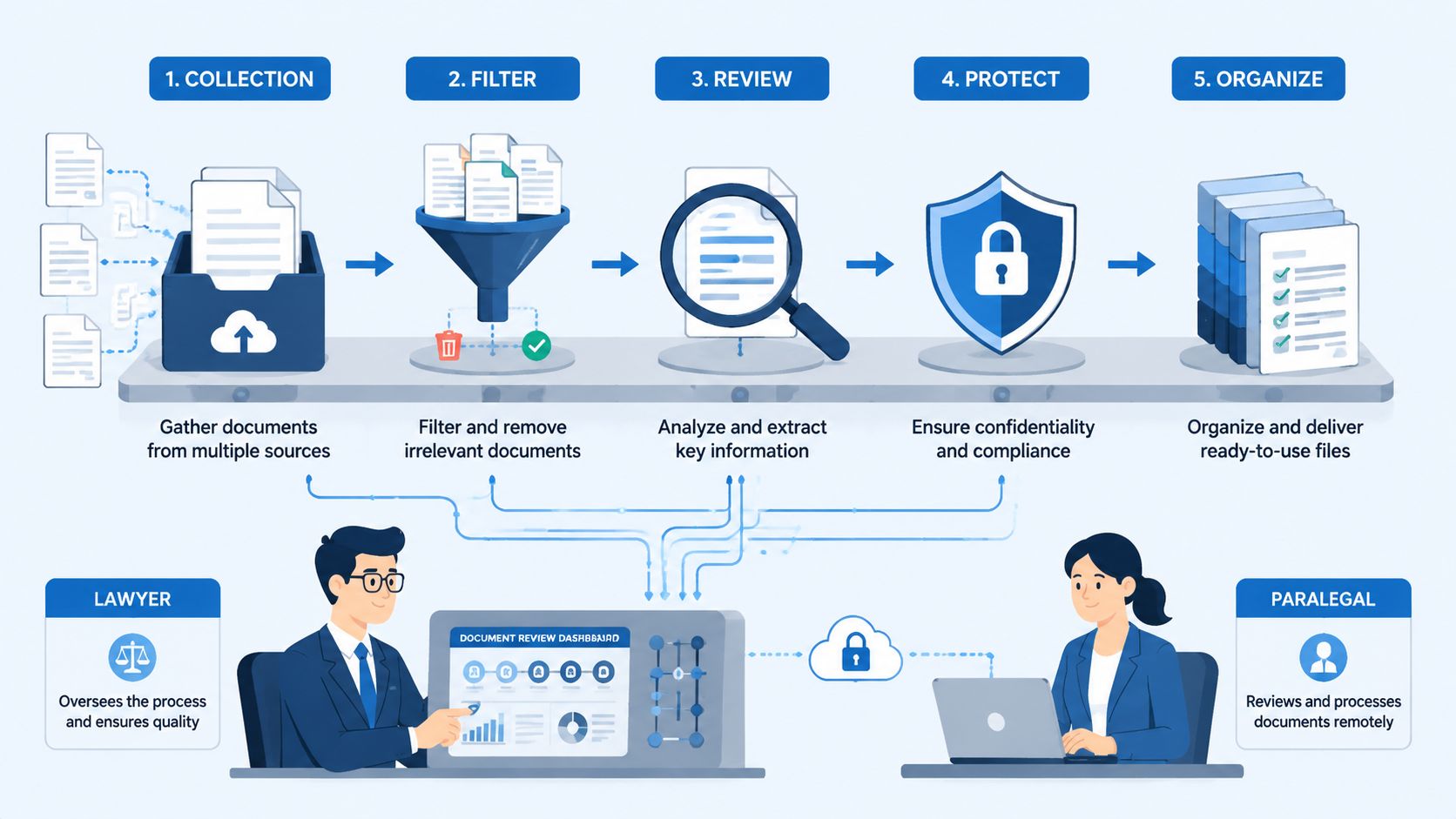
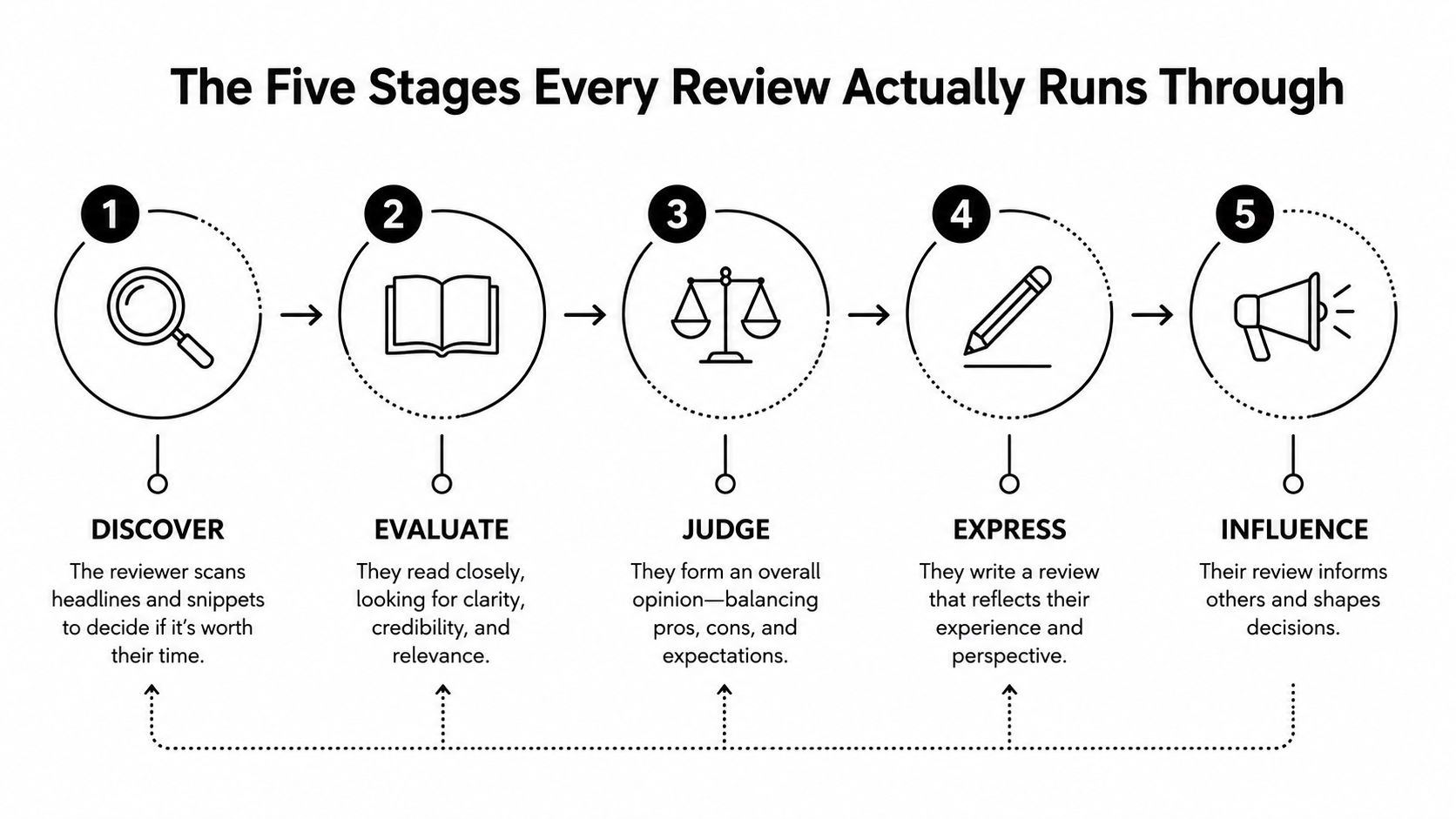
A defensible review has five operating stages. They may happen inside one platform, but they shouldn't blur into one another. Each stage needs an owner, an output, and a deliberate hand-off.
Collection begins with the custodian list, source inventory, preservation decisions, and date boundaries. Processing then converts collected material into reviewable records, preserving metadata, document families, and load file outputs.
The owner is usually a discovery project manager working with the collection vendor and case team. The failure mode is predictable: unscoped date ranges, missing sources, broken families, or deduplication that removes useful custody information. Deduplicate email families carefully. A near-duplicate message across custodians may be redundant for review but important for showing who possessed it.
Early assessment removes obvious noise before reviewers spend time reading. Apply agreed filters, search terms, file-type decisions, deduplication rules, and other culling choices. Vendor duplicates are particularly dangerous when the team hasn't documented whether it's deduplicating across custodians, within a custodian, or only at the message level.
The deliverable is a defined review population and a written explanation of how it was created. If the population changes, record who approved the change and why. Workflow discipline at this point delivers more value than another dashboard. Teams comparing process automation options may also find this overview of the benefits of automated document workflows useful when mapping hand-offs and approvals.
First-level reviewers code documents for responsiveness, issue tags, confidentiality, and escalation. Responsiveness asks whether a document belongs in the production set. Issue tags identify why it matters. Privilege is a separate judgment, not a decorative checkbox.
The review manager owns throughput and consistency. The typical failure is a protocol that says “responsive” without giving reviewers usable examples for borderline documents. Time-box the first pass by batch and review the metrics daily. If reviewers are speeding up while escalation rates collapse, don't celebrate yet. They may be skipping hard calls.
A senior reviewer or attorney handles privilege, work product, redactions, and difficult responsiveness calls. The privilege log should develop in parallel, not appear as a frantic spreadsheet project the night before production.
QC samples reviewer decisions against the protocol, checks consistency, and routes errors back for correction. Federal court e-discovery guidance recognizes manual review, keyword searching, and TAR as the main review methods, and counsel can use different methods for different data categories.
Production converts cleared records into the agreed format, applies Bates numbering, validates metadata and families, and confirms that privileged and nonresponsive documents stay out. The production owner should run a final content and format check before delivery.
A production hand-off without a sign-off record is a trap. The team needs to know what was produced, what was withheld, who approved privilege decisions, and which quality checks were completed. If your workflow can't answer those questions later, it wasn't a workflow. It was a group chat with invoices.
Manual review, keyword search, and technology-assisted review are not rival belief systems. They are operating choices for different risk profiles, and the strongest matters usually combine them with human oversight.
Manual review gives attorneys and trained reviewers direct control. It also moves at human speed, with quality tied to training, fatigue, supervision, and calibration. Keyword search surfaces names, phrases, custodians, and defined issues quickly. Literal searches miss concepts expressed differently, while broad terms can flood the queue with noise. TAR, including continuous active learning, ranks documents by predicted responsiveness and updates those rankings as reviewers code more material.
Judge TAR with recall, precision, and F1, not vendor adjectives. Recall measures the share of relevant documents found. Precision measures the share of retrieved documents that are relevant. One controlled study reported TAR averages of 77% recall, 85% precision, and 80% F1, compared with manual review at 59% recall, 32% precision, and 36% F1. The controlled TAR study points to the practical requirement: build a representative training set and document validation instead of treating the tool's label as proof of quality.
| Method | Recall / Precision | Cost per Document | Best Use Case | Defensibility |
|---|---|---|---|---|
| Manual review | Human judgment, with quality shaped by training and calibration | Often hourly rather than fixed | Smaller, unusually sensitive, or conceptually difficult sets | Strong when protocol, supervision, and sampling are documented |
| Keyword search | Depends heavily on term design and testing | Not inherently cheaper, reviewer time still follows | Known names, phrases, custodians, and narrow issues | Defensible when negotiated, tested, and documented |
| TAR and continuous active learning | Controlled study averages 77% recall and 85% precision | Varies by platform and staffing model | Large populations where prioritization and iterative learning matter | Strong when seed selection, validation, overturns, and sampling are preserved |
The cost column stays blunt because no universal per-document price exists across these methods. Matter complexity, data type, privilege density, platform fees, and QC requirements change the bill. A firm can staff the review with vetted remote paralegals and still need attorneys for privilege and difficult calls. Buying another tool does not remove that governance work.
Keyword search performs poorly on multilingual, short-form, and conversational data if the team relies on literal terms. TAR can improve prioritization, but it still requires a representative seed set, a review protocol, validation records, and a clear path for human overrides. For a practical look at AI legal document review, check whether the workflow exposes uncertainty, records reviewer decisions, and lets the team audit model changes later.
Choose manual review for narrow populations or highly specialized judgment. Choose keyword methods when the vocabulary is stable and the search can be tested. Choose TAR when linear review is economically irrational, the methodology may face scrutiny, and the team can measure performance rather than trust a dashboard.
Fast review can fail in slow motion. A team rushes through a batch, produces a privileged email, discovers inconsistent issue coding, and later can't reconstruct which protocol version guided the decision. The platform completed its job. The people running the matter didn't preserve theirs.
A defensible protocol starts before production pressure arrives. Lock coding definitions, identify escalation rules, maintain the privilege log as decisions are made, and preserve the audit trail for reviewer actions, model rankings, overrides, and remediation.
Training rounds expose ambiguity before the full team starts. Give reviewers representative edge cases, compare decisions, and revise the protocol where reasonable people diverge.
Calibration sessions keep the interpretation stable. The review manager should document the answer, not merely announce it in a meeting. A locked decision log prevents the same question from being reinvented by every shift.
Inter-reviewer sampling checks whether the protocol works across people. Quality control guidance distinguishes document-level QC from process-level quality assurance, which includes protocol design, training, audits, and calibration. This QC and QA guidance makes the important point that teams must check both the decision and the process producing it.
Blind re-review catches errors that ordinary confirmation misses. A useful operating range is 5% to 10% blind re-review, but the appropriate rate should reflect the matter's risk, data complexity, and court expectations. Don't use a percentage as a magic charm. Use it as a documented control with an escalation rule when errors exceed the agreed tolerance.
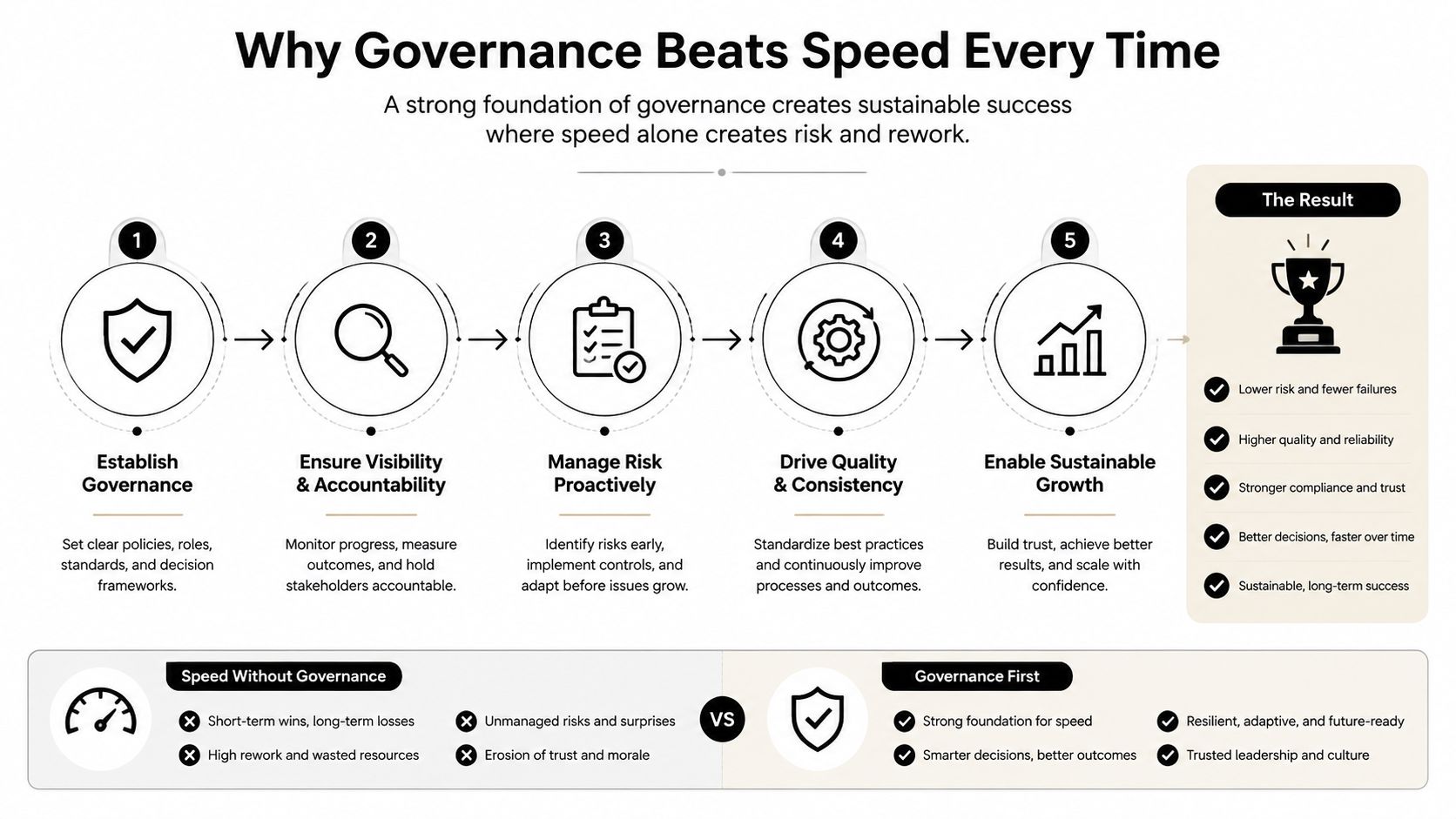
One person should own protocol changes, calibration records, sampling results, privilege escalation, and the final audit package. That person isn't replacing the lead attorney. They're making sure the lead attorney can see where the process is drifting.
Set a privilege check cadence, require senior review for borderline calls, and pause affected batches when QC shows a pattern rather than an isolated mistake. A clear quality control procedure is far cheaper than explaining an unexplained production gap to a judge.
The firms winning here aren't necessarily running the fastest platform. They're the firms that can prove, months later, that the review was fair, supervised, reproducible, and responsive to detected errors.
Review budgets need two separate conversations. The first asks what the team pays to inspect documents. The second asks what the team pays when a cheap method creates rework, privilege disputes, or a defective production.
The historical data explains the pressure. Review represented 73% of total production costs in the RAND study, while processing represented 19%. More recent industry reporting projects review's share of total e-discovery spending at 52% in 2025, down from 64% in 2024, and reports many GenAI-assisted reviews landing around $0.26 to $0.50 per document. The 2025 e-discovery review update frames the shift correctly: technology can reduce review's share without eliminating upstream preparation or downstream validation.
| Method | Per-Document Cost | Total Budget for 500K Documents | Defensibility Risk |
|---|---|---|---|
| TAR bulk review | $0.50 benchmark in the planned model | $250,000 | Low to moderate when validated, higher when seed and QC records are weak |
| Manual first-pass | $3.50 benchmark in the planned model | $1,750,000 | Moderate, depending on calibration and supervision |
| Hybrid human-AI review | Varies by platform, validation, staffing, and privilege complexity | Must be modeled from actual workflow inputs | Often manageable, but risk shifts to governance and validation |
The requested $250,000 to $900,000 range for a 500,000-document matter doesn't reconcile with a $3.50 manual rate, which would produce $1.75 million before platform and project-management overhead. That's precisely why firms should refuse simplistic budget tables. Use a blended estimate, identify which population receives TAR or manual review, and price QC, privilege, rework, and production separately.
Three pricing models are worth negotiating:
Teams evaluating affordable AI pricing for teams should compare total workflow cost, not the sticker price of an AI seat. The margin opportunity comes from orchestration, a smaller core team supervising flexible reviewers while technology reduces repetitive reading.
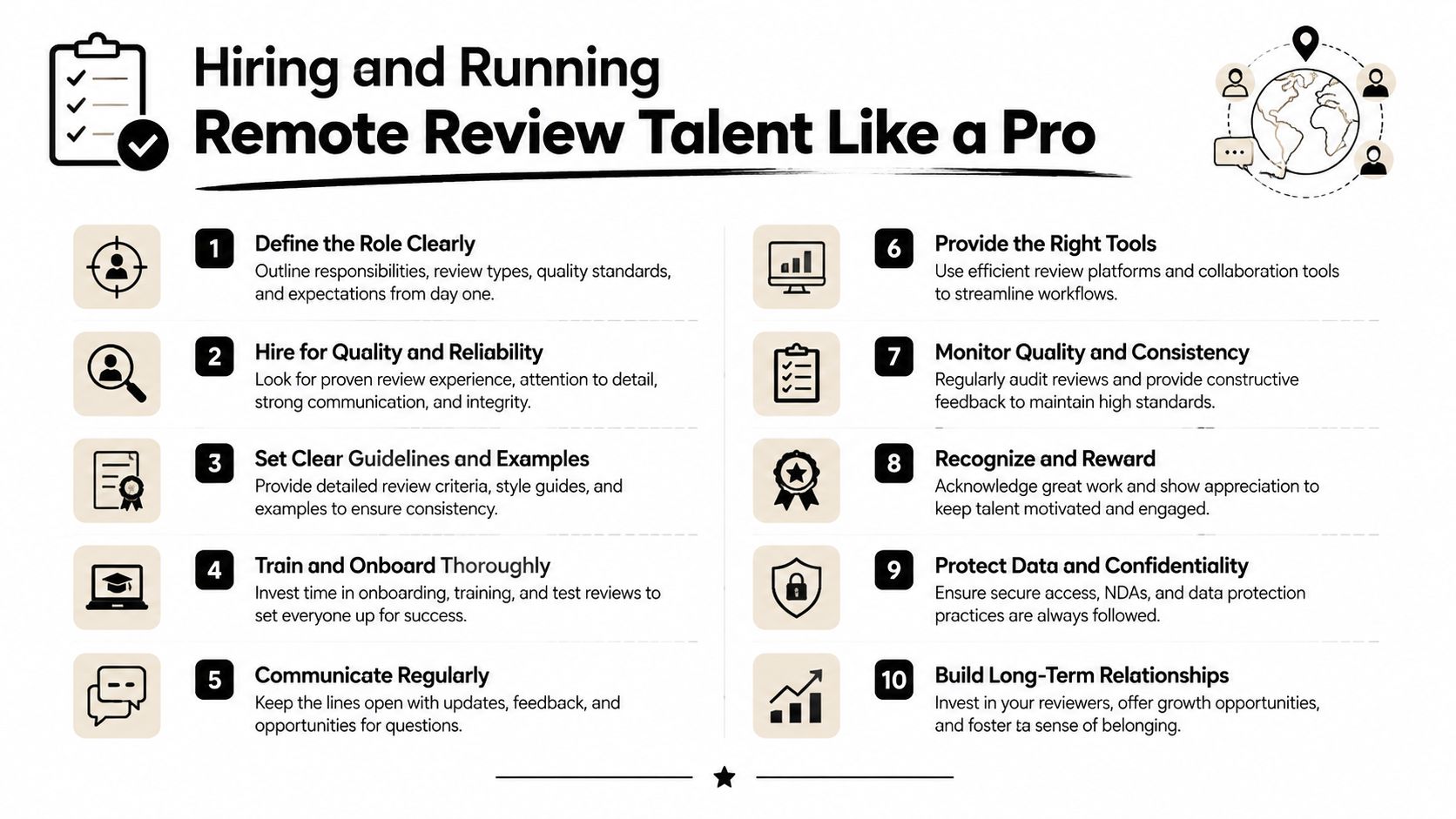
Remote paralegals are an underused lever because firms often treat review staffing as emergency labor. That's backwards. A vetted distributed team can absorb predictable volume, but only if the firm runs it like a controlled legal operation rather than a gig marketplace.
Start with a review-specific job description. State the matter type, platform experience, required coding tasks, confidentiality conditions, working hours, escalation expectations, and whether the assignment includes privilege exposure. “Legal research experience” is too vague. Ask for responsiveness coding, family review, privilege spotting, issue tagging, and production awareness.
The practical skills test should include three short exercises:
Verify credentials, prior matter experience, platform familiarity, and conflicts before onboarding. A specialized marketplace such as HireParalegals connects firms with remote legal professionals for assignments including document review, but the hiring firm still owns conflicts, supervision, confidentiality, and legal judgment.
At minimum, require MFA, a controlled VPN, no local downloads, role-based access, and audit logs. Confirm that the review platform records coding changes and reviewer identity. Remote access is not a security strategy by itself, and a home office is not a privilege protocol.
Run daily standups during launch, then use a cadence the matter can support. Review dashboards should show throughput, escalation volume, QC overturns, privilege designations, and unresolved blockers. Hold weekly calibration meetings, publish decisions, and route difficult calls to a named attorney or senior reviewer.
Never outsource final responsive calls, privilege strategy, production sign-off, or decisions requiring attorney work product. Remote reviewers can scale execution. They can't replace accountable counsel.
Paste this into the matter template before loading the first batch:
| Checklist Item | Common Mistake | One-Line Fix |
|---|---|---|
| Agreements | Unsigned agreements remain in the review set | Search for signature blocks and route execution questions to counsel |
| Spreadsheets | Embedded Excel files contain hidden sheets | Inspect native files and preserve relevant embedded content |
| Deduplication | Cross-custodian deduplication erases custody context | Preserve custodian and family metadata even when suppressing duplicates |
| Bates numbering | Late collections create numbering gaps | Freeze production ranges only after collection changes are reconciled |
| Privilege log | Entries identify junior reviewers instead of the basis for privilege | Use consistent descriptions and attorney-approved log conventions |
| Family accounts | Shared or family-member accounts get confused | Map account ownership and document the custody relationship |
| Text messages | Mobile messages never enter the collection plan | Name messaging sources explicitly during scoping |
| Mobile apps | App data hides inside iCloud backups | Identify backup sources and validate extraction completeness |
| Scope changes | New custodians or dates enter without a budget reset | Require written approval for every material scope expansion |
| Final QC | The team rushes checking in the last 48 hours | Protect production QC time and escalate unresolved errors before release |
The last row deserves more attention than it usually gets. Rushed QC in the final 48 hours before production creates privilege waiver risk because the team loses time to investigate, re-review, and correct patterns. A production deadline is not a reason to remove the control designed to protect it.
The document review process is governance, not grep. Lean teams win by combining a written protocol, technology that prioritizes work, and vetted remote paralegals who execute clearly bounded tasks. Artificial intelligence can accelerate classification and summarization, but human validation remains essential for privilege, close responsiveness calls, and production approval. The profitable operating model is hybrid, measured, and auditable.
There's no defensible universal timeline. It depends on data complexity, culling, method, reviewer capacity, privilege density, and the production deadline. A team should model stages separately instead of multiplying document count by an assumed reviewer speed.
There isn't one universal number. A defensible budget states the method, population, QC scope, privilege treatment, platform fees, project management, and rework assumptions. Per-document pricing without those boundaries is a magic trick performed with your client's money.
TAR makes sense when volume and repetition make linear review inefficient, and when the team can create a representative seed set, measure recall and precision, and preserve the validation record. Continuous active learning can reduce the cost of finding relevant documents per unit of recall. A large evaluation classified 9,863,366 documents across 34 review projects and achieved 88% average recall using iterative model refinement and statistically validated sampling. The TREC e-discovery evaluation illustrates the scale at which governed learning can operate.
Counsel owns privilege strategy and final privilege decisions. Senior reviewers can identify, organize, and escalate candidate documents, but the responsible attorney must approve the governing approach and production sign-off.
Courts and opposing counsel will care less about the score's polish than the method behind it. Explain the data scope, seed decisions, protocol, validation, sampling, human overrides, and production checks. A relevance score is evidence within a process, not a substitute for a defensible process.
The next operating changes are already clear. Teams will test generative-AI second-pass drafting, consider on-premises LLM review rooms for sensitive matters, and prepare for tighter electronically stored information protocols tied to amended Rule 26 amendments. The tools will keep changing. Your audit trail shouldn't.
If your next matter has a large review population, build the protocol before the invoice starts growing teeth. Define the five hand-offs, assign an attorney-owned privilege track, choose TAR or manual review based on measurable risk, and test remote reviewers with real coding exercises. Then staff the flexible work with vetted legal talent, document every override, and make production sign-off a deliberate decision instead of a midnight ritual.