
 16 minutes read
A litigation team can collect the right custodians, preserve the evidence, and still lose control of a matter during review. The familiar symptoms are easy to recognize: reviewers apply different responsiveness standards, privilege questions sit in scattered comments, email threads lose their chronology, and a partner discovers a production problem just before the deadline. Remote staffing can increase capacity, but it can also make those gaps harder to see.
Document review processes work when they treat speed and defensibility as connected operational goals. The review manager needs a written protocol, a staged workflow, clear ownership, quality checks, and an audit trail that shows what happened and why. Technology-assisted review and AI can reduce repetitive work, but they don't remove human responsibility for privilege, materiality, intent, or final production decisions.
This blueprint explains where review creates the greatest pressure, how to structure each stage, how to coordinate distributed teams, and how to validate both human and AI-assisted decisions. It also addresses a practical question that many guides overlook: how can a law firm prove that its review was reliable when people, tools, and decisions are spread across locations?
At 4:30 p.m., a review manager sees the queue shrinking, yet the privilege log is incomplete and reviewers in two locations are applying different issue codes. The matter appeared on schedule until someone checked the decisions rather than the volume. That gap is the operational risk: speed can conceal missed responsive documents, inconsistent privilege calls, and an audit trail too thin to defend later.
A firm can spend days preparing a collection and still lose control when reviewers open the first document. Each file may require a responsiveness decision, issue coding, privilege screening, family review, and escalation. A weak call at this stage creates rework for senior attorneys and increases the chance that responsive or privileged material will be mishandled.
The cost structure explains why review needs active management. A RAND study cited in Everlaw's document review guidance found that review represented about 73% of total document-production costs, compared with roughly 8% for collection and 19% for processing. The same guidance places average linear review pace in the 1990s at about 60 to 70 documents per hour. These figures identify where inefficient instructions, handoffs, and quality checks consume the most labor.
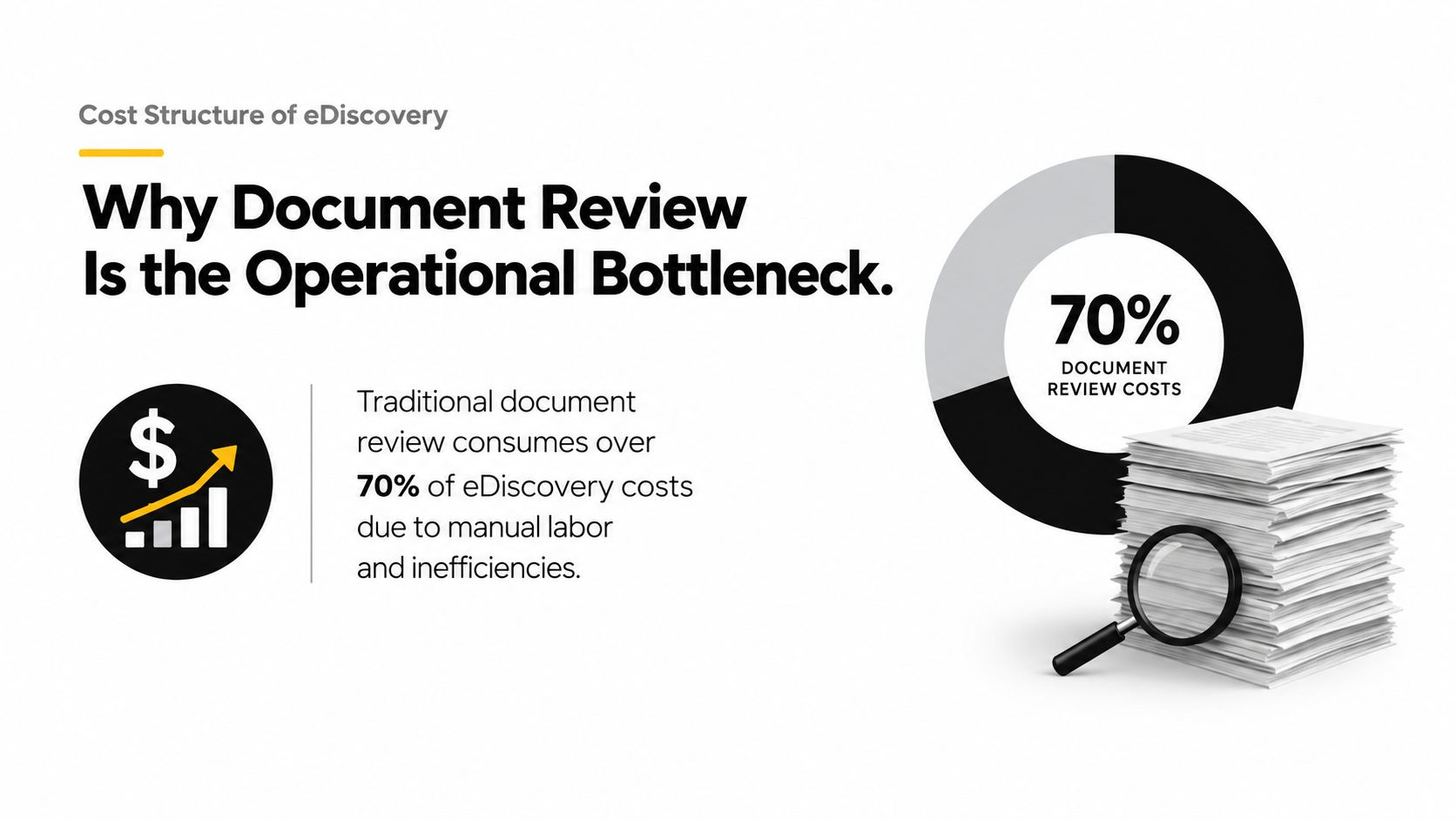
That historical pace is a poor planning assumption for collections containing messages, attachments, spreadsheets, scans, and other unstructured material. Reviewers must interpret context, preserve document families, distinguish legal advice from ordinary business discussion, and record reasons for uncertain decisions. Remote teams add another control problem when questions are resolved in private chats or undocumented calls.
A simple workload example shows the pressure. A 100,000-document production can require about 2,000 attorney review hours at 50 documents per hour, according to Microsoft's eDiscovery guidance. That demand can overwhelm a small litigation team while senior attorneys handle depositions, negotiations, motions, and client communication.
First-pass review should narrow the population before documents reach the most expensive layer of legal judgment. The Everlaw guidance describes first-pass review as a filtering stage that can reduce a dataset by about 40%. Scope decisions, deduplication, search design, and reviewer instructions therefore function as cost controls, provided the team checks that filtering has not weakened recall or privilege protection.

Practical rule: Measure more than documents completed. Track whether the process reduces senior-attorney review while preserving recall, privilege protection, and a reconstructable audit trail.
Managers who treat review as passive labor often respond after the queue has grown. Adding reviewers may raise visible throughput while leaving sensitive calls under-checked. A defensible program records who made each material decision, which protocol version applied, what changed, and when an attorney resolved an exception.
Collection strategy must connect to downstream review capacity. Document why custodians, date ranges, file types, and search parameters were selected. Preserve scope changes and approval records, because expanding the population without revisiting staffing and quality controls can invalidate the assumptions behind the original plan.
Digital workflows in other records-heavy environments can inform indexing, retrieval, and access discipline. Teams comparing clinical document digitisation tools may find useful process ideas, but legal review still requires matter-specific coding, privilege controls, family handling, and production functions.
A legal process improvement framework can help firms examine duplicate work, manual handoffs, and unclear ownership before a deadline turns them into corrections. The objective is a review process that is faster because it is controlled, not faster because human judgment has been hidden.
A reviewer opens a batch containing an email, its attachment, and a message that may reveal legal advice. The protocol does not explain how to classify them, the attorney is unavailable, and the deadline is approaching. That situation creates inconsistent coding, lost context, and an audit trail that cannot explain why the final decision was made. A defensible workflow sets those rules before the first batch is assigned.
The review manager, supervising attorney, and technical lead should agree on custodians, data sources, date ranges, document types, issues, and production obligations. Responsiveness criteria must turn each request or investigative question into an observable decision. A reviewer should not have to infer the standard from a broad description of the dispute.
Write down the treatment of:
Include close-call examples, not only straightforward ones. A draft agreement, an email forwarding legal advice, or a message with an incomplete attachment can expose gaps that ideal examples will not reveal. Each example should show the coding decision and the reason for escalation.
Processing should preserve relevant metadata and make the collection searchable. Deduplication, family grouping, date and custodian filters, and targeted searches can reduce noise before human review begins. Search terms help identify likely issue populations, but they do not replace reviewer judgment. Document the filters and their purpose so the team can explain how the population was shaped.
Assign batches according to a recorded logic. Keeping related emails and attachments together preserves chronology and reduces the chance that one reviewer sees only a fragment while another sees the surrounding context. A shared knowledge system can help teams store and find info about matter instructions, coding decisions, and recurring issue definitions, provided access controls fit confidential legal work.
Run interim quality control at 25%, 50%, and 75% completion milestones, as described in Conduent's discovery workflow guidance. At each milestone, sample coded documents, compare reviewer patterns, record disagreements, and update the protocol when a recurring ambiguity appears. The manager should also identify which batches and protocol versions were tested.
Sample non-responsive material as well. A reviewer who marks an entire family non-responsive may overlook a relevant attachment or issue-specific message. Testing that population can expose over-culling, incorrect tags, or inconsistent treatment while corrections remain possible.
A practical lifecycle looks like this:
Every step should leave a usable record. The audit trail should identify the protocol version, reviewer, decision, escalation, correction, and approval. It should also connect related documents and show when a coding rule changed. That history lets a manager or attorney reconstruct the workflow, test whether human judgment was applied consistently, and explain why a document was included, excluded, redacted, or withheld.
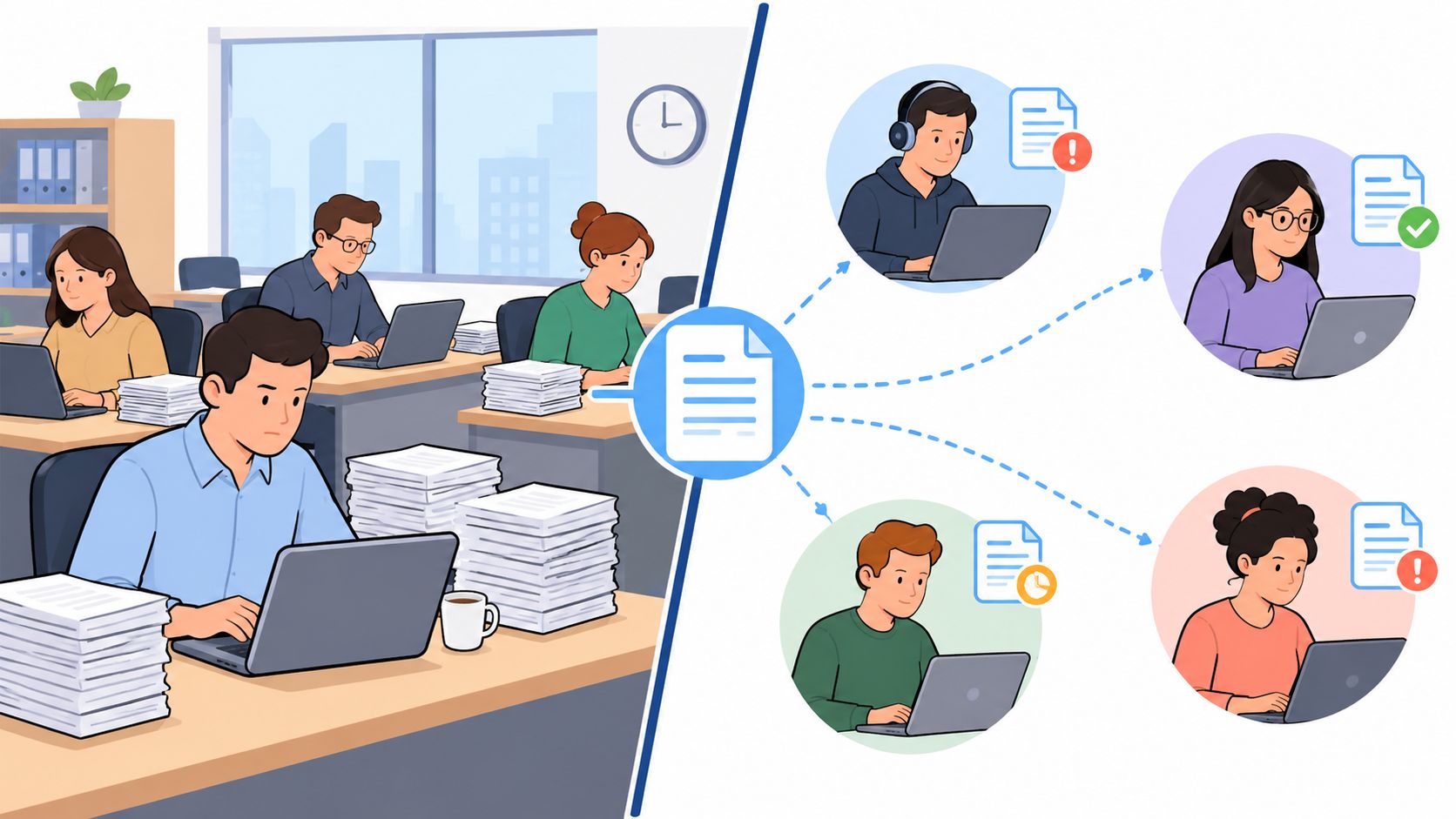
Onsite review offers proximity, but proximity isn't the same as consistency. A room full of reviewers can still produce conflicting tags if the protocol is vague or managers don't compare decisions. Remote review introduces additional risks, especially when teams work across time zones, but it also makes it possible to assign specialized staff and extend coverage without requiring everyone to sit in one office.
| Staffing model | Where it can work well | Main control required |
|---|---|---|
| Onsite team | Matters requiring frequent live discussion and rapid escalation | A written protocol and centralized decision log |
| Fully remote team | Large, repeatable first-pass populations with strong platform controls | Access management, calibration, and visible reviewer activity |
| Hybrid team | Matters combining high-volume coding with sensitive legal judgment | Clear separation between first-pass, QC, and senior review |
| Distributed specialist model | Privilege, issue, chronology, or foreign-language review | Defined handoffs and documented escalation ownership |
A remote team can lose context in ordinary ways. One reviewer leaves a comment in an email thread, another records a different interpretation in a spreadsheet, and a third changes the tag without documenting the reason. The final database may show the result, but not the reasoning or whether the same standard applied across related documents.
Time zones make chronology harder to preserve. A question posted at the end of one reviewer's day may be answered after another reviewer has already coded similar documents. Without a central decision register, the team repeats the same discussion and may apply different outcomes to materially similar evidence.
Remote managers should therefore require:
A remote paralegal or contract reviewer can help validate routine flags, locate missing exhibits, compare related documents, and escalate questions that require legal judgment. The reviewer shouldn't independently decide privilege, materiality, litigation strategy, or other questions reserved for qualified attorneys.
The right staffing model depends on the work, not just the available headcount. A first-pass responsiveness queue may suit trained remote reviewers using a tightly written protocol. A privilege population involving mixed communications, incomplete attachments, or nuanced work-product questions should move to senior legal reviewers with matter-specific supervision.
Firms evaluating remote legal support can consider a service such as HireParalegals' virtual paralegal employment process alongside direct hiring, contract staffing, and internal allocation. The relevant evaluation points are prior document-review experience, confidentiality training, platform proficiency, working-hour alignment, communication discipline, and the ability to escalate rather than guess.
Remote access also requires security discipline. Where a matter includes medical records or other protected health information, HHS guidance on remote use of ePHI says a covered entity should first analyze vulnerabilities connected to remote access and offsite use, then apply reasonable and appropriate risk-management measures. Access should be limited to authorized users based on role and need to know, and workforce members should be trained and properly authorized.
The practical standard is simple. Give remote staff only the access they need, make every judgment traceable, and ensure that a senior owner can review both the decision and its context.
A fast review can still miss the document that changes the case. Throughput measures activity, not completeness or consistency. A defensible program therefore tests both the relevant documents identified and the relevant documents left behind, while preserving enough evidence for counsel to explain how those tests were run.
Recall measures how much of the relevant population the review identified. Precision measures how much of the identified population is relevant. Broad coding can improve recall while producing an expensive responsive population crowded with irrelevant material. Aggressive culling can improve precision while excluding evidence.
Independent validation exposes those trade-offs. One TREC e-discovery benchmark described in eDiscovery AI's validation guidance covered 34 review projects classifying 9,863,366 documents. Manual review of 6,957 documents identified 34,723 relevant documents in 234.25 labor hours. The example shows how targeted sampling can test a large population without manually treating every document in the same way.
Those figures do not establish a universal sampling formula. Before relying on results, the review manager should document the validation population, sampling method, reviewer qualifications, coding standard, and acceptance criteria. The audit trail should also show who approved each choice and when the protocol changed.
Disagreement does not automatically indicate poor reviewer performance. Responsiveness may depend on legal context, document families, and the wording of the requests. Repeated disagreement does indicate that the protocol, examples, or calibration process may need correction.
The same validation guidance reports 43% inter-reviewer agreement for responsive and non-responsive coding, while agreement on the responsive decision alone was 9%. Those results show why an individual reviewer's coding cannot validate itself.
Use a defined response:
Remote teams need the same controls in a form that supports later examination. A shared, versioned log should connect each batch to its reviewers, calibration status, decisions, escalations, and rework. That record helps distinguish an isolated coding error from a systematic gap.
The validation file should allow counsel to explain how the team tested completeness and consistency. Include the approved protocol, training materials, calibration results, sampling rationale, QC findings, adjudication decisions, and changes made after testing.
Privilege requires a separate control track. In one case discussed in Conduent's workflow analysis, fewer than 10% of documents reviewed for privilege were privileged, while about 50% of privileged documents went unidentified. The combination shows the risk of broad privilege searches without issue tags, sampling, and senior review.
A strong QC program does not promise zero error. It demonstrates a repeatable method for detecting, correcting, and documenting error before production.
A model can sort a large review queue quickly, yet still misread a privileged exchange or miss the significance of an attachment. The operational question is therefore not whether AI is faster. It is whether the team can show where the tool was used, how its output was tested, and which human reviewer made the final decision.
AI is useful for repetitive classification and prioritization. It becomes risky when its output is treated as a legal conclusion. Privilege, intent, materiality, and litigation strategy often depend on context that a short text extract cannot capture. Remote teams face an added risk: reviewers may follow different interpretations unless the system records instructions, overrides, escalations, and approvals in one audit trail.
AI and TAR can support prioritization, clustering, duplicate detection, summarization, extraction, and identification of likely issue populations. They can connect related documents and expose patterns that keyword searches may miss. These functions reduce review effort while leaving legal conclusions with accountable reviewers.
Human reviewers should retain responsibility for nuanced determinations, including:
The AI legal document review workflow should identify the automation boundary, the person who verifies each output, and the method for recording disagreement. A model can flag a potentially privileged email for senior review. The assigned attorney or qualified reviewer should make the final privilege decision and document the basis for it.

AI cannot restore context lost during collection or processing. Poor OCR can make a scanned document difficult to search. Missing attachments can change an email's meaning, while inconsistent formatting, incomplete families, and corrupted metadata can weaken automated classification.
Run a controlled evaluation before adoption:
Security requires a separate assessment. Teams considering multi-tenant systems should understand grounding for multi-tenant security, then confirm access controls, data handling terms, retention settings, audit logging, and confidentiality commitments. A security feature does not replace the firm's responsibility to determine whether the tool suits the matter.
A defensible operating model combines automation with human control. Automation handles volume and pattern recognition, remote reviewers perform structured first-pass work and context checks, and attorneys own decisions carrying legal consequences. The audit trail should make each boundary visible.
Document review processes should be managed as controlled legal operations, not as a queue of files assigned to whoever is available. Review is the dominant eDiscovery cost center, so firms should reduce avoidable volume before first-pass work, define responsiveness and privilege criteria in writing, and assign ownership at every stage.
Remote teams can work defensibly when the firm centralizes instructions, preserves chronology, records decisions, limits access, and gives senior reviewers a clear escalation role. Quality control should test recall, precision, non-responsive populations, privilege decisions, and reviewer consistency. AI can accelerate sorting and prioritization, but human judgment remains necessary for complex legal conclusions and final production approval.
Start by auditing one active matter. Map the workflow from collection through production, identify every informal handoff, select a sample for independent review, and confirm that your audit trail can explain who made each material decision. Then revise the protocol, calibrate the team, and introduce automation only where the validation record supports it.
If your firm needs additional capacity for a structured document review project, review the matter's coding requirements, security controls, and escalation needs first. Then speak with a qualified remote legal staffing provider to evaluate candidates against those criteria and interview the people who will handle the work.