 14 minutes read
You've searched “attorney jobs Orlando” until every job board feels like a rerun. You've polished the résumé, sent applications to firms you barely recognize, and waited for replies that never arrived. Meanwhile, another candidate with less impressive credentials may already be interviewing because they targeted the practice areas Orlando firms hire for.
That's the part most job searches miss. Orlando isn't one broad legal market. It's a collection of concentrated practice areas, hiring channels, and employer preferences. If you aim everywhere, you'll spend months competing for the wrong openings. Aim where demand clusters, and your search becomes far more manageable.
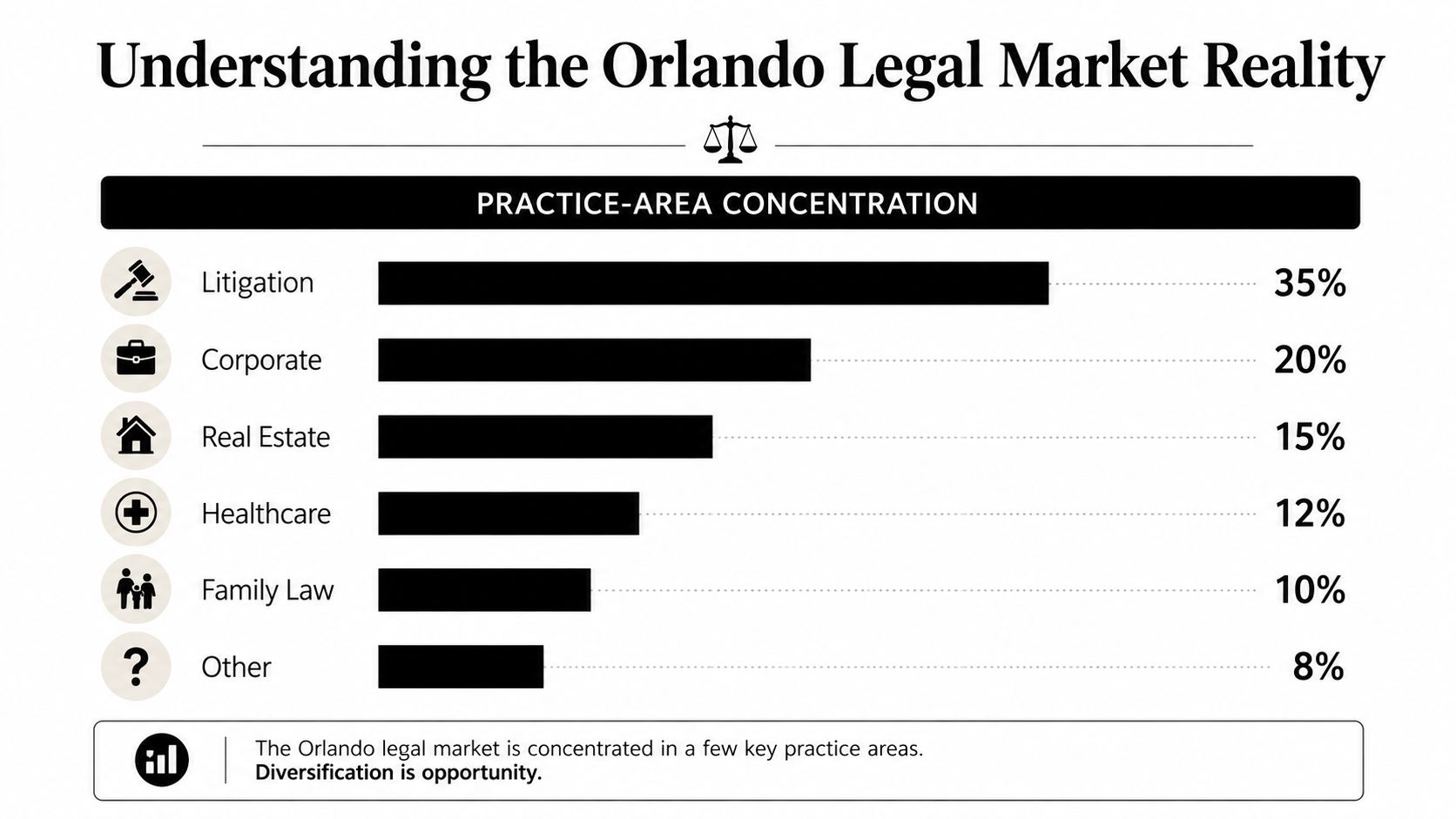
A candidate can spend months applying for Orlando attorney jobs and still miss the hiring pattern. The mistake is treating every practice area as equally active. Orlando's market is anchored by Central Florida's employer base and development cycle, so visible demand clusters around litigation, insurance defense, personal injury, construction, and transactional real estate or corporate work. Family law and other specialties have openings, but occasional listings do not equal steady hiring volume.
The practical consequence is simple: choose the practice area before you choose the job title. An insurance-defense or construction firm may want someone who can manage an active caseload, draft efficiently, and handle hearings with limited supervision. A transactional real estate practice may focus on deal work, development documents, title issues, and business relationships. A résumé that only says “licensed attorney” gives a hiring partner little reason to call.
Florida's broader legal employment base helps explain why Orlando supports hiring across several established practices. The state had 86,000 lawyers and judges in May 2024, while the Orlando-Kissimmee-Sanford metro remains one of Florida's largest job centers. That combination supports demand in employment, litigation, family, and corporate work (Florida and Orlando legal employment context).
The search phrase “attorney jobs Orlando” is too broad to guide a serious campaign. Add the specialty:
Litigation has the deepest visible pool, with real estate and construction close behind in job-listing patterns tied to Central Florida's employers and development activity (Orlando attorney job listings and practice-area patterns). Relevant experience does not guarantee a perfect fit. It does tell you where to build a targeted employer list instead of applying randomly.

Recruiter's rule: Search by practice area first, title second. “Associate attorney” is a label. “Insurance defense associate with deposition experience” is a hiring profile.
Competition also affects timing. Florida's attorney concentration sits above the national baseline, with a location quotient of 1.33 in the cited labor-market data. Firms that delay interviews or offers can lose experienced candidates, so keep your applications focused and your follow-up prompt (BLS Florida lawyer employment data).
You can spend three months applying to every “attorney” posting in Orlando and still miss the firms doing the hiring. The problem is usually poor targeting. Orlando's hiring volume clusters around particular practice areas, so your search should combine official legal channels, local relationships, direct firm research, and selective recruiter outreach.
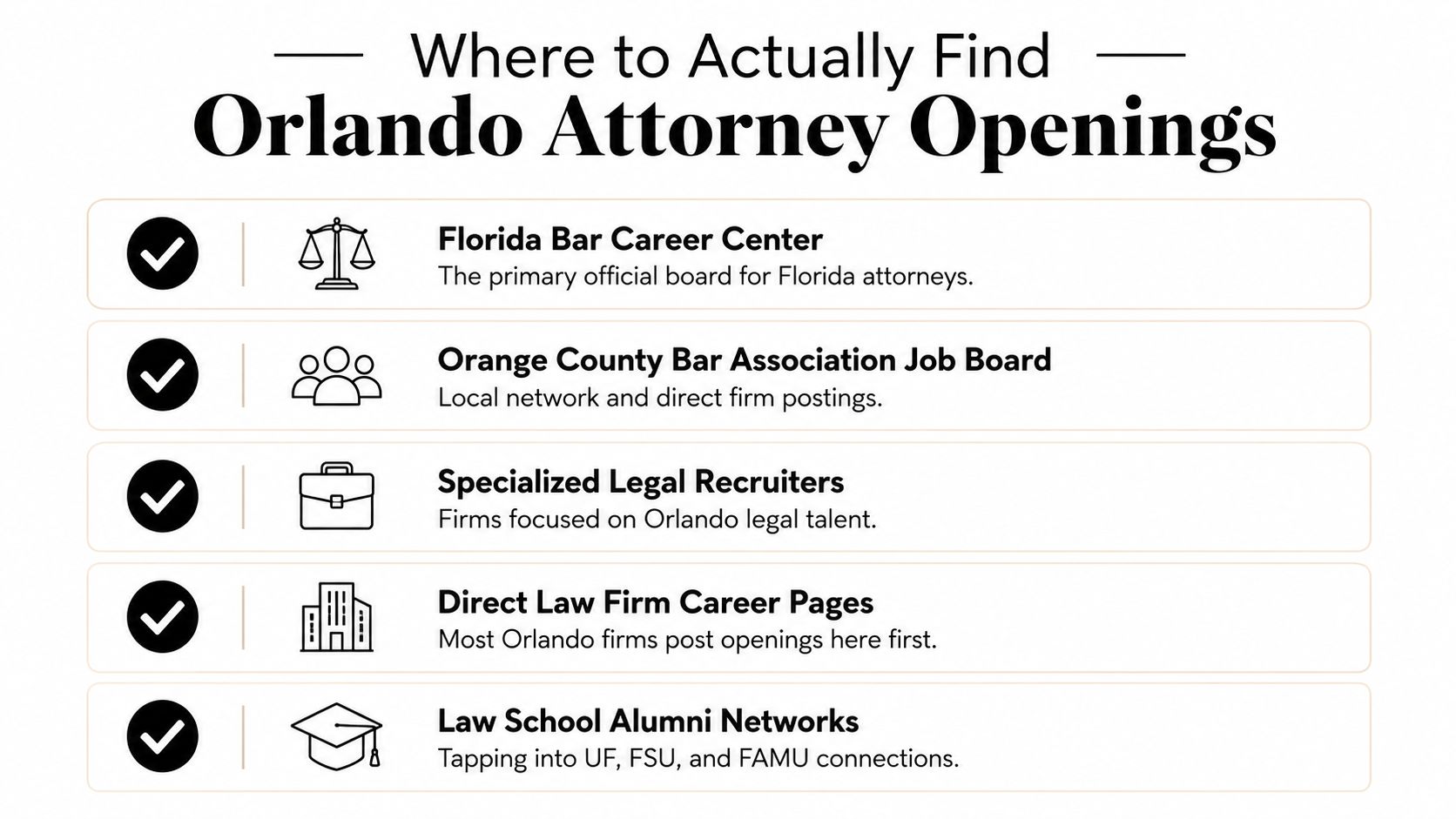
The Florida Bar Career Center belongs in every Florida attorney's search. It keeps listings tied to the state's licensing environment and legal community. Florida attorney hiring often depends on Florida credentials, so confirm your admission status and eligibility before spending time on an application.
The Orange County Bar Association can provide local visibility and direct firm connections. Review its professional programming, member communications, and job resources instead of relying only on national aggregators. Local postings may reveal the employer, practice group, or referral relationship behind an opening.
Law school networks deserve more attention. UF, FSU, and FAMU alumni can offer introductions, referral context, and practical information about firms that do not advertise broadly. Ask for market insight first. A concise message about a specific practice area usually works better than a vague request for employment.
Experienced litigators should contact legal recruiters with a clear practice profile. State your specialty, years of experience, courtroom or deposition background, and preferred employer type. “Open to opportunities” gives a recruiter little to work with.
Junior candidates should build a focused firm list and apply through employer career pages while seeking introductions from alumni and bar contacts. Direct firm websites matter because Orlando employers may post openings there before sending them to broad aggregators. Review those pages weekly, identify the groups that match your background, and tailor each application.
Candidates considering adjacent legal support work can use Orlando jobs no degree needed to review broader local options, while keeping those roles separate from licensed attorney positions. For paralegal and related legal openings, consult legal jobs in Orlando.
Use Orlando and nearby Central Florida location filters, then add practice-area terms. Separate alerts for litigation, construction, real estate, insurance defense, and corporate work will outperform one oversized alert covering every legal title.
A major job board showed 221 attorney jobs in Orlando in August 2026, confirming regular hiring activity, but the count says nothing about fit (Orlando lawyer job listings). Read each posting for the actual work, required credentials, and likely client base. Your objective is not to collect listings. It is to find openings where your experience addresses a firm's immediate need.
A litigation associate I'd advise would often say they were “networking” because they attended an event, collected cards, and connected with people online. That's not networking. That's stationery acquisition.
The useful version starts with a practice-area target. If you want construction work, attend programs where construction litigators, developers, contractors, insurers, and referral partners gather. If you want family law, spend time in family-law circles rather than attending every general event in town and hoping the right person wanders over.

Orange County Bar Association events and Florida Bar CLE programs give you a reason to speak with attorneys beyond “Are you hiring?” That question puts pressure on a stranger and often produces a polite dead end. Better questions focus on the work:
Listen closely, then follow up with something specific from the conversation. A short message that references the program, identifies your relevant experience, and asks to stay connected feels professional. A five-paragraph autobiography does not.
The best networking conversation doesn't end with a résumé attachment. It ends with a reason for the other person to remember your name.
CLEs work especially well for candidates changing practice areas. A lawyer moving toward real estate, construction, or family law can use relevant education to show intentionality, but CLE attendance alone won't replace actual experience. Pair it with a writing sample, pro bono matter, contract assignment, or concise explanation of how your existing skills transfer.
Send the follow-up while the interaction is still fresh. Then maintain the relationship without turning every message into a disguised application. Share a relevant development, congratulate a contact on a professional milestone, or ask a thoughtful question about a practice area.
Unposted roles often emerge when a partner realizes a workload problem has become urgent. If that partner already knows your specialty, writing ability, and professional style, you're no longer an anonymous applicant. You're a known quantity, which is a much better place to negotiate from.
Orlando firms can spot a mass-mailed résumé quickly. If the document opens with broad claims about being “results-oriented” and never names the work the firm handles, it belongs in the same pile as every other generic application.
Lead with the practice area. A litigation résumé should make pleadings, discovery, depositions, hearings, motion practice, and case ownership easy to find. A real estate résumé should foreground deal work, drafting, review, diligence, closings, and client communication. A construction résumé should show the relationship between contract analysis, claims, disputes, and project stakeholders.
Hiring partners often scan the opening portion before deciding whether to continue. Use a sharp professional summary, followed by experience bullets that show what you handled rather than what your job description permitted.
Weak wording says you “assisted with litigation matters.” Stronger wording identifies the type of matters, your role, and the work product you produced, without inflating your responsibility. If you took depositions, drafted dispositive motions, managed discovery, negotiated resolutions, or appeared in court, say so plainly.
For out-of-state experience, remove the mystery. Explain how your prior practice transfers to Florida work, identify your Florida Bar status accurately, and address relocation directly. “Why Orlando?” shouldn't sound like a vacation brochure. Give a professional reason tied to market fit, family, long-term plans, or the employer's practice.
A useful cover letter connects three points:
Don't repeat your résumé in paragraph form. Don't describe yourself as passionate about justice unless you can connect that statement to the work. Hiring attorneys want evidence that you understand their matters and can contribute without requiring a full professional reboot.
Candidates who struggle with structure can use a tool to create personalized cover letters with AI, then edit every sentence for accuracy, voice, and firm-specific detail. AI can help organize a draft. It can't tell whether your description of a construction dispute is legally precise, and it certainly shouldn't invent experience you don't have.
Application standard: If a hiring partner can't identify your practice area and relevant work within a quick scan, the document needs another edit.
Salary discussions in Orlando reward preparation, not guesswork. Candidates waste months targeting specialties with limited hiring volume, then accept the first offer because they never established a realistic range. Practice area, seniority, billable expectations, and responsibility all affect the number.
One dataset places the 2025 average Attorney or Lawyer salary in Orlando at $79,751, with entry-level compensation around $52,529 and early-career pay around $69,176 (Orlando attorney salary benchmarks). Another reports a 2025 average of $91,728, with a 25th-to-75th percentile range of $61,100 to $111,900 (Orlando attorney salary range data).
Use the figures below as conversation points, not promises. They combine lower estimates, average figures, and upper-percentile data from the cited benchmarks. Adjust them for the specialty hiring, your Florida Bar status, portable clients, and the role's production requirements.
| Experience Level | Lower Range | Average | Upper Range |
|---|---|---|---|
| Entry level | $52,529 | $79,751 | $91,728 |
| Early career | $69,176 | $91,728 | $111,900 |
| Experienced or senior | $91,728 | $93,936 | $111,900 |
Methodology: The table compiles Payscale, Gusto, and Salary.com benchmarks cited in this section. The sources use different samples and methods, so compare ranges rather than treating any figure as a guaranteed offer.
Florida data provides wider context. BLS reported 61,320 lawyers in Florida in 2023, with an annual mean wage of $147,320, compared with 54,740 lawyers in 2021 and an annual mean wage of $129,390 (Florida lawyer employment and wage data). Nationally, lawyers had a median annual wage of $145,760 in May 2024, while the top 10% earned more than $239,200 (national and Florida legal employment context).
Ask how the firm sets salary progression, bonuses, billable expectations, origination credit, benefits, remote flexibility, and review timing. A lower base can work when the path to responsibility is documented. Vague promises cannot cover rent.
For hourly-rate context, review attorney hourly rate guidance before making a counter. State a reasonable range, give the business reason, and stop. Candidates often weaken their position by continuing to negotiate against themselves.
Upper-tail data supports separating senior roles from junior offers. One source reports top attorney earners at $147,391, while another lists a lawyer average as high as $173,542, with levels ranging from $99,612 for Attorney I to $238,248 for Attorney VI (Orlando lawyer salary levels). Experience still prints money, particularly in the Orlando specialties generating real hiring volume.
The traditional associate-to-partner ladder is useful, but it isn't the only credible route through Orlando's legal market. Contract attorney work, legal staffing, remote roles, and solo practice can help you earn income, build evidence, test a specialty, or get closer to a permanent position.
The trick is choosing the pathway for a reason. Taking a contract role because it gives you exposure to construction litigation can be strategic. Taking random assignments with no connection to your target practice can leave your résumé looking busy but directionless.
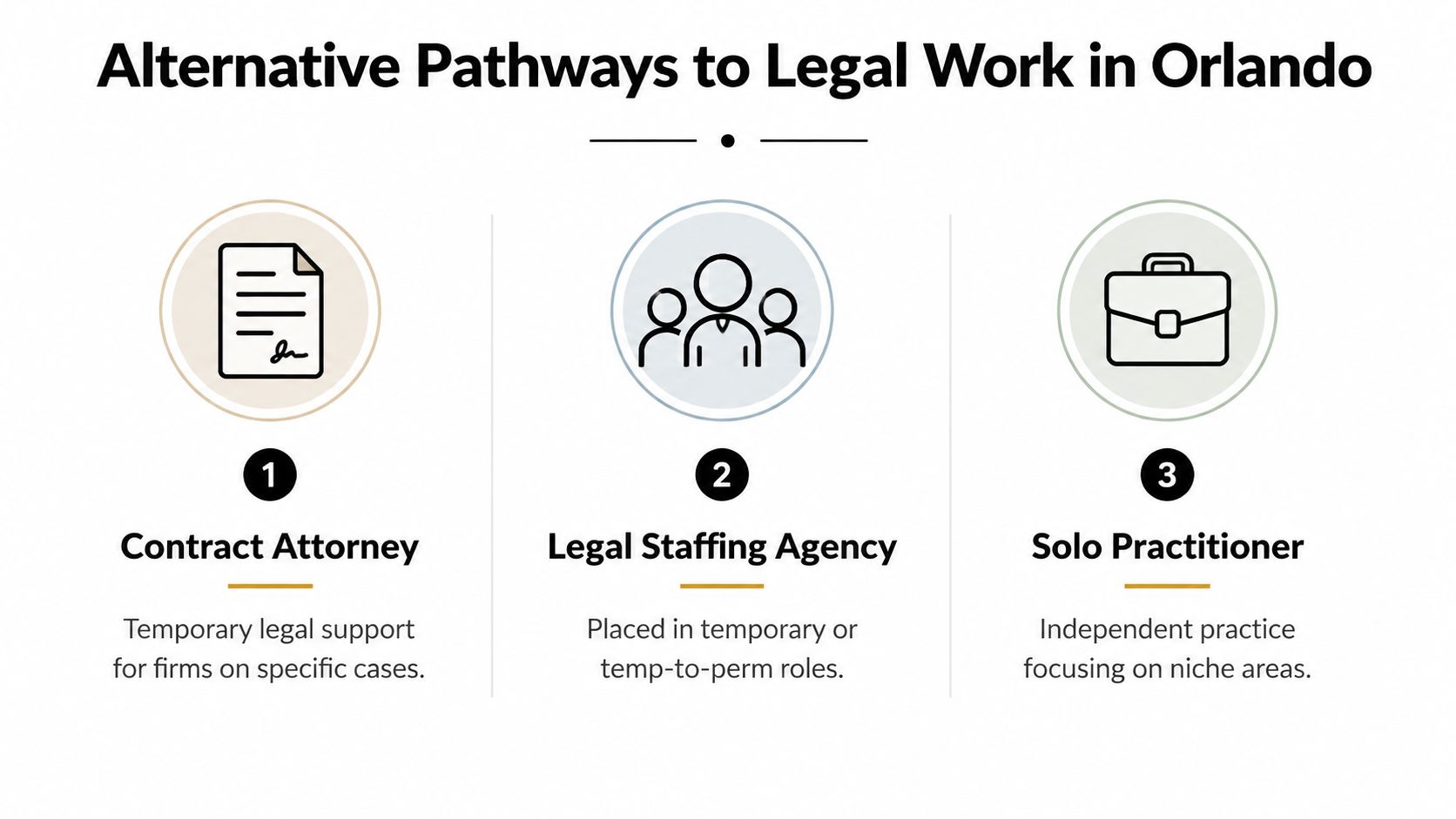
A contract attorney can support document review, research, drafting, discovery, or overflow matters. Firms get immediate capacity, while candidates gain recent work they can discuss in interviews. Put the assignments on your résumé by matter type and responsibility, not as a vague line that suggests you were waiting for something better.
Legal staffing agencies can provide temporary or temp-to-perm placements. They're most useful when you communicate your preferred practice area, availability, Florida licensing status, and acceptable work structure. “Anything legal” sounds flexible, but recruiters hear “no defined target.”
Remote work also deserves a serious look. Orlando-based firms may serve clients across Florida or use remote attorneys for research, drafting, litigation support, and specialized matters. Review remote attorney jobs in Florida when location flexibility is part of your strategy, but verify the employer's expectations around licensure, court appearances, supervision, and client contact.
Opening a practice can offer control and a niche focus, but it also requires client development, systems, billing discipline, trust-account compliance, and administrative stamina. A strong lawyer can still struggle if they dislike sales or fail to build dependable operations.
Of counsel arrangements occupy a useful middle ground. They can provide flexibility and a professional home without requiring the same commitment as a conventional partnership track. Clarify compensation, conflicts, client ownership, supervision, malpractice coverage, and expectations before agreeing.
Choose alternatives strategically: The right temporary role expands your skills and relationships. The wrong one simply extends your search while adding another explanation to your résumé.
HireParalegals is one option for firms and legal professionals evaluating flexible staffing, with a platform focused on connecting US law firms with remote legal talent. Treat it as a staffing channel, not a substitute for deciding what kind of attorney role you want.
If your target is a permanent Orlando position, set a review point for every alternative pathway. Keep applying to the right practice groups, maintain local relationships, and leave each assignment with a clear accomplishment you can carry into the next interview.
Stop searching every Orlando attorney listing and hoping the right role recognizes you. Pick one or two target practice areas, rewrite your résumé around the work those firms need, contact the Florida Bar and Orange County legal networks, and build a short list of employers whose practice matches your experience. Then apply with speed and specificity, because generic applications waste time and concentrated markets don't wait.