
 18 minutes read
A partner hires a remote paralegal, labels the arrangement “1099,” and feels clever for avoiding another W-2 onboarding process. Then the paralegal works the firm's hours, uses the firm's software, follows an associate's instructions, and becomes part of the litigation team. At that point, the label is doing about as much legal work as a decorative potted plant.
For law firms, independent contractor versus employee classification is especially tricky. Legal support work often requires confidentiality controls, supervision, standardized workflows, client deadlines, and close integration with attorneys. Those practical necessities can look a lot like employment, even when the contract says “independent contractor” in bold.
The stakes reach beyond payroll. Worker status can affect overtime, tax withholding, benefits, unemployment insurance, workers' compensation, and labor-law coverage. The Bureau of Labor Statistics' July 2023 count reported 11.9 million independent contractors, equal to 7.4% of total employment, but that official count covers contractors on their sole or main job and therefore differs from broader estimates that include side work and other independent income.
| Dimension | Independent Contractor | Employee |
|---|---|---|
| Primary relationship | Runs an independent business and provides defined services | Works as part of the firm's workforce |
| Direction | Firm focuses on the result, not the method | Firm may control what work is done and how |
| Payment | Usually by project, milestone, or deliverable | Usually through payroll under ongoing employment terms |
| Tax administration | Business generally handles its own tax obligations | Firm handles payroll withholding and employer obligations |
| Benefits | Generally not eligible for employee benefits through the firm | May qualify for applicable benefits and leave policies |
| Best fit for a law firm | Defined, specialized, temporary matter support | Ongoing paralegal work integrated into daily operations |
The practical recommendation is simple: default to employee status unless the facts clearly support contractor treatment under every applicable test. A cheap classification that collapses under scrutiny is not a saving. It's deferred billing from the IRS, the Department of Labor, state agencies, and possibly a plaintiff's lawyer.
The partner's mistake looked harmless at first.
A mid-size law firm had a complex litigation matter, an overflowing discovery queue, and no appetite for another permanent hire. The partner brought in a remote paralegal as a 1099 contractor at $500 per week. The arrangement seemed tidy. The paralegal would process discovery, the firm would pay the invoices, and everyone would move on to the next emergency.
Six months later, an IRS CP2000 notice arrived questioning the classification. The partner pulled the engagement file and discovered the inconvenient details. The paralegal used firm letterhead, worked set hours, logged into firm-provided software, followed the direction of an associate, and handled work inside the firm's normal litigation workflow.
That's not a magic “contractor” formula. It's a collection of facts pointing toward employee status under the IRS common-law approach, which examines behavioral control, financial control, and the relationship between the parties. The IRS explanation of employee and independent-contractor status specifically focuses on whether the business controls what will be done and how it will be done.
The CP2000 notice is only the first uncomfortable envelope. A classification dispute can lead to questions about back payroll taxes, state unemployment contributions, workers' compensation coverage, overtime, and recordkeeping. A Department of Labor review can create a separate problem because the Fair Labor Standards Act treats independent contractors as people in business for themselves and generally doesn't cover them as employees.
Then comes the phone call nobody wants to make: “We may have classified a legal worker incorrectly. How does that affect our coverage?” The malpractice carrier conversation may not become a coverage dispute, but it becomes awkward quickly. Confidentiality obligations, access controls, client communications, and supervision all become relevant to how the relationship operated.

Practical rule: The contract matters, but the firm's daily conduct matters more.
Law firms face unusual exposure because paralegals rarely operate in a vacuum. They may work inside a matter-management system, follow attorney-approved procedures, attend recurring team meetings, use firm templates, and respond to client-driven deadlines. Those practices may be sensible, even necessary. They can still support employee classification.
A firm should examine the entire relationship before choosing a tax form. For a useful primer on what different 1099 forms do and why reporting matters, review this guide to 1099 forms by Jumpstart Partners. Just don't mistake reporting a payment for proving the worker was properly classified.
This guide focuses on the tests, the side-by-side trade-offs, the federal rule changes affecting current analysis, and a hiring process designed for firms that recruit remote legal talent across state lines.
No single label decides worker status. The IRS, the Department of Labor, and state agencies can apply overlapping frameworks, each asking a slightly different version of the same uncomfortable question: Is this person operating an independent business, or economically dependent on the firm?
The IRS groups its common-law analysis into three categories.
Behavioral control asks whether the firm directs what the worker does and how the worker does it. A paralegal required to work particular hours, follow a partner's detailed process, track billable time in the firm's system, complete mandatory internal training, and use firm-provided Westlaw access presents stronger employee signals than a specialist who chooses the method and submits a finished work product.
Financial control examines who bears business risk and who controls the economics. A worker who supplies equipment, advertises services, serves multiple clients, negotiates project fees, and can realize a profit or loss through business decisions looks more independent. A worker reimbursed for expenses, given firm equipment, paid on an ongoing hourly basis, and offered employee-style benefits looks less independent.
The relationship of the parties covers written agreements, benefits, permanence, and the practical expectations of both sides. Calling someone a contractor while placing them on a permanent team won't rescue the arrangement. The IRS says businesses can file Form SS-8 when the classification remains unclear and seek a formal determination through the IRS common-law employee guidance.
For FLSA purposes, the Department of Labor analyzes six factors:
The DOL's classification FAQs describe these factors as a practical framework. For a law firm, the integral-to-the-business factor deserves special attention. A paralegal performing core discovery, case preparation, or litigation support may be doing work central to the firm's operations, even if the person works from another state.
The firm shouldn't treat the six factors as a scorecard where three “contractor” answers automatically win. The facts must be considered together. A project-based specialist who controls methods, supplies tools, serves other clients, and can profit from efficient work presents a much stronger contractor profile than a remote paralegal embedded in one firm's daily operations.
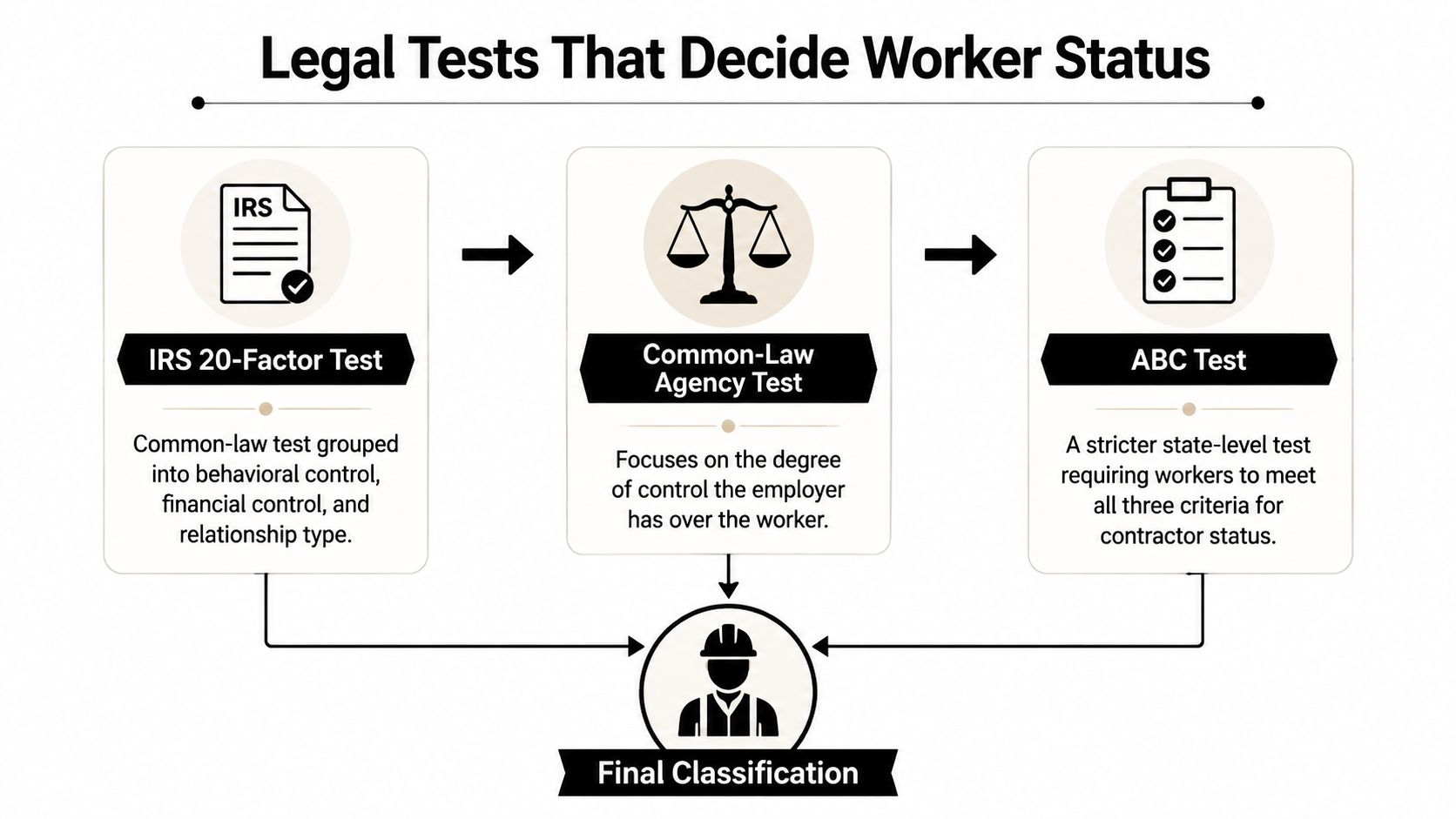
Federal analysis is only one layer. States may apply their own tests, with California's ABC framework often presenting a particularly strict challenge. New York uses a different approach, and the resulting patchwork can create conflicting outcomes for a multi-state firm.
That means a paralegal might look independent under an IRS analysis and still fail a state test. The hiring firm must identify the jurisdictions that matter, including where the worker performs services and where the firm's employment obligations may arise. Firms that need help evaluating off-payroll arrangements can also consult Lighthouse Consultants' off-payroll support for broader classification and engagement considerations.
The cost comparison is where many managing partners get seduced by the spreadsheet.
A contractor invoice looks clean. The firm pays the agreed rate, receives the work, and avoids the visible machinery of payroll. An employee costs more administratively because the firm must manage withholding, payroll taxes, applicable benefits, leave, records, and employment policies.
That comparison is incomplete if it ignores control and legal exposure.
| Dimension | Independent Contractor (1099) | Employee (W-2) |
|---|---|---|
| Tax obligations | The worker generally handles self-employment tax and the firm reports payments using the applicable information-return process | The firm withholds applicable taxes and handles employer payroll obligations, including its share of employment taxes |
| Benefits exposure | Usually no firm-sponsored health insurance, retirement participation, or paid time off through the contractor arrangement | May qualify for applicable health, retirement, leave, and other employee benefits |
| Supervision | Firm should define the result, scope, deadline, and quality requirements without controlling the worker's day-to-day method | Firm can set hours, assign tasks, supervise methods, and integrate the worker into team operations |
| Payment structure | Project, milestone, or deliverable-based payment supports independence when the facts match | Salary or ongoing hourly payroll is consistent with employment |
| Equipment and systems | Worker generally supplies meaningful tools and operates an independent business | Firm commonly supplies tools, accounts, systems, templates, and workspace |
| Permanence | Limited or project-based relationship is stronger contractor evidence | Ongoing relationship with recurring duties points toward employee status |
| Termination | Contract ends under its terms, often after completion or breach | Employment ends under applicable employment rules, policies, and agreements |
| Compliance risk | Misclassification risk remains if actual practices resemble employment | Higher visible payroll administration, but cleaner treatment when the role is integrated and controlled |
A remote litigation paralegal billing 40 hours per week at $35 per hour produces a contractor invoice of $1,400 per week, before considering any other obligations. The fully loaded W-2 cost depends on the firm's payroll taxes, benefits, leave, insurance, and other employment expenses. The apparent savings can narrow to roughly 12% to 18% once compliance risk is priced in, but that range comes from the scenario's assumptions rather than a universal rule. A firm should model its actual package instead of borrowing a convenient multiplier.
The familiar loaded-employee estimate of 1.25 to 1.4 times base salary is often used for planning, but it isn't a legal safe harbor and shouldn't be treated as one. A contractor rate doesn't become defensible merely because it's lower than the employee budget.
The cheapest worker is often the one whose classification survives contact with the facts.
Control is the dividing line partners most often underestimate. A firm can require confidentiality, protect privileged information, impose security standards, and demand accurate work from a contractor. It shouldn't manage that contractor like an employee and then point to the invoice as proof of independence.
For firms comparing international engagement models, this UK contractor advice for 2026 offers useful context, although U.S. firms still need U.S. federal and state analysis.
A law firm that wants one permanent classification answer is asking the legal system for a product it doesn't sell.
The modern U.S. distinction has roots in Supreme Court decisions from the 1940s, including NLRB v. Hearst Publications in 1944, followed by United States v. Silk and Rutherford Food Corp. v. McComb in 1947. Those decisions helped shape an economic-reality approach that looks at the working relationship rather than the title printed on a contract.
The Department of Labor issued a final FLSA classification rule on January 10, 2024, and the rule became effective on March 11, 2024. The rule replaced the 2021 rule and used a broader six-factor economic-reality analysis grounded in longstanding judicial precedent. The Congressional Research Service summary of the 2024 rule identifies the same six factors: profit or loss, investments, permanence, control, integral work, and specialized skills connected to business-like initiative.
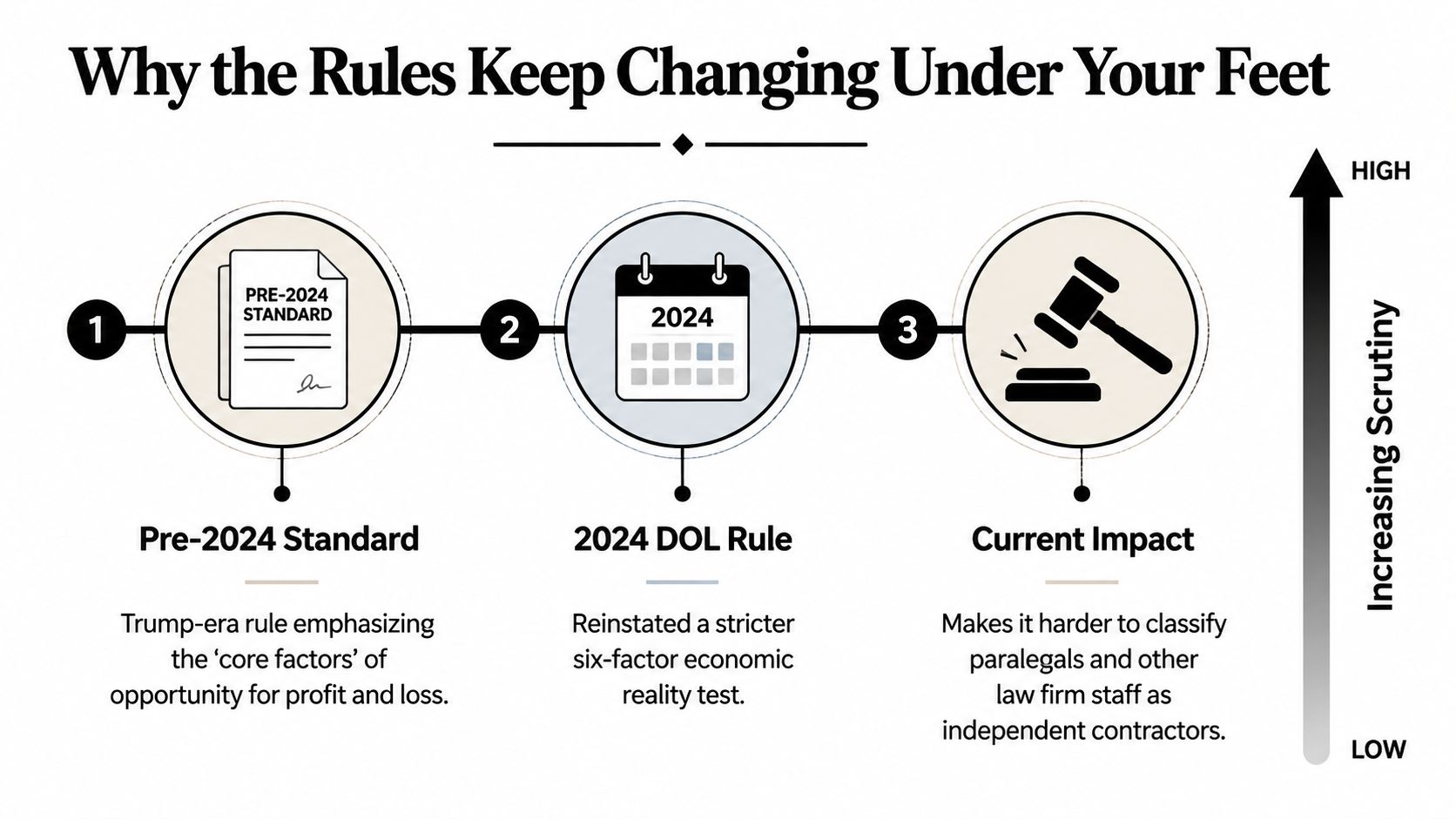
The DOL later said it would stop enforcing the 2024 rule and revert to older guidance. A new proposed rule appeared in 2026, creating another turn in the federal sequence. The DOL's 2026 rulemaking page captures the current transition and explains why firms shouldn't treat one administration's rule as a permanent business plan.
The important point isn't political scorekeeping. It's operational risk. Federal enforcement guidance may change, but courts and state agencies can apply their own reasoning. The FLSA rule also doesn't answer every classification question under other federal laws or state statutes.
A remote paralegal in Texas may work for a firm with California clients, collaborate with lawyers in New York, and access systems controlled from another state. Client location alone doesn't decide status, but multi-state operations create more places where the firm must examine obligations. The firm needs a jurisdiction map, not a single checkbox.
Firms using contingent legal talent should also understand how the engagement fits into broader workforce planning. The practical discussion in this resource on contingent workforce management is useful for separating temporary capacity from a role that has become permanent.
Misclassification isn't a single fine. It's a stack of possible claims that can arrive from different directions.
The IRS may question payroll tax treatment. The Department of Labor may examine minimum wage, overtime, and employee coverage under the FLSA. State agencies may pursue unemployment contributions or workers' compensation issues. A worker may bring a private wage claim, and multiple workers with similar arrangements may create class or collective action risk.
The human cost also deserves attention. The Economic Policy Institute's analysis estimates that a typical misclassified construction worker could lose about $19,526 per year, while a truck driver could lose about $21,532 per year in income and benefits. A separate EPI report cited in the same discussion gives occupation-dependent annual losses reaching $20,399 and $23,266. Those figures illustrate why a classification dispute affects more than the firm's bookkeeping. Workers can lose access to benefits and social insurance protections.
The requested scenario involves three remote paralegals earning $65,000 each, but the verified information doesn't provide a reliable basis for calculating a total law-firm exposure. I won't manufacture a dramatic number to make the warning sound sharper. The precise amount depends on hours, overtime, state law, tax treatment, benefits, willfulness, records, and the claims truly available.
| Penalty Source | Basis | Estimated Exposure | Notes |
|---|---|---|---|
| IRS and payroll taxes | Reclassification may create withholding and employer payroll-tax obligations | Fact-specific | Depends on compensation, reporting, records, and applicable relief |
| DOL wage claims | Minimum wage and overtime obligations if the worker is an employee | Fact-specific | The worker's hours, pay, records, and classification analysis matter |
| State agencies | Unemployment insurance, workers' compensation, and related labor obligations | Fact-specific | State standards and enforcement vary |
| Private litigation | Individual wage claims or coordinated claims involving similarly engaged workers | Fact-specific | Similar contracts and practices can expand the dispute |
| Benefits and social insurance | Lost benefits or protections tied to employee status | Fact-specific | The worker's actual eligibility and the relevant plan or statute control |
A firm should treat repeated contractor arrangements as a pattern, not isolated paperwork. If several paralegals share the same schedule, systems, reporting structure, and payment model, one adverse finding can invite questions about the rest.
Payroll administration deserves its own review. This practical guide to payroll compliance for law firms can help partners identify the operational records and processes that support accurate treatment. A classification checklist won't erase liability, but it's far better than discovering the firm has no consistent rationale after an audit notice arrives.
Compliance becomes more reliable when the firm builds it into the workflow before a partner promises a start date.
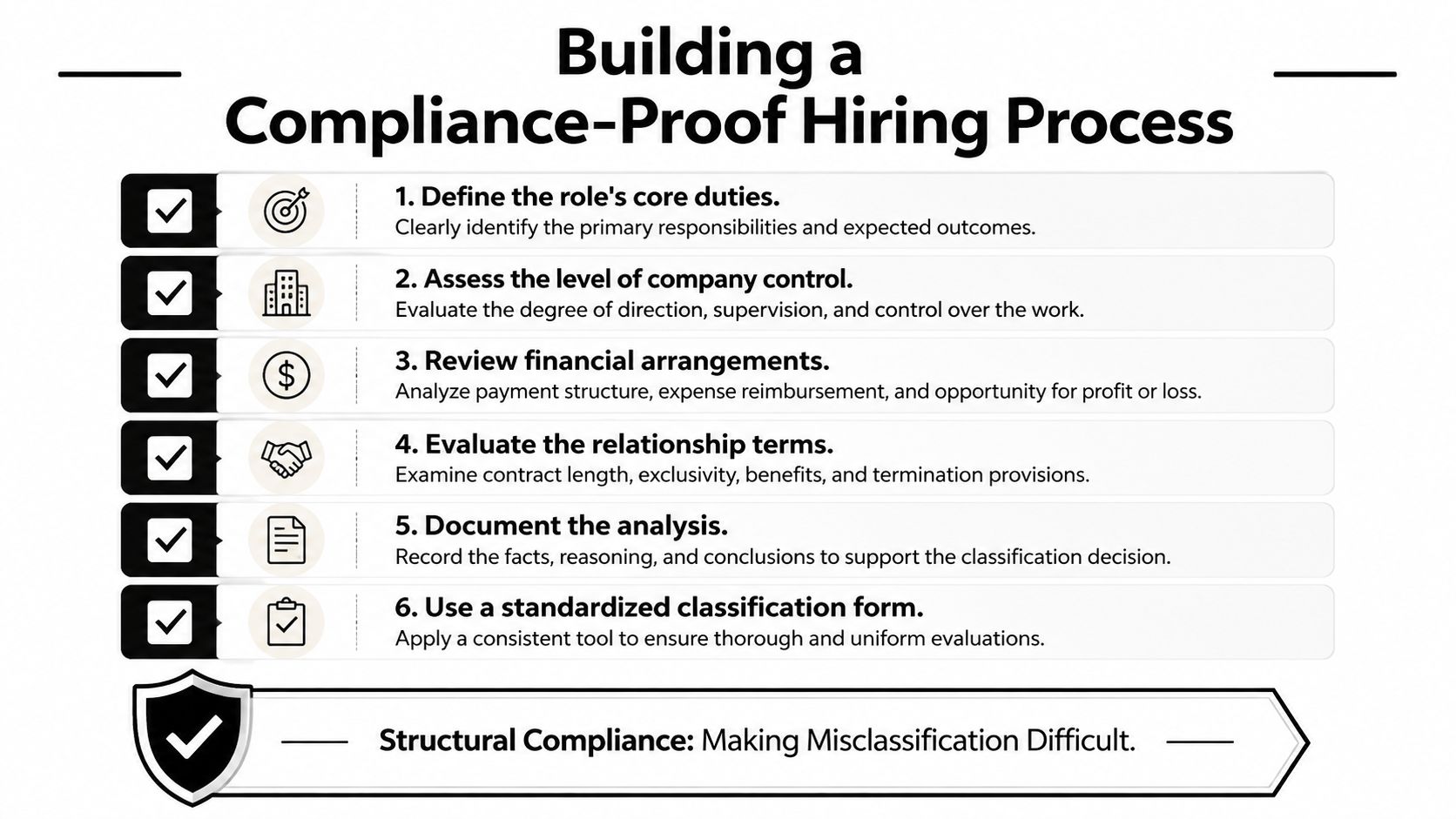
The first step is to classify the role, not the person. Ask what the paralegal will do, who controls the method, whether the work is recurring, who supplies the tools, whether the worker serves other clients, and whether the role is integral to ordinary firm operations. The answers should be documented before anyone chooses “1099” because the budget is tight.
A practical file should contain:
The contract should reinforce reality, not attempt to replace it. For a defensible contractor relationship, define a specific scope, avoid unnecessary exclusivity, permit delegation where appropriate, use milestone-based payments when the work supports them, and state that the worker operates an independent business. None of those clauses can rescue a relationship where the firm dictates every working detail.
Confidentiality and security provisions still matter for legal work. A contractor may need limited system access, privileged-information safeguards, data-security obligations, insurance requirements, and quality standards. Those protections should be customized to the engagement rather than written as a disguised employee handbook.
Use a W-2 employee when the firm needs recurring availability, direct supervision, firm systems, ongoing training, and work central to daily operations. Use a 1099 contractor only when the worker operates an independent business and the applicable federal and state tests support that conclusion.
A managed staffing model can make sense when the firm needs remote legal support but doesn't want to administer every classification, payroll, and benefits issue itself. HireParalegals offers remote legal talent and a Contractor of Record model involving contracts, payroll, and related compliance administration. Firms evaluating available candidates can also review remote legal jobs and talent options while deciding whether direct employment, direct contracting, or managed engagement fits the role.
The decision tree is blunt by design:
The right choice depends less on the worker's title than on the job you're creating.
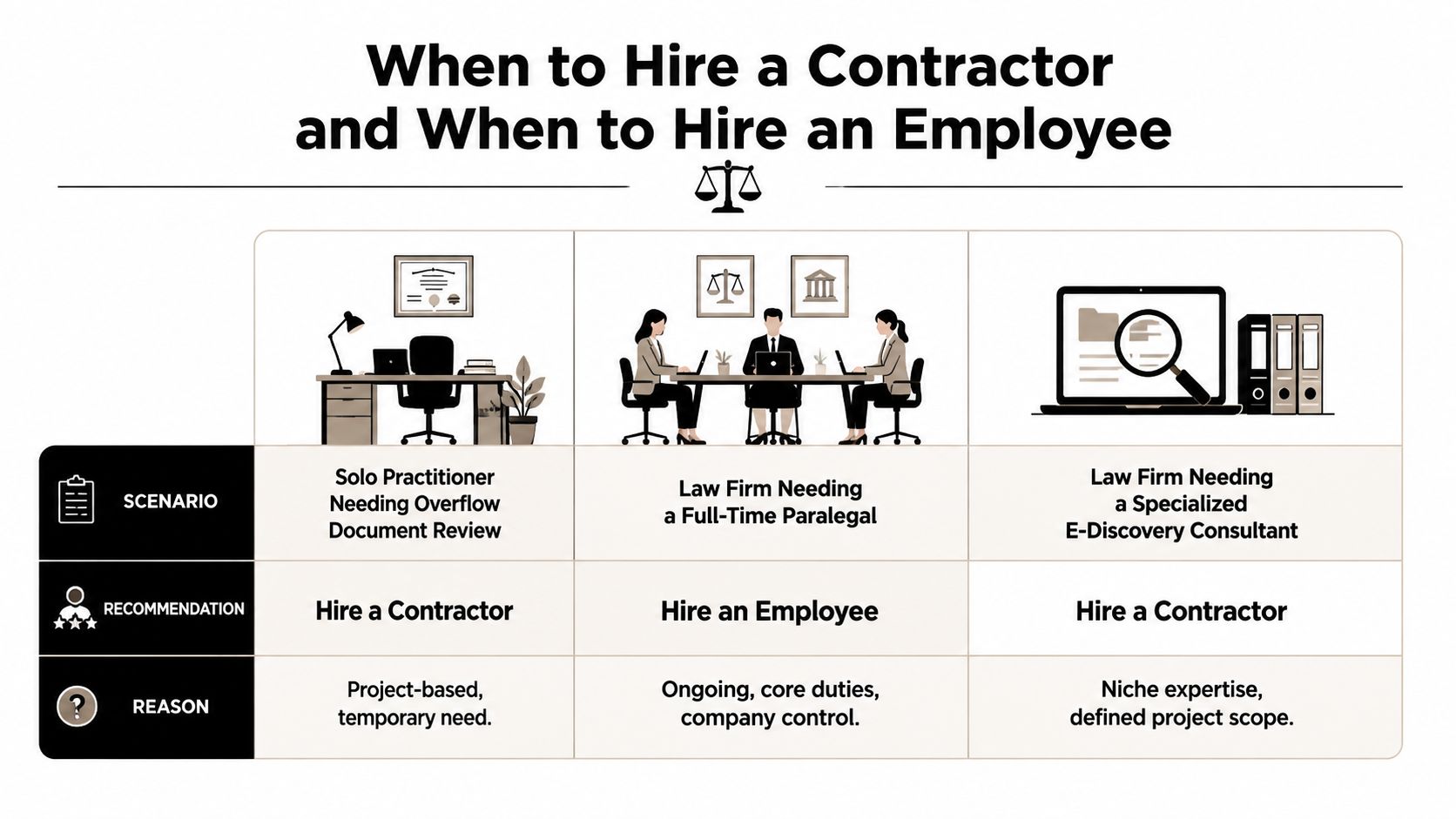
A solo practitioner who needs overflow document review for one matter may have a defensible contractor arrangement if the work has a defined scope, the reviewer controls the process, uses their own tools, and delivers a completed work product. The firm still must protect confidential information and check the relevant state rules.
A mid-size firm building a permanent remote paralegal team should hire employees. Recurring case assignments, associate supervision, firm software, set availability, internal training, and core litigation duties create an employment-shaped relationship. Calling that team “contractors” is an invitation to audit arithmetic.
A boutique practice hiring a specialized e-discovery consultant for a defined project may use a contractor when the consultant brings specialized expertise, controls the technical approach, bears business risk, and isn't functioning as an embedded member of the firm.
| Hiring situation | Duration | Supervision | Integration | Recommendation |
|---|---|---|---|---|
| Overflow review for one matter | Temporary | Limited, focused on deliverables | Limited | Contractor may fit |
| Permanent remote paralegal team | Ongoing | Direct and recurring | High | Employee |
| Specialized litigation or e-discovery project | Defined scope | Technical independence | Project-specific | Contractor may fit |
| Unclear role with changing duties | Uncertain | Likely to increase | Likely to increase | Employee until facts support another model |
Budget matters, but it's a secondary decision. If the firm controls the work, needs continuity, and relies on the person for core operations, employee status is the safer default even when the contractor invoice looks attractive.
Federal guidance has changed repeatedly, and state tests can diverge. A firm hiring across state lines should document the analysis before engagement, not after the worker complains.
Cutting corners to save 20% on payroll costs is a gamble, not a strategy. The supplied facts don't establish that percentage as a universal cost figure, so treat it as a hypothetical budgeting example, not a promise. The house may be the DOL, the IRS, a state agency, or a private plaintiff. It usually has better records than the firm hopes.
Before hiring your next remote paralegal, document the role, run the IRS and DOL analysis, check the worker's state rules, and decide whether the facts support a contractor relationship. If the role is ongoing and supervised, put the person on payroll. If you need flexible legal talent without building every classification and payroll process internally, evaluate a managed engagement model and have counsel review the arrangement before the first invoice lands.