
 15 minutes read
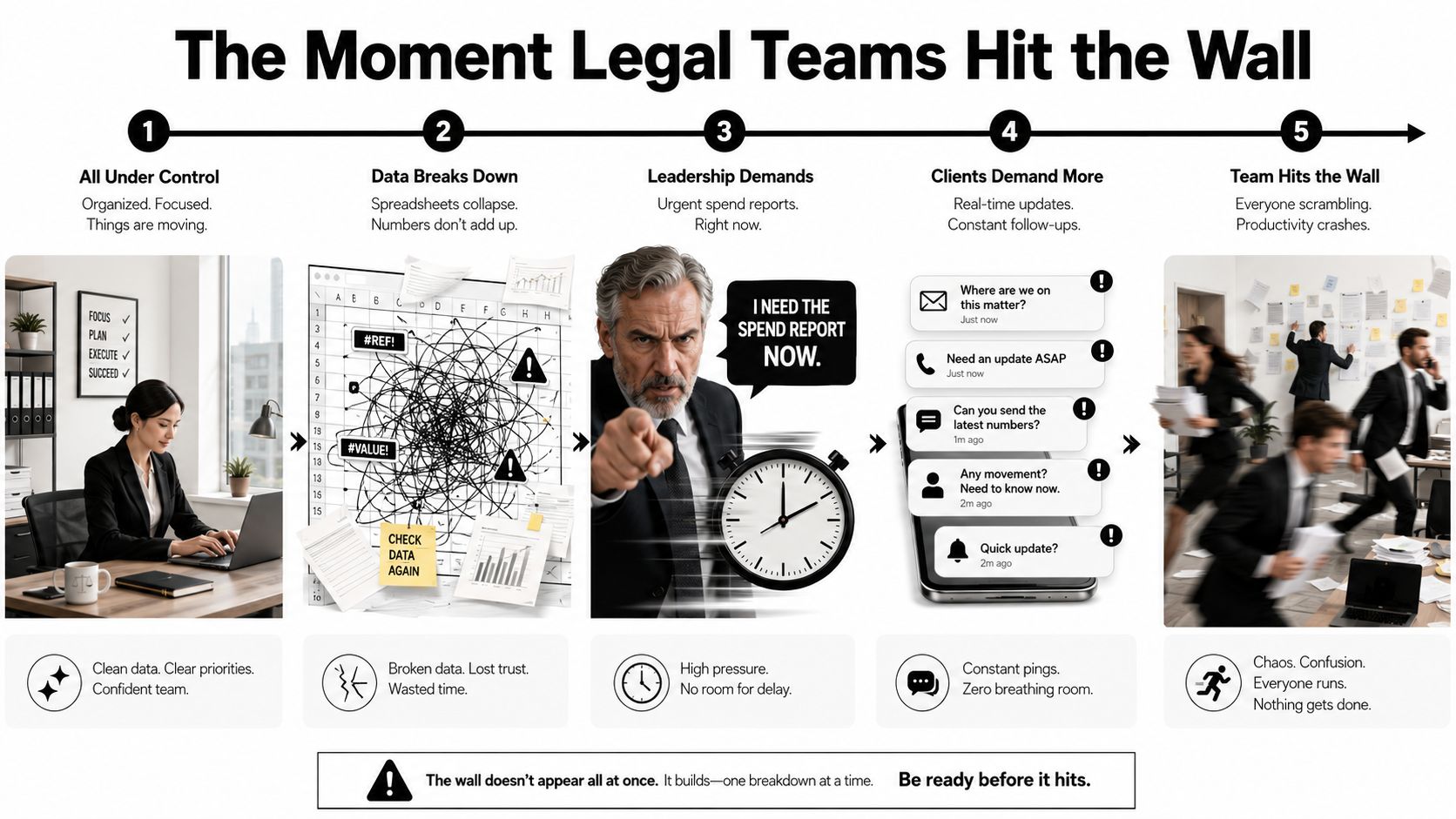
You know the scene. The intake spreadsheet is wobbling, a partner wants outside counsel spend by Friday, a client wants live matter updates, and the team is one missed handoff away from a small riot. That's usually the moment someone says, “We need legal operations,” and half the room acts like it's a luxury reserved for giant corporate legal departments. Cute. Wrong.
Legal operations management isn't admin with a fancier badge. It's the operating system that keeps legal work from turning into an inbox-based survival contest. And yes, the field has gone mainstream, which is a polite way of saying the old “we'll just handle it manually” approach is now officially a bad habit. In the 2021 Association of Corporate Counsel Chief Legal Officers Survey, 61% of departments said they had at least one legal operations professional, up from 21.2% in 2015, and legal ops positions had grown more than 75% since 2018 (legal operations statistics).
If your team is still stitching together updates in email threads and spreadsheets, start by documenting the chaos before you try to “fix” it. A simple process map beats a heroic guess every time, and a clean workflow board does more for morale than another round of status meetings. If you want a practical example of process documentation done without ceremonial nonsense, the framework at this process documentation guide is a solid reference point.
There's also a useful reality check for teams trying to run legal work on pure tribal knowledge. Wisely's monday.com consultancy can help teams organize work in a way that survives handoffs, which is the entire game in legal ops once the volume starts climbing: Wisely's monday.com consultancy.
The first sign you've outgrown ad hoc legal work is not a crisis, it's a pattern. The spreadsheet breaks, the request queue gets fuzzy, and suddenly nobody can answer a basic question without a scavenger hunt. That's not “being busy.” That's a process pretending to be a system.
The myth I'd like to retire is that legal operations management is a luxury for giant in-house departments. It isn't. The institutional shift is already visible, and it's especially relevant for smaller and mid-sized teams that can't afford to waste lawyer time on admin theater. The ACC data shows legal ops has become a durable management function, not a side quest, which is exactly why firms and in-house teams alike are paying attention (legal operations statistics).
Managing partners, general counsel, and operations leads all hit the same wall, just from different angles. A partner sees margin leakage. A GC sees budget ambiguity. An ops lead sees handoffs so messy they could be used as a compliance lesson.

Practical rule: if a question about spend, status, or ownership takes more than one person and more than one system to answer, you've already crossed into legal ops territory.
That's why this work serves more than “corporate legal.” It helps firms, mid-market legal teams, and lean departments that need predictable delivery without hiring a mini bureaucracy. The winner here isn't the fanciest department, it's the one that can show up Monday morning and know where the work is, who owns it, and what's stuck.
The ugly truth is that no one gets nostalgic for a system after it starts failing. Teams don't miss spreadsheets once they've had a real intake path, and they certainly don't miss guessing games about spend. If your team is feeling that pressure now, congratulations, you're not broken. You've just outgrown the duct tape.
Legal operations management is the discipline of running legal work like a business function, not a heroic rescue mission. Lawyers handle the law. Legal ops handles how work moves, gets measured, gets funded, and gets improved. That means people, process, technology, data, vendor management, and finance all have a defined place instead of living in everyone's inbox and optimism.
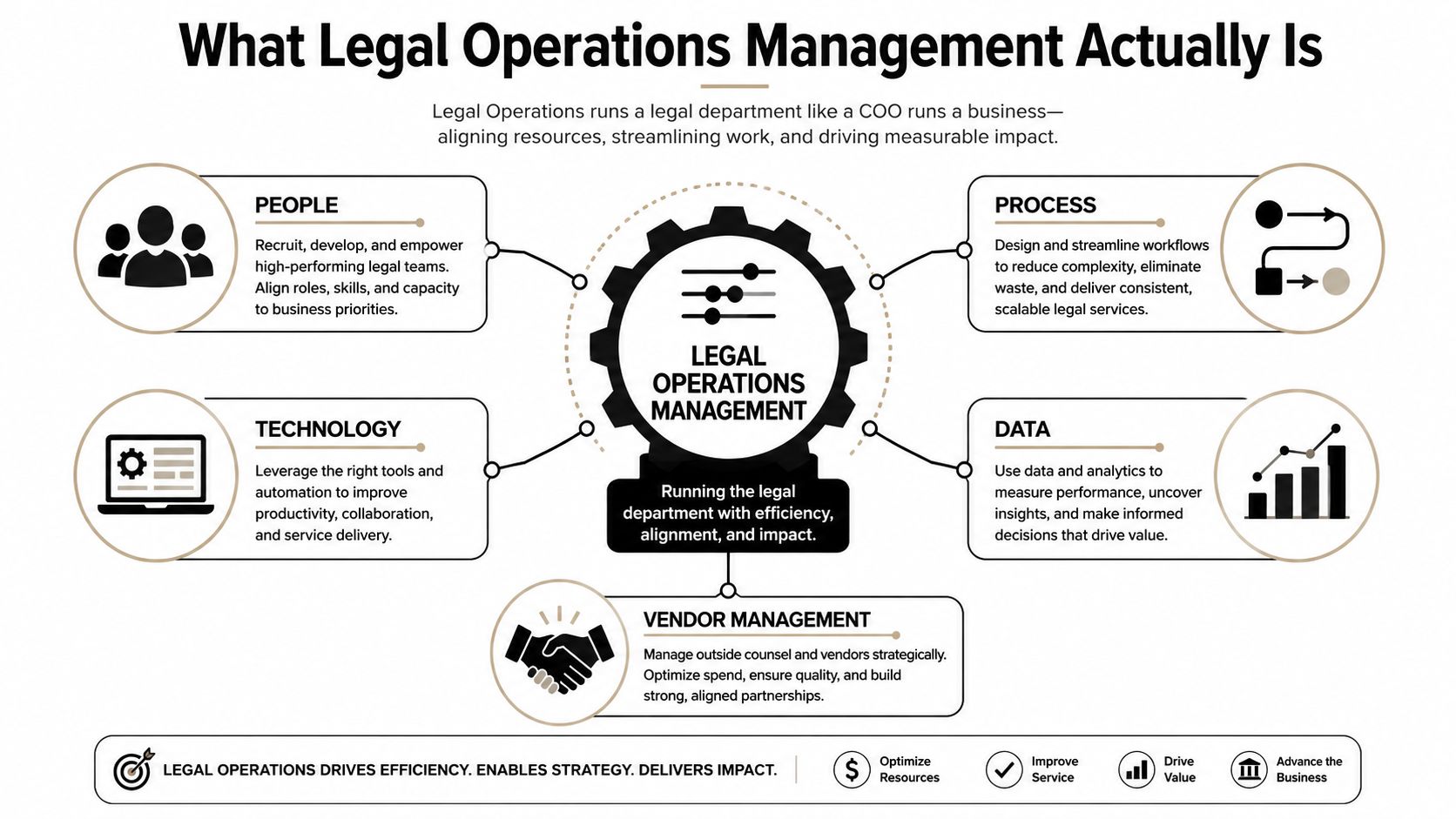
The point is simple. This function is formalized now, not improvised. Industry findings from CLOC and Thomson Reuters show legal ops teams putting real weight on process development and project management, data analytics, technical and process support, vendor management, and financial management (CLOC and industry operations findings). That is the operating model, whether the team sits inside a firm, a corporate legal department, or a scrappy mid-sized practice trying to stop work from leaking through the cracks.
People is the operating layer. In practice, that means someone owns coordination, not just execution. If you cannot name who owns intake, reporting, and follow-up, you do not have legal ops, you have a shared headache.
Process is the part everyone skips until the chaos gets expensive. You cannot automate a workflow you have not mapped, and you cannot improve a process nobody has written down. Small teams get burned here fastest, especially when everyone assumes the smartest lawyer should also be the process designer.
Technology should remove friction, not add another login and another apology. That is why in-house legal software matters. It turns repeat requests, routing, and status visibility into something other than manual labor. If the tool makes your team more dependent on heroics, the tool is the problem.
Data is what stops legal from running on vibes. Not every metric deserves to become a KPI, which is why legal ops teams should only promote numbers that tie to business outcomes like cycle time reduction or spend discipline. If the metric does not help someone make a decision, it is decoration.
Vendor management keeps outside counsel and service providers from drifting into chaos. That means performance expectations, billing discipline, and real oversight, not polite relationship management with a fancy title. Mid-sized firms and lean legal teams feel this pain fast because outside help often fills gaps that headcount never will.
Finance and compliance are the glue. Legal ops earns its seat with CFOs because spend, predictability, and risk belong in the same conversation. Learn more about the role at legal operations manager.
If you are building from scratch, start with process and finance before you get distracted by shiny software. A tool can speed up a clean workflow. It can also speed up a bad one, which is a great way to waste money and learn nothing.
I've watched this movie too many times. A 40-attorney firm buys a contract lifecycle management platform before mapping a single workflow, then spends the next eight months cleaning up the mess. The software didn't fail. The sequencing did.
The killer is almost never headcount or budget. It's workflow structure, invisible work between steps, unclear handoffs, and tools that create friction instead of removing it. Industry analysis keeps pointing to the same ugly culprits, invisible work, deadlines tracked but not progress-tracked, coordination overhead, and tools that make things harder rather than easier (legal operations challenges).
The bad rollout usually starts with enthusiasm and ends with spreadsheet archaeology. Someone buys the platform, someone else promises the process will “settle in,” and nobody defines who owns the stages in between. Then attorneys stop trusting the tool, because of course they do, it's now just a fancier inbox with notifications.
The better example is boring in the best possible way. One 15-attorney firm starts with one practice area, one intake form, and one weekly review. No drama, no transformation theater, just a clean workflow and a weekly look at what's stuck. That's how legal ops earns trust, by making the work visibly easier before it tries to make it complex.
Stop trying to modernize everything at once. One workflow, one owner, one review rhythm. That's enough to prove the model.
For smaller and mid-sized teams, the lesson is blunt. Don't buy the platform first. Don't hire for the org chart first. Start with the bottleneck, then the handoff, then the tool. If you reverse that order, you'll spend months explaining why the shiny new system is somehow producing more frustration than the old chaos ever did.
A legal ops dashboard can look polished and still waste everyone's time. If it does not change a decision, it is wall art with graphs. The numbers that deserve space are the ones tied to spend, speed, and workload reality.
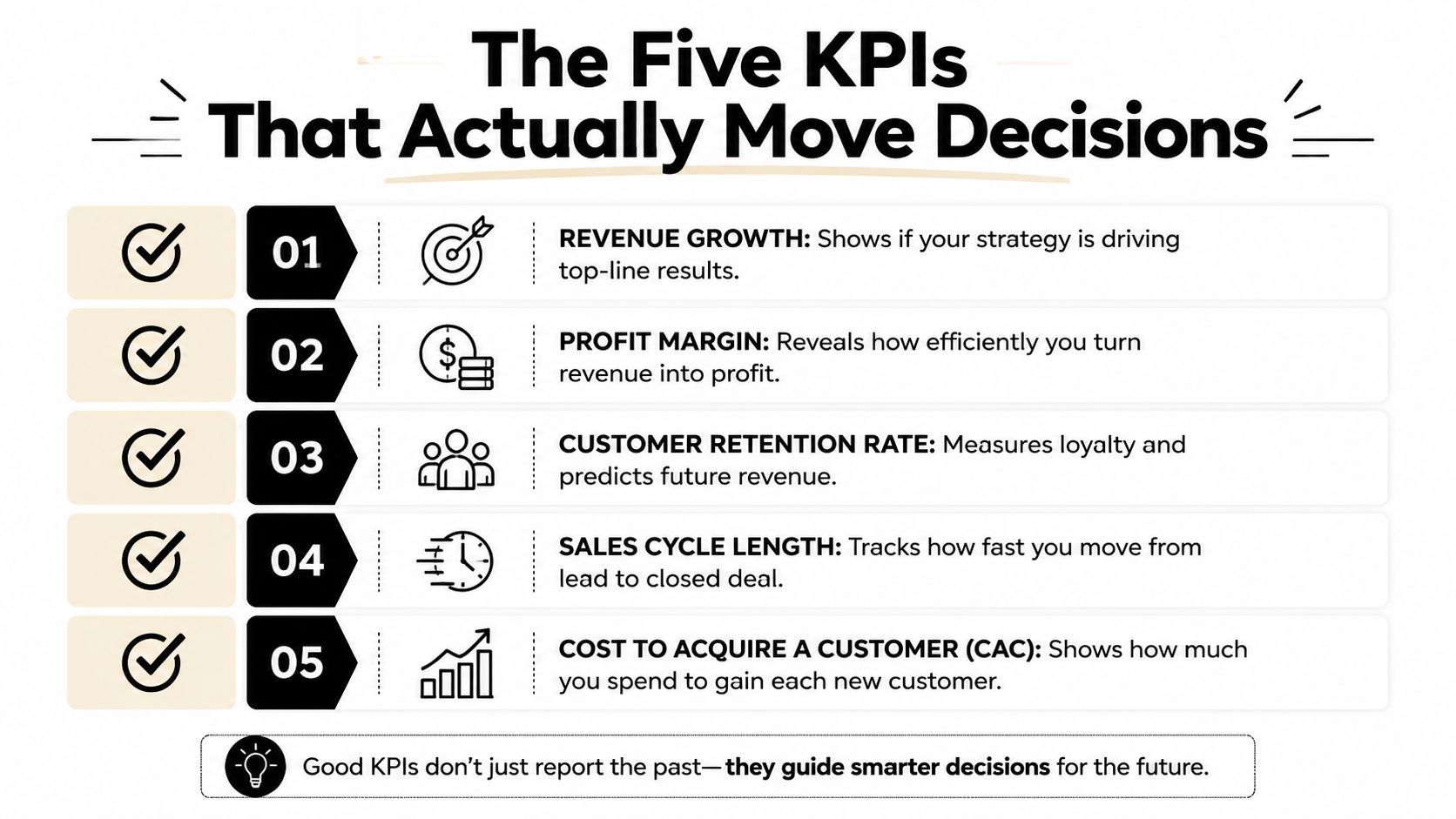
The legal department operations index shows the usual suspects legal teams track, including total spend by law firm, forecasted versus actual spend, matters opened and closed, and spend by business unit (legal department operations index). That list is useful, but only if the numbers lead to action. Mid-sized firms and smaller legal teams need the same discipline without the Fortune 500 bloat, which means fewer vanity charts and more signals that expose where work is leaking, slowing down, or piling onto the same few people.
Total spend by law firm shows where the money goes. If a partner wants to know which firms are driving cost, this is the first answer they should get.
Forecasted versus actual spend is where credibility lives or dies. If the forecast keeps missing, finance stops treating legal as a planning partner and starts treating it like a surprise generator.
Matters opened and closed gives you flow, not just volume. A rising pile of open matters usually means the team is creating backlog faster than it is clearing it.
Cycle time broken into stages is the diagnostic gold. Drafting, internal review, negotiation, and signature turnaround each point to a different bottleneck, which means each points to a different fix.
Workload distribution shows whether one person is carrying half the department's pain. If the balance looks lopsided, you have a staffing or routing problem, not a motivation problem.
A metric becomes a KPI when it is tied to a business objective. If legal spend as a share of revenue matters to your CFO, that belongs on the board-level dashboard. If the team cares about contract-review cycle time, track it by stage and connect it to renewal speed or sales throughput. That is the difference between reporting and management.
Simple test: if the number does not change a decision, it does not belong in the top dashboard.
Smaller teams win by being selective. You do not need twenty charts. You need five numbers that force a conversation about spend, speed, or workload, and you need a clear owner for each one. Start there, then add more only when someone can explain which decision the new number will change.
Mid-sized legal teams do not need a grand reinvention. They need a sequence that fits reality, survives a budget meeting, and does not require a dedicated ops army on day one. Start with a phased rollout, assign one owner per phase, name one deliverable, and make one risk the focus of each stage.
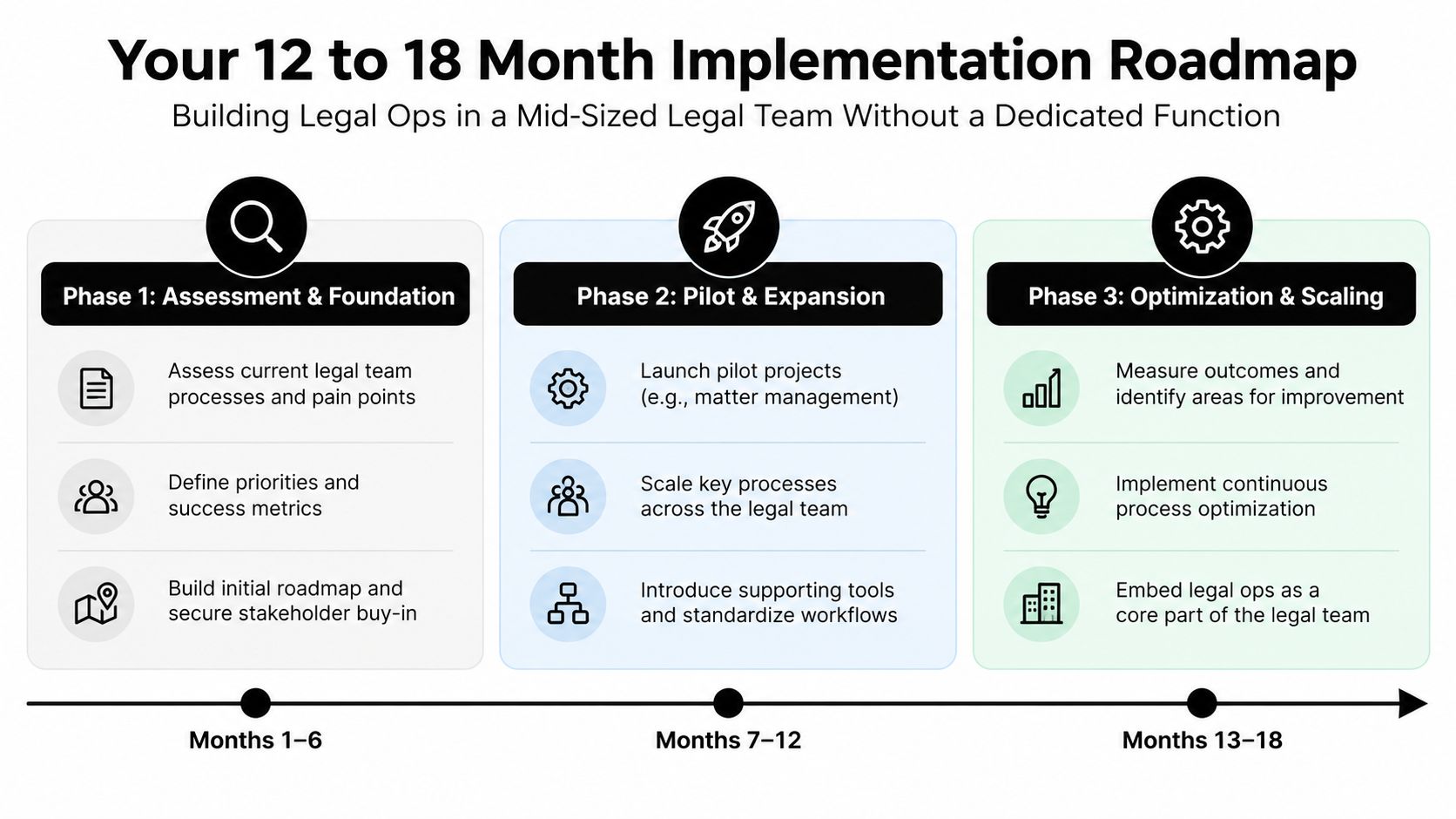
A practical benchmark for mid-sized in-house legal teams recommends a 12- to 18-month roadmap split into three phases, months 1-4 to centralize outside counsel spend and document templates, months 5-10 to pilot CLM in one region with success criteria, and months 11-18 to roll out CLM globally and add AI-assisted drafting and review with governance (mid-sized legal operations roadmap).
The first move is boring and necessary. Centralize outside counsel spend, document your templates, and launch a matter intake portal. If you are a five-person team, the single owner should be whoever can chase the data, whether that is the GC, a senior paralegal, or an operations-minded manager. The risk here is simple, trying to standardize too much before the intake path works.
Next, pick one region or business unit and pilot contract lifecycle management with success criteria set before you start. Skip that step and the rollout turns into a popularity contest, which is a great way to mistake noise for progress. The owner should sit close to the business users, because adoption lives or dies there, not in procurement.
Once the pilot works, expand CLM globally and add AI-assisted drafting and review with controls around use, review, and output quality. The team needs a governance mindset for this, not a toy-scrapbook mindset. If you are bringing in a broader transformation plan, execute a future-proof transformation plan with the same discipline you would use for any business-critical rollout.
The three actions I would put on Monday's list are straightforward. Centralize spend data, standardize templates, and launch a matter intake path. Do those three well and you build the base layer every other improvement depends on.
Legal ops staffing is where a lot of teams get sentimental and then expensive. Full-time, contract, and on-demand remote support all have a place. Pretending otherwise is how you end up over-hired, under-used, or waiting six months for the “perfect” hire while the work keeps landing.
| Legal Operations Staffing Models at a Glance | Time to Productivity | Cost Profile | Best Fit |
|---|---|---|---|
| Full-time hire | Slower at first, stronger over time | Higher fixed cost | Steady, high-volume, long-cycle work |
| Contract paralegal | Faster for a defined scope | Flexible, project-based | Mapped projects with a clear end |
| On-demand remote paralegal | Fastest when the workflow is defined | Variable and scalable | Bursty demand, niche expertise, timezone-aligned support |
The default for teams under 20 lawyers is usually not a full-time hire first. It's a hybrid model that lets you prove the workflow before you harden the org chart. That's especially true when demand spikes unpredictably, or when the team needs US-timezone coverage without the overhead of a permanent seat. If you're pressure-testing the model, workforce planning strategies is a relevant reference point.
Full-time hire makes sense when the workload is constant and the team owns recurring operations, like spend reporting, vendor oversight, or contract routing. The upside is continuity. The downside is that you've committed before the pattern is fully proven.
Contract support works when the project has a clean end state. If you're migrating templates, cleaning a backlog, or standing up a new process, a contract paralegal can be the sharpest tool in the drawer.
On-demand remote paralegals are the fastest way to cover bursty work or niche needs without building permanent overhead. HireParalegals also fits this model, because it's built for US law firms needing remote legal support, which can be handy when you need coverage before you're ready to commit to a permanent role.
The right question isn't “what's the best staffing model?” It's “what's the least expensive model that can solve the real bottleneck without slowing everyone else down?”
That question saves teams from two common mistakes, over-hiring too early and under-staffing too long. Both are expensive. One shows up on payroll. The other shows up in everything else.
The same mistakes keep showing up, and yes, many teams can recognize at least two of them from their own hallway conversations. The fix is not more enthusiasm. It's fewer dumb decisions.
The American Bar Association frames legal operations as the part of the legal department that makes it a strategic business partner instead of a cost center, prioritized through strategic planning, service delivery optimization, technology utilization, and risk management (ABA business law guidance).
A key indicator is whether the program changes behavior. If the answer is no, the program is still a presentation. Once legal ops starts improving routing, visibility, and predictability, it becomes infrastructure.
Pick one practice area, one bottleneck, and one KPI, then staff it with the smallest credible team that can move it. That's the whole game. Not a platform. Not a reorg. A decision.
Authoritative guidance says legal ops reporting needs to shift toward business-impact metrics like legal spend as a percentage of revenue, time-to-resolution, and business-enablement outcomes, because C-suite buy-in comes from enterprise metrics, not internal workload trivia (C-suite buy-in guidance).
If you're running a small or mid-sized legal team, stop waiting for the perfect operating model to arrive from the sky. Choose one workflow, one owner, and one measurable outcome this week, then build the dashboard and template set around that. That's how legal operations management starts to look less like a buzzword and more like a department that finally knows what it's doing.