
 15 minutes read
A matter lands on a Friday afternoon, a filing deadline is approaching, and your existing team is already committed to client calls, discovery, or court preparation. Recruiting a permanent legal assistant won't solve this week's workload, while a general temp agency may not understand your practice area, document systems, or confidentiality obligations. On demand staffing services give law firms a way to add qualified legal support for a defined workload without committing immediately to a permanent hire.
The model can work for a solo practitioner who needs overflow paralegal help, a mid-sized firm handling a litigation surge, or a corporate legal department managing an acquisition or compliance project. The value isn't just speed. The evaluation involves skill fit, confidentiality, conflicts, supervision, jurisdiction, data access, classification, and the cost of keeping capacity idle after the matter ends.
This guide explains what on demand staffing services mean for legal buyers, how they compare with temp agencies and direct hires, where they fit by firm size and practice area, and which controls should be in place before outside talent touches a matter.
A three-week discovery review rarely needs a permanent paralegal. It does require someone who understands privilege, can work in the firm's document system, follows confidentiality controls, and knows when an attorney must make the call. That distinction is the practical meaning of on demand staffing services for law firms: adding legal support for a defined workload without carrying an ongoing position after the matter slows.
A platform or specialized provider may match the firm with paralegals, legal assistants, contract attorneys, or project professionals from an existing talent pool. The engagement can cover a short project, a workload surge, or an arrangement that expands and contracts with demand. Compared with a direct hire, the firm may gain speed and avoid maintaining unused capacity. Compared with a traditional temp agency or a BPO, a legal-focused provider may offer stronger practice-area and systems alignment, but the firm must still verify quality, security, supervision, and responsibility for errors.
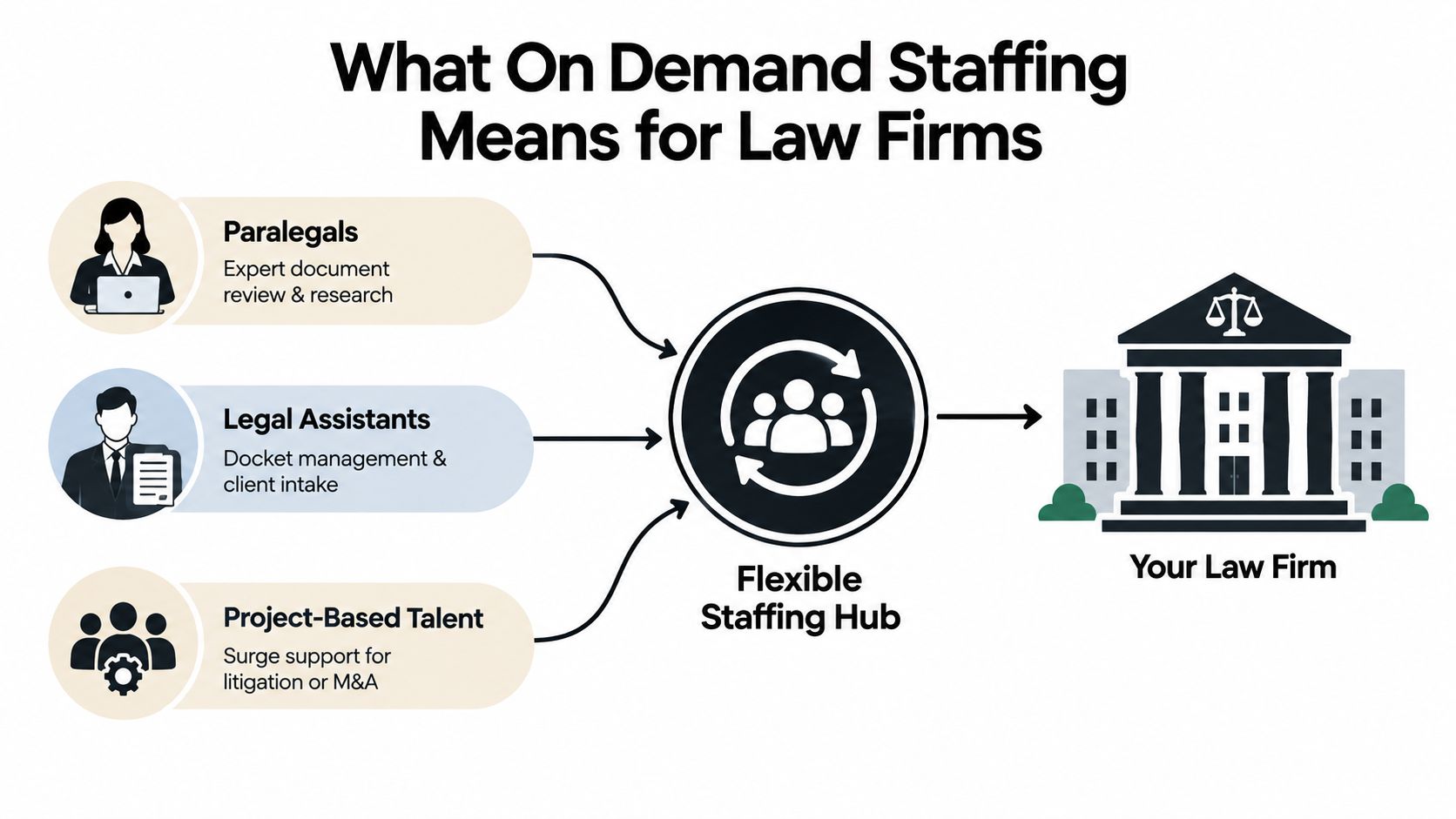
A useful request goes beyond a job title. State the matter type, jurisdiction, expected tasks, required software, working hours, supervision structure, confidentiality restrictions, and planned end point. A family-law assignment involving pleading preparation and court-form organization calls for a different profile from commercial-litigation privilege review or corporate contract abstraction.
The provider presents candidates against that brief. The firm remains responsible for professional judgment, work allocation, quality review, client communications, and access decisions. A paralegal can organize information, prepare materials under supervision, and support case operations. The role does not include diagnosing legal issues, providing independent legal advice, or performing work reserved for licensed attorneys.
A solo practitioner might use project support for intake, discovery organization, or docket updates. A mid-sized firm may add capacity when a large production arrives or attorneys take leave. A corporate legal department may bring in contract support during an acquisition, then end access after abstraction and audit work finish. Flexibility has value only when the assignment is scoped, supervised, secured, and reviewed.
Before approving a provider, examine these legal-operational questions:
A specialized option such as flexible staffing solutions for law firms may suit a buyer seeking legal talent rather than general office labor. It does not replace the firm's conflict check, supervision duties, security controls, or professional-responsibility analysis.
Cost comparisons often fail because buyers compare a contractor's hourly bill rate with an employee's wage and ignore the rest of the employment cost. A direct hire may require recruiting time, interviews, background checks, onboarding, payroll administration, benefits, equipment, training, and continued compensation when the matter pipeline slows. A temp agency typically includes those administrative services in a markup on the worker's bill rate. An on-demand platform may charge for access to a curated pool and matching process, but the commercial terms vary by provider.
No universal rate comparison is reliable without the actual engagement terms. Instead, compare what you pay, what the provider handles, how quickly work can begin, and what happens when demand falls.
| Factor | On-Demand Platform | Traditional Temp Agency | Direct W-2 Hire |
|---|---|---|---|
| Primary use | Defined projects, overflow, or variable capacity | Temporary coverage sourced through an agency | Ongoing role with sustained workload |
| Candidate access | Existing, specialized talent pool | Agency roster, which may be broad or legal-specific | Firm builds its own candidate pipeline |
| Speed | Some legal platforms advertise shortlists within a day, but verify the service level and candidate availability | Often requires a new request and agency search | Usually slower because sourcing, interviews, notice periods, and onboarding remain with the firm |
| Commitment | Can be structured around hours, project scope, or a renewable period | Temporary assignment under agency terms | Ongoing employment commitment |
| Administrative burden | Provider may coordinate matching, contracting, and billing | Agency generally manages payroll administration | Firm manages payroll, taxes, benefits, equipment, and employment records |
| Quality control | Depends on screening depth, interview rights, work samples, and supervision | Depends heavily on the agency's legal staffing expertise | Firm controls selection directly but must perform all screening |
| Scaling | Capacity can usually be adjusted through the provider | Adjustments depend on available agency workers | Reducing capacity can create employment and morale issues |
| Main risk | A fast match can still be the wrong match if the brief and controls are weak | A general roster may not fit specialized legal work | The firm carries the full hiring and retention burden |
On-demand models can be economically sensible when the alternative is missed deadlines, attorney overtime, delayed billing, or a permanent hire with insufficient utilization. They can be a poor fit when the work is continuous, highly integrated with firm operations, or requires long-term institutional knowledge. Use a legal hiring cost reduction framework to separate visible labor expense from recruiting, management, training, and idle-capacity costs.
Before approving a provider, estimate the work in terms of deliverables rather than a vague number of hours. Identify the expected volume, review time, attorney supervision, software seats, training, and any premium for specialized experience. Ask whether the provider charges a placement fee, recurring platform fee, hourly markup, minimum commitment, conversion fee, or cancellation charge.
Also ask who employs or contracts with the worker and who handles payroll reporting. The answer affects classification, insurance, confidentiality, tax administration, and termination procedures. Requirements vary by arrangement and jurisdiction, so the firm should confirm the structure with qualified employment counsel or a compliance professional rather than relying on a sales summary.

Practical rule: A low hourly price doesn't make a good engagement if the attorney must redo the work, correct preventable errors, or manage access problems.
The best use of on demand staffing services depends on the firm's workload pattern, not just its headcount. A solo practice usually needs targeted relief around a bottleneck. A mid-sized firm may need several people with coordinated assignments. A corporate legal department often needs repeatable project capacity that can be measured against an existing outsourcing arrangement.
A family-law solo may have enough recurring work to justify support but not enough predictable volume for a full-time employee. A remote paralegal can organize intake information, prepare a checklist for divorce filings, assemble discovery packets, and track requested documents under the attorney's direction. The attorney remains responsible for legal advice, filing decisions, client communications that require legal judgment, and final review.
The arrangement works best when the solo provides standardized templates, a secure file structure, scheduled check-ins, and a narrow initial assignment. It works poorly when the attorney sends unstructured email instructions and expects the remote worker to infer priorities from a crowded inbox.
A litigation group may receive a large document production, enter a fast-moving class action, or face overlapping attorney leave. Contract reviewers and litigation paralegals can absorb defined workstreams such as chronology building, exhibit organization, document coding, deposition preparation, or discovery tracking. The supervising team should assign one matter lead, establish review protocols, and define escalation rules for privilege, relevance, and unusual documents.
Litigation demand can be irregular, so the firm should avoid treating temporary capacity as a substitute for core case ownership. A reviewer who processes documents quickly but escalates inconsistently may create more work for senior attorneys.
An in-house team may use project-based legal support for contract abstraction during an acquisition, policy research during a compliance review, or intellectual-property administration around a filing deadline. Transactional work often benefits from repeatable templates and stable workflows, while regulatory and investigations work may require more specialized screening and stricter access segmentation.
Practice area changes the risk profile. Immigration, family law, employment, health-related matters, and litigation can involve sensitive personal information and urgent deadlines. Corporate and transactional work may be easier to modularize, but confidentiality, privilege, data residency, and conflicts still require attention.
A simple decision test helps:
If the answer is no, direct hiring or a tightly governed outsourcing relationship may be more appropriate.
A remote legal professional should not receive matter access merely because a provider says the candidate is vetted. The firm must decide what information the person may see, what work the person may perform, who supervises it, and how the engagement ends. Confidentiality obligations, conflicts, unauthorized practice concerns, insurance, and cybersecurity all belong in the intake process.
Start with a written confidentiality agreement or NDA tied to the relevant matter, client information, systems, and engagement period. Run a conflict check against the firm's client and adverse-party information before sharing substantive facts. The check should account for the worker's prior engagements and any restrictions imposed by the provider.
A paralegal may support legal work, but the firm must preserve attorney supervision and avoid delegating legal judgment that the person isn't authorized to exercise. The applicable boundaries can depend on the person's role, location, the firm's jurisdiction, and the nature of the task. Have counsel or the firm's ethics adviser review unusual arrangements, especially cross-border work or tasks involving direct client contact.
Give the worker only the access required for the assigned matter. Use individual accounts, multifactor authentication, role-based permissions, approved document-management tools, and audit logs. Don't rely on personal email, consumer messaging apps, unrestricted downloads, or informal file transfers for client material.
A practical pre-engagement checklist should include:
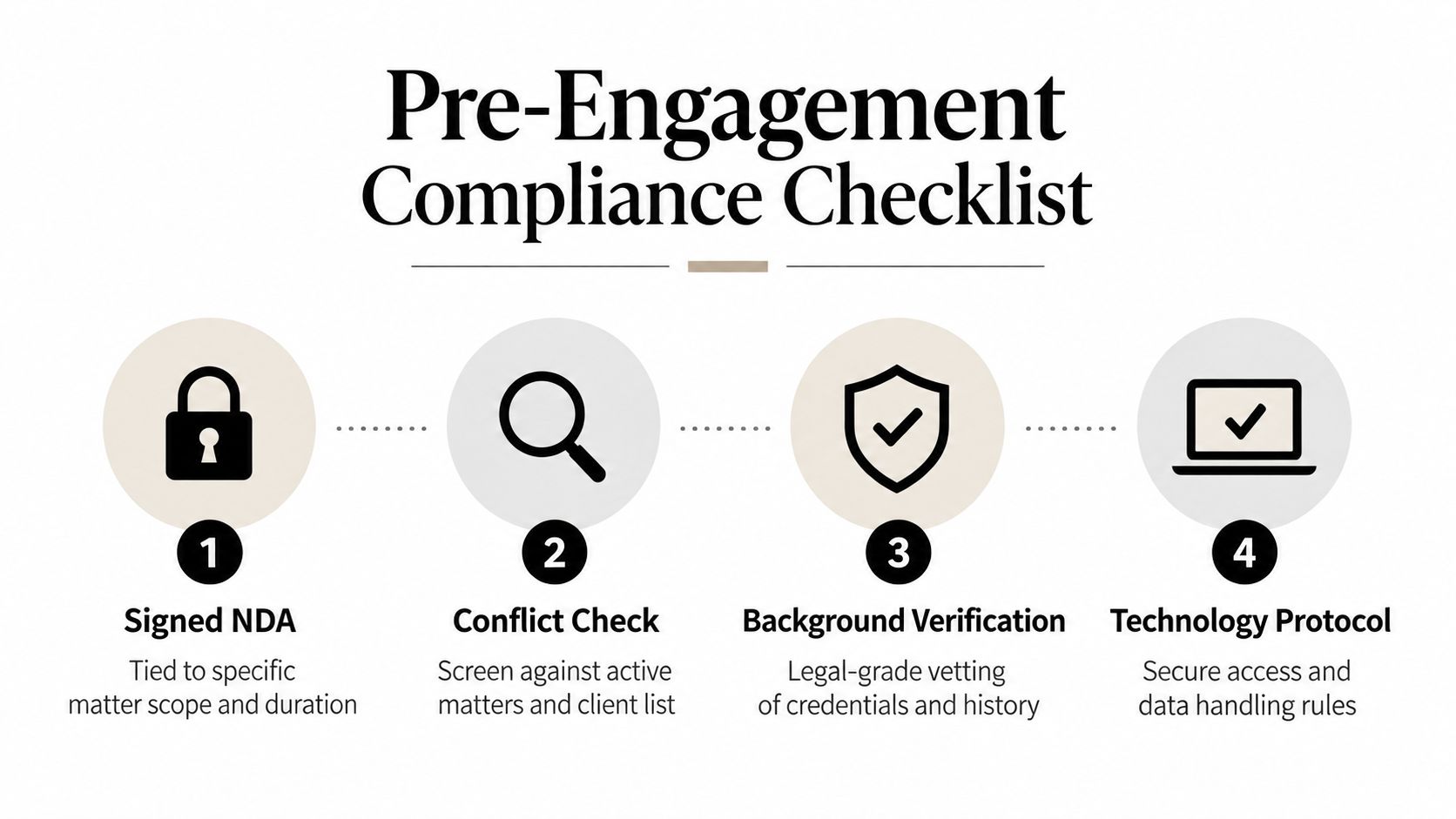
The firm's engagement documents should address confidentiality, ownership of work product, data handling, subcontracting, incident reporting, jurisdiction, dispute procedures, termination, and post-engagement deletion or return of information. A provider's background verification process can support diligence, but it doesn't eliminate the firm's obligation to assess conflicts and supervise the work.
A specialized platform's value appears in the handoffs. Consider a firm that needs a remote paralegal for a litigation project and wants someone familiar with its document-management system, working hours, matter type, and confidentiality requirements.
The request should begin with a structured brief. The firm identifies the practice area, jurisdiction, tasks, software, schedule, supervision, and commercial parameters. A useful provider then uses that information to narrow the pool instead of forwarding a stack of generic resumes.
By midday, the firm should have enough information to compare candidates meaningfully. That may include a CV, interview notes, work samples, relevant matter experience, language ability, availability, and rate terms. The attorney or manager should still interview the candidates and test their understanding of the assignment.
Before work starts, the provider and firm should document the agreement, confidentiality terms, conflict status, billing arrangement, and access requirements. The firm's administrator then provisions a limited seat in the document-management system and confirms that the worker can reach approved tools without receiving unnecessary matter data.
Some platforms advertise a shortlist within 24 hours, including HireParalegals, but the firm should confirm what that promise covers. A shortlist isn't the same as a completed conflict check, signed agreement, system onboarding, or verified ability to perform the work. Speed creates value only when each control keeps pace with sourcing.
Look for operational features that make the relationship manageable after the hire:
HireParalegals describes a platform connecting U.S. law firms with remote legal professionals and offering shortlist-based hiring. If a firm considers it, the buyer should evaluate its actual agreement, screening documentation, conflict workflow, data handling, billing terms, and replacement process in the same way it would evaluate any other provider.
On demand staffing isn't turnkey. The provider can accelerate sourcing, but the firm still has to define work, supervise output, control access, and measure whether the arrangement is working.
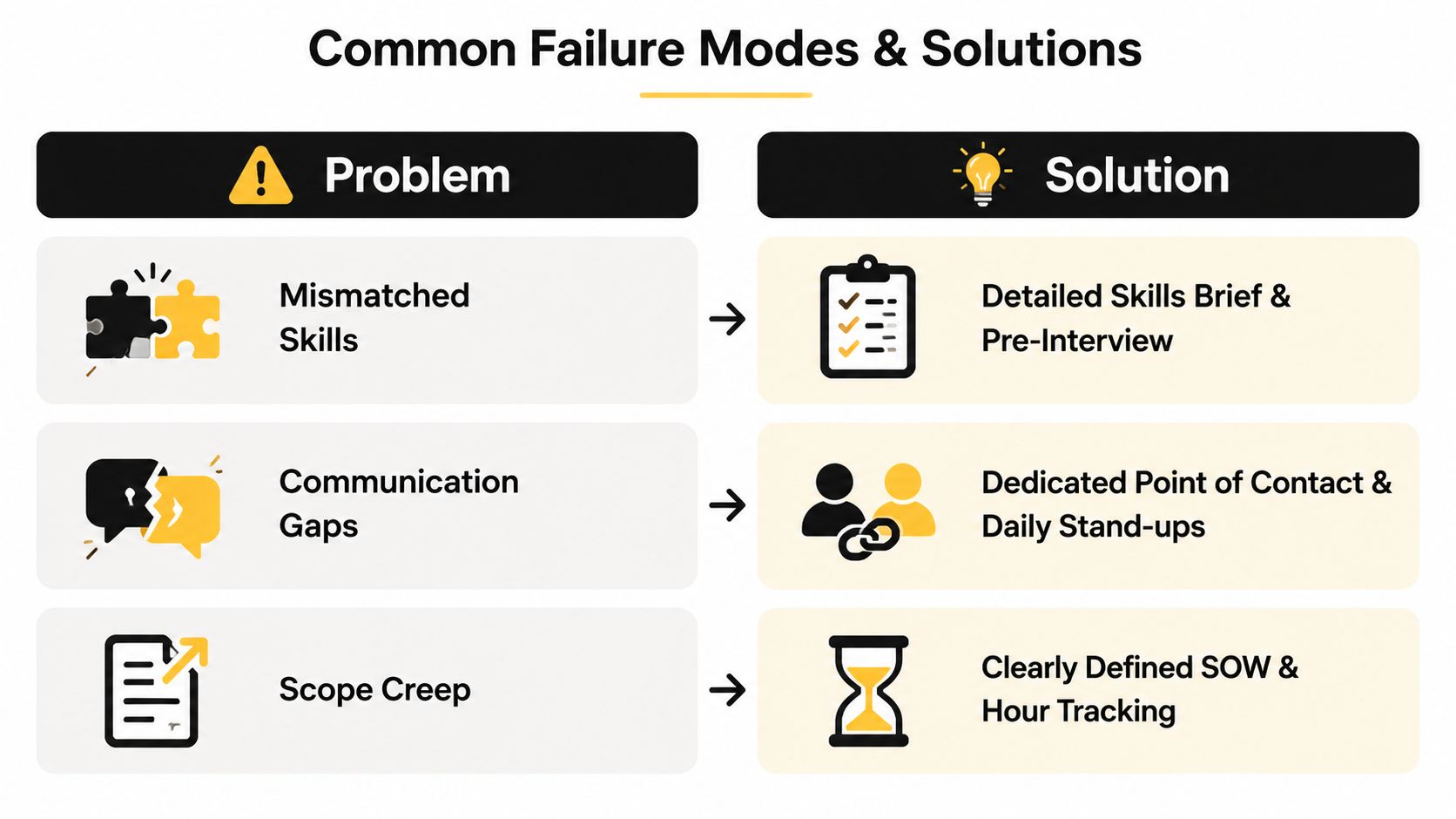
Bad matching usually starts with an underspecified request. “Need a paralegal” doesn't identify whether the firm needs discovery experience, docket management, legal research, billing support, or client intake. Require a skills brief, interview, and a paid sample using anonymized work or a controlled test. Don't give a new contractor live client data just to evaluate basic competence.
Scope creep turns a flexible assignment into an unbudgeted second job. Use a written statement of work, task priorities, hourly cap, approval rules for additional work, and regular burn reports. If the provider or worker receives changing instructions from several attorneys, appoint one owner.
Classification mistakes can arise when a firm controls a worker's schedule, methods, tools, and ongoing duties in a way inconsistent with the intended relationship. Ask who employs or contracts with the person, who issues required tax forms, who manages payroll, and how the arrangement complies with applicable rules. Obtain professional advice for the specific structure. A platform's administrative role doesn't automatically resolve every legal obligation.
Single-person dependency creates continuity risk. Keep documented procedures, maintain a second qualified contact for critical workflows, and avoid storing matter knowledge only in a worker's private notes. A replacement plan matters most when the work supports court deadlines, client intake, or recurring billing operations.
Confidentiality failures often happen through convenience. Enforce NDA terms, DMS-only file transfers, approved communication channels, least-privilege access, and immediate credential revocation when the matter closes. The firm should retain audit evidence showing who accessed, changed, exported, or shared sensitive material.
A fast engagement is successful only when the firm can explain who had access, what they were allowed to do, and how the firm verified the result.
On demand staffing services make the most sense when a law firm has a defined workload, a clear supervisor, and a credible reason not to make a permanent hire yet. Solo practitioners can use the model for overflow drafting support, intake administration, or docket organization. Mid-sized firms can absorb matter surges or leave coverage without immediately expanding fixed headcount. Corporate legal departments can add project capacity for contract abstraction, compliance reviews, or policy work while comparing the arrangement with existing BPO resources.
Before signing, resolve the practical questions: Who performs the conflict check? Where may the worker access data? What jurisdiction and professional boundaries apply? Who owns the work product? What happens when the engagement ends? How are credentials, files, invoices, incidents, and replacement requests handled?
HireParalegals is one option for firms seeking a fast shortlist of remote legal support, but the right next step is a controlled evaluation. Prepare a matter-specific skills brief, define the access rules, and request a candidate review that includes interview, verification, conflict handling, and commercial terms before assigning live work.
If your firm needs vetted remote paralegal support for a defined project or workload surge, review HireParalegals' flexible staffing solutions and compare the proposed candidates against your matter requirements, supervision plan, and compliance checklist before moving forward.