
 15 minutes read
Temporary legal staffing is a flexible workforce model in which firms use contract professionals for caseload spikes, specialized projects, and coverage gaps, and 42% of legal departments use contract talent, rising to 74% among companies with more than $20 billion in revenue. The firms using it well treat it as capacity planning, not as an emergency substitute for sound management.
The popular advice is to use temporary staff only when someone resigns, takes leave, or faces an unexpected trial deadline. That advice is too narrow. A contract paralegal, legal assistant, or attorney can protect throughput, add specialized capability, and give a firm room to make a permanent hiring decision without forcing the existing team to absorb every backlog.
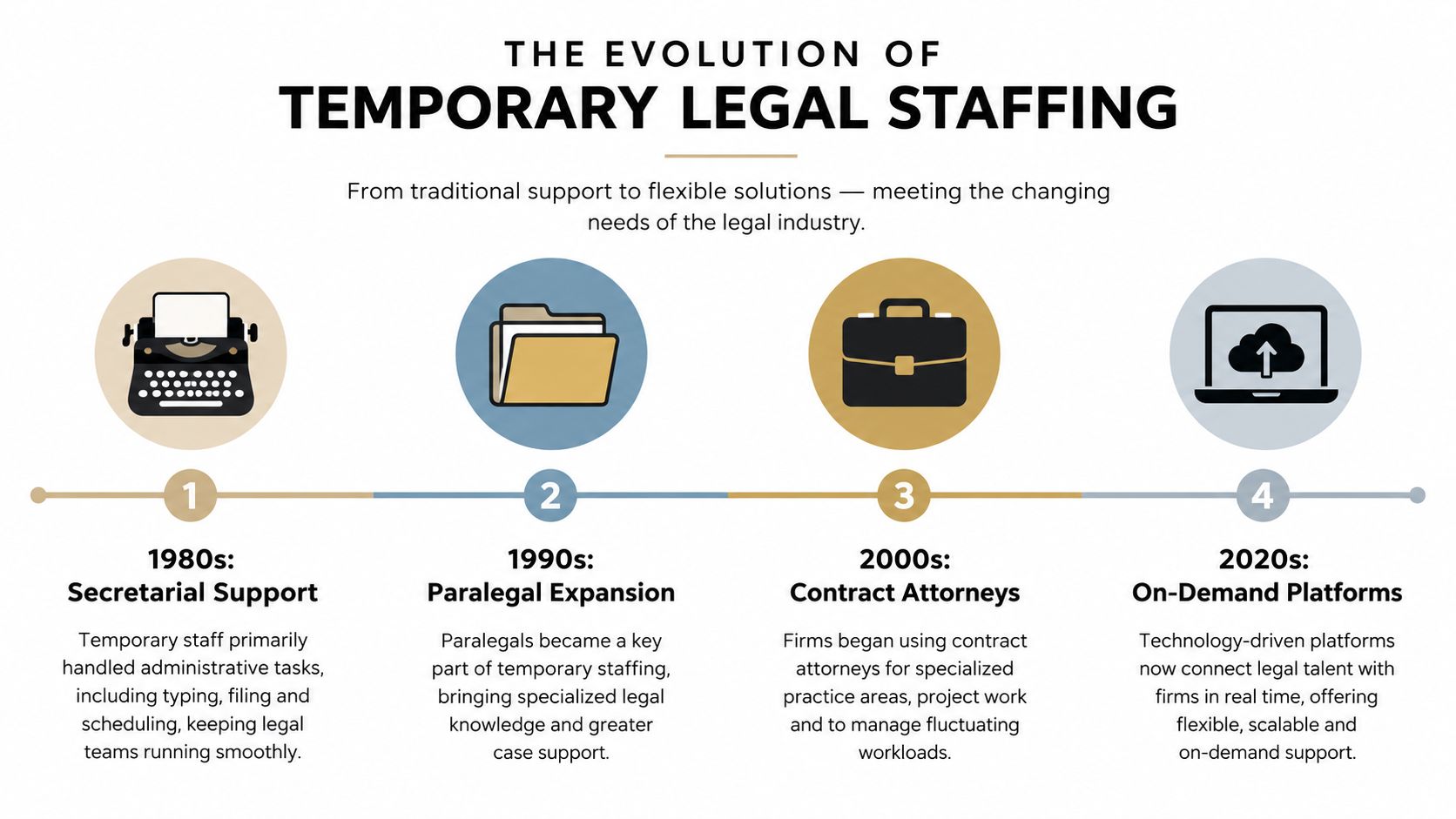
The right model depends on the work, the supervision available, the required level of legal judgment, and how much responsibility the firm wants the vendor to carry. This guide explains how temporary legal staffing developed, how agency temps compare with contract attorneys and on-demand platforms, why demand is expanding, how to evaluate vendors, and how to manage remote and cross-border arrangements without losing control of confidentiality or quality.
Temporary legal staffing means engaging a qualified legal professional for a defined workload or period instead of adding that person to the firm's permanent headcount. The assignment may involve discovery review, contract analysis, compliance support, litigation administration, legal research, case-file organization, or coverage for an absent employee.
The model usually has three parties. The staffing agency or platform sources and contracts with the professional, the law firm defines the work and supervises day-to-day performance, and the placed professional performs the assignment within the firm's systems and processes. That triangular relationship separates the worker's employment or engagement relationship from the client firm's operational supervision.
The modern staffing model has roots in 1948, when lawyers Elmer Winter and Aaron Scheinfeld founded Manpower Inc. after struggling to find a temporary secretary for their own law firm. The business formalized a structure in which the staffing agency employed the worker rather than the client company, helping establish temporary staffing as a distinct labor category. By the early twenty-first century, the broader temporary staffing industry had become a global business employing tens of millions of workers annually and generating revenue measured in hundreds of billions of dollars, as described in this history of temporary staffing.
Law firms first notice temporary staffing when a critical employee leaves in the middle of a matter. The more useful question is whether the firm has recurring work that doesn't justify permanent headcount, or whether it needs expertise that would be difficult to recruit and retain for a single project.
That distinction changes how partners manage the workforce. A contract paralegal can handle a defined discovery queue while permanent staff focus on privilege decisions and client communication. A contract attorney can review a large set of documents under established protocols. A compliance-focused professional can support an implementation project without requiring the firm to maintain that capability after the project ends.
The U.S. legal staffing market reflects this broader use. One industry report places legal staffing revenue at approximately $4.5 billion in 2022 and approximately $4.8 billion in 2025, with growth concentrated in compliance, litigation support, and contract review. The same report says ten U.S. providers generated a combined $1 billion, or 65% of total market revenue, in 2023, which indicates a concentrated market rather than a field made up only of small local agencies. Those figures come from this legal staffing industry analysis.

Practical rule: Define the work before you define the worker. A narrow, measurable assignment produces better temporary placements than a vague request for “another paralegal.”
Temporary legal staffing also deserves a clear boundary. A temporary professional supports the firm's legal work, but the firm remains responsible for assigning work, protecting client information, supervising legal judgment, and complying with applicable professional obligations. For firms comparing U.S. arrangements with international contingent labor structures, this overview of UK and EU contingent worker compliance provides useful comparative context, although U.S. firms must confirm their own obligations with qualified counsel.
The three common models solve different problems. Agency temps are usually the strongest fit for general administrative or legal support that must start quickly. Contract attorneys are appropriate when the assignment requires legal training and attorney-level analysis. On-demand platforms can suit firms that need remote, specialized support and want to review candidates before committing to an engagement.
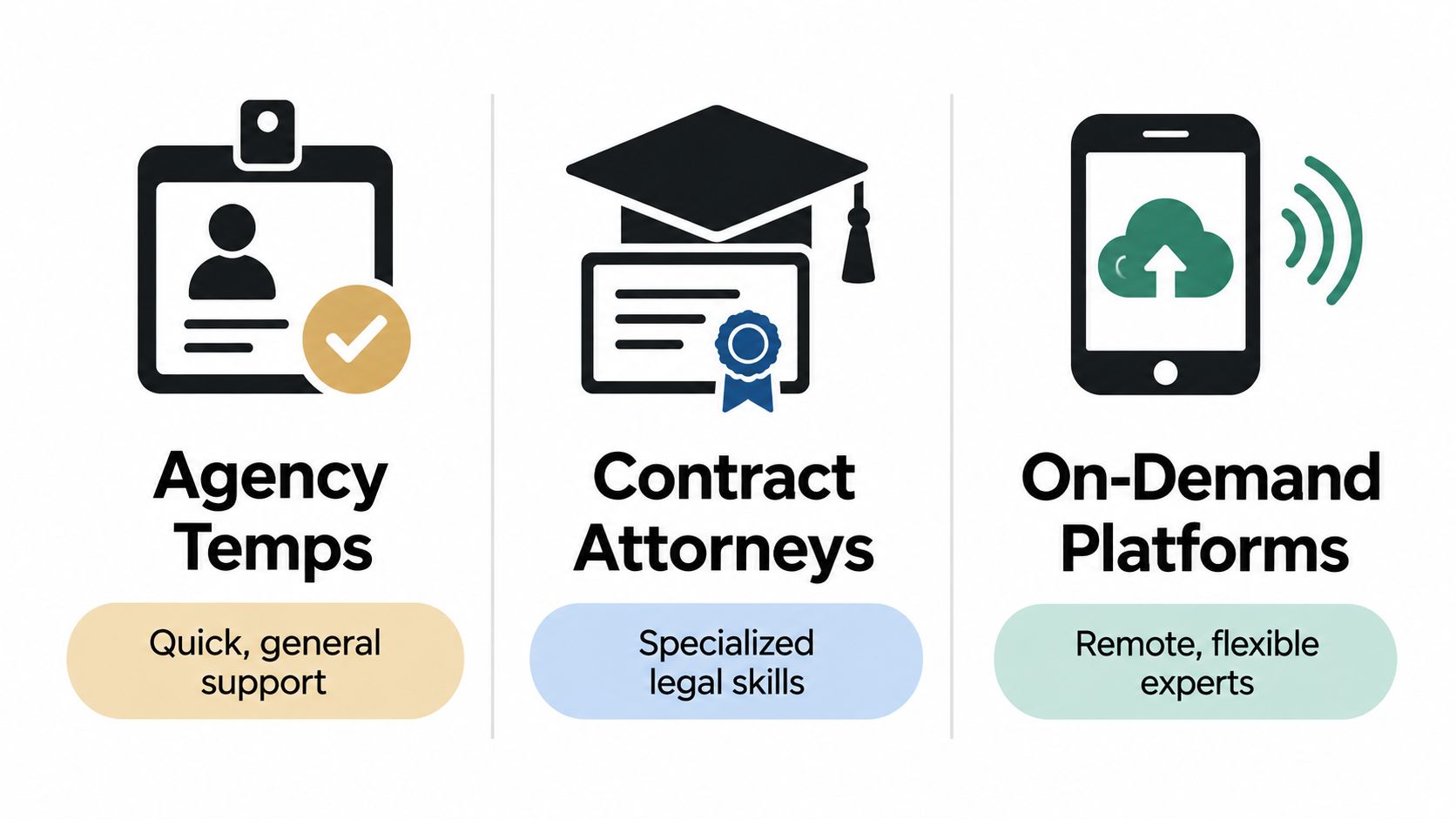
| Model | Typical work | Who manages the relationship | Main advantage | Main risk |
|---|---|---|---|---|
| Agency temps | Legal administrative support, filing, scheduling, document organization | Agency and supervising firm | Fast access to general support | A broad agency may not understand legal workflows |
| Contract attorneys | Document review, legal research, contract analysis, defined attorney projects | Vendor or attorney arrangement, with firm supervision | Specialized legal capability | The firm must define scope and supervision carefully |
| On-demand platforms | Remote paralegal, legal assistant, contract attorney, and project support | Platform for engagement administration, firm for work direction | Flexible access to curated remote talent | Remote access, communication, and confidentiality require discipline |
Traditional agencies typically take the staffing brief, source candidates, manage payroll, and invoice the firm. This arrangement is straightforward when the firm needs a legal secretary, intake coordinator, docketing assistant, or litigation support professional for a defined period.
The limitation is specialization. An agency that fills roles across many industries may not distinguish between a family-law assistant, a litigation paralegal, and a transactional coordinator. Ask how candidates are assessed for legal terminology, document handling, deadline control, confidentiality, and the specific practice area involved.
Contract attorneys make sense when the work requires legal analysis rather than only process execution. They may review documents under a defined protocol, support a transaction, conduct targeted research, or help manage a compliance project. They shouldn't be treated as unsupervised substitutes for the responsible partner or client-facing attorney.
The firm should document the scope, escalation rules, review standards, and access permissions before the assignment begins. A contract attorney can increase capacity, but the firm still has to decide which work requires senior review and which decisions remain with the matter team.
On-demand platforms are useful when a firm wants remote support, a broader geographic talent pool, or access to a professional with a particular practice-area background. A curated shortlist can reduce the time spent reviewing unsuitable applications, but it doesn't remove the firm's duty to interview the candidate and test the actual skills required.
A platform may be preferable to a traditional agency when the firm wants to compare several remote candidates, align work hours across locations, or extend a project without rebuilding the search. Firms evaluating this model can review on-demand staffing services for law firms and compare the engagement terms with those offered by local agencies.
The right choice isn't the model with the lowest stated rate. It is the model that assigns responsibility clearly, presents candidates who can perform the work, and gives the firm enough control over quality, confidentiality, and duration.
Temporary legal staffing has moved beyond simple vacancy coverage because legal departments are managing two constraints at once. They need more capacity for specialized and document-heavy work, but they also face difficulty finding qualified permanent professionals quickly enough.
Robert Half reports that 51% of legal leaders plan to add more contract talent in the second half of 2026, while 61% say finding skilled professionals is more difficult than it was a year earlier. The same source reports that 74% experienced project delays because of skills shortages and 69% said projects were canceled, as summarized in this legal hiring outlook. These figures make the operational argument clear. Contract professionals protect active work when a permanent search cannot keep pace.
A legal team with a discovery backlog has a throughput problem, not merely a headcount problem. If the firm leaves the backlog with already busy permanent staff, deadlines become less predictable, senior lawyers spend time on lower-level process work, and client communication suffers.
A temporary paralegal can absorb document organization, chronology preparation, database review, exhibit coordination, or defined discovery tasks. The assignment should have an owner, a queue, a quality standard, and an escalation path. Without those controls, the firm may add a person but not add useful capacity.
The cost logic also deserves a more precise treatment. The 2026 ACC Law Department Benchmarking Report says 77% of internal legal spend is tied to lawyer compensation and 93% of external spend goes to law firms, according to this legal staffing and benchmarking overview. Temporary staff create a more adjustable cost layer when fixed compensation or outside-counsel commitments make rapid budget changes difficult. That doesn't mean contract talent is always cheaper. It means the firm can align spending more closely with a defined workload.
The false choice is “temporary or permanent.” Robert Half reports that 51% of legal leaders plan to increase contract or temporary hiring in the second half of 2026, while 58% plan to increase permanent headcount, according to its legal team hiring guidance. Firms are using both models because they solve different timing and capacity problems.
A permanent hire builds long-term institutional knowledge. A temporary hire supplies immediate capacity, specialized experience, or a controlled way to handle uncertain demand. The managing partner should decide whether the assignment has a defined end, a renewable workload, or a genuine permanent need that requires a separate search.
A temporary placement is strategic when the firm knows what work it is buying, how quality will be measured, and what happens when the assignment ends.
Demand can move in both directions. The American Staffing Association reported that temporary and contract staffing employment fell 7.5% quarter over quarter in early 2026, representing 154,000 jobs, as noted in the Robert Half research cited above. That volatility is a reason to avoid careless expansion, not a reason to reject flexible staffing altogether.
Before engaging a vendor, set a maximum initial scope, review performance at defined intervals, and identify the conditions for extension or termination. Longer-term engagements, part-time work, and temp-to-perm arrangements can all be useful, but each requires clear treatment of supervision, billing, access, and ownership of work product.
Price is a poor first filter. A vendor that sends an unsuitable candidate quickly can create more work than it removes. Evaluate the partner on legal fluency, candidate validation, responsiveness, confidentiality controls, and billing clarity.
Use the first conversation to test the vendor's process. Ask how it verifies employment history, checks references, evaluates legal skills, handles confidentiality commitments, and confirms the candidate's ability to work during your firm's required hours. Ask who remains responsible for payroll, engagement documentation, replacement requests, and offboarding.
You should also ask the vendor to describe a comparable placement without disclosing confidential client information. The answer will show whether the vendor understands the difference between a document-review assignment, a litigation support role, and a legal administrative position.
A broader PEO vendor checklist from Benely can help structure questions about responsibilities, documentation, and service boundaries. It isn't a substitute for legal staffing due diligence, but the same discipline applies. Put every material obligation in writing.
Use a simple scorecard before choosing a candidate:
| Evaluation area | What to verify |
|---|---|
| Legal capability | Practice-area experience, terminology, drafting or review skills |
| Work quality | Sample exercise, attention to detail, ability to follow written protocols |
| Communication | Clear professional English, responsiveness, escalation judgment |
| Security | Confidentiality terms, access controls, device and workspace expectations |
| Availability | Start date, working hours, expected assignment duration |
| Commercial terms | Hourly or project billing, minimums, extension terms, replacement policy |
Don't confuse a polished résumé with validated performance. Give finalists a short, realistic exercise based on the role. For a litigation paralegal, that might involve organizing a document index or identifying missing information in a case chronology. For a contract attorney, it might involve applying a review protocol to a limited sample.
A specialized service such as legal staffing agency comparison guidance can help a firm identify different vendor models. If you consider HireParalegals, treat it as one on-demand option for remote legal support and evaluate its candidate process, terms, and fit against the same scorecard.
The firm should prepare a role brief before the start date. Include the matter background, task boundaries, communication channel, document conventions, escalation contacts, access permissions, and quality-review process.
Limit access to what the assignment requires. Schedule an early work review rather than waiting until the end of the first billing period. Early correction is cheaper than allowing a misunderstanding about naming conventions, privilege handling, or filing procedures to spread across a large queue.
Cross-border staffing adds administrative decisions that shouldn't be left to informal email exchanges. Before a remote professional starts, establish who contracts with the worker, who processes payment, who handles required records, and how the firm will respond if the engagement changes.
The firm should obtain advice on worker classification, tax treatment, employment obligations, data transfers, and local requirements in the worker's country. Those rules vary by jurisdiction and engagement structure. A staffing partner may administer payment and documentation, but the firm remains responsible for confirming that the arrangement is suitable for its professional and client obligations.
Remote legal work requires more than a confidentiality clause. Decide which applications the professional may use, whether the worker may download files, how documents are returned, and what happens to local copies when the assignment ends. Use firm-controlled accounts where practical, require strong authentication, and prohibit work from shared or unsecured environments when the matter's sensitivity makes that necessary.
The same principle applies to any remote staff arrangement involving regulated information. A staffing partner should explain its onboarding, access, offboarding, and incident-reporting procedures instead of merely describing a candidate as “trusted.”
Use this sequence:
The firm should also assess whether remote work creates client-communication or professional-responsibility concerns. A remote paralegal can prepare work under supervision, but shouldn't independently provide legal advice, make legal decisions, or represent the firm unless the role and applicable rules expressly permit it.
For firms that need an administrative partner for payment processes, payroll management for remote legal staffing is a useful area to investigate. Treat payroll administration as one component of the arrangement, not as proof that classification, confidentiality, or professional obligations have been resolved.
Consider a mid-sized litigation firm facing a sudden increase in document review. The permanent team understands the matters, but senior attorneys are spending too much time coordinating files and answering process questions. The managing partner decides not to force a permanent hiring decision while the workload remains uncertain.
The firm writes a role brief covering the review protocol, document naming rules, expected work hours, escalation points, and access limits. It interviews a remote contract paralegal with litigation experience, assigns a supervising associate, and starts with a controlled queue rather than opening the entire matter at once.
On the first day, the supervising associate explains the matter and reviews a small sample of completed work. The contract paralegal organizes documents, maintains the review log, flags unclear items, and escalates potential privilege questions instead of resolving them independently. The associate retains responsibility for legal judgment while the temporary professional handles the defined production workflow.
By the end of the initial review period, the firm has better visibility into the remaining queue and can decide whether to extend the assignment, add another professional, or proceed with a permanent search. The value isn't only that one person worked remotely. The value is that the firm converted an unpredictable backlog into a managed capacity decision.
That scenario also shows the limit of the model. If the firm cannot provide a supervisor, clear protocols, timely feedback, or secure access, temporary staffing will create friction rather than remove it. A flexible worker still needs a functioning operating environment.
Temporary legal staffing is a mature operating model for firms that need controlled flexibility, specialized skills, or immediate capacity. Use it for defined work, set ownership clearly, and measure performance against the matter's actual requirements.
Choose the vendor model that fits the assignment, verify candidates with practical evidence, and settle payroll, confidentiality, access, and offboarding responsibilities before work begins. Audit your recurring staffing gaps now, then decide which should be handled with permanent headcount and which are better served by a disciplined contract bench.
If your firm is carrying a document backlog, preparing for a temporary capacity spike, or struggling to recruit a specialized legal professional, define the work and required start date first. Then request a focused shortlist from a legal staffing provider and interview candidates against a written scorecard before approving the engagement.